
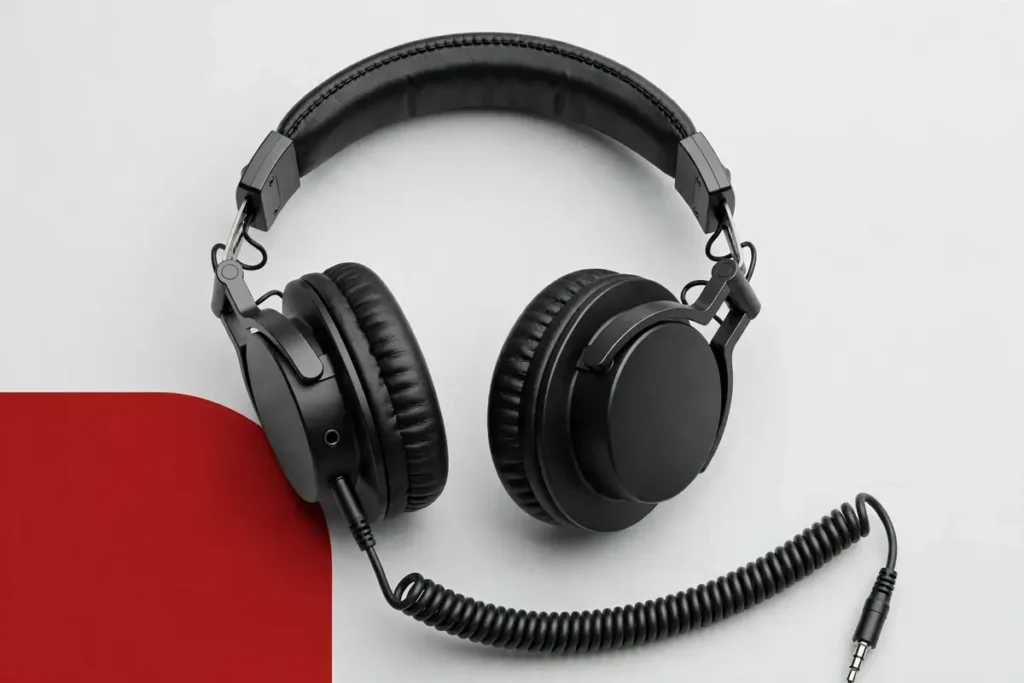
This Shure SRH 440 headphone review covers one of the longest-running budget studio headphones still on sale, a closed-back design that home studios keep buying because it tells the truth about a recording at a modest price. The SRH 440 formula has never changed: a 40mm neodymium driver tuned for accuracy, a detachable coiled cable, and a folding frame that survives being thrown in a bag. One identity note before anything else: the headphone reviewed here is the original SRH440, not the updated SRH440A, which is a different model with different specifications.
A note on method and scores. This is a research-based review, built from Shure’s published specifications, the verified Amazon US listing for this exact model and the wider review record. The scores are our provisional assessment. Two bars follow the house convention for wired headphones with no battery and no microphone: battery sits at a neutral 5.0 and calls at 3.0, which pulls the overall down to 5.9. Read sound at 7.8 and value at 8.8 as the real verdict on what this headphone does.

Shure SRH440 5.9/10
Why you: you need honest monitoring on a budget. An accurate, extended response, a detachable coiled cable and a folding frame, with value at 8.8 in our scoring.
Trade-off: the low end runs lean, isolation is passive only, and comfort is serviceable rather than plush across long sessions.
40mm driver · 44 Ω · 3 m coiled cable · Closed-back · 311 g
Sound quality
The SRH440 was tuned to be believed, not flattered. Shure specifies an enhanced, extended response from 10 Hz to 22,000 Hz, and the delivery matches the brief: vocals and instruments sit where the recording puts them, the treble carries genuine detail, and nothing gets a cosmetic bass lift to make it sound impressive in a shop. Sound scores 7.8, strong for a headphone at this level, and it is the reason the model keeps its place in studios that could afford to replace it.
What the SRH440 does with ordinary music follows from the same tuning. Acoustic recordings sound natural, with voices placed plainly in front of you and no artificial warmth added. Busy rock mixes stay readable because the midrange is not buried under the bass, and small details, a brushed snare, a finger sliding on a string, survive at modest volumes. It is a presentation that rewards attention rather than spectacle, which is either exactly what you want or a clear sign to shop elsewhere.
The low end is the honest compromise. Bass is present and cleanly defined, but it runs lean, so kick drums and bass synths report their pitch and shape more than their physical weight. For tracking and for checking balance, that leanness is useful. For mixing bass-heavy music, it means the lowest decisions should be cross-checked on speakers, a standard workflow step rather than a flaw unique to this headphone. Our guide to the best headphones for mixing sets the SRH440 against the other budget monitors that take this job seriously.
Isolation and studio use
There is no active noise cancelling here, and the 3.5 ANC bar reflects passive isolation only. The closed-back shells do the two jobs a studio actually asks of them. They keep click tracks and guide vocals from leaking into a microphone while recording, and they take the edge off room noise while you work. In a shared office or on a train, they mute the world rather than silencing it, and buyers who need real quiet should look at active models instead.
That focus is deliberate. The SRH440 is a tool for recording and checking work, and every part of the design points the same way, from the long coiled cable that reaches across a desk to the folding hinges that let it live in a kit bag between sessions.
Comfort and build
Comfort scores 7.2, and the description that fits is serviceable. At 311 g without the cable, the SRH440 is not heavy, the headband padding is adequate, and the earcups fold flat and collapse inward for storage. What it does not offer is the plush, forget-you-are-wearing-it feel of comfort-first models: clamp is firm, the pads are functional rather than soft, and long sessions benefit from the occasional break.
Fit is adjustable in the ordinary ways: the headband extends to suit larger heads, the cups swivel to sit flat against the ears, and the whole frame folds down small enough for a drawer or the included bag. Nothing about it feels luxurious, and nothing about it feels fragile either. For a shared studio headphone that different people pick up all week, that balance is the point.
Build follows the same working brief. The frame is mostly plastic, which keeps the weight down and the price where it is, and the parts that fail on cheap headphones have been thought about. The cable detaches, the pads are replaceable in principle, and there are no electronics to die. Bought for a studio, it tends to simply keep working.
Cable, powering and what is in the box
The 3 metre coiled cable is the right choice for the job. It reaches from an interface to a seated player without dragging, keeps its slack coiled instead of tangling across the desk, and unplugs from the left earcup when it eventually wears, turning the most common headphone failure into a cheap part swap. The box also carries a carrying bag and a threaded 1/4 inch adapter, so the SRH440 plugs into mixers and interfaces as happily as into a laptop.
Powering is a non-issue. At 44 ohms impedance and 105 dB/mW sensitivity, with a 500 mW maximum input, the SRH440 reaches working volume from interfaces, mixers, keyboards and phones with no dedicated amplifier required. Readers weighing a step up inside the same family will find the flagship treatment in our Shure SRH1540 review, and the wider field in our roundup of the best studio headphones.
SRH440 or SRH440A?
The names are close enough to cause real confusion, so it is worth stating plainly. The SRH440A is a later, updated model with its own specifications and its own listings. This review covers the original SRH440, the version specified in the table below, with the coiled cable and collapsible frame described above. If a listing shows the A suffix, it is a different headphone, and the scores on this page do not transfer to it.
Shure SRH440 specs
| Spec | Shure SRH440 |
|---|---|
| Driver | 40mm neodymium dynamic |
| Design | Closed-back, collapsible |
| Frequency response | 10-22,000 Hz |
| Impedance | 44 Ω |
| Sensitivity | 105 dB/mW |
| Maximum input power | 500 mW |
| Weight | 311 g (without cable) |
| Cable | 3 m coiled, detachable |
| In the box | Carrying bag, 1/4 inch adapter |
Verdict
Buy the SRH440 if you record or mix at home and your budget is firm. Accurate sound at 7.8, value at 8.8, a replaceable cable and a frame built for work add up to the budget studio reference this headphone has quietly been for years. The 5.9 overall is an artefact of the wired scoring convention explained above, not a judgement on the monitoring.
Skip it if you listen mainly for pleasure and want bass weight, if you need a microphone for calls, or if you work in noise that demands active cancelling. Those are different headphones. As a tool that tells the truth cheaply, the SRH440 still earns its place.
Frequently asked questions
Is the Shure SRH440 good for mixing?
Yes, within its limits. The tuning is accurate and extended with a lean low end, so mixes translate honestly, but bass-heavy decisions should be checked on speakers because the SRH440 underplays the lowest octave rather than exaggerating it.
What is the difference between the SRH440 and the SRH440A?
The SRH440A is a later, updated model with its own specifications. This review covers the original SRH440, the long-running version with the 3 metre coiled detachable cable and collapsible frame. The two are sold as different products, so check the model name on the listing before buying.
Does the Shure SRH440 need a headphone amplifier?
No. At 44 ohms with 105 dB/mW sensitivity, the SRH440 reaches full volume from interfaces, mixers, laptops and phones without a dedicated amplifier.
Does the Shure SRH440 have a microphone or noise cancelling?
Neither. It is a wired studio headphone with no microphone and no active noise cancelling. The closed-back shells provide passive isolation only.
Is the Shure SRH440 cable replaceable?
Yes. The 3 metre coiled cable detaches from the left earcup, so a damaged cable is a cheap replacement instead of a dead headphone.

I am the founder of Sound Mavericks, where I provide the polite truth about audio equipment. I started this site because consumer electronics reviews are often too technical. Instead of using a silent lab, I test headphones, earbuds, and Bluetooth speakers in the real world – like on a noisy subway or in a busy coffee shop.
To stay independent, I buy my own review units (mostly from the United States) rather than accepting free gifts from brands. Once I finish testing a product, I sell it locally to our community. My goal is to help you understand sound quality, active noise cancellation (ANC), and battery life without the marketing hype.
