
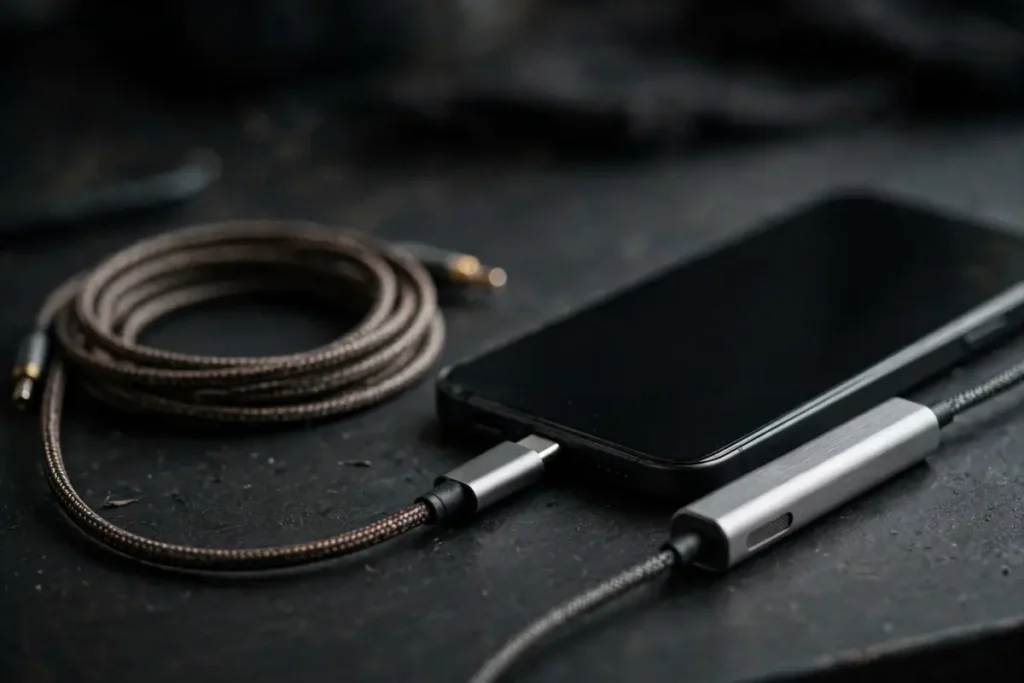
This ifi go bar kensei review covers the flagship of iFi’s GO Bar dongle range: a USB-C DAC and headphone amplifier machined from stainless steel, built around a Cirrus Logic converter with a 16-core XMOS processor, and carrying K2HD processing from JVCKENWOOD. It offers a 4.4mm balanced output rated at 477mW into 32 ohms, a 3.5mm S-Balanced output, analogue XBass+ and XSpace processing, iEMatch for sensitive earphones and a Turbo mode for hungry headphones.
A note on how this review was put together. It is a research review, built from iFi’s published specifications, the verified Amazon US listing and independent review coverage. We have not had a unit on the desk, so there is no hands-on claim anywhere on this page, and there is no score. We do not score source gear from a spec sheet.

Why you: you want the most processing and the most drive the dongle format offers. K2HD works on your PCM library, the balanced output delivers 477mW into 32 ohms with 7.2V of swing for high-impedance loads, and iEMatch plus Turbo cover both ends of the sensitivity range.
Trade-off: it is the priciest way to buy a dongle, and every feature is wired: no Bluetooth, no battery, and a power draw of up to 4W that your phone pays for. The control scheme is buttons and indicator lights, so the manual earns its keep during the first week.
iFi GO Bar Kensei specifications
| Spec | iFi GO Bar Kensei |
|---|---|
| DAC chipset | Cirrus Logic, with 16-core XMOS USB processor |
| Formats | PCM up to 32-bit/384kHz, DSD256 native, DXD, full MQA decoding |
| Input | USB-C (audio and power) |
| Outputs | 4.4mm balanced and 3.5mm S-Balanced |
| Output power (balanced) | 477mW into 32 ohms; 7.2V into 600 ohms |
| Output power (S-Balanced) | 300mW into 32 ohms; 3.8V into 600 ohms |
| SNR | 132 dB balanced, 121 dB S-Balanced (iFi ratings) |
| THD+N | 0.0025% or less, balanced at 600 ohms |
| Processing | K2HD (PCM up to 192kHz), XBass+, XSpace, 4 digital filters |
| Gain tools | iEMatch for sensitive IEMs, Turbo mode (+6dB) |
| Output impedance | 1 ohm or less; about 3.6 ohms with iEMatch engaged |
| Power consumption | Under 4W, host powered |
What the Kensei adds over the standard GO Bar
The GO Bar shape is familiar: a metal bar, USB-C at one end, headphone sockets at the other. The Kensei edition changes the recipe in three ways. The body is Japanese stainless steel rather than the standard alloy, the clock and power circuitry are upgraded, and K2HD processing joins the feature list. K2HD comes from JVCKENWOOD and works on PCM material, analysing the signal and reconstructing harmonic content above the range standard mastering keeps. Whether it transforms a given recording is a listening question; what is factual is that no other dongle in iFi’s range carries it, and it anchors this model at the top of the line.
The rest of the toolkit is iFi’s established portable set. XBass+ adds analogue low-end weight without a digital EQ’s side effects, XSpace widens the presentation for closed-in recordings, and four selectable digital filters let you pick between bit-perfect playback and gentler roll-offs. Our guide to the best portable DACs and dongles shows the field this model sits at the head of.
Power and the two gain tools
The output numbers are strong for the format. The balanced socket delivers 477mW into 32 ohms and holds 7.2V into a 600-ohm load, which is the figure that matters for high-impedance full-size headphones. The S-Balanced 3.5mm output gives 300mW into 32 ohms with iFi’s crosstalk-reducing layout for single-ended cables. Turbo mode adds 6dB on top for the headphones that need it.
At the other end of the range, iEMatch is the feature sensitive-IEM owners actually use. It drops the output level so the hiss floor falls away and small volume steps stop feeling like jumps. The trade is a higher output impedance, around 3.6 ohms with iEMatch engaged, so the sensible pattern is iEMatch on for delicate earphones and off for everything else. Between the two tools, the Kensei covers a wider sensitivity range from one body than most dongles attempt.
Formats and conversion
Conversion runs through a Cirrus Logic DAC driven by a 16-core XMOS processor. PCM support reaches 32-bit/384kHz, DSD plays natively to DSD256, and MQA gets full decoding rather than software rendering. iFi’s rated figures point the same way as the rest of the design: 132 dB signal-to-noise on the balanced output and THD+N at or below 0.0025% into a 600-ohm load. Those are manufacturer ratings, not our measurements, and this review treats them as such.
For streaming listeners the practical summary is short. Tidal and Qobuz hi-res libraries play at full rate, local DSD collections play natively, and ordinary streams pass through the same quiet output stage. Listeners comparing desktop options alongside portables should read our best DACs guide, where the wired-only desktop units state their own case.
The four filters, in plain terms
PCM playback offers four digital filters. Bit-Perfect bypasses filtering for listeners who want the file untouched. Standard and Minimum Phase trade sharpness against ringing in the usual ways, and iFi’s GTO filter is its own Gibbs-effect-minimised design, the one the company recommends as the all-round setting. In practice the differences are small and sit at the edge of audibility on most material, but the choice costs nothing to offer and some listeners have firm preferences. The honest summary is that the filters are seasoning. The conversion quality underneath them is the meal, and on the published figures that quality is not the weak point of this design.
Living with it
Daily use is plug and play on USB-C phones, tablets and computers, with a Lightning adapter cable in the box for older iPhones. Controls are small buttons with LED indicators for format, volume and the active processing modes. Reviewers who have lived with the unit praise the sound and the build, and raise the same two reservations: the control language takes time to learn, and a device drawing up to 4W shortens a phone’s day on long sessions. Both points are fair. This is a listener’s tool rather than a casual accessory, and it rewards the manual-reading its price implies. Owners of iFi’s other portables can compare the approach in our iFi hip-dac 3 review, and iPhone-focused buyers may prefer the shorter list in our portable DAC for iPhone guide.
Verdict
The GO Bar Kensei makes sense if you want one dongle that covers sensitive IEMs and demanding full-size headphones, plays every format you are likely to own, and adds processing tools most rivals skip. Buy it for wired listening at the top of the portable range. Skip it if Bluetooth, a battery or a simple two-button dongle is what you need, because it offers none of those things and charges a flagship price for the ones it does.
Frequently asked questions
What is K2HD processing on the GO Bar Kensei?
K2HD is processing technology from JVCKENWOOD that iFi licenses for this model. It works on PCM files up to 192kHz and aims to restore harmonics and waveform detail lost during digital mastering and compression. It does not apply to DSD or MQA playback. It is the headline difference between the Kensei and the standard GO Bar.
How much power does the GO Bar Kensei deliver?
iFi rates the 4.4mm balanced output at 477mW into 32 ohms and 7.2V into 600 ohms, and the 3.5mm S-Balanced output at 300mW into 32 ohms and 3.8V into 600 ohms. Turbo mode adds 6dB of gain for demanding headphones, and iEMatch pulls the output down for sensitive earphones.
Does the GO Bar Kensei have Bluetooth or a battery?
No. It is a wired USB-C device powered by the host phone, tablet or computer, drawing under 4W. If you need a wireless receiver, a Bluetooth DAC amp is the right category instead.
What formats does the GO Bar Kensei support?
PCM up to 32-bit/384kHz, native DSD up to DSD256, DXD, and full MQA decoding. Four digital filters are selectable for PCM playback: Bit-Perfect, GTO, Standard and Minimum Phase.
What is iEMatch for?
iEMatch attenuates the output for very sensitive in-ear monitors, so hiss stays down and the volume control gains usable range. It raises output impedance to about 3.6 ohms when engaged, so it is a tool for sensitive IEMs rather than a setting to leave on for everything.

I am the founder of Sound Mavericks, where I provide the polite truth about audio equipment. I started this site because consumer electronics reviews are often too technical. Instead of using a silent lab, I test headphones, earbuds, and Bluetooth speakers in the real world – like on a noisy subway or in a busy coffee shop.
To stay independent, I buy my own review units (mostly from the United States) rather than accepting free gifts from brands. Once I finish testing a product, I sell it locally to our community. My goal is to help you understand sound quality, active noise cancellation (ANC), and battery life without the marketing hype.

