
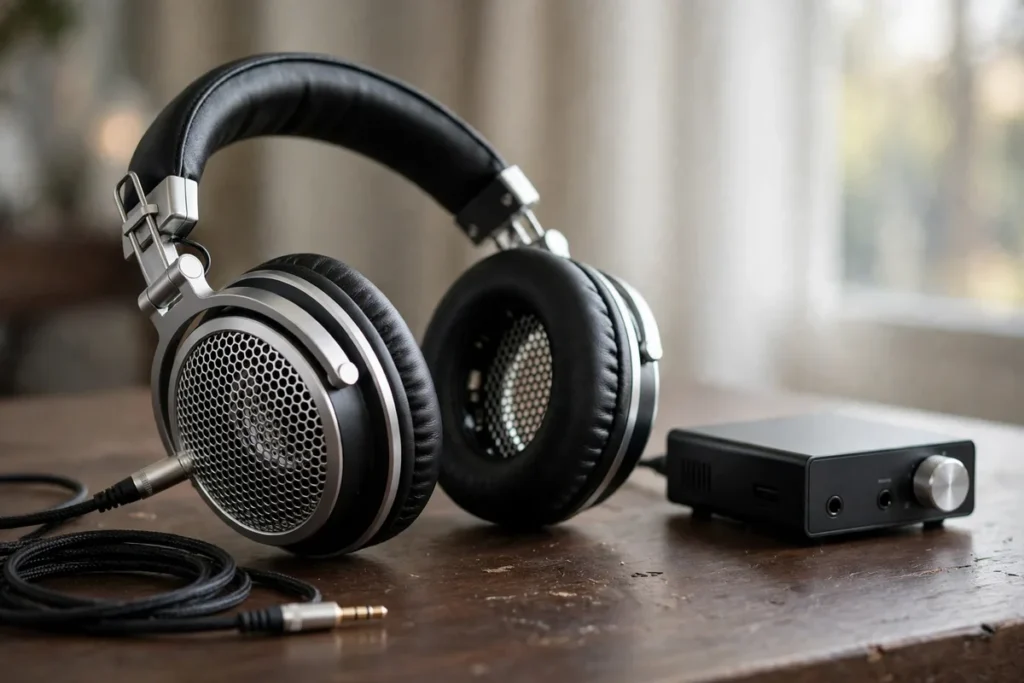
This HiFiMan HE400se review covers the cheapest well-known route into planar magnetic sound: an open-back over-ear headphone with Stealth Magnets, a near-neutral tuning and a price that undercuts most dynamic rivals. It is sold through HiFiMan’s own Amazon US listing, and it has held its place as the default budget planar recommendation for years. The catch is power. At 91 dB sensitivity it wants a real source behind it, and that requirement shapes everything about who should buy it.
This is a research review. We have not tested the HE400se on our own heads, so the verdict below is built from HiFiMan’s published specifications, the verified Amazon US listing, and published measurement data. The scores are the same ones our Headphone Finder already carries for this model, taken from our existing coverage.
One thing to pin down first, because HiFiMan sells two editions of this headphone. The Amazon US listing is the international version: Stealth Magnets and a 32 Ω rating. A China-market edition without Stealth Magnets, rated at 25 Ω, circulates through import sellers at lower prices. They are not the same product. This review covers the US listing and its 32 Ω specification throughout.

HiFiMan HE400se 5.8/10
Why you: you want genuine planar magnetic speed and a near-neutral tuning at an entry-level price, and you listen at a desk in a quiet room.
Trade-off: it leaks sound in both directions, there is no microphone, and the low sensitivity leaves it quiet and thin from a phone or a weak laptop output, so a small amp belongs in the budget.
Planar magnetic driver with Stealth Magnets · Open-back · 32 Ω · 91 dB · 385 g · Detachable dual 3.5 mm cable
The score, explained: 5.8 with three wired-model bars
The overall number needs translating, because three of the six bars describe things this headphone never tried to be. Noise cancelling scores 1.5 because the HE400se is open-back with no cancelling hardware at all: sound passes through the grills in both directions, by design. Calls scores 3.0 because the cable has no microphone. Battery scores 5.0 because a wired headphone has no battery to rate, and our scale parks that bar at a neutral placeholder rather than pretending otherwise.
Judge it on the bars that describe the headphone itself. Sound at 8.6 and Value at 9.0 are the story: few headphones at this money measure as clean or sound as quick. Comfort at 7.8 is honest mid-pack, held back by weight and a headband some listeners need to adjust as a session goes on. The 5.8 overall is an artefact of a scoring scale built to compare every headphone type on one page. On the desk it was made for, the HE400se performs well above that number.
Sound: near-neutral, quick, and honest about its limits
The tuning is the reason this headphone keeps its reputation. Published measurements of the HE400se agree on the same basic shape: bass that extends properly into the sub-bass and stays close to flat instead of boosted, a midrange dip around 1.5 to 2 kHz, and a treble peak near 7 to 8 kHz. That recipe reads as neutral with a sparkle on top. Kick drums and bass guitars carry real weight without bloat, and the planar driver keeps low notes tidy when a dynamic driver at this price would start to smear them.
The midrange dip is mild but real. Vocals sit a step back rather than in your face, which some listeners hear as spacious and others hear as distant. The treble peak is the split opinion: it adds air and detail on well-recorded material, and it can bite on bright or poorly mastered tracks. Sibilance shows up on the wrong recording. Neither flaw is hard to live with, and both respond well to a small EQ adjustment, which this headphone takes cleanly thanks to its low distortion.
Staging and imaging are where the planar design earns its keep against dynamic rivals. The stage is wider than most closed and open dynamic headphones at the money, and instruments stay separated instead of stacking in the middle. It is not the last word in precision, and the step up to HiFiMan’s own Sundara sharpens both placement and separation, but at this level the HE400se gives you the planar character in full: fast transients, flat bass, and detail that does not come from a treble boost alone. Our explainer on dynamic vs planar magnetic drivers covers why the two designs behave this way.
Design, comfort and build
The HE400se uses HiFiMan’s modern entry-level chassis: large round cups, exposed mesh grills, a padded adjustable headband and hybrid ear pads. At 385 g it is light for a full-size planar, though still heavier than most dynamic headphones in its class, and the weight is spread evenly enough that long sessions are fine for most heads. The headband padding is the comfort weak point in owner reports. It can press at the crown after an hour or two, and shifting the band slightly forward or back is the usual fix.
Build quality is plain rather than premium. The cups and yokes are plastic, the finish is silver and black, and nothing about it feels expensive in the hand. Nothing feels fragile either. The grills protect the drivers, the yokes move without creaking, and the parts most likely to wear, the pads and the cable, both unplug or pull off for replacement. Treat it as a tool that sounds above its price rather than an object to admire, and it makes sense.
Power, cables and the missing microphone
The specification that decides your experience is sensitivity: 91 dB. The 32 Ω impedance looks phone-friendly, and a phone or laptop will indeed play the HE400se, just quietly, and with the bass thinning out as the output runs out of headroom. This is the most common disappointment in owner reports, and it is a source problem, not a headphone problem. A modest desktop amp or a dongle DAC with real output power transforms it, and either belongs in the budget from the start. Our guide to impedance and whether you need an amp walks through the maths in plain terms.
The included cable is a dual-entry design with a 3.5 mm plug at each cup, a 3.5 mm plug for your source, and a 6.35 mm adapter in the box for amplifiers and receivers. Because the cup connectors are a common standard, replacement and balanced cables are easy to find and cheap. What the cable does not have is a microphone or a remote. There is no way to take a call on the stock cable, which is exactly what the Calls score of 3.0 is recording. A third-party cable with an inline mic, or a separate desktop microphone, is the workaround.
HiFiMan HE400se specifications
| Product | HiFiMan HE400se |
| Design | Open-back, over-ear |
| Driver | Planar magnetic with Stealth Magnets, Neo Supernano diaphragm |
| Frequency response | 20 Hz to 20 kHz |
| Impedance | 32 Ω (international version; the China-market edition is 25 Ω) |
| Sensitivity | 91 dB |
| Weight | 385 g |
| Cable | Detachable, dual 3.5 mm plugs at the cups |
| Connector | 3.5 mm plug, 6.35 mm adapter included |
| Microphone | None |
| Buy | Check Price on Amazon |
HiFiMan HE400se vs HiFiMan Sundara
The obvious question is whether to step up to the Sundara, the next open-back planar in HiFiMan’s line and the subject of our HiFiMan Sundara review. The Sundara is lighter, its driver reaches far beyond the audible band on paper, and its imaging and separation are a clear step ahead. The HE400se counters with a tuning that is arguably as well judged, the same appetite for power, and a much smaller bill. If the Sundara is the reference point for its class, the HE400se is the point where planar sound stops being an upgrade and becomes the starting option.
| HiFiMan HE400se |  HiFiMan Sundara | |
| Design | Open-back, over-ear | Open-back, over-ear |
| Driver | Planar magnetic, Stealth Magnets | Planar magnetic, NEO supernano diaphragm |
| Frequency response | 20 Hz to 20 kHz | 6 Hz to 75 kHz |
| Impedance | 32 Ω | 32 Ω |
| Sensitivity | 91 dB | 92 dB |
| Weight | 385 g | 342 g |
| Our score | 5.8/10 | 6.1/10 |
| Buy | Check Price | Check Price |
Who should buy the HiFiMan HE400se
Buy it if you are building a first serious listening setup and want to know what planar magnetic drivers do differently, without spending your way up the range to find out. It suits desk listening in a quiet room, listeners who value a balanced tuning over a bass boost, and anyone willing to pair it with a small amplifier. It also holds a place in our best budget audiophile headphones ranking as the planar pick, which is where it belongs.
Skip it if your listening happens in shared or noisy spaces, because the open back leaks in both directions and offers no isolation at all. Skip it if you need a microphone for calls or voice chat out of the box. And skip it if your only source is a phone with a weak output and there is no room in the budget for a dongle DAC or a small amp, because that pairing is where most disappointed owners went wrong.
Frequently Asked Questions
Does the HiFiMan HE400se need an amp?
Effectively, yes. The impedance is a low 32 Ω, but sensitivity is only 91 dB, so phones and laptops play it quietly and with thin bass. A small desktop amp or a powered dongle DAC is the standard pairing and brings out the bass the tuning is capable of.
What is the difference between the HE400se versions?
HiFiMan sells two editions. The international version, which is what the Amazon US listing sells, has Stealth Magnets and a 32 Ω rating. A China-market edition without Stealth Magnets is rated at 25 Ω and turns up through import sellers. Check the listing and the impedance before buying from a marketplace seller.
Does the HiFiMan HE400se have a microphone?
No. The included cable has no microphone and no remote. For calls or voice chat you need a third-party cable with an inline mic or a separate microphone.
Is the HiFiMan HE400se good for gaming?
For single-player games, yes. The wide stage and tidy imaging place effects well, and the flat bass keeps explosions from swamping dialogue. Voice chat needs a separate microphone, and the open back leaks sound in shared rooms.
Does the HiFiMan HE400se leak sound?
Yes, in both directions. The open grills pass sound freely, so people nearby will hear what you play and you will hear the room. It is a quiet-room headphone.
Can you replace the HE400se cable and ear pads?
Yes. The cable detaches at both cups with standard 3.5 mm plugs, so replacements and balanced cables are easy to find. The pads also come off for swapping, and fresh pads restore the fit and seal that worn pads lose.
Final verdict
The HE400se remains the easiest recommendation in budget headphones, with the same two conditions it has always carried: give it a quiet room and give it power. Meet those, and the 8.6 Sound and 9.0 Value bars tell the real story, a near-neutral planar with clean bass, quick transients and honest detail at an entry-level price. The 5.8 overall says more about our scale than about this headphone. Judged as what it is, the first step into planar sound, it is still the step to take.

I am the founder of Sound Mavericks, where I provide the polite truth about audio equipment. I started this site because consumer electronics reviews are often too technical. Instead of using a silent lab, I test headphones, earbuds, and Bluetooth speakers in the real world – like on a noisy subway or in a busy coffee shop.
To stay independent, I buy my own review units (mostly from the United States) rather than accepting free gifts from brands. Once I finish testing a product, I sell it locally to our community. My goal is to help you understand sound quality, active noise cancellation (ANC), and battery life without the marketing hype.
