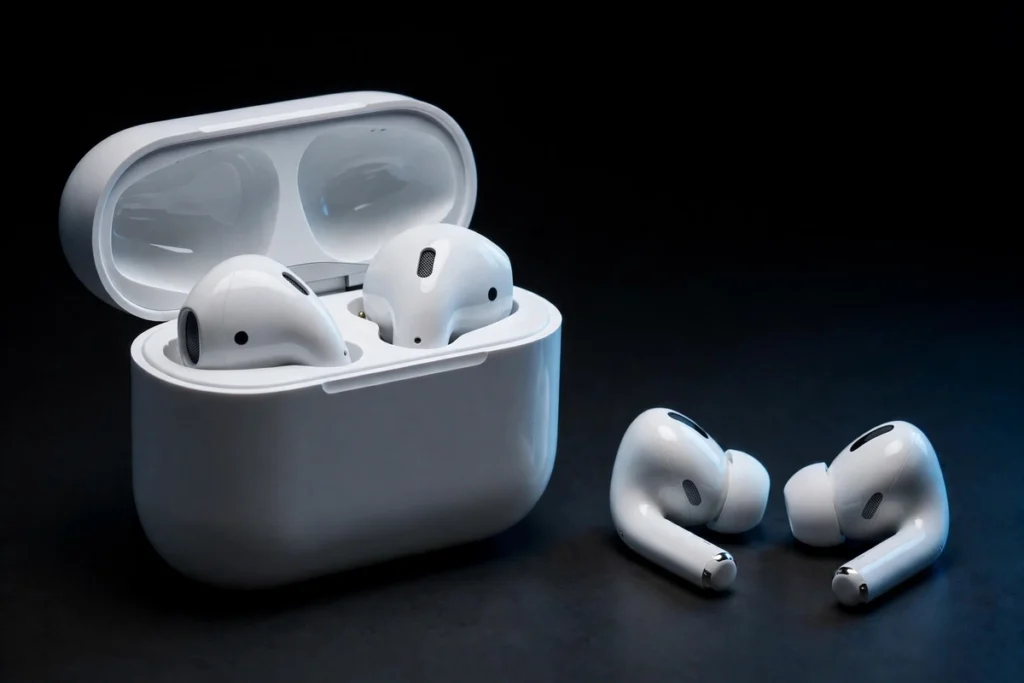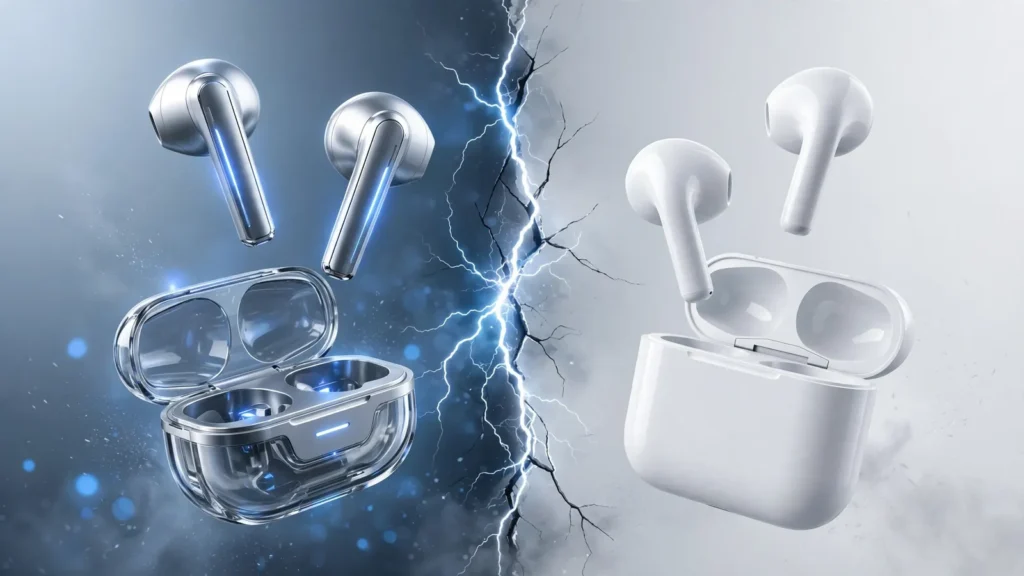
The Galaxy Buds 3 Pro vs AirPods Pro 2 question has one honest answer before any spec sheet: your phone decides the winner. Samsung’s flagship earbuds are the best match for Galaxy and Android users, while Apple’s AirPods Pro 2 remain unbeatable inside the Apple ecosystem. But the details matter — Samsung brings a two-way driver, stronger water resistance, and deeper customization, while Apple counters with best-in-class noise cancelling refinement and a feature set nobody else can touch on iPhone.
In this comparison, SoundMavericks breaks down sound, ANC, fit, features, ecosystem, and battery so you can pick the right pair for your devices — not someone else’s.
Galaxy Buds 3 Pro vs AirPods Pro 2: Specs at a Glance
| Feature | Galaxy Buds 3 Pro | AirPods Pro 2 |
|---|---|---|
| Driver | 2-way (woofer + tweeter) with dual amplifier | Custom high-excursion driver with dedicated amplifier |
| Chip | Samsung in-house | Apple H2 |
| Bluetooth | 5.4 | 5.3 |
| Codecs | SSC (hi-res on Galaxy), AAC, SBC | AAC, SBC |
| Noise cancelling | Adaptive ANC, 3 mics + VPU per bud | Adaptive ANC, Adaptive Audio, Conversation Awareness |
| Spatial audio | 360 Audio with head tracking | Personalized Spatial Audio with head tracking |
| Water resistance | IP57 (buds) | IP54 (buds and case) |
| Battery (ANC on) | 6 hrs buds / 26 hrs total | 6 hrs buds / 30 hrs total |
| Charging | USB-C, wireless | USB-C, MagSafe, Qi, Apple Watch charger |
| Multipoint | Yes, auto-switch across Galaxy devices | Automatic switching between Apple devices only |
| Companion app | Galaxy Wearable (Android only) | Built into iOS (no app on Android) |
| Colors | Silver, White | White |

Samsung Galaxy Buds 3 Pro
Samsung’s flagship buds — best for Galaxy and Android phones.

Sound Quality: Two-Way Drivers vs Apple’s Tuning
The Galaxy Buds 3 Pro take the more ambitious hardware route: a two-way driver setup — a dedicated woofer for bass plus a tweeter for highs — driven by a dual amplifier. In theory, splitting the frequency range between two specialized drivers delivers cleaner separation and more detailed treble than a single dynamic driver can manage. Samsung’s default tuning is energetic and bass-forward, which suits pop, hip-hop, and EDM, and the Galaxy Wearable app gives you a full custom equalizer to reshape the sound to your taste.
The AirPods Pro 2 go the other way: a single custom high-excursion driver paired with a dedicated amplifier, tuned by Apple for balance and consistency. Apple’s tuning is more neutral out of the box — tighter, more controlled bass and smooth mids — and Adaptive EQ automatically adjusts the frequency response to your ear shape in real time. What you don’t get is a manual EQ; Apple gives you no equalizer at all, so the sound you hear is the sound Apple chose.
SoundMavericks’ take: on pure hardware, Samsung’s two-way driver is the more premium design, and paired with the Samsung Seamless Codec (hi-res up to 24-bit/96kHz on Galaxy phones) it has the higher ceiling for detail. But codecs matter: the Buds 3 Pro’s hi-res codec only works with Samsung phones — everyone else gets AAC or SBC. The AirPods Pro 2 stick to AAC everywhere, but Apple’s tuning and Adaptive EQ make that single codec sing. If you’re a tweaker who wants an EQ and hi-res wireless audio on a Galaxy phone, Samsung wins. If you want great sound with zero fiddling, Apple wins.
Noise Cancellation: Both Excellent, Apple More Refined
Both earbuds offer strong adaptive ANC that handles the usual enemies — engine drone, office chatter, subway rumble — with real authority. Samsung equips each Buds 3 Pro with three microphones plus a voice pickup unit, and its Adaptive ANC continuously adjusts to your surroundings. Transparency (Ambient Sound) mode is genuinely good, with an option to boost ambient voices.
The AirPods Pro 2, powered by the H2 chip, deliver what Apple claims is up to twice the noise cancelling of the original AirPods Pro — and independent testing has consistently ranked them among the very best ANC earbuds you can buy. Where Apple pulls ahead is intelligence: Adaptive Audio dynamically blends ANC and transparency based on your environment, Conversation Awareness automatically lowers your media volume when someone speaks to you, and Adaptive Transparency tames sudden loud noises (sirens, construction) without muting the world entirely.
SoundMavericks’ take: raw noise reduction is close enough that most people couldn’t tell them apart in a blind test. Apple’s edge is in the smart features layered on top — Conversation Awareness alone is the kind of thing you miss immediately once you’ve used it. For commuters and office workers on iPhone, that refinement is decisive.
Fit and Comfort
Here’s where the two diverge most physically. Samsung redesigned the Buds 3 Pro around an AirPods-style stem design — a first for the Galaxy Buds line — with angled stems and swappable silicone tips for a canal-type seal. The metallic silver finish and glowing “blade lights” on the stems make them the flashier pair, and the transparent charging case lid is a nice touch. At IP57, they’re also genuinely workout-proof: dust-tight and able to survive submersion.
The AirPods Pro 2 keep Apple’s familiar stem design with silicone tips, now including an extra-small size for a total of four tip options. Fit is a known Apple strength — light, secure, and comfortable for long sessions — though like all sealed in-ear designs, comfort still depends on your ear shape. The IP54 rating covers sweat and rain, and the case adds a lanyard loop plus a built-in speaker for Find My alerts.
SoundMavericks’ take: both are comfortable for most ears, but the Buds 3 Pro’s IP57 rating makes them the safer pick for gym sessions and rainy runs. If you want more color choice than white, Samsung’s silver and white options win by default.
Features and Controls
Samsung loads the Buds 3 Pro with Galaxy AI tricks: real-time Interpreter mode for live translation on recent Galaxy phones, Adaptive EQ that tunes sound to your hearing, Voice Detect, and Auracast broadcast audio support. Controls are pinch-and-swipe gestures on the stems — pinch to play/pause or answer calls, swipe for volume. The Galaxy Wearable app (Android only) unlocks the EQ, ANC levels, touch customization, and firmware updates.
Apple’s feature list is built around the H2 chip and iOS integration: Personalized Spatial Audio with dynamic head tracking, Adaptive Audio, Conversation Awareness, Personalized Volume, and Siri hands-free. Controls are squeeze-based on the stems, with swipe volume control. Everything is configured in iOS Settings — there’s no app, and on Android you get basic Bluetooth audio with no configuration at all.
SoundMavericks’ take: feature-for-feature, Samsung offers more knobs to turn; Apple offers more things that just work. The catch on both sides is the same: the headline features are locked to their own platforms.
Ecosystem: Samsung vs Apple (This Is the Real Comparison)
Let’s be blunt: buy the buds that match your phone. The Galaxy Buds 3 Pro auto-pair and auto-switch across Samsung’s ecosystem, unlock the Seamless Codec’s hi-res audio on Galaxy phones, and get their full app experience only on Android. Pair them with an iPhone and they become ordinary Bluetooth earbuds — no Wearable app, no hi-res codec, no 360 Audio personalization.
The AirPods Pro 2 are the mirror image: magical on iPhone with iCloud pairing, automatic device switching, audio sharing, Find My precision tracking via the U1 chip, and Siri. Pair them with a Samsung phone and you lose nearly everything that makes them special — no app, no firmware updates, no spatial audio controls.
Cross-platform users should know about Bluetooth multipoint: the Buds 3 Pro can stay connected to two devices and auto-switch between them, which is genuinely useful if you split time between a Galaxy phone and a laptop. The AirPods Pro 2 skip standard multipoint entirely, relying on Apple’s automatic switching — which only works between Apple devices signed into the same iCloud account.
If you’re weighing newer Apple options too, our AirPods 5 vs AirPods Pro 3 comparison and AirPods Pro 3 vs Sony WF-1000XM6 cover where Apple’s lineup — and its biggest rival — stand now. Samsung shoppers should also check our Galaxy Buds 4 Pro review to see whether the newer model is worth the step up.
Battery Life and Charging
Rated battery life is nearly identical on the buds themselves: up to 6 hours of listening with ANC on for both. The difference is in the case: the AirPods Pro 2’s case stretches total listening time to 30 hours, while the Buds 3 Pro’s case totals 26 hours. Both support wireless charging plus USB-C wired charging, so either way you’re covered at your desk and on the road.
Apple’s case goes further: it adds MagSafe compatibility, works with an Apple Watch charger in a pinch, and includes a speaker for Find My sounds plus a lanyard loop. Samsung’s case counters with its transparent lid design — form over function, but it looks great.
SoundMavericks’ take: Apple wins on total stamina and charging flexibility. If you regularly go multiple days between charges, those extra hours in the case add up.
Call Quality
Both are strong callers. Samsung’s three-microphone array with a dedicated voice pickup unit is designed to isolate your voice from wind and background noise, and it performs well in breezy conditions. Apple’s beamforming mics with the H2 chip’s computational audio are equally impressive, with voice isolation that holds up on busy streets. For a deeper dive into which earbuds handle calls best, see our best noise-cancelling earbuds for phone calls roundup.
Who Should Buy Which?
Buy the Galaxy Buds 3 Pro if: you use a Samsung Galaxy phone (or any Android), want hi-res wireless audio via the Seamless Codec, value a customizable EQ, need IP57 water resistance for workouts, or want true multipoint auto-switching.
Buy the AirPods Pro 2 if: you use an iPhone, want the most refined ANC experience with Adaptive Audio and Conversation Awareness, value seamless switching across Apple devices, or want the longest total battery life with the most flexible charging case.
The bottom line from SoundMavericks: these are the two best platform-locked earbuds in the world, and neither makes sense on the other team. Match the buds to your phone and you can’t go wrong — mismatch them and you’re paying flagship money for a dumbed-down experience.
Frequently Asked Questions
Which is better, the Galaxy Buds 3 Pro or the AirPods Pro 2?
It depends on your phone. The Galaxy Buds 3 Pro are better for Samsung and Android users thanks to the two-way driver, hi-res Seamless Codec, custom EQ, and IP57 rating. The AirPods Pro 2 are better for iPhone users thanks to the H2 chip’s refined ANC, Adaptive Audio, Conversation Awareness, and seamless Apple ecosystem integration.
Do the Galaxy Buds 3 Pro work with iPhone?
Yes, they connect to iPhones as standard Bluetooth earbuds with working ANC and touch controls. But you lose the Galaxy Wearable app, the hi-res Seamless Codec, 360 Audio personalization, and Galaxy AI features — so iPhone users get a noticeably pared-down experience.
Do the AirPods Pro 2 work with Android phones?
They connect and play audio over Bluetooth, but there’s no companion app on Android, so you can’t update firmware, customize controls, or use spatial audio settings. Most of what makes the AirPods Pro 2 special requires an iPhone.
Which has better noise cancelling, Galaxy Buds 3 Pro or AirPods Pro 2?
Both have excellent adaptive ANC that’s hard to tell apart in raw noise reduction. The AirPods Pro 2 pull ahead on smarts — Adaptive Audio, Conversation Awareness, and Adaptive Transparency make the overall noise-control experience more refined, especially for iPhone users.
Which has better battery life?
Both buds last up to 6 hours with ANC on. The AirPods Pro 2 win on total stamina: their case delivers 30 hours of total listening time versus 26 hours for the Galaxy Buds 3 Pro, and the case charges via USB-C, MagSafe, Qi, or an Apple Watch charger.
Is it worth switching ecosystems for one of these?
No — neither pair justifies switching phones. Each is at its best only within its own ecosystem, and both are deliberately limited on the other platform. Buy the one that matches the phone you already own.

I am the founder of Sound Mavericks, where I provide the polite truth about audio equipment. I started this site because consumer electronics reviews are often too technical. Instead of using a silent lab, I test headphones, earbuds, and Bluetooth speakers in the real world – like on a noisy subway or in a busy coffee shop.
To stay independent, I buy my own review units (mostly from the United States) rather than accepting free gifts from brands. Once I finish testing a product, I sell it locally to our community. My goal is to help you understand sound quality, active noise cancellation (ANC), and battery life without the marketing hype.