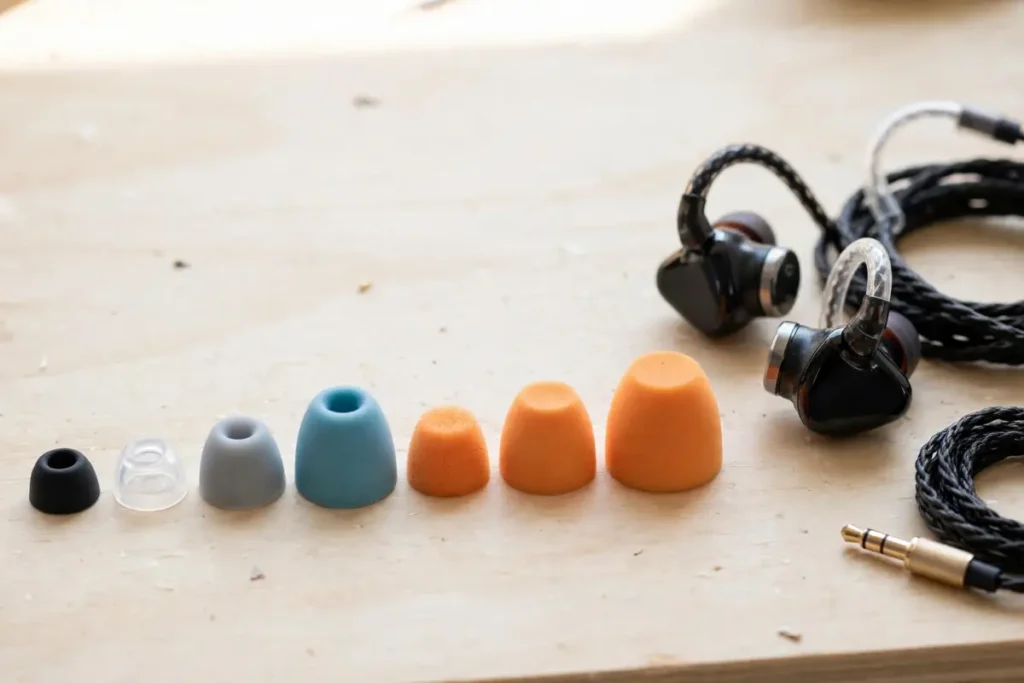
The best IEM ear tips are the ones that seal your ears, on your IEMs, and stay sealed while you move. That sounds obvious, yet most fit frustration comes from buying tips by brand reputation instead of by the four things that decide fit: the size range, the material, the bore diameter, and whether the core matches your IEM nozzle. This page ranks six verified replacement tips on those four things, including a genuine large-size option for the listeners who write to forums asking where the very large ear tips are. None of these products carries a score: ear tips are fit parts, not scored headphones, and every card below is scoreless on purpose.
One rule before the picks: fix the seal before you judge any IEM. A leaking tip loses bass, thins the midrange and tempts you to raise the volume, and listeners regularly blame an IEM for what its tips did. If your current set sounds thin and will not stay put, start here rather than with a new IEM. Our best budget IEMs coverage makes the same point from the IEM side.
The shortlist
SpinFit CP100: Best first upgrade: a patented rotating core that angles with the canal, for nozzles from 4.5 to 5 mm. Check Price on Amazon
Comply T-400: Best seal and isolation: memory foam that moulds to the canal, in a three-pair pack. Check Price on Amazon
AZLA SednaEarfit MAX: Best size range: a mixed MS, M and ML pack, so one purchase tests three sizes. Check Price on Amazon
Final Audio Type E: Best for taming brightness: a full five-size kit with case and nozzle adaptor. Check Price on Amazon
SpinFit W1 (size L): Best for large canals: the large end of the W1 range, with a double W-shaped core for stability. Check Price on Amazon
How to choose: size, material, bore, nozzle
Size first. Tip sizes are not standardised between brands, so a medium in one range is not a medium in another, and most ears need different sizes left and right. Mixed packs exist for exactly this reason. Material second. Silicone is durable, washable and keeps the top end open; foam seals more reliably in awkward canals and isolates better, but wears out and softens treble slightly. Bore third. The bore is the hole the sound travels through: wider bores tend to preserve treble, narrower bores tend to soften it, and the core diameter must match your IEM nozzle or the tip will slip, stretch or refuse to fit. Nozzle fit last, and it is a hard gate: check the stated nozzle range on the listing before anything else on this page.
The picks, one by one
SpinFit CP100

SpinFit CP100
Why you: the canal is not straight, and the CP100 core rotates to follow it, which keeps the seal when you talk, chew or move. The listing covers nozzles from 4.5 to 5 mm, the common wired IEM range.
Trade-off: It is a silicone tip, so it cannot match foam for isolation in very noisy rooms, and the rotating core adds a little height that very shallow-fitting IEMs may not like.
Silicone · Rotating core · Nozzle 4.5-5 mm · Sizes SS to L on the range
The CP100 is the default first upgrade for a reason. Most fit failure is angular: the IEM nozzle points one way, the canal bends another, and a rigid tip seals on one side and leaks on the other. SpinFit builds a bend into the core, so the tip meets the canal at the canal angle. Listeners whose seal breaks when they move their jaw are the exact audience, and they are a large share of the people asking about tips at all.
Buy the size you think you are, and the size above if your ears run large; the range covers SS through L across its listings. On sound, it is close to neutral: it fixes the seal without imposing a tuning of its own, which makes it the right first step before experimenting with foam or narrow-bore options.
Comply T-400

Comply T-400
Why you: memory foam solves the canals silicone cannot: squeeze it down, let it expand, and it fills the shape you actually have. The T-400 listing covers a wide run of wired IEM brands, in a three-pair pack.
Trade-off: Foam is a consumable. It wears, it absorbs moisture, and it softens the top end a little, so buy it as a recurring fit tool, not a permanent part.
Memory foam · 400-series core · Three pairs · Sizes S to L on the range
Comply foam is the answer when the problem is the canal itself: irregular shape, a seal that will not hold, or a listener who needs isolation on trains and in shared rooms. The foam expands to the space available, which no pre-shaped silicone can do, and the result is the most dependable bass seal on this page, because bass is what a leak takes first.
The honest costs are lifespan and a mild softening up top. Foam tips are replaced, not kept, and regular users should expect to treat them like strings on an instrument. For travel and noisy listening, that trade is worth it; for quiet home listening, silicone usually serves better and lasts. Size by your current silicone size and step up if in doubt, since foam compresses before it expands.
AZLA SednaEarfit MAX

AZLA SednaEarfit MAX
Why you: one pack, three sizes: this listing bundles MS, M and ML pairs, which solves the two problems buyers actually have, not knowing their size, and having two different ears. The MAX material grips well without foam fragility.
Trade-off: The pack is a standard-fit line aimed at common nozzles; very small or very large canals should look at the ends of the wider AZLA range or the W1 in L below.
Silicone · Mixed MS/M/ML pack · Wide brand compatibility on the listing
The MAX earns its slot on packaging logic as much as material. Half sizes are the quiet innovation here: the step from M to ML is smaller than the usual full-size jump, so ears that sit between sizes stop compromising. The mixed pack turns one purchase into a fitting session, and whichever size loses still serves as a spare pair.
The material is a grippy silicone that resists the slow outward creep plain silicone suffers during long sessions. Listeners whose IEMs work loose gradually, rather than failing to seal at all, are the target. Compatibility on the listing spans the major earbud and IEM brands; check your nozzle against it before ordering, as with every pick here.
Final Audio Type E

Final Audio Type E
Why you: the kit is the experiment box: five sizes in a case, with a nozzle adaptor, from the maker of the E-series IEMs. Its narrower bore and soft silicone calm bright, sharp IEMs while the adaptor widens what it fits.
Trade-off: The calming effect is the point and the limit: on an already warm IEM it can take the life out of the top end. Buy it as a tuning tool, not a neutral default.
Silicone · Five-size kit · Case and nozzle adaptor included
Type E is the tip listeners reach for when an IEM is nearly right. A hard, bright top end is the common complaint with budget and analytical sets, and the Type E bore and soft compound take the edge off without EQ. The kit format helps: five sizes with a case means the fitting session and the tuning experiment happen in the same purchase.
The nozzle adaptor in the box matters more than it looks. It lets the tips sit on narrower nozzles than the core alone would hold, which widens the IEMs this kit can serve. If your IEM is warm already, skip this one and take the CP100; if it is bright and you love everything else about it, this is the cheapest fix in audio.
SpinFit W1

SpinFit W1
Why you: a double W-shaped tube core in medical-grade silicone, built to hold the IEM steady and keep the seal planted during movement. The medium listing anchors the range.
Trade-off: Sold per size, so you need to know your size or buy two; it rewards listeners who have already done the basic fitting work.
Medical-grade silicone · W-shaped core · Sizes SS to L on the range
The W1 is the step up within the SpinFit idea: where the CP100 bends, the W1 braces. Its W-shaped core stiffens the tip structure, so the seal survives head movement and the IEM sits at a consistent depth, which keeps the sound consistent too. Listeners who listen while moving around the house, rather than seated, feel the difference most.
Because it sells per size, treat it as the second purchase, not the first: learn your size on a mixed pack or the CP100, then buy the W1 in that size. The medical-grade silicone is soft against the canal for long sessions, and the range runs SS to L, which leads directly to the last pick.
SpinFit W1 in size L: the large-canal option

SpinFit W1 (Size L)
Why you: this is the listing for the listener every standard range leaves behind: the W1 in L, the large end of the range, with the same W-core stability in a size that actually fills a large canal.
Trade-off: Large is relative between brands, so measure against your current tips: if a standard L nearly seals, this is the step up; if nothing has ever sealed, pair it with the Comply foam route.
Medical-grade silicone · Size L · W-shaped core
The forum question behind this article asked, in plain terms, where the very large ear tips are. This is the honest answer on this page: the large end of a range that runs genuinely large, rather than a standard range relabelled. A large canal with a medium tip never seals, loses its bass, and slides out; the W1 in L is built for exactly that ear.
If even this will not seal, the remaining routes are foam, which expands beyond its resting size, and stepping through the AZLA half sizes to their L. Do not solve a large-canal problem by forcing a deep fit with a small tip; depth is not a substitute for diameter, and forcing it only makes the canal sore.
Compared: the six picks side by side
| Pick | Material | Bore and core | Best for | |
|---|---|---|---|---|
| SpinFit CP100 | Silicone | Standard | First upgrade, rotating core | Check Price on Amazon |
| Comply T-400 | Memory foam | Foam core | Seal and isolation first | Check Price on Amazon |
| AZLA SednaEarfit MAX | Silicone | Standard | Mixed half-size pack | Check Price on Amazon |
| Final Audio Type E | Silicone | Narrower | Calms bright IEMs, five-size kit | Check Price on Amazon |
| SpinFit W1 | Medical-grade silicone | W-core | Stability in motion | Check Price on Amazon |
| SpinFit W1 (Size L) | Medical-grade silicone | W-core | Large canals | Check Price on Amazon |
Also consider
AZLA SednaEarfit MAX (MS): the smaller end of the same MAX line, sold as an MS pair, for listeners who already know the big pack runs large on them. Beyond tips, fit problems sometimes belong to the IEM: shallow, small-shell sets in our best earbuds for small ears coverage solve a different fit problem than tips can. And if you are fitting tips to a deep-fit set, our Etymotic ER4XR review covers the flange-tip end of the fit world.
Buying notes
Order of operations matters. First, learn your size with a mixed pack or a range that sells half sizes. Second, pick material by room: foam for noise and travel, silicone for home and longevity. Third, use bore as a tuning tool only after the seal is right, Type E to calm, wider and firmer options to open. Fourth, check the nozzle range on the listing against your IEM every time; a perfect tip on the wrong core is a lost tip in a bag or, worse, in a canal.
Keep the losers. The sizes that do not fit today become spares, gifts for a second IEM, or the comparison set that tells you whether a new IEM fits badly or its stock tips do. Most IEMs ship with adequate tips and excellent drivers; the six products above exist for the sizeable minority of ears the stock box does not serve.
The fitting session: fifteen minutes that fix most problems
Do the fitting once, properly, with music you know well and a passage with real bass in it. Fit the size you think you are, play the passage, and press each tip gently inward with a fingertip. If the bass fills out under pressure, the tip is too small or not seated: step up a size or push the fit deeper before judging anything else. If the bass is full without pressure and the IEM stays put when you talk and turn your head, that size is yours on that side. Repeat on the other ear without assuming the answer matches, because for many listeners it does not.
Then test movement. Walk around, chew, yawn, and tilt your head. A seal that breaks when your jaw moves is an angle problem, which is the SpinFit case. A seal that slowly loosens over ten minutes is a grip problem, which is the AZLA case or a step up in size. A seal that never forms at all, on any size, is a shape problem, which is the foam case. Naming the failure correctly matters more than which brand you buy, because each pick on this page exists to answer one of those three failures.
Keep notes, literally. Write the size that worked, per ear, per IEM, somewhere you will find it when you reorder. Tips are consumables and spares, and the listener who knows they are M left and ML right buys once, correctly, every time after. The listener who guesses buys the same wrong pack twice.
One last check before you order anything: confirm whether your IEM is a wired set with a standard nozzle or a true wireless model with a short, wide nozzle and a charging case to clear. Several picks here are wired-IEM tips first, and a tall tip that fits the nozzle can still stop a wireless case from closing. The listings state their fit class plainly, so read that line before the size chart.
Frequently asked questions
How do I know which ear tip size I need?
Start with the size that seals without force. A sealed tip passes two tests: the bass sounds full rather than thin, and the IEM stays put when you move your jaw and turn your head. Most listeners are medium in one ear and a different size in the other, which is why mixed-size packs such as the AZLA SednaEarfit MAX set on this page are the sensible first buy. If no stock size seals, go a size up before changing brands.
Silicone or foam tips: which is better?
Neither, for different jobs. Foam, such as the Comply T-400, moulds to the canal and gives the most reliable seal and isolation, at the cost of a shorter life and a slightly softened top end. Silicone lasts far longer, washes clean, and keeps the treble intact. Many listeners end up owning both: foam for travel and noisy rooms, silicone for daily use at home.
Do ear tips change the sound?
Yes, through the seal and the bore. A broken seal loses bass first, which is the change most listeners notice. Bore width matters after that: a wider bore tends to keep the treble open, a narrower bore tends to soften it, which is why the Final Type E is often used to calm a bright IEM. Treat tips as the cheapest tuning tool you own, but fix the seal before chasing tuning effects.
What if standard tips are too small for my ears?
Go to the large end of ranges that actually run large. The SpinFit W1 in size L is the pick on this page for bigger canals, and the AZLA range runs in half sizes up to L, so you can step up in smaller increments. If a large tip still will not seal, foam is the fallback: the Comply foam expands to fill space that a fixed silicone shape cannot.
How often should ear tips be replaced?
Foam tips are a consumable: replace them when they stop expanding fully or start tearing, which regular users meet within a few months. Silicone tips last far longer and mainly need washing; replace them when the flange loses its spring or the core starts slipping on the nozzle. A tip that slips is a fit problem and a lost-IEM risk, not a small annoyance.

I am the founder of Sound Mavericks, where I provide the polite truth about audio equipment. I started this site because consumer electronics reviews are often too technical. Instead of using a silent lab, I test headphones, earbuds, and Bluetooth speakers in the real world – like on a noisy subway or in a busy coffee shop.
To stay independent, I buy my own review units (mostly from the United States) rather than accepting free gifts from brands. Once I finish testing a product, I sell it locally to our community. My goal is to help you understand sound quality, active noise cancellation (ANC), and battery life without the marketing hype.