

If you are shopping for the best DAP under $300 in 2026, the tier splits cleanly in two. On one side are open-Android players, the HiBy R4 and the FiiO JM21, which run the full Spotify, TIDAL and Qobuz apps. On the other side are smaller Linux-based players from HiBy, Shanling, TempoTec and Hidizs that skip the app store, play local files with less fuss, and stretch battery life much further. One honest warning: this tier is bottom-heavy. Five of our six picks sit in the lower half of the budget, because FiiO moved the M21 above the ceiling and left the top stretch thin. Under the line you still get plenty: every player here has a balanced 4.4mm output, decoding up to at least DSD256, and microSD expansion. Our top pick is the HiBy R4, the only player in the tier that pairs open Android with a genuinely strong amplifier. We do not score DAPs; below are the trade-offs that matter, stated plainly.

Best overall Our top pick
Why you: you stream as much as you play local files and want the strongest all-round package in the tier: open Android, a Class A amp stage and 525mW of balanced power.
Trade-off: it is the biggest, heaviest player here at 231g, battery life is a modest 11 hours, and its Android 12 will age faster than the hardware.
Android 12Snapdragon 6654x ES9018C2M525mW balanced4.7in screenAbout 11h battery
The six picks at a glance
| Player | System | DAC chips | Balanced power | Battery (rated) | Buy |
|---|---|---|---|---|---|
| HiBy R4 | Android 12 | 4x ES9018C2M | 525mW | About 11h | Check Price |
| FiiO JM21 | Android 13 | 2x CS43198 | 700mW + 700mW | 12.5h balanced | Check Price |
| HiBy R3 Pro II | HiByOS | 2x CS43198 | 480mW | Up to 21h | Check Price |
| Shanling M1s | MTouch 2.0 | ES9038Q2M | 245mW | 10.5h balanced | Check Price |
| TempoTec V3 | HiByOS | 2x AK4493SEQ | 610mW | 3500mAh cell | Check Price |
| Hidizs AP80 Pro Max | HiByOS | 2x ES9219C | 190mW | 10 to 12h | Check Price |
HiBy R4: the complete package
The R4 is the player the rest of this tier gets measured against. Four ESS ES9018C2M DAC chips feed a Class A amplifier stage, a configuration you normally meet much higher up the price ladder, and the balanced output delivers 525mW into 32 ohms. That is enough for almost any IEM and most portable headphones, with the single-ended output at 165mW for efficient sets. Open Android 12 on a Snapdragon 665 with 3GB of RAM runs the streaming apps without drama, and HiBy’s system-wide SRC bypass keeps playback bit-perfect outside the stock music app.
The costs are physical. At 231g with a 4.7 inch screen, the R4 is a jacket-pocket device rather than a shirt-pocket one, and the mecha-styled shell will not suit everyone. Battery life of about 11 hours is the weakest here, a direct tax of the Class A stage and the big display. If you mostly play files you already own, the Linux players below do that job smaller and for longer.
FiiO JM21: proper Android, lowest spend

Best value Android
Why you: you want full Android 13 with the Play Store in a slim 13mm body, and a balanced output that on paper out-powers everything else in this guide.
Trade-off: 3GB of RAM makes it a one-app-at-a-time machine, and the fit and finish feel plainer than the R4 next to it.
Android 13Snapdragon 680Dual CS43198700mW + 700mW balanced156g, 13mm thin12.5h balanced
The JM21 is the value play of the tier and the cheapest way into open Android. A Snapdragon 680 keeps Android 13 moving, dual Cirrus Logic CS43198 DACs handle conversion, and the balanced output is rated at 700mW per channel into 32 ohms, the highest figure in this guide. In practice the JM21 sounds clean and stays cool, and at 156g it carries like a phone rather than a brick. Battery life runs about 12.5 hours from the balanced output, longer single-ended.
The compromises are the ones you would expect at the lowest spend in the tier. The 3GB of RAM in the common 32GB version means streaming apps reload when you switch between them, and the plastic-and-glass build lacks the R4’s engineered feel. Treat it as a streaming-first player that happens to play local files well, and it makes complete sense. The Android section below covers how it stacks up against the R4 directly.
HiBy R3 Pro II: the battery champion

Best battery life
Why you: you play local files first and want the longest battery in the tier, in a small metal body, with TIDAL and Qobuz on board for when Wi-Fi is around.
Trade-off: streaming on HiByOS is online-only with no offline downloads, there is no internal storage, and the 3.3 inch screen is small for browsing a huge library.
HiByOS (Linux)Dual CS43198480mW balancedUp to 21h battery3.3in screen160g
The R3 Pro II is the local-file specialist. Dual CS43198 DACs and four OPA1622 amp chips deliver 480mW from the balanced output, close to R4 territory, while the 4000mAh battery is rated for up to 21 hours of playback because HiByOS sips power where Android gulps it. Standby runs to weeks rather than days. The aluminium body with its suede or glass back (colour dependent) feels a class above the price.
Know what you are giving up. HiByOS carries built-in TIDAL and Qobuz clients, but they stream over Wi-Fi only, with no offline downloads, so the microSD card remains the real library. There is no internal storage at all, and USB DAC mode has noticeable latency, which rules it out for video. As a files-first player with occasional streaming, though, nothing in the tier runs longer.
Shanling M1s: the pocket purist
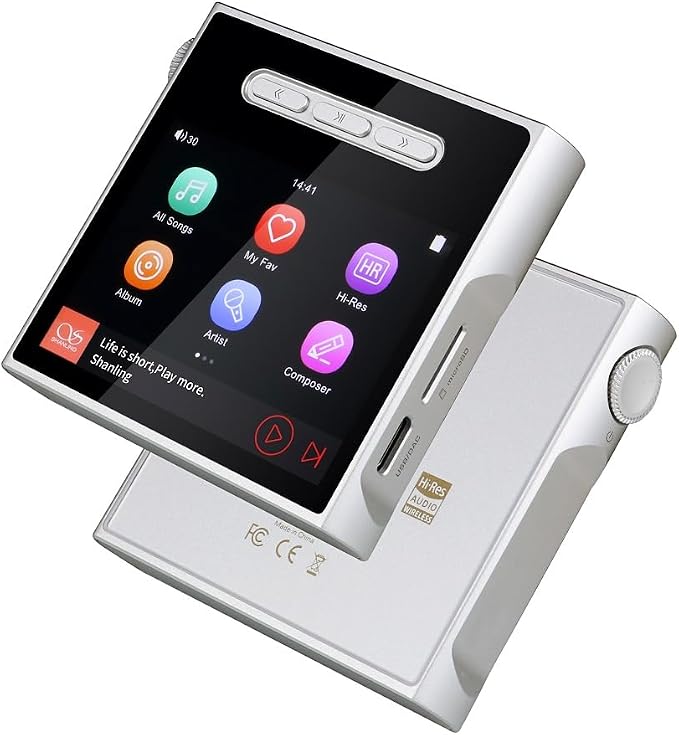
Smallest and lightest
Why you: you want a player that disappears into a pocket: 106g, physical buttons and a scroll wheel, a balanced output, and nothing on it that is not music.
Trade-off: MTouch carries no streaming apps at all, Wi-Fi serves AirPlay and DLNA only, and balanced power is the second lowest in this guide.
MTouch 2.0ES9038Q2M245mW balanced106g2.8in screenUp to DSD512
The M1s is the minimalist option. Shanling’s MTouch system boots fast, stays out of the way, and is worked through a mix of touchscreen, side buttons and a volume wheel, which makes one-handed use on a train realistic. The single ESS ES9038Q2M DAC is a proven chip, balanced power of 245mW covers IEMs and easy headphones, and decoding runs to PCM 768kHz and DSD512, the highest figures in this guide. Battery life is rated at 14.5 hours single-ended.
The compromise is unambiguous: this is a files-only player. Wi-Fi exists for AirPlay and DLNA around the house, not streaming services, and there is no internal storage. Two-way Bluetooth 5.0 with LDAC at least lets it feed wireless headphones properly. If your library lives on a card, the M1s is the neatest way to carry it.
TempoTec V3: AKM chips, serious power

AKM chips, serious power
Why you: you want AKM DAC chips and the strongest balanced output of the small players, plus TIDAL and Qobuz built in, without Android’s battery tax.
Trade-off: the 3.2 inch screen and basic interface feel plain, Wi-Fi is 2.4GHz only, and it is not an Android player despite what some listings claim.
HiByOS basedDual AK4493SEQ610mW balanced3.2in screen3500mAh batteryTIDAL + Qobuz built in
The V3 is the only AKM-based player in this tier. Dual AK4493SEQ chips, a dedicated FPGA and dual crystal oscillators give it a slightly warmer, relaxed presentation than the ESS and Cirrus players around it, and the numbers back the hardware up: 610mW from the balanced output and 330mW single-ended, with decoding to DSD512. It is a small metal box at roughly 200g with a 3.2 inch screen, two-way Bluetooth 5.1, and built-in TIDAL and Qobuz.
One correction worth stating plainly: some listings title the V3 as an Android player. It is not. The V3 runs a HiByOS-based system, so there is no Play Store and no Spotify app. Buy it for local files plus TIDAL or Qobuz streaming and it is excellent value. Buy it expecting Android and you will return it.
Hidizs AP80 Pro Max: streaming in miniature

Tiny, with streaming
Why you: you want the smallest player in this guide that still streams, for a gym bag or a shirt pocket, and your listening is IEMs.
Trade-off: balanced power is the lowest here and the small battery needs regular charging, so full-size headphones are not its job.
HiByOSDual ES9219C190mW balanced2.95in screen10 to 12h batteryTIDAL + Qobuz built in
The AP80 Pro Max packs the full small-player formula into the smallest body here: dual ESS ES9219C DACs, a 4.4mm balanced output, Wi-Fi with TIDAL and Qobuz built in, plus DLNA and AirPlay for home use. At 190mW the balanced output is modest, but it is honestly specified for the job this player is for, which is IEMs on the move. Battery life of 10 to 12 hours from the small 1300mAh cell is fair given the size.
Choose it when size decides and you still want streaming on board. If you can carry something bigger, the R3 Pro II gives you more power and nearly double the battery for similar money.
Android in the 200 to 300 band: what you actually get
A common version of this search asks for Android specifically in the 200 to 300 range, so here is the straight answer: the HiBy R4 is the only open-Android player that sits inside that band. The FiiO JM21 is the tier’s other Android player, running the newer Android 13, but it sits lower in the budget. So the choice is not Android versus Android at this money. It is the R4’s stronger amplifier and build against the JM21’s newer system and smaller spend.
What open Android buys you is the full app catalogue: Spotify, Apple Music, TIDAL and Qobuz with proper offline downloads, plus podcast and audiobook apps, all installed from the Play Store. Both players bypass Android’s sample-rate conversion system-wide, so third-party apps play bit-perfect. What it costs is battery life (11 to 12.5 hours against up to 21 on the R3 Pro II), size, and freshness: neither player will see an Android version upgrade, so the apps will eventually outgrow them even though the audio hardware will not wear out. With 3GB of RAM on both, they are happiest running one app at a time.
If your streaming is TIDAL or Qobuz only, the HiByOS players below them cover it without the Android tax. And if you decide a phone does the app job better, our roundup of the best Android music players covers the app side of that setup.
Streaming without Android: the HiByOS route
Three of the six players here, the R3 Pro II, TempoTec V3 and AP80 Pro Max, run HiByOS with TIDAL and Qobuz clients built in. That covers a large share of hi-res streaming listeners, with real battery and size advantages. The limit is firm, though: the clients stream over Wi-Fi only, with no offline downloads. Treat them as a bonus on top of a microSD library, not a replacement for one. The Shanling M1s goes further and skips streaming entirely; its Wi-Fi is for AirPlay and DLNA. All four small players also work as Bluetooth sources with LDAC or aptX, and as USB DACs for a laptop.
How to choose
- Streaming first, apps and offline downloads: HiBy R4 if the budget reaches it, FiiO JM21 if it does not.
- Local files and long battery: HiBy R3 Pro II, and it is not close.
- Smallest possible: Shanling M1s for files only, Hidizs AP80 Pro Max if you want streaming in the tiny body.
- Hardest headphones to drive: JM21 on rated power, then the TempoTec V3 and R4.
- New to the format: our explainer on what a DAC is covers the conversion half of what these players do.
What sits above this tier
Step over the ceiling and the character changes. HiBy’s RS2 II pairs an in-house Darwin R2R ladder with a deliberately app-free design; our HiBy RS2 II review covers who that suits. FiiO’s M25 R2R takes the same ladder idea into an Android player with far more power on tap, covered in our FiiO M25 R2R review. Both are for buyers who already know a ladder DAC is what they want. For everyone else, this tier is the sensible stopping point.
Frequently asked questions
What is the best DAP under $300?
For most buyers, the HiBy R4. It is the only player in the tier that combines open Android for full streaming apps with a Class A amp stage and 525mW of balanced power. If you play local files and value battery life over apps, the HiBy R3 Pro II is the better fit.
Which Android DAP in the 200 to 300 range should I buy?
The HiBy R4 is the only true Android player sitting inside the 200 to 300 band. The FiiO JM21 is the other open-Android pick in this guide and sits lower in the tier, so if your budget stretches to the R4, its amp stage and build are the step up; if not, the JM21 covers the same apps for less.
Can these players stream Spotify?
Only the two Android models, the HiBy R4 and FiiO JM21, run the Spotify app. The HiByOS players (R3 Pro II, TempoTec V3 and Hidizs AP80 Pro Max) carry built-in TIDAL and Qobuz clients instead, and the Shanling M1s has no streaming apps at all.
Do the HiByOS players support offline downloads from TIDAL or Qobuz?
No. The built-in TIDAL and Qobuz clients on HiByOS players stream over Wi-Fi only. For listening away from Wi-Fi, load a microSD card with your own files, which all six players here support up to at least 1TB.
How much output power does a DAP need?
For IEMs, anything in this guide is plenty, including the 190mW Hidizs AP80 Pro Max. For full-size headphones, look at the balanced figures: the FiiO JM21 (700mW per channel), TempoTec V3 (610mW) and HiBy R4 (525mW) drive most portable and many home headphones comfortably. Very demanding planars still belong on a desktop amp.
Is a DAP under $300 better than a phone with a dongle DAC?
For sound quality per dollar a good dongle runs close, and our guide to the best portable DACs and dongles covers the strongest options. A DAP wins on battery (your phone keeps its charge), storage, physical controls and zero notification interruptions. If you stream all day and already carry a phone everywhere, the dongle route is rational; if you want a separate, focused player, this tier is where DAPs start making sense.

I am the founder of Sound Mavericks, where I provide the polite truth about audio equipment. I started this site because consumer electronics reviews are often too technical. Instead of using a silent lab, I test headphones, earbuds, and Bluetooth speakers in the real world – like on a noisy subway or in a busy coffee shop.
To stay independent, I buy my own review units (mostly from the United States) rather than accepting free gifts from brands. Once I finish testing a product, I sell it locally to our community. My goal is to help you understand sound quality, active noise cancellation (ANC), and battery life without the marketing hype.

