Ask ten recording engineers to name the best AKG headphones and you will get the same short list argued in a different order: the K371 for closed-back work, the K712 Pro for open-back reference listening, and the K240 Studio because it has simply always been there. AKG’s catalogue is a studio catalogue. There are no noise cancelling flagships and no app-driven wireless models in this ranking, because the headphones that built AKG’s reputation run on cables and are judged on tuning, comfort and how honestly they present a mix.
This list ranks seven current AKG models using our own published scores where we have set them. Three picks carry full six-bar score sets from our headphone database. Four are unscored here, and their cards say so rather than borrowing numbers from elsewhere. Every model links to its verified Amazon US listing, so the check on each pick is a click rather than a search.

Why you: The modern closed-back AKG, tuned close to the Harman target, with an 8.8 Sound score and a live SoundMavericks review behind it.
Trade-off: Passive isolation only. It will not quiet a plane cabin the way a noise cancelling headphone does.
How to read the scores on wired studio headphones
Our scoring runs six bars: Sound, ANC, Calls, Comfort, Battery and Value. Wired studio headphones carry placeholder values on three of them. Battery sits at 5.0 because there is no battery, Calls sits at 3.0 because there is no microphone, and the ANC bar reflects passive isolation from the earcups alone, which is why the open-back models score 1.5 there. Those conventions drag the overall figures for the K371, K712 Pro and K612 Pro into the high fives and low sixes, despite Sound bars between 8.6 and 9.0. Read the Sound and Comfort bars first on this list. They are the bars that decide whether a studio headphone earns its keep.
The best AKG headphones, pick by pick
The K371 is the AKG most people should buy. Its tuning follows the Harman target closely, which in practice means bass with some weight, clear mids and treble that stays controlled on bright recordings. Sound scores 8.8 in our database, the highest of the closed-back models here, and Comfort scores 8.4 because the folding frame is light and the earpads seal without clamping hard. Our full AKG K371 review covers the tuning and the fit in detail.
Three detachable cables ship in the box, including a coiled one for studio desks, and the mini-XLR connector at the earcup is a sturdier arrangement than the fixed cables on the cheaper models below. Value scores 9.0, the strongest value mark in this list, because the K371 covers tracking, editing and listening with a dongle without a real weakness. The isolation is passive only, so it will not quiet a plane cabin the way a noise cancelling headphone does. Within its brief, nothing else in the AKG line covers as much ground.

Why you: AKG’s open-back flagship for critical listening and mixing, with the highest Sound bar in this list at 9.0 and a 9.2 Comfort score.
Trade-off: Open backs leak sound in both directions, and the 62-ohm drivers want a proper headphone output or a small amp.
The K712 Pro is AKG’s open-back flagship for critical listening, and its Sound bar of 9.0 is the highest in this list. The presentation is wide and precise: instruments sit in defined positions, reverb tails stay audible, and small balance mistakes in a mix are hard to hide from. Comfort scores 9.2, helped by the self-adjusting headband and the large velour pads that spread the clamp over a wide area.
Two things to plan around. The 62-ohm drivers ask for a proper headphone output or a small desktop amp to reach their best, and the open backs leak sound in both directions, so they suit a quiet room rather than a shared office. The ANC bar of 1.5 is the open design stated plainly: there is no isolation to speak of. For mixing and mastering work at a desk, this is the AKG to build around.

Why you: Open-back reference sound for less than the K712 Pro, with a flatter hand on the bass that many engineers prefer for checking balances.
Trade-off: At 120 ohms it is the hardest drive here. A phone dongle plays quietly, so budget for a modest amp.
The K612 Pro is the quieter sibling of the K712 Pro: same open-back family, a flatter hand on the bass, and a Sound score of 8.6 that reflects a tuning many engineers prefer for checking balances. Where the K712 adds a small lift for musicality, the K612 stays closer to neutral, which makes it the more honest tool for long mixing sessions where excitement gets tiring.
Its 120-ohm impedance is the highest here, so a phone dongle will play quietly and a modest amp is close to mandatory. Comfort scores 8.6 on the same self-adjusting headband design as the flagship. If the flagship’s price is the obstacle, the K612 Pro keeps most of the reference character and gives up mainly the extra polish and the easier drive requirements. Value scores 8.4 for exactly that reason.

Why you: The open-back soundstage favourite that tops enthusiast AKG rankings, with a wider and more spread-out image than most rivals at its level.
Trade-off: Leaner bass than consumer ears expect, and it needs a decent amplifier to fill out. We have not set a score set for it yet.
Scores: not set yet for the K702. We only print scores we have set in our own scoring pass, so this card carries no bars rather than borrowed numbers.
Check Price on AmazonThe K702 built its reputation on soundstage. Its 45mm Varimotion drivers present a wider, more spread-out image than most open-back rivals, which is why it keeps appearing in enthusiast rankings of AKG models long after launch. Voices and orchestral recordings in particular get room to breathe, and the detachable cable and replaceable pads make it a headphone owners keep for years.
Buyers should know about the leaner bass before they order. The tuning favours clarity over low-end weight, and listeners coming from consumer headphones often reach for an equalizer in the first week. It also needs a decent amplifier to fill out. Judged as a soundstage tool for acoustic and classical listening, it remains one of the most distinctive models in the line, and it is the open-back we would hand to someone who listens to ensembles rather than beats.

Why you: The K371 format on a tighter budget: closed-back, folding, detachable cable, and light enough for long tracking sessions.
Trade-off: A simpler tuning than the K371, with less refinement at the frequency extremes. No published score set yet.
Scores: not set yet for the K361. We only print scores we have set in our own scoring pass, so this card carries no bars rather than borrowed numbers.
Check Price on AmazonThe K361 is the K371’s smaller sibling: a closed-back, folding studio headphone built around a 50mm driver and a lighter frame. It shares the family shape, the oval earpads and the detachable cable, and it folds flat for a bag in a way the open-back models cannot. For tracking and everyday studio tasks it covers the same ground as the K371 at a lower tier of the range.
The tuning is the step down. Where the K371 follows the Harman target closely, the K361 carries a simpler balance with less refinement at the frequency extremes, and we have not published a score set for it yet. Treat it as the pick for buyers who want the AKG closed-back format on a tighter budget and accept a little less accuracy in exchange. Studios buying several pairs for tracking rooms often make exactly that call.

Why you: The semi-open studio staple that has been a tracking-room fixture for decades, easy to drive from almost any interface or mixer.
Trade-off: Modest bass and a long fixed cable that suits a studio desk better than a commute. No published score set yet.
Scores: not set yet for the K240 Studio. We only print scores we have set in our own scoring pass, so this card carries no bars rather than borrowed numbers.
Check Price on AmazonThe K240 Studio is the semi-open design that has sat in tracking rooms for decades, identifiable by its gold trim and self-adjusting headband. The semi-open backs give it a more natural sense of space than a sealed headphone while keeping enough isolation for vocal takes, and the 55-ohm drivers run happily from almost any interface or mixer output you plug them into.
Its case rests on longevity and on how many engineers learned their craft wearing a pair. The bass is modest and the build is utilitarian, with a long fixed cable that suits a studio desk better than a commute. As a first serious headphone for recording and casual listening alike, it remains easy to recommend, and replacement pads and parts are still easy to find, which keeps old pairs in service.
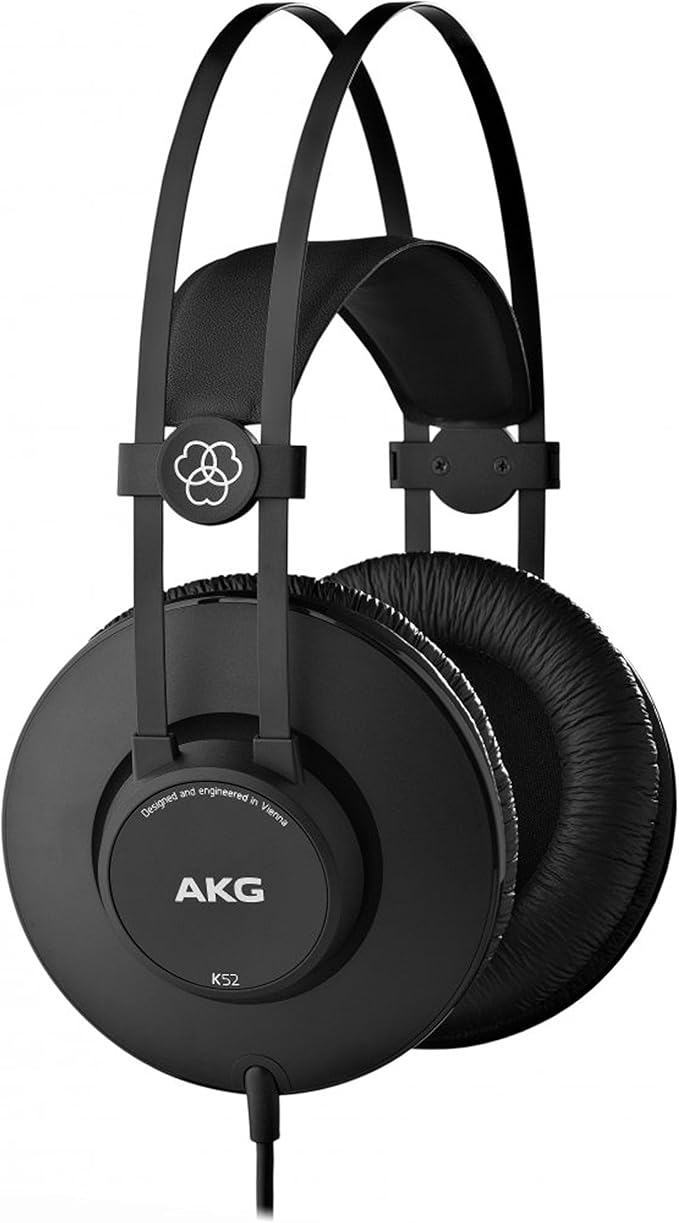
Why you: A first studio headphone that punches above its tier: our standalone review scored it 8.6 overall, with comfort at 8.8 and value at 9.2.
Trade-off: Fixed cable, basic plastic frame and a consumer-friendly tuning rather than a studio reference curve.
Scores: we have not set a six-bar score set for the K52. Its standalone review, linked in the text below, carries its published verdict.
Check Price on AmazonThe K52 is the entry point: a closed-back 40mm design that weighs about 200 grams and sits at the bottom of the range. Our standalone AKG K52 review scored it 8.6 overall on its review card, with comfort at 8.8 and value at 9.2, which is why it holds a place in this list rather than making up the numbers at the end of it.
Keep expectations in proportion. The cable is fixed at 2.5 metres, the frame is basic plastic, and the tuning is a consumer-friendly curve rather than a studio reference. What you get for very little money is a light, comfortable closed-back that sounds better than it should and survives being thrown in a bag. For a first headphone, a spare pair, or a set for a keyboard practice corner, that is a genuinely useful brief.
Closed-back, open-back or semi-open?
The AKG line splits cleanly by back design. Closed-back models (K371, K361, K52) keep sound in and noise out, so they suit tracking, commuting and shared rooms. Open-back models (K712 Pro, K612 Pro, K702) trade isolation for space and accuracy, and they belong at a quiet desk with a decent amplifier, which is why our best studio headphones list mixes the two families by task rather than by brand. The K240 Studio sits between them: semi-open, with a little of each character and the modest price to match.
Best AKG headphones compared
| Headphone | Design | Driver | Sound | Overall |
|---|---|---|---|---|
| AKG K371 | Closed-back | 45mm | 8.8 | 6.3 |
| AKG K712 Pro | Open-back | 45mm | 9.0 | 6.0 |
| AKG K612 Pro | Open-back | 40mm | 8.6 | 5.9 |
| AKG K702 | Open-back | 45mm | – | Not scored |
| AKG K361 | Closed-back | 50mm | – | Not scored |
| AKG K240 Studio | Semi-open | 30mm | – | Not scored |
| AKG K52 | Closed-back | 40mm | 8.6* | 8.6* |
*K52 figures are from our standalone review card for that model, which uses a four-category card rather than the six-bar set. Overall figures for wired models carry the placeholder conventions explained above.
Frequently asked questions
What is the best AKG headphone for mixing?
For mixing at a quiet desk, the K712 Pro is the top pick here, with a 9.0 Sound score and a wide, precise presentation. The K612 Pro is the flatter and cheaper alternative. If the room is shared or you also track, the closed-back K371 is the better tool.
Do AKG studio headphones need an amplifier?
Some do. The K612 Pro (120 ohms), K702 and K712 Pro all sound their best from a proper headphone output or a small desktop amp, and the K612 Pro plays quietly from a phone dongle. The K371, K361 and K52 run happily from almost any source.
Are AKG headphones good for everyday listening?
The K371 is the natural everyday pick: it folds, it is light, and its tuning suits mixed playlists without help from an equalizer. The open-back models belong at home, where their sound leakage does not bother anyone.
Which AKG headphone should a beginner buy?
The K52 is the low-risk start, and our review scored it 8.6 overall. The K361 is the step up for tracking work, and the K371 is the one to buy if you expect to keep the same pair for years.
How do AKG headphones compare with Sennheiser and beyerdynamic?
AKG’s strengths are soundstage width in the open-back line and the Harman-influenced tuning of the K371 and K361. Sennheiser leans warmer, beyerdynamic leans brighter and builds heavier. All three make proper studio tools; the fit and tuning decide it more than the badge does.

I am the founder of Sound Mavericks, where I provide the polite truth about audio equipment. I started this site because consumer electronics reviews are often too technical. Instead of using a silent lab, I test headphones, earbuds, and Bluetooth speakers in the real world – like on a noisy subway or in a busy coffee shop.
To stay independent, I buy my own review units (mostly from the United States) rather than accepting free gifts from brands. Once I finish testing a product, I sell it locally to our community. My goal is to help you understand sound quality, active noise cancellation (ANC), and battery life without the marketing hype.