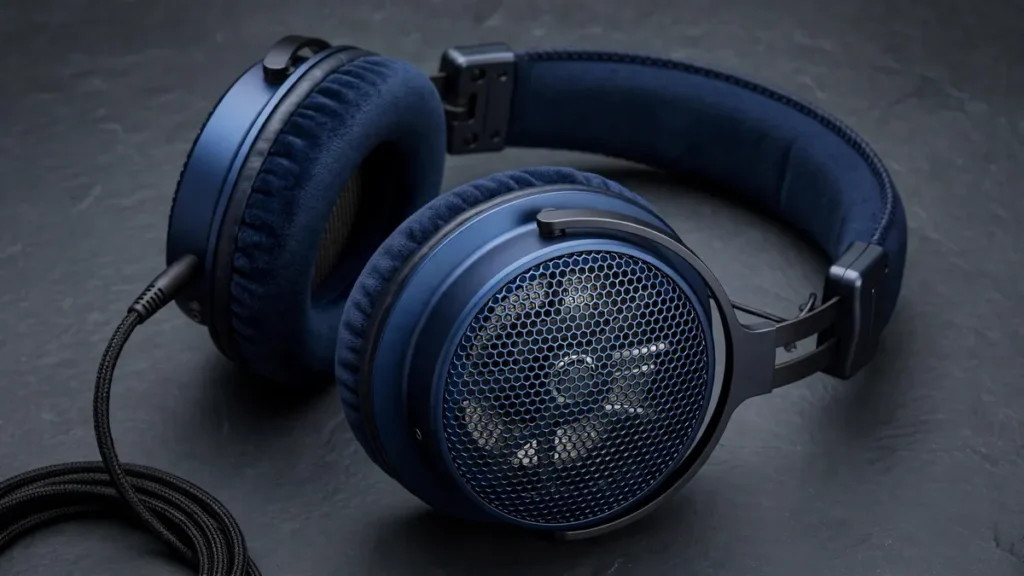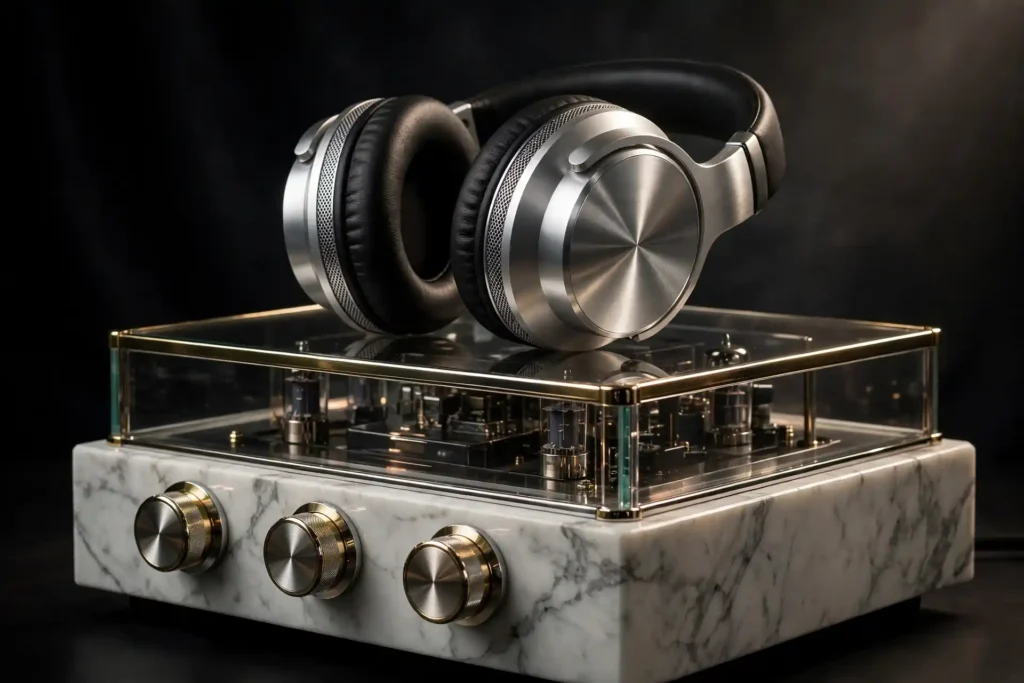
The sennheiser he 1 is not a headphone you buy — it is a headphone system you commission. Successor to the legendary 1991 Orpheus, the HE 1 pairs an electrostatic headset with a dedicated amplifier and DAC carved into glass and a solid block of Carrara marble, with vacuum tubes that rise from the chassis at a touch. It is Sennheiser’s statement that no compromise was allowed: the widest frequency response and the lowest distortion the company has ever measured in a sound reproduction system.
We have not had the HE 1 in our own listening room — almost nobody outside Sennheiser’s experience centers has. This is an analysis review: our verdict below is built from Sennheiser’s published specifications and documentation, plus published measurements and listening notes from independent reviewers who have spent serious time with the system. If you searched for the price angle, here is the honest framing up front: the HE 1 is built to order through Sennheiser rather than stocked on shelves, so there is no simple sticker number to quote — use the button below to check current listings.
SoundMavericks Review: Sennheiser HE 1
| Sound Quality | 10.0 |
| Design & Craftsmanship | 10.0 |
| Innovation & Engineering | 10.0 |
| Features & Connectivity | 8.5 |
| Practicality | 7.0 |
| Value | 6.0 |

What Is the Sennheiser HE 1?
The HE 1 is Sennheiser’s flagship electrostatic headphone system — the successor to the original Orpheus (HE 90), which Sennheiser introduced in 1991 as a no-compromise engineering showcase and produced in a limited run of just 300 units. A quarter-century later, Sennheiser presented the HE 1 as the modern Orpheus: same philosophy, contemporary technology, even more luxurious materials.
Unlike a normal headphone, the HE 1 is a complete, matched system. The headset itself is only half the story; the other half is the HEV 1 amplifier base, which combines a vacuum-tube preamplifier stage, a high-voltage transistor amplifier, and a full digital-to-analog converter section in one chassis. You feed it digital audio over USB, optical, or coaxial — or analog over RCA or balanced XLR — and everything downstream, from conversion to amplification to the electrostatic drivers, was designed together as a single unit. Each system is assembled largely by hand (Sennheiser’s Tullamore, Ireland facility handles final assembly), with thousands of individual parts and many hours of labor in every unit.
Sennheiser HE 1 Specs
Here are the official specifications, taken from Sennheiser’s product documentation:
| System type | Electrostatic headphone + matched amplifier/DAC system |
| Transducer | Electrostatic; 2.4-micrometer platinum-vaporized diaphragm |
| Electrodes | Gold-vaporized ceramic |
| Frequency response | 8 Hz to over 100 kHz |
| Total harmonic distortion | 0.01% at 1 kHz, 100 dB SPL — the lowest Sennheiser has ever measured |
| Amplifier | Hybrid: vacuum-tube stage plus Cool Class A MOS-FET high-voltage amplifier integrated into the ear cups |
| DAC | 8× ESS SABRE ES9018 (four in parallel per channel); up to 32-bit/384 kHz PCM and DSD |
| Digital inputs | USB, optical S/PDIF, coaxial S/PDIF (ASIO supported) |
| Analog inputs | Unbalanced RCA, balanced XLR |
| Headphone cable | 99.9% silver-plated OFC |
| Ear cups | Precision-machined solid aluminum; handmade leather pads with velour/microfibre |
| Amplifier housing | Glass over a solid Carrara marble block (spring-loaded, vibration-damped); dials milled from single brass pieces, chrome-plated |
| Availability | Built to order through Sennheiser |
Design & Build: Marble, Glass and Brass
The HE 1 is the rare audio product that belongs in a design museum as comfortably as in a listening room. The amplifier sits in a housing of glass over a solid block of Carrara marble — the same stone associated with Renaissance sculpture — chosen as much for its vibration-damping properties as its looks. The vacuum tubes are spring-mounted to that damped marble block and shielded by quartz glass against airborne noise, so the structure itself is part of the acoustic engineering.
The theater starts before a note plays: with a touch, the tubes rise silently from the chassis, then pause to let them reach optimum operating temperature before you listen. The control dials are each milled from a single piece of brass and chrome-plated. Up top, the headset’s ear cups are precision-machined from solid aluminum with handmade leather ear pads over a soft velour and microfibre construction. Nothing about the HE 1 looks or feels mass-produced, because it isn’t.
The Technology Inside: Electrostatics, Tubes and Eight DACs
Three engineering decisions define the HE 1’s sound, and each is worth understanding.
1. Electrostatic drivers. Instead of a conventional dynamic driver pushing air with a voice coil, the HE 1’s diaphragms are whisper-thin (2.4 micrometers) platinum-vaporized films suspended between gold-vaporized ceramic electrodes. The entire diaphragm surface moves uniformly, which is why electrostatics are famous for speed, detail, and vanishingly low distortion. Sennheiser’s measured 0.01% THD is the lowest figure it has ever recorded on any sound reproduction system.
2. Amplifiers in the ear cups. The HE 1 is the first electrostatic headphone with its high-voltage amplifier — a Cool Class A MOS-FET design — integrated directly into the ear cups. That eliminates the capacitive reactance of a long cable run between a separate energizer and the drivers, which Sennheiser says delivers dramatically better impulse fidelity than conventional electrostatic setups. The chassis contributes a vacuum-tube stage for the voltage gain, giving the system both tube character and transistor precision. If the tube-versus-transistor debate interests you, our tube amp vs solid state guide breaks down what each topology actually does to the sound.
3. Eight DACs working as one. Digital sources feed eight ESS SABRE ES9018 converter chips — four running in parallel per stereo channel — which averages out conversion errors and drops the noise floor. The system handles high-resolution PCM up to 32-bit/384 kHz as well as DSD, over USB, optical, or coaxial, with ASIO support for bit-perfect playback from a computer. For context on what those numbers mean, see our guides to the best DACs and best headphone amp/DAC combos.
The consensus among independent reviewers who have heard it at length — including a fully measured review by crinacle and listening sessions documented by the headphones.com team — is that the HE 1 delivers reference-grade technical performance with a musical, non-fatiguing presentation. Our read of the evidence: this is not a “detail at the expense of enjoyment” headphone. It is tuned to be both the measurement champion and the emotional one.
Who Is the Sennheiser HE 1 For?
Let’s be direct: the HE 1 is for a tiny audience, and knowing whether you’re in it is the whole buying decision.
It is for the endgame audiophile who has owned summit-tier gear and wants the definitive statement piece; the collector who values the Orpheus lineage and museum-grade craftsmanship; and the listener with a dedicated listening room, a serious digital library (or vinyl rig feeding the analog inputs), and the patience for a built-to-order purchase process. If “the best, regardless of compromise” is your actual purchasing philosophy rather than a slogan, this is the product Sennheiser built for you.
It is not for anyone seeking value per dollar — by design, the HE 1 optimizes for the absolute, not the ratio. It is not portable, not wireless, and not something you toss in a bag. If you want the finest sound Sennheiser makes that you can actually buy off a shelf and carry home today, our best Sennheiser headphones roundup and the Sennheiser HD 660S2 review cover the realistic flagship tier — and our best headphones for audiophiles guide maps the entire summit-fi landscape.
Sennheiser HE 1 vs the Alternatives
The HE 1’s most direct rival is the HiFiMan Shangri-La Sr electrostatic system, the other member of the ultra-flagship electrostatic club — crinacle’s coverage of the summit tier treats them as the two reference points at the very top. Below that rarified air, the realistic alternatives are Stax’s flagship electrostatic systems and Sennheiser’s own HD 800 S / HD 660S2 dynamic flagships, which deliver a large fraction of the audiophile experience in a conventional, ownable package.
Our honest positioning: no dynamic headphone, however good, reproduces the specific effortlessness of a well-executed electrostatic system — the HE 1’s reason to exist is that last few percent that measurements can barely capture and words barely describe. But the gap between a top dynamic flagship and the HE 1 is far smaller than the gap in exclusivity suggests. Buy the HE 1 because you want the statement, the craftsmanship, and the lineage — not because a flagship dynamic headphone sounds broken next to it. It doesn’t.
Our Verdict: Is the Sennheiser HE 1 Worth It?
“Worth it” is the wrong question for the HE 1, and also the only question that matters. As an engineering achievement, it is essentially flawless: the lowest distortion Sennheiser has ever measured, a driver and amplifier architecture with no real precedent, materials and build quality that belong in an art gallery, and a listening experience that independent reviewers describe in near-mystical terms. Nothing we can point to at any price does what it does as completely.
As a purchase, it fails every rational value test ever devised — and it was designed to. The HE 1 exists for the buyer who has already won the value game and wants the absolute. Our verdict: if you are shopping with your head, buy a flagship dynamic headphone and never look back; if you are commissioning with your heart and your listening room, the HE 1 is the definitive answer, and nothing else will scratch the itch. Either way, start from our best headphones for audiophiles guide to calibrate what “summit” means before you climb it.
Frequently asked questions
What is the Sennheiser HE 1?
The Sennheiser HE 1 is the company’s flagship electrostatic headphone system — a matched set comprising an electrostatic headset and a dedicated amplifier/DAC base built into glass and a solid Carrara marble block. It is the successor to the legendary 1991 Orpheus and represents Sennheiser’s no-compromise statement on what headphones can achieve.
Is the Sennheiser HE 1 the successor to the Orpheus?
Yes. The original Orpheus (HE 90) was introduced in 1991 as Sennheiser’s engineering showcase and was produced in a limited run of 300 units. The HE 1, presented in 2015, is its official successor — same philosophy of zero compromise, rebuilt with modern electrostatic drivers, in-ear-cup amplification, and contemporary digital conversion.
Why can’t I find a simple price for the Sennheiser HE 1?
Because it isn’t sold like a normal headphone. The HE 1 is built to order through Sennheiser’s own channels rather than stocked at retail, and pricing varies by region and configuration. The “Check Price on Amazon” buttons in this article run a live Amazon search so you can see current listings and related electrostatic gear.
Can you buy the Sennheiser HE 1 on Amazon?
There is no standard off-the-shelf Amazon listing for the HE 1 — it is a built-to-order system purchased through Sennheiser. The Amazon search linked in this article is the honest route: it shows whatever current listings, related electrostatic headphones, and companion gear are available.
What makes the HE 1 different from other expensive headphones?
Three things: true electrostatic drivers with 2.4-micrometer platinum-vaporized diaphragms; the first-ever integration of the high-voltage amplifier directly into the ear cups, eliminating cable capacitance losses; and a hybrid tube-plus-transistor amplifier with eight parallel DAC chips, all housed in a vibration-damped marble and glass chassis. Most expensive headphones optimize one link in the chain — the HE 1 rebuilds the entire chain as one system.
Who should buy the Sennheiser HE 1?
The endgame audiophile or collector with a dedicated listening room who wants the definitive statement piece and values the Orpheus lineage and craftsmanship as much as the sound. If value per dollar matters to you at all, a flagship dynamic headphone from our best headphones for audiophiles guide is the rational choice.

I am the founder of Sound Mavericks, where I provide the polite truth about audio equipment. I started this site because consumer electronics reviews are often too technical. Instead of using a silent lab, I test headphones, earbuds, and Bluetooth speakers in the real world – like on a noisy subway or in a busy coffee shop.
To stay independent, I buy my own review units (mostly from the United States) rather than accepting free gifts from brands. Once I finish testing a product, I sell it locally to our community. My goal is to help you understand sound quality, active noise cancellation (ANC), and battery life without the marketing hype.