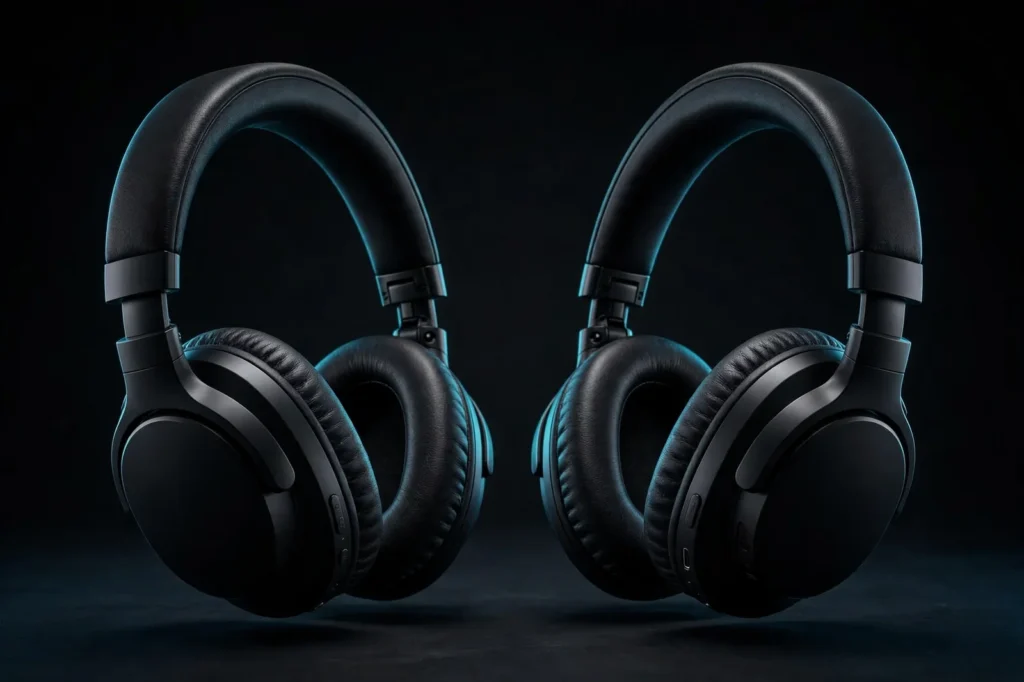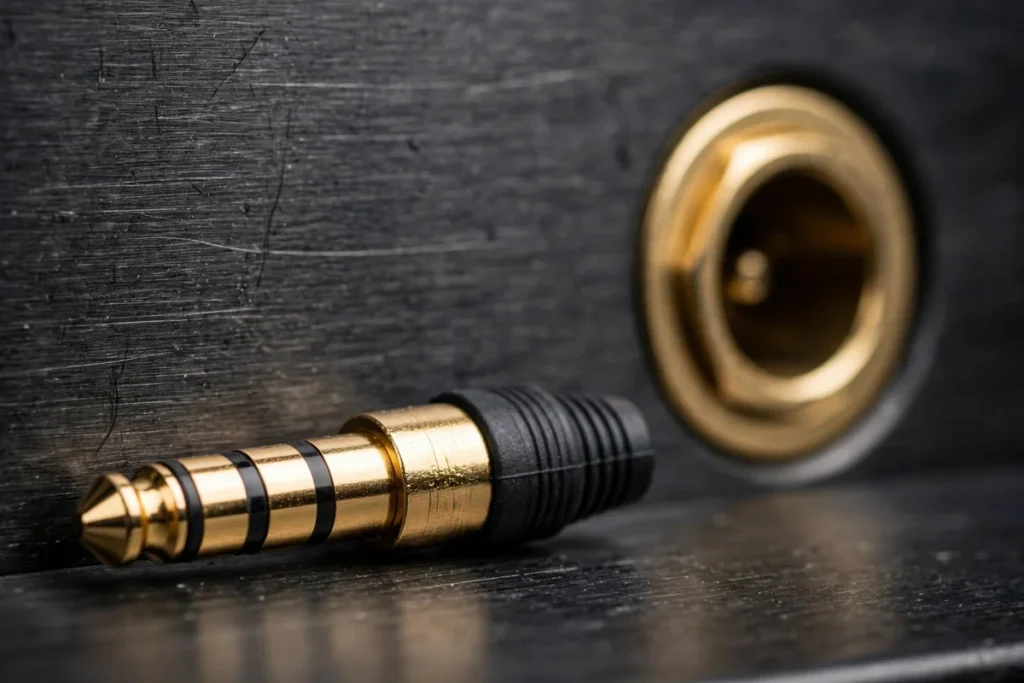
The 1/4 inch headphone jack is the big connector you’ll find on guitar amps, studio headphones, and mixing desks — the one that dwarfs the small 3.5mm plug on your phone. Also called the quarter-inch jack (or typed out as “1 4 headphone jack” in searches), it measures 6.35mm across and has been the standard connector for professional and semi-professional audio gear for over a century. If you’ve ever tried to plug your earbuds into a guitar amp and found the hole way too big, this guide explains exactly what you’re looking at — and which adapter you need.
At SoundMavericks we’ve tested countless headphones with 1/4 inch plugs and adapters, and in this guide we’ll cover what the 1/4 inch headphone jack is, where it’s used, how it compares to the smaller 3.5mm jack, the difference between TRS and TS plugs, and the best 1/4 inch to 3.5mm adapters for connecting your gear.
What Is a 1/4 Inch Headphone Jack?
A 1/4 inch headphone jack is a cylindrical audio socket, 6.35mm (one quarter of an inch) in diameter, designed to accept a matching 1/4 inch plug. The connector traces its lineage back to the 19th century, when it was invented for telephone switchboards — the same “phone plug” design later became the standard for musical instruments, studio equipment, and pro-audio gear.
On a pair of stereo headphones, the 1/4 inch plug uses a TRS (tip-ring-sleeve) layout: the tip carries the left channel, the ring carries the right channel, and the sleeve is the shared ground. That’s why you’ll see two black insulating bands dividing the plug into three metal sections — tip, ring, sleeve. This is the same three-contact arrangement as a 3.5mm headphone plug, just scaled up.
One important catch: not every 1/4 inch plug does the same job. A TS (tip-sleeve) plug has only one band and two contacts — it carries a mono signal and is the standard for guitar and bass cables. A TRS plug can also carry a balanced mono signal (tip hot, ring cold, sleeve ground) in studio gear, or a stereo headphone signal. The plugs look almost identical, so knowing which one you have matters when choosing adapters and cables.
Where Is the 1/4 Inch Headphone Jack Used?
The 1/4 inch headphone jack is the working connector of the pro audio world. You’ll find it on:
- Guitar and bass amplifiers (headphone out and line out)
- Mixing consoles, audio interfaces, and patch bays
- Studio headphones — many full-size models ship with a 1/4 inch plug or a screw-on 1/4 inch adapter
- Headphone amplifiers and home stereo receivers
- Electronic keyboards, drum machines, and DJ controllers
It persists for practical reasons: the larger plug has more contact surface, seats with a reassuringly solid click, and is far harder to snap off than a 3.5mm connector — a real consideration on stage or in a busy studio. If you’re setting up a proper listening chain, our best headphone amps guide covers amps that overwhelmingly use 1/4 inch headphone outputs.
1/4 Inch Headphone Jack vs 3.5mm: What’s the Difference?
The 1/4 inch headphone jack and the 3.5mm (1/8 inch) jack carry exactly the same stereo signal — the connector size itself doesn’t change what you hear. The differences are mechanical and conventional, not sonic:
| Feature | 1/4 inch (6.35mm) | 3.5mm (1/8 inch) |
|---|---|---|
| Typical use | Studio gear, guitar amps, mixers, pro headphones | Phones, laptops, portable players, earbuds |
| Durability | Very rugged; resists bending and breakage | More fragile; easier to snap under strain |
| Connection feel | Deep, solid seating with a positive click | Lighter seating; can work loose |
| Contact area | Larger contact surface | Smaller contact surface |
| Sound quality | Same signal as 3.5mm | Same signal as 1/4 inch |
Be skeptical of claims that a 1/4 inch plug sounds “richer” or “more detailed” than 3.5mm — that’s not how connectors work. The real advantage is durability and the pro-audio standard: when your amp, mixer, and studio headphones all use 1/4 inch, everything plugs together without adapters. The main trade-off is bulk — there’s a reason the smaller jack won in portable gear.
TRS vs TS: Know Which 1/4 Inch Plug You Need
This is where most confusion comes from. Before buying an adapter, count the insulating bands on the plug:
- TRS (3 contacts, 2 bands): stereo headphones, or balanced mono lines in studio equipment. This is what headphone adapters are built for.
- TS (2 contacts, 1 band): mono instrument signals — electric guitars, basses, unbalanced pedalboard connections. Do not use a stereo TRS headphone adapter here and expect correct results.
- TRRS (4 contacts, 3 bands): stereo plus microphone — common on 3.5mm phone headsets. Standard 1/4 inch headphone adapters don’t pass the mic channel, so expect stereo audio only.
One practical warning: pushing a TRS-to-3.5mm adapter into a mono TS jack (like a guitar input) can produce one-sided audio or a dead connection, because the ring contact lands on the wrong part of the circuit. Match the adapter to the jack’s job.
How to Connect 1/4 Inch and 3.5mm Devices
There are two adapter directions, and buying the wrong one is the single most common mistake:
1/4 inch to 3.5mm adapter (6.35mm male to 3.5mm female)
This is the adapter most people are looking for: it turns the big 1/4 inch jack on your amp, mixer, or audio interface into a small socket for your everyday 3.5mm earbuds or headphones. Plug the 1/4 inch end into the amp, and your 3.5mm plug goes into the other side. Most studio headphones actually include a screw-on version of this exact adapter in the box.
3.5mm to 1/4 inch adapter (3.5mm male to 6.35mm female)
The reverse: for headphones with a fixed 1/4 inch plug — like many studio headphones for mixing — that you want to use with a phone, laptop, or portable player. This adapter plugs into the 3.5mm socket and gives you a 1/4 inch jack on the other end.
The Best 1/4 Inch to 3.5mm Adapters
We’ve verified these adapters against their live Amazon listings. Any decent gold-plated TRS adapter will sound identical to any other — there’s no audible difference between a $6 adapter and a $20 one — so we judge on build quality, grip, and value per adapter.
1. Amazon Basics 6.35mm to 3.5mm Adapter (2-Pack) — Best Overall

The Amazon Basics 6.35mm male to 3.5mm female adapter is our default pick: a pair of gold-plated TRS adapters with a solid metal housing and knurled grip for easy plugging. It connects your 3.5mm headphones to the 1/4 inch jack on amps, mixers, and AV receivers with a secure, noise-free fit, and the two-pack means you get a spare for the gig bag.
2. Cable Matters 1/4 to 1/8 Adapter (5-Pack) — Best Value

The Cable Matters 5-pack is the same adapter style — gold-plated 6.35mm male to 3.5mm female TRS — in a five-pack that’s ideal if you run multiple setups or keep losing adapters. Solid copper construction, corrosion-resistant gold plating, and a low per-unit cost make it the sensible buy for studios and bands.
3. Cable Matters 3.5mm to 6.35mm Adapter (5-Pack) — Best Reverse-Direction Pick

For headphones with a fixed 1/4 inch plug, you need the reverse direction: the Cable Matters 3.5mm male to 6.35mm female adapter plugs into your phone or laptop’s 3.5mm socket and accepts a 1/4 inch headphone plug. Gold-plated, stereo TRS, and sold as a cost-effective 5-pack — it’s the one to buy if your studio cans have a permanently attached quarter-inch plug.
Common 1/4 Inch Headphone Jack Problems (and Fixes)
- Sound in only one ear: usually a TRS adapter pushed into a TS mono jack, or the plug isn’t fully seated. Push it in until it clicks, and confirm the jack is stereo.
- Crackling when the cable moves: a loose or worn adapter. A quality adapter with a knurled metal housing seats more securely than cheap plastic ones.
- Adapter won’t stay in the guitar amp: guitar inputs are TS mono jacks — a stereo headphone adapter doesn’t belong there. Use headphones on the amp’s dedicated headphone output instead.
- Microphone stops working: standard 1/4 inch adapters pass stereo audio only — the fourth (mic) contact on a TRRS headset plug has nowhere to go.
Frequently Asked Questions
What does a 1/4 inch headphone jack mean?
It means the socket (or plug) measures 1/4 of an inch — 6.35mm — in diameter. It’s the large “quarter-inch” connector used on guitar amps, mixers, audio interfaces, and studio headphones, as opposed to the smaller 3.5mm jack on phones and laptops.
Is a 1/4 inch headphone jack better than 3.5mm?
Not in sound quality — both carry the same signal. The 1/4 inch connector is more durable, seats more securely, and is the professional standard for studio and stage gear. The 3.5mm jack wins on size and portability, which is why it dominates portable devices.
Can I plug 3.5mm headphones into a 1/4 inch jack?
Yes — with a 1/4 inch to 3.5mm adapter (6.35mm male to 3.5mm female). Plug the 1/4 inch end into the amp or mixer and your 3.5mm headphones into the adapter. No settings to change; it’s purely mechanical.
What’s the difference between 1/4 inch TRS and TS?
TRS (tip-ring-sleeve, two black bands) has three contacts for stereo headphones or balanced mono studio lines. TS (tip-sleeve, one band) has two contacts for mono instrument signals like guitars. They look nearly identical, so check before buying adapters.
Do 1/4 inch adapters degrade sound quality?
No — a decent gold-plated adapter adds no audible degradation. It simply re-routes the same contacts to a different-sized plug. Just make sure the plug is fully seated and the adapter matches the jack (stereo TRS adapter for stereo jacks).
The Bottom Line on the 1/4 Inch Headphone Jack
The 1/4 inch headphone jack is the connector that separates consumer gear from pro gear: 6.35mm of solid, century-old engineering that still anchors guitar amps, mixers, and studio headphones today. It doesn’t sound better than 3.5mm — but it’s tougher, more reliable, and the universal language of studio equipment. Keep a 1/4 inch to 3.5mm adapter in your kit, know the difference between TRS and TS, and you’ll never be caught with a plug that doesn’t fit again. If you’re wondering whether your headphones actually need the bigger output, our impedance and amp explainer is a good next read.
Check Price on Amazon — Cable Matters 5-Pack
Check Price on Amazon — Reverse 3.5mm Adapter

I am the founder of Sound Mavericks, where I provide the polite truth about audio equipment. I started this site because consumer electronics reviews are often too technical. Instead of using a silent lab, I test headphones, earbuds, and Bluetooth speakers in the real world – like on a noisy subway or in a busy coffee shop.
To stay independent, I buy my own review units (mostly from the United States) rather than accepting free gifts from brands. Once I finish testing a product, I sell it locally to our community. My goal is to help you understand sound quality, active noise cancellation (ANC), and battery life without the marketing hype.