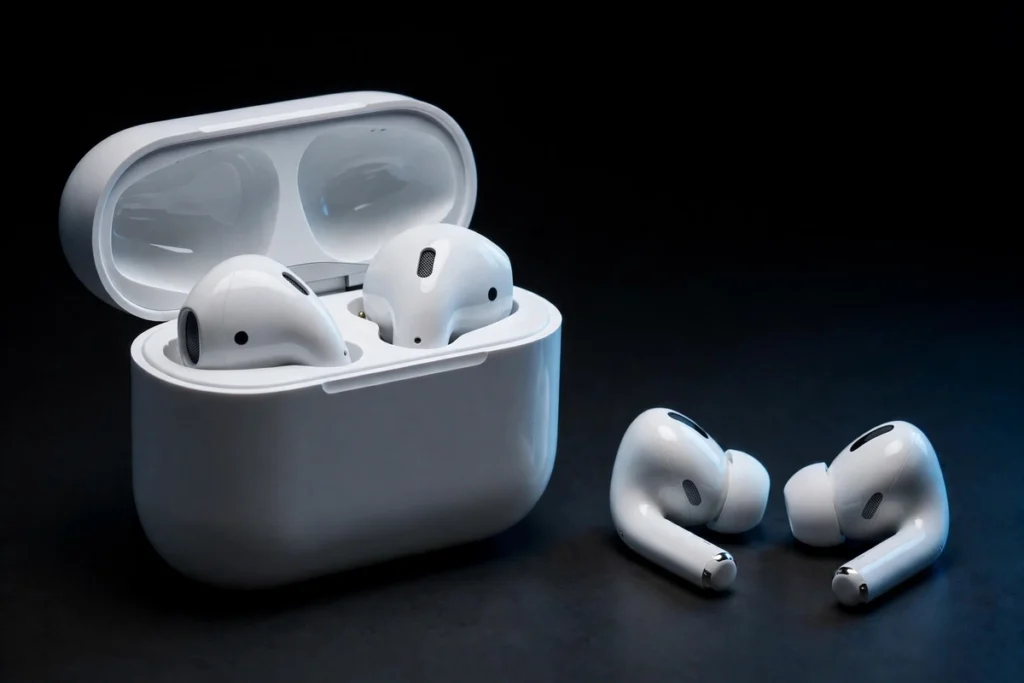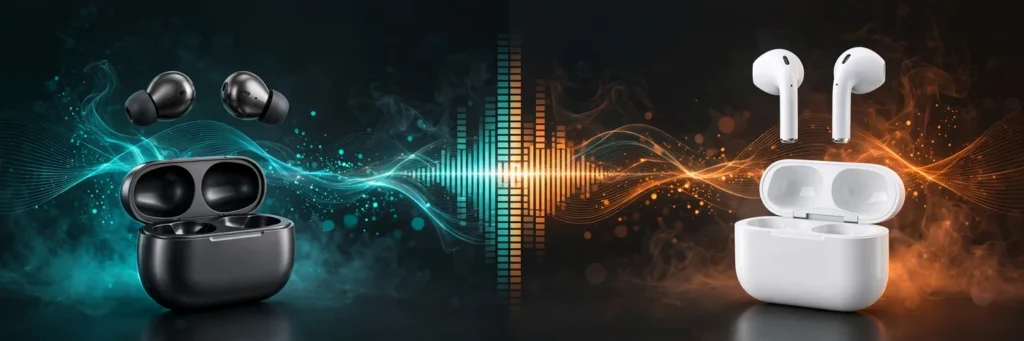
Sony WF-1000XM5 vs AirPods Pro 2 is the flagship earbuds matchup that refuses to die — and for good reason. Sony’s best true wireless earbuds against Apple’s best remain the two most-compared wireless earbuds in 2026. Both deliver superb sound, excellent noise cancellation and flagship features, but they were built for different people. In this comparison, we break down the key differences across sound quality, ANC, comfort, battery life, call quality and ecosystem fit so you can pick the right pair with confidence.
A note on method: this comparison is research-based — we have not had both units in for hands-on testing. Every spec below comes from Sony, Apple and retailer-published documentation, and our analysis draws on published lab measurements and controlled side-by-side reviews from outlets like SoundGuys, RTINGS, Tom’s Guide and Laptop Mag.
The Verdict Up Front
The Sony WF-1000XM5 is the better all-around pair of earbuds. It wins on sound quality (LDAC hi-res support, full custom EQ), raw battery life per charge and true multipoint, and it works at full strength on both Android and iPhone.
The AirPods Pro 2 (USB-C) is the better pick if you live in the Apple ecosystem. Nothing matches its seamless pairing, automatic device switching, personalized spatial audio and ecosystem-only conveniences on an iPhone, iPad or Mac.
The short rule: your phone decides. Android users should buy the Sony. iPhone-first users get more daily joy from the AirPods. Keep reading for the evidence behind that call.
Sony WF-1000XM5 vs AirPods Pro 2: Spec Comparison
| Spec | Sony WF-1000XM5 | AirPods Pro 2 (USB-C) |
|---|---|---|
| Driver | 8.4 mm Dynamic Driver X | Custom high-excursion Apple driver + custom amplifier |
| Chip / processors | Integrated Processor V2 + HD Noise Canceling Processor QN2e | Apple H2 |
| Bluetooth | 5.3 with multipoint (2 devices) | 5.3 with automatic switching across Apple devices |
| Audio codecs | SBC, AAC, LDAC | AAC (SBC fallback) — no LDAC |
| Active noise cancellation | Industry-leading ANC, Auto NC Optimizer | Up to 2x more ANC than the original Pro, Adaptive Audio |
| Transparency mode | Ambient Sound mode with 20 adjustable levels | Adaptive Transparency |
| Battery, buds (ANC on) | Up to 8 hours | Up to 6 hours |
| Battery, total with case | Up to 24 hours | Up to 30 hours |
| Quick charge | 3 minutes ≈ 1 hour of playback | 5 minutes ≈ 1 hour of playback |
| Charging | USB-C, Qi wireless | USB-C, MagSafe, Qi wireless, Apple Watch charger |
| Water resistance | IPX4 (buds only) | IP54 (buds and case) |
| Call microphones | 3 mics per bud + bone-conduction sensor, AI noise reduction | Dual beamforming mics + inward-facing mic per bud, Voice Isolation |
| Spatial audio | 360 Reality Audio | Personalized Spatial Audio with dynamic head tracking |
| Companion app | Sony Sound Connect (10-band EQ, Adaptive Sound Control, Speak-to-Chat) | iOS Settings (Adaptive EQ, Ear Tip Fit Test, Find My) |
| Colors | Black, Silver, Smoky Pink | White |
| SoundMavericks analysis winner | Sound, ANC depth, battery, versatility | iPhone integration, convenience |
Sony WF-1000XM5: Our Analysis
Sony’s flagship earbuds pack two dedicated processors — the Integrated Processor V2 handling audio and the QN2e handling noise cancellation — driving an all-new 8.4 mm Dynamic Driver X. The headline differentiator is LDAC: on Android phones that support it, the XM5 transmits hi-res wireless audio the AirPods Pro 2 cannot match. The Sony Sound Connect app adds a 10-band EQ, Adaptive Sound Control and Speak-to-Chat, and foam-style tips in four sizes create a deep seal that does a lot of the ANC’s heavy lifting.
The honest caveats, per long-term reviews: the smaller, lighter shell doesn’t suit every ear shape, and the fit takes more trial and error than Apple’s. But as an audio-first package that works everywhere, it’s the most complete flagship earbud in the category.
AirPods Pro 2 (USB-C): Our Analysis
Apple’s flagship is built around the H2 chip and one overriding idea: the earbuds should disappear into your Apple life. One-tap pairing, automatic switching between iPhone, iPad and Mac, Personalized Spatial Audio tuned to your ear shape, and Siri and Find My baked in — these are conveniences Sony cannot replicate on iOS. The 2023 USB-C revision added IP54 dust resistance, lossless audio with Apple Vision Pro, and iOS 17 features like Adaptive Audio and Conversation Awareness, which automatically lowers volume when someone talks to you.
The catch: outside Apple’s ecosystem, most of that magic evaporates. On Android, the AirPods Pro 2 become a standard Bluetooth earbud with ANC — good hardware with its best features locked away. And the codec story is Apple-only: AAC is well optimized on iPhone but there’s no LDAC or any hi-res option for audiophiles.
Sony WF-1000XM5 vs AirPods Pro 2 Sound Quality: Which Is Better?
Sound is where Sony’s lead is clearest. The WF-1000XM5’s LDAC codec transmits up to three times the data of AAC, and on Android with a hi-res streaming source (Tidal, Qobuz, Amazon Music HD), the difference is audible: tighter bass, crisper transients, more air around instruments. Add Sony’s 10-band EQ and you can reshape the signature to your taste, fixing the slightly recessed midrange some reviewers note in the stock tuning.
The AirPods Pro 2 are no slouch — reviewers praised their balanced sound with natural vocal clarity, and Adaptive EQ tailors the response to your ear fit in real time. On an iPhone, both buds are constrained to AAC, so the codec gap shrinks — but Sony’s larger driver and full EQ still give it the edge. Tom’s Guide (89 vs 85 out of 100) and Laptop Mag both scored Sony higher for sound.
Winner: Sony WF-1000XM5. If audio quality is your top priority, especially on Android, this isn’t close.
Which Has Better Noise Cancellation: Sony WF-1000XM5 or AirPods Pro 2?
Both are elite noise cancellers, and both improved meaningfully over their predecessors. Sony’s two-processor setup with three mics per bud targets low-frequency rumble — airplane engines, trains, HVAC drone — with excellent wind-noise handling, and the foam-style tips add passive isolation that helps everywhere.
Apple’s H2-driven ANC is rated at up to twice the cancellation of the original AirPods Pro, and it’s particularly strong on midrange and vocal frequencies. Adaptive Audio blends ANC and Transparency on the fly, and Apple’s Adaptive Transparency remains the most natural-sounding pass-through mode of the two.
Reviewer opinion splits the crown narrowly: Laptop Mag gave Sony a clean ANC win, Tom’s Guide scored it 19/20 vs 18/20, and most comparisons land on Sony by a nose — particularly for travel and low-end rumble. For hearing your surroundings naturally, Apple edges it.
Winner: Sony WF-1000XM5, by a hair. Buy either for ANC; choose on other criteria.
Comfort and Fit
This category is ear-shape dependent, and the designs take opposite approaches. Sony went smaller and lighter than the WF-1000XM4, with polyurethane foam tips that expand to seal your ear canal — great passive isolation, but the fit can feel fussy, and some users report the tips wear out over months of use.
Apple kept its familiar stemmed design with silicone tips in four sizes (including XS) and an Ear Tip Fit Test in iOS that verifies your seal acoustically. The lighter, less intrusive feel suits more ear shapes with less fuss, and many long-term users rate the AirPods as the more comfortable all-day wear.
Winner: AirPods Pro 2 for most people. Sony’s seal isolates better, but Apple’s fit works for more ears with less effort.
Sony WF-1000XM5 vs AirPods Pro 2 Battery Life
Sony wins the number that matters most day to day: up to 8 hours of ANC-on playback per charge versus Apple’s 6. On a long flight or workday, the Sony keeps playing long after the AirPods need a case break.
Apple wins the total: the MagSafe case holds up to 30 hours against Sony’s 24, with more ways to top up — MagSafe, Qi, USB-C, even an Apple Watch charger. Sony supports USB-C and Qi only, but charges faster: 3 minutes buys an hour of playback versus 5 on the AirPods.
Winner: Sony for listening stamina; Apple for case reserves and charging flexibility.
Call Quality: Which Is Better for Phone Calls?
Sony invested heavily in the uplink: three microphones per bud, a bone-conduction sensor that reads your jaw’s vibrations, and AI-based noise reduction trained on voice samples. Laptop Mag’s side-by-side testing found Sony’s calls clearly better, noting the wind-noise handling in particular — the mesh-covered mics keep gusty conditions from wrecking your voice.
The AirPods Pro 2 handle calls well in quiet conditions, and iOS 17’s Voice Isolation improves clarity — but only when paired with an iPhone. In wind and noisy streets, more ambient noise bleeds through on Apple’s side.
Winner: Sony WF-1000XM5. If you take calls outdoors or in noisy environments, our best earbuds for phone calls roundup goes deeper on call-mic evidence across the category.
iPhone vs Android: The Deciding Factor
Everything above collapses into one question: what phone do you own? On an iPhone, the AirPods Pro 2 unlock their full arsenal — instant pairing, iCloud device switching, Personalized Spatial Audio, Ear Tip Fit Test, Find My, Siri, hearing-health features, Adaptive Audio. Sony’s XM5 works on iPhone (AAC, ANC, app features), but you’re paying for LDAC you’ll never use.
On Android, the math flips. The AirPods Pro 2 lose spatial audio personalization, device-switching magic, the fit test, Find My and firmware updates (which require an Apple device). The Sony WF-1000XM5 gives Android users everything: LDAC, full app functionality, true two-device multipoint, and the same ANC and call quality.
Verdict on ecosystem: iPhone → AirPods Pro 2. Android → Sony WF-1000XM5, no contest.
Value: Which Should You Buy?
Both sit in the premium tier and both see frequent discounts — but the value question is really about how much of the product you can use. For an iPhone user, the AirPods Pro 2 deliver more usable features than anything else at the tier. For an Android user — or anyone splitting time between phone and laptop — the Sony’s universal compatibility, longer per-charge battery and codec advantage make it the safer buy.
If over-ear flagships are also on your radar, our Sony WH-1000XM6 vs Bose QuietComfort Ultra 2 showdown applies the same evidence-first method to the headphone side.
Sony WF-1000XM5 vs AirPods Pro 2: Final Verdict
Our analysis lands where the independent reviews land: the Sony WF-1000XM5 is the better pair of earbuds; the AirPods Pro 2 are the better pair of earbuds for iPhone users. Sony wins sound quality, noise cancellation depth, per-charge battery life and call quality, and it works fully on every platform. Apple’s win is narrower but very real: nothing integrates with an iPhone like the AirPods Pro 2, and that seamlessness is worth choosing if you’ll never leave the ecosystem.
- Buy the Sony WF-1000XM5 if you use Android, care most about sound quality, want LDAC hi-res audio, need true multipoint, or take calls in wind and noise.
- Buy the AirPods Pro 2 if your world is iPhone, iPad and Mac — automatic switching, spatial audio and ecosystem conveniences you’ll use every day.
Frequently Asked Questions
Do AirPods Pro 2 work with Android phones?
Yes, they connect over standard Bluetooth and play music, take calls and run ANC and transparency mode. But you lose most of Apple’s best features: automatic device switching, Personalized Spatial Audio, the Ear Tip Fit Test, Find My tracking, Siri and firmware updates. If Android is your primary phone, the Sony WF-1000XM5 is the better buy.
Does the Sony WF-1000XM5 support LDAC on iPhone?
No. LDAC requires both the earbuds and the source device to support it, and iPhones only support AAC and SBC. On an iPhone the XM5 still sounds excellent over AAC, but you’re paying for a headline feature you can’t use — which is why iPhone users should lean toward the AirPods Pro 2.
Which earbuds have better battery life?
The Sony WF-1000XM5 lasts longer per charge: up to 8 hours with ANC on versus 6 hours on the AirPods Pro 2. Apple’s charging case holds more total charge (30 hours vs 24) and supports more charging methods, including MagSafe.
Which is better for phone calls, Sony WF-1000XM5 or AirPods Pro 2?
The Sony WF-1000XM5, based on side-by-side reviewer testing. Its three-mic array plus bone-conduction sensor and AI noise reduction handles wind and street noise better than the AirPods Pro 2’s mic system, which lets more ambient noise through in gusty conditions.
Is the Sony WF-1000XM5 worth it over the AirPods Pro 2 for music?
For serious listening on Android, yes — LDAC and a full 10-band EQ give the Sony a clear edge. On an iPhone the gap narrows (both use AAC), but Sony’s driver and tuning still earn higher sound scores from reviewers like Tom’s Guide and Laptop Mag.

I am the founder of Sound Mavericks, where I provide the polite truth about audio equipment. I started this site because consumer electronics reviews are often too technical. Instead of using a silent lab, I test headphones, earbuds, and Bluetooth speakers in the real world – like on a noisy subway or in a busy coffee shop.
To stay independent, I buy my own review units (mostly from the United States) rather than accepting free gifts from brands. Once I finish testing a product, I sell it locally to our community. My goal is to help you understand sound quality, active noise cancellation (ANC), and battery life without the marketing hype.