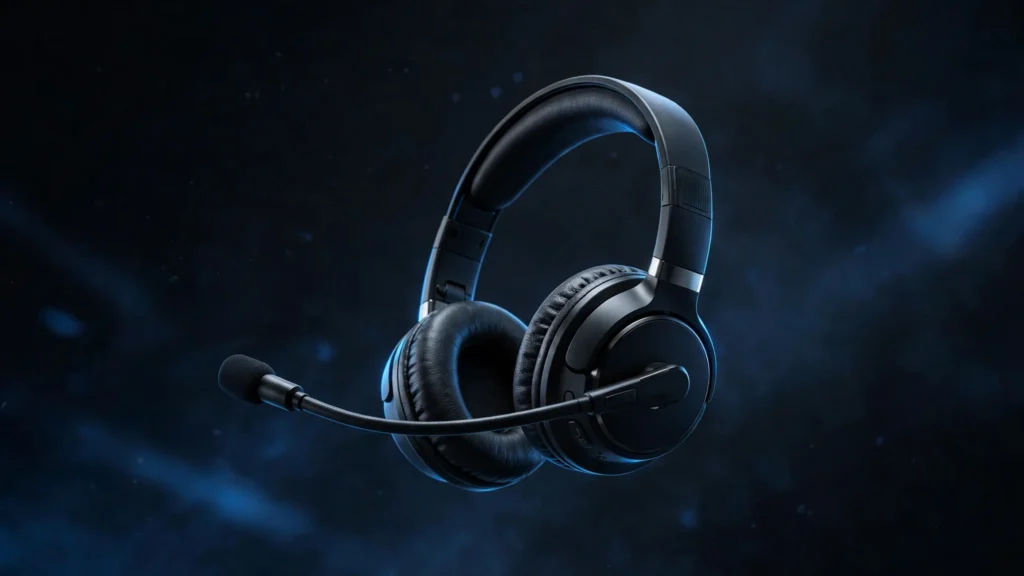
SoundMavericks’ picks are editorial analysis: we compared the leading professional call center headsets from Jabra, Poly and EPOS against live Amazon US listings for microphone quality, comfort, connectivity and durability. Specs below are manufacturer and listing figures, not invented numbers. Last updated October 2026.
Finding the best call center headset is a different job than buying headphones for music. Agents wear them for eight hours straight, supervisors deploy them by the dozen, and the person who matters most is not the one wearing it — it is the customer on the other end of the call. That flips the usual buying logic: microphone quality and all-day comfort outrank sound quality, and boom mics, USB dongles and busylights matter more than codecs and thumping bass.
One important distinction before the picks. This guide covers dedicated professional call center headsets — Jabra Evolve and Engage, Poly Voyager and Blackwire, EPOS/Sennheiser office models with boom mics and unified-communications certifications. If you are after consumer noise-cancelling headphones to wear in an office, that is a different product entirely — see our best noise cancelling headphones for work and call centers guide instead. Now — the professional picks.
The Best Call Center Headsets at a Glance
★ OUR PICK: Jabra Evolve2 75
An 8-microphone array with a hideaway boom arm, adjustable ANC and a busylight — the most complete professional wireless package here.
🎧 BEST MONO EARPIECE: Poly Voyager 5200 UC
Four adaptive mics plus WindSmart processing in a featherweight earpiece, with a USB dongle and charging case for desk-and-mobile agents.
📶 BEST DECT WIRELESS: Jabra Engage 75
A DECT base station with up to 490 feet of range and 5-device connectivity — built for desk-phone floors where Bluetooth cannot roam.
🔌 BEST WIRED USB: Jabra Evolve2 40
3-microphone call technology, a 360-degree busylight and memory-foam comfort on a simple USB cable — the wired sweet spot.
🔧 WIRED WORKHORSE: EPOS | Sennheiser SC 660 USB ML
An ultra noise-cancelling mic, brushed-aluminum and Vectran-reinforced build, and a 3-year warranty — made for the toughest contact centers.
💰 BUDGET PICK: Poly Blackwire 3220
PC wideband audio, a noise-cancelling mic and SoundGuard hearing protection on a wired USB headset — enterprise basics done right.
Quick Comparison
| Headset | Type | Connection | Talk time | Standout feature |
|---|---|---|---|---|
| Jabra Evolve2 75 | On-ear, duo | Bluetooth + USB dongle | Up to 24 hrs | 8-mic array, hideaway boom, ANC |
| Poly Voyager 5200 UC | Mono earpiece | Bluetooth + USB dongle | 7 hrs (+14 with case) | WindSmart, 20 g, voice commands |
| Jabra Engage 75 | Mono (duo avail.) | DECT + Bluetooth in base | 13 hrs | 490 ft range, 5-device base |
| Jabra Evolve2 40 | On-ear, duo | Wired USB | N/A (wired) | 3-mic tech, 360° busylight |
| EPOS | Sennheiser SC 660 USB ML | Binaural wired | Wired USB | N/A (wired) | Ultra NC mic, ActiveGard, 3-yr warranty |
| Poly Blackwire 3220 | On-ear, duo | Wired USB | N/A (wired) | Dynamic EQ, SoundGuard, fold-flat |
Best Overall: Jabra Evolve2 75

Key specs: 8-microphone array with hideaway boom arm · adjustable hybrid ANC + HearThrough · Bluetooth 5.2 with USB adapter · up to 36 hrs listening / 24 hrs talk · 197 g · busylight · on-ear detection · Teams/UC variants
The Evolve2 75 is the pick we would hand to an agent who spends their entire day on calls. Eight microphones — four analog, four digital MEMS — feed a beamforming array with a retractable boom arm that positions the capsule close to the mouth, which is the single biggest factor in call clarity. When you are done, the boom swings up out of the way for discreet wear between calls. Adjustable hybrid ANC handles the agent’s side of the noise, while a busylight on the earcup tells the open-plan office to leave you alone.
Connectivity is the full professional stack: Bluetooth 5.2 with a USB dongle in the box, so the PC sees a pre-paired, rock-solid connection instead of finicky built-in Bluetooth. Multipoint keeps a phone and laptop connected at once, on-ear detection pauses when you lift it off, and a fast-charge top-up buys hours of talk time from a short break. At 197 g it sits in the comfort sweet spot for all-day wear, and Jabra ships Teams-certified and UC variants so IT gets exactly the flavor it needs.
Pros: Best-in-class mic array for the money; ANC plus HearThrough; dongle-based USB connection; busylight; Teams and UC variants.
Cons: On-ear fit is not for everyone across a full shift; charging stand version costs extra; no 3.5mm fallback.
Best Mono Earpiece: Poly Voyager 5200 UC

Key specs: Mono in-ear earpiece · 4 adaptive mics + DSP · WindSmart wind-noise tech · up to 7 hrs talk · charging case adds up to 14 hrs · USB dongle in the box · Smart Sensors · voice answer/ignore
Not every call-center worker sits at a desk. For agents who split time between phone and PC, take calls on the move, or simply cannot stand a headband for eight hours, the Voyager 5200 UC is the classic answer. Four adaptive microphones and proprietary DSP cancel disruptive background noise, and six layers of WindSmart technology keep the voice clear even near open windows or in transit — Poly has been refining this formula since the Voyager Legend days.
The UC kit matters for desk work: the included USB dongle gives the PC integrated call controls for Teams, Zoom and RingCentral, while Smart Sensors answer calls when you put the earpiece on and transfer them when you take it off. Saying “answer” or “ignore” handles incoming calls hands-free. The listed unit (HP Poly 7K2F3AA) ships with the newer BT700 dongle, spare eartips, charging case and cable, so a single purchase covers desk, commute and home office.
Pros: Genuinely portable; excellent wind and noise rejection for its size; dongle + case included; hands-free voice controls.
Cons: 7-hour talk time needs the case for full-day coverage; mono sound is not for music; earpiece fit varies by ear.
Best DECT Wireless: Jabra Engage 75

Key specs: DECT wireless, up to 150 m / 490 ft range · connects up to 5 devices (desk phone, 2× softphone, 2× mobile) · up to 13 hrs talk · 90-min full charge, 40% in 30 min · mono and stereo variants · touchscreen base · busylight · PeakStop + IntelliTone 2.0 hearing protection
DECT is the wireless standard call centers were built on, and the Engage 75 is its flagship. Where Bluetooth tops out around 30 meters, the Engage 75 roams up to 150 meters (490 feet) from its base — agents can walk the floor, visit the break room and stay on the call. Jabra claims three times the user density of competing DECT systems with no loss in connection quality, which matters when a whole floor is on headsets at once.
The touchscreen base is the command center: it connects a desk phone, two softphones over USB, and two mobile devices over Bluetooth — five devices on one headset, switchable from the base. A directional noise-cancelling mic, busylight and Skype for Business Open Office certification cover the call-quality checklist, while PeakStop and IntelliTone 2.0 hearing protection guard ears across long shifts. Mono and stereo variants share the same base, so hot-desking floors can mix and match.
Pros: Unmatched roaming range; 5-device base station; serious hearing protection; hot-desk friendly.
Cons: Base station means it lives at one desk; mono variant is single-ear by design; premium positioning.
Best Wired USB Headset: Jabra Evolve2 40

Key specs: Wired USB-A (USB-C variant available) · 3-microphone call technology · 40 mm leak-tolerant speakers · passive noise cancellation · 360° busylight · memory-foam cushions · Teams/UC variants · 2-year warranty
Wired is not a compromise in call centers — it is a strategy. No batteries to die mid-shift, no pairing dropouts, no charging logistics across fifty desks. The Evolve2 40 is the wired headset we would deploy at scale: a 3-microphone call array that Jabra’s listing credits with cutting background conversation noise, 40 mm leak-tolerant speakers for clear voice reproduction, and memory-foam cushions with an angled design the listing says cancels substantially more ambient noise than the previous generation.
The busylight deserves a mention: Jabra enlarged it and made it visible from every angle, so it actually works as a do-not-disturb signal in open offices. Plug-and-play USB with Teams-optimized variants means IT can roll these out without a software project, and the two-year warranty keeps the total cost of ownership honest.
Pros: Zero battery anxiety; strong passive isolation; visible-from-anywhere busylight; easy fleet deployment.
Cons: Cable tethers you to the desk; no ANC; USB-A only on this listing (check the USB-C variant for newer laptops).
Best Wired Workhorse: EPOS | Sennheiser SC 660 USB ML
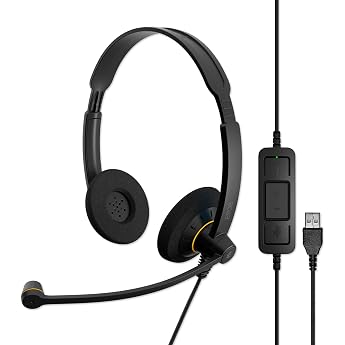
Key specs: Wired USB, binaural · ultra noise-cancelling mic + ANC for the wearer · EPOS Voice Clarity · ActiveGard hearing protection · brushed aluminum + stainless steel + Vectran-reinforced cable · in-line call control · proximity sensor · fold-flat earcups · 3-year international warranty
The SC 660 is the headset contact-center managers buy when they are tired of replacing headsets. Stainless-steel hinges, brushed-aluminum parts and Vectran-reinforced cabling defend against the daily abuse of shift changes — headbands stretched, cables snagged, boom arms adjusted fifty times a day. An ultra noise-cancelling microphone with EPOS Voice Clarity keeps speech crisp in noisy rooms, and unusually for a wired headset, it adds active noise cancellation for the wearer’s comfort.
ActiveGard acoustic-shock protection, an in-line call-control unit, a proximity sensor for automatic call handling, and a three-year international warranty round out the enterprise checklist. It is certified for Skype for Business and the major UC platforms, so it slots into existing infrastructure without drama.
Pros: Built like industrial equipment; ANC on a wired headset; 3-year warranty; serious hearing protection.
Cons: Heavier-duty build is not the lightest wear; wired only; overkill for casual home-office use.
Best Budget Pick: Poly Blackwire 3220

Key specs: Wired USB-A stereo · PC wideband + hi-fi stereo with Dynamic EQ · noise-cancelling mic · SoundGuard acoustic limiting · in-line call controls · lightweight metal headband · fold-flat earcups + carry case · 2-year global warranty
Outfitting a team on a budget does not have to mean outfitting them badly. The Blackwire 3220 sits at #22 in Amazon’s Computer Headsets category for a reason: PC wideband audio for calls, a noise-cancelling microphone, and Dynamic EQ that automatically switches between voice-optimized and hi-fi stereo tuning for music and multimedia. The in-line controls handle answer, end, hold, redial, mute and volume without touching the PC.
Poly’s SoundGuard technology limits exposure above 118 dBA, the metal headband survives daily wear, and the fold-flat earcups plus carry case make it genuinely portable. For bulk purchases, training rooms and first headsets, this is the sensible floor of the category.
Pros: Excellent value; Dynamic EQ for calls and music; SoundGuard protection; portable fold-flat design.
Cons: Wired only; no ANC; this listing is USB-A — confirm port type before buying for USB-C-only laptops.
Honorable Mentions
Jabra Engage 50 II. The wired member of the Engage family: 3-mic noise-cancelling technology on a USB cable with the Engage+ software’s real-time call analytics — background-noise levels and interruptions measured live. A strong pick for supervisors who want call-quality data, not just hardware.
Poly Voyager Focus 2 UC. For noisy call centers that want ANC plus a boom mic: hybrid ANC, a three-mic array and up to 25 hours of talk time in a duo over-ear design. It sits closer to consumer ANC territory, which is why it did not make the main list — but for loud floors it earns the mention.
How to Choose the Best Call Center Headset
Wired vs wireless. Wired USB headsets never die mid-shift, never drop a pairing and are cheaper to deploy by the dozen — the Evolve2 40, SC 660 and Blackwire 3220 all live here. Wireless (Bluetooth or DECT) buys freedom of movement: Bluetooth with a USB dongle is the flexible hybrid pick, while DECT is the call-center-native choice for roaming large floors. If your agents sit at fixed desks, wired wins on reliability and cost.
DECT vs Bluetooth. Bluetooth tops out around 30 meters and shares the crowded 2.4 GHz band with Wi-Fi; a USB dongle fixes most stability issues. DECT runs on its own dedicated band with up to 490 feet of range and far higher user density — purpose-built for call centers, which is why the Engage 75 uses it. Choose DECT for desk-phone floors and high-density offices; choose Bluetooth for hybrid and mobile workers.
Mono vs duo. Mono (single-ear) headsets keep one ear open to the room — agents hear colleagues and supervisors, and nothing covers the ear for eight hours. Duo (stereo) headsets block office noise and help concentration. Noisy open plans favor duo; collaborative floors favor mono. Our headset vs headphones explainer digs deeper into the terminology.
Microphone quality is the real spec. The customer hears the mic, not the drivers. Boom mics close to the mouth beat earpiece mics; multi-mic arrays with DSP beat single mics. Two different cancellations matter here: ANC quiets the agent’s ears, while ENC (environmental noise cancellation) strips background noise from the transmitted voice for the customer. In a call center, ENC is the one that protects your customer-satisfaction scores. If call clarity is your whole job, our earbuds for phone calls and headphones with a mic for clear calls guides cover the consumer side.
Comfort for 8-hour shifts. Weight is the headline number — under 150 g for mono, under 200 g for duo is the comfort zone — but clamping force and cushion material decide whether a headset hurts at hour six. Memory foam and leatherette beat hard plastic. If nothing on the head works for you, bone-conduction designs exist, but they are niche in call centers.
UC certification. “Certified for Microsoft Teams” or “Optimized for UC” means the headset’s call controls, mute status and firmware are tested against the platform — worth it when IT supports hundreds of seats. All six picks here carry UC or Teams variants.
Hearing protection. Eight hours of headset audio is an occupational-health question. Look for acoustic-shock protection (Poly SoundGuard, Jabra PeakStop/IntelliTone, EPOS ActiveGard) that limits sudden spikes and daily average exposure. This is genuinely more important than driver size.
Call Center Headsets vs Consumer Headphones
These are different tools for different jobs. A consumer ANC headphone (Sony, Bose) is tuned for music and built for one owner; a professional call center headset is tuned for voice, built for boom-mic clarity, UC integration, busylights and fleet deployment. Consumer models usually hide the mic in the earcup — fine for a quiet home office, bad for a noisy floor. If your “call center” is a quiet spare room and you mostly want music between meetings, the consumer route is cheaper and more comfortable — our best noise cancelling headphones for work and call centers guide covers exactly that scenario, and our best office headsets roundup sits in between.
Best Call Center Headset FAQs
Is a wired or wireless call center headset better?
Wired is more reliable and cheaper to deploy: no batteries, no pairing, no charging logistics. Wireless is better for agents who move — Bluetooth with a USB dongle for hybrid workers, DECT for large floors with desk phones. For fixed-desk call centers, wired USB headsets like the Evolve2 40 or SC 660 are the pragmatic default.
What is DECT, and is it better than Bluetooth for call centers?
DECT is a dedicated wireless standard for voice with up to 490 feet of range and very high user density, built specifically for call centers. Bluetooth reaches about 100 feet and shares spectrum with Wi-Fi. DECT wins for roaming desk-phone floors; Bluetooth wins for flexibility with phones and laptops. The Jabra Engage 75 is the DECT pick in this guide.
Should I get a mono or duo call center headset?
Mono keeps one ear open to the room — better for collaborative floors and supervisor check-ins, and lighter for long shifts. Duo blocks office noise and aids concentration in loud open plans. There is no universal answer; match it to your floor’s noise level and culture.
How long should a call center headset last?
A quality wired headset typically survives two to four years of daily use; wireless models are limited by battery health, usually two to three years before talk time degrades. Build quality matters more than price here — metal headbands and reinforced cables (like the SC 660’s Vectran cabling) outlast all-plastic designs, and longer warranties (two to three years on the picks above) signal manufacturer confidence.
Do I need a dedicated call center headset for working from home?
Not necessarily. If your home is quiet, a good consumer noise-cancelling headphone with a decent mic handles calls fine — see our best noise cancelling headphones for work and call centers guide. You need a dedicated call center headset when the mic matters more than the music: noisy households, professional voice work, or UC-platform integration with your employer’s systems.
What is the difference between a call center headset and office headphones?
A call center headset has a boom or close-proximity microphone tuned for voice, UC certifications, and often a busylight; it is built for talking all day. Office headphones prioritize listening — music, ANC, comfort — with the mic as a secondary feature. Our headset vs headphones guide breaks down the distinction in full.

I am the founder of Sound Mavericks, where I provide the polite truth about audio equipment. I started this site because consumer electronics reviews are often too technical. Instead of using a silent lab, I test headphones, earbuds, and Bluetooth speakers in the real world – like on a noisy subway or in a busy coffee shop.
To stay independent, I buy my own review units (mostly from the United States) rather than accepting free gifts from brands. Once I finish testing a product, I sell it locally to our community. My goal is to help you understand sound quality, active noise cancellation (ANC), and battery life without the marketing hype.