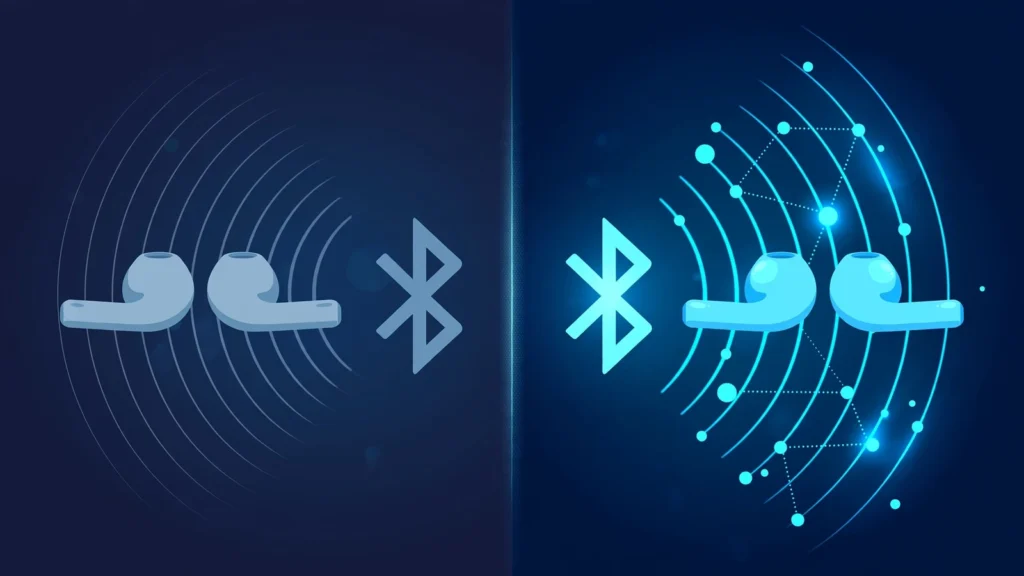
Bluetooth 5.4 has been showing up on spec sheets since 2023, and headphone shoppers keep asking the same question: is it actually better than 5.3 for audio, or just a bigger number? Here’s the short version SoundMavericks gives everyone who asks: Bluetooth 5.4 is not a sound-quality upgrade over 5.3. Its headline features — Periodic Advertising with Responses and encrypted advertising data — were designed for electronic shelf labels and giant networks of tiny low-power devices, not for the earbuds in your pocket. For headphone and earbud buyers, 5.3 remains excellent, 5.4 adds modest efficiency and security gains, and the things that actually change what you hear — the codec, the drivers, and the tuning — sit entirely outside the version number.
This guide is the engineering truth about both versions: what changed, what didn’t, and the practical verdict on which one should influence your next purchase.
The 30-second answer
- Bluetooth 5.3 (2021) refined low-energy connections: steadier links, better power behavior, and improved periodic advertising. It arrived alongside the rollout of LE Audio, so most 5.3 headphones and earbuds already support the features buyers care about.
- Bluetooth 5.4 (2023) adds communication features for large networks of low-power devices — PAwR, encrypted advertising data, new GATT security levels. Almost none of it changes music playback, calls, or latency on headphones.
- Sound quality: identical potential. Both versions can carry LE Audio’s LC3 codec and Auracast; the codec negotiated between your phone and your earbuds decides the audio, not the version number.
- Speed: no change. Bluetooth 5.4 is not faster than 5.3.
- The buyer rule: never pick the worse headphone because its box says 5.4. When two products are otherwise equal, take 5.4 for slightly better efficiency and future-proofing.
What Bluetooth 5.3 brought to the table
Bluetooth 5.3, adopted in mid-2021, was an efficiency and reliability release for Bluetooth Low Energy. Its four headline features, in plain English:
- Connection Subrating: lets two connected devices switch between fast and slow connection intervals without renegotiating — handy when a device toggles between “send data now” and “mostly idle.” Better real-world power behavior.
- Periodic Advertising Enhancement: more efficient broadcasting of periodic data — part of the groundwork for how broadcast-style features like Auracast share the airwaves.
- Channel Classification Enhancement: smarter handling of interference on the crowded 2.4 GHz band, for steadier connections.
- Encryption Key Size Control: tighter control over encryption key sizes for more consistent security negotiation between devices.
Timing mattered more than any single feature. LE Audio — the Bluetooth SIG’s next-generation audio framework built around the LC3 codec — was completed in 2022 on the Bluetooth 5.2-and-later foundation, so 5.3 hardware is fully capable of LE Audio, LC3, and Auracast. If a 5.3 earbud lacks Auracast, that’s a product decision, not a Bluetooth limitation.
What Bluetooth 5.4 adds
Bluetooth 5.4, adopted in early 2023, kept the same radio and added four features aimed squarely at large networks of low-power devices:
- PAwR (Periodic Advertising with Responses): devices can receive scheduled broadcasts and send responses back without forming a traditional connection. It’s two-way communication for devices that were previously receive-only — the headline 5.4 feature.
- Encrypted Advertising Data: advertising packets can now be broadcast securely without first establishing a connection — important when thousands of devices are shouting into the same airspace.
- LE GATT Security Levels Characteristic: a standardized way for devices to declare and negotiate security levels.
- Advertising Coding Selection: hosts can choose the coding scheme used for advertising data, balancing range against throughput.
The Bluetooth SIG’s headline use case was electronic shelf labels — tens of thousands of supermarket price tags that need secure, synchronized, battery-sipping updates. PAwR is genuinely clever engineering. It is also almost entirely irrelevant to how your earbuds play music. None of the 5.4 features touch the audio path: no new codec, no new bitrate, no new latency figure for headphones.
Bluetooth 5.3 vs 5.4: the differences that matter
| Feature | Bluetooth 5.3 | Bluetooth 5.4 |
|---|---|---|
| Released | 2021 | 2023 |
| Design focus | LE efficiency, connection reliability, power management | Secure, scalable LE communication for large device networks |
| Headline features | Connection Subrating, Periodic Advertising Enhancement, Channel Classification Enhancement, Encryption Key Size Control | PAwR, Encrypted Advertising Data, LE GATT Security Levels, Advertising Coding Selection |
| Max data rate | 2 Mbps (LE 2M PHY) | 2 Mbps (LE 2M PHY) — no speed increase |
| LE Audio / LC3 support | Yes | Yes — identical |
| Auracast support | Yes (device-dependent) | Yes (device-dependent) — identical |
| Sound quality impact | None by itself | None by itself — the codec decides |
| Power efficiency | Very good | Slightly better in complex, networked environments |
| Security | Strong | Stronger advertising-layer security |
| Best for | Headphones, earbuds, everyday devices | Headphones and earbuds, plus IoT, shelf labels, sensor networks |
Does Bluetooth 5.4 improve sound quality?
Short answer: no. Sound quality over Bluetooth is decided by three things, in order: (1) the headphone’s drivers and tuning, (2) the quality of your source audio, and (3) the codec negotiated between your phone and your headphones. The Bluetooth version is the radio underneath all of it — it carries whatever codec both ends agree on.
Both 5.3 and 5.4 can run LE Audio’s LC3 codec, which delivers better-than-SBC quality at roughly half the bitrate with 20–30 ms latency, and both can support Auracast broadcast audio. Whether a given earbud actually does is a product decision. We cover which codecs genuinely move the needle in our Bluetooth audio codecs guide and which devices do Auracast right in our best Auracast headphones roundup — plus the full picture of what Auracast is in our Auracast explainer.
Marketing will sometimes imply that 5.4 equals better sound. It doesn’t. A well-tuned Bluetooth 5.3 earbud on a good codec will outperform a mediocre 5.4 earbud every time.
What actually matters more than the version number
If the spec sheet says “Bluetooth 5.3” or “Bluetooth 5.4,” here’s what to read instead:
- Codec support. LC3 for LE Audio efficiency and 20–30 ms latency, aptX Adaptive or aptX Lossless for higher-fidelity Android playback, LDAC for hi-res Android listening. The codec is the audible upgrade; the version number is not.
- Auracast support. If broadcast audio at airports, gyms, and public venues — or hearing-aid compatibility — matters to you, check for Auracast explicitly. It’s a feature flag on both 5.3 and 5.4 devices, never guaranteed by the version.
- Chip implementation. Two earbuds can both say “Bluetooth 5.3” and behave very differently. Antenna design, the chipset, and the manufacturer’s software stack decide real-world stability far more than the spec number on the box.
- Multipoint. Connecting to your phone and laptop at the same time is a product feature, not a version feature — see our Bluetooth multipoint explainer for how it works.
Real Bluetooth 5.4 headphones and earbuds in 2026
Bluetooth 5.4 adoption in audio is ramping but still selective. The clearest examples on the market:
- The 5.4 reference earbud: the Samsung Galaxy Buds3 Pro lists Bluetooth 5.4 on its spec sheet, paired with a dual-driver design (10.5 mm dynamic plus 6.1 mm planar), adaptive ANC, and Galaxy AI features. It’s the easiest way to hear what a current-generation 5.4 earbud sounds like — and Samsung’s newer lineup builds on the same platform (see our Galaxy Buds4 Pro review).
- The 5.4 over-ear flagship: the Bose QuietComfort Ultra Headphones (2nd Gen) combines Bluetooth 5.4 with the full aptX Adaptive family, including aptX Lossless via Snapdragon Sound — a good example of version 5.4 and strong codec support in one package.
- Also on 5.4: the Nothing Ear (3) and a growing number of 2026 releases list Bluetooth 5.4 on their spec sheets.
And the honest counterpoint: plenty of excellent 2026 flagships still ship Bluetooth 5.3 — and sound superb. The version number is not the quality signal. Judge the headphone, not the digits.
The verdict: should you care?
Here’s SoundMavericks’ practical guidance, stripped of the marketing:
- Buying new in 2026, two products otherwise equal: take 5.4. You get modest efficiency and security gains plus more future-proof hardware. It’s a tiebreaker, not a reason.
- Choosing between a better 5.3 headphone and a worse 5.4 headphone: take the better headphone, every time. Drivers, tuning, ANC, and codec support will always outweigh the version number in what you actually hear.
- Already own 5.3 gear: there is no audio reason to upgrade for the version alone. Your 5.3 earbuds support the same LE Audio, LC3, and Auracast capabilities as 5.4 equivalents.
The bigger-number instinct is understandable — but with Bluetooth 5.4, the real story is what it did for supermarkets and sensor networks, not for your music.
Frequently Asked Questions
Is Bluetooth 5.4 faster than 5.3?
No. Bluetooth 5.4 is not a speed upgrade: both versions top out at 2 Mbps over the LE 2M PHY. The 5.4 specification focused on communication efficiency, advertising-layer security, and supporting larger networks of low-power devices — not on raw throughput.
Does Bluetooth 5.4 improve sound quality?
Not by itself. Sound quality is decided by the headphone’s drivers and tuning, the quality of the source audio, and the codec negotiated between your phone and your headphones. Both 5.3 and 5.4 can run the same codecs, including LE Audio’s LC3.
Do both Bluetooth 5.3 and 5.4 support LE Audio and Auracast?
Yes. LE Audio was built on the Bluetooth 5.2-and-later foundation, so both 5.3 and 5.4 hardware can fully support LE Audio, the LC3 codec, and Auracast broadcast audio. Whether a specific device does is a manufacturer decision — check for Auracast explicitly rather than trusting the version number.
What is PAwR in Bluetooth 5.4?
PAwR stands for Periodic Advertising with Responses. It lets devices receive scheduled broadcasts and send responses back without forming a traditional connection — two-way communication for devices that were previously receive-only. It was designed for networks of low-power devices like electronic shelf labels, not for headphones.
Which earbuds have Bluetooth 5.4?
Confirmed examples include the Samsung Galaxy Buds3 Pro and the Nothing Ear (3), and adoption is growing in 2026 releases. Over-ear, the Bose QuietComfort Ultra Headphones (2nd Gen) ship with Bluetooth 5.4. Always verify on the spec sheet — many listings emphasize the version while the features that matter more (codecs, Auracast, multipoint) need a separate check.
Should I upgrade my Bluetooth 5.3 headphones to 5.4?
Not for the version number alone. Your 5.3 headphones support the same audio capabilities — the same codecs, LE Audio, and Auracast — as 5.4 equivalents. Upgrade when a new headphone offers better sound, better ANC, or features you actually want, not when it offers a bigger Bluetooth digit.

I am the founder of Sound Mavericks, where I provide the polite truth about audio equipment. I started this site because consumer electronics reviews are often too technical. Instead of using a silent lab, I test headphones, earbuds, and Bluetooth speakers in the real world – like on a noisy subway or in a busy coffee shop.
To stay independent, I buy my own review units (mostly from the United States) rather than accepting free gifts from brands. Once I finish testing a product, I sell it locally to our community. My goal is to help you understand sound quality, active noise cancellation (ANC), and battery life without the marketing hype.