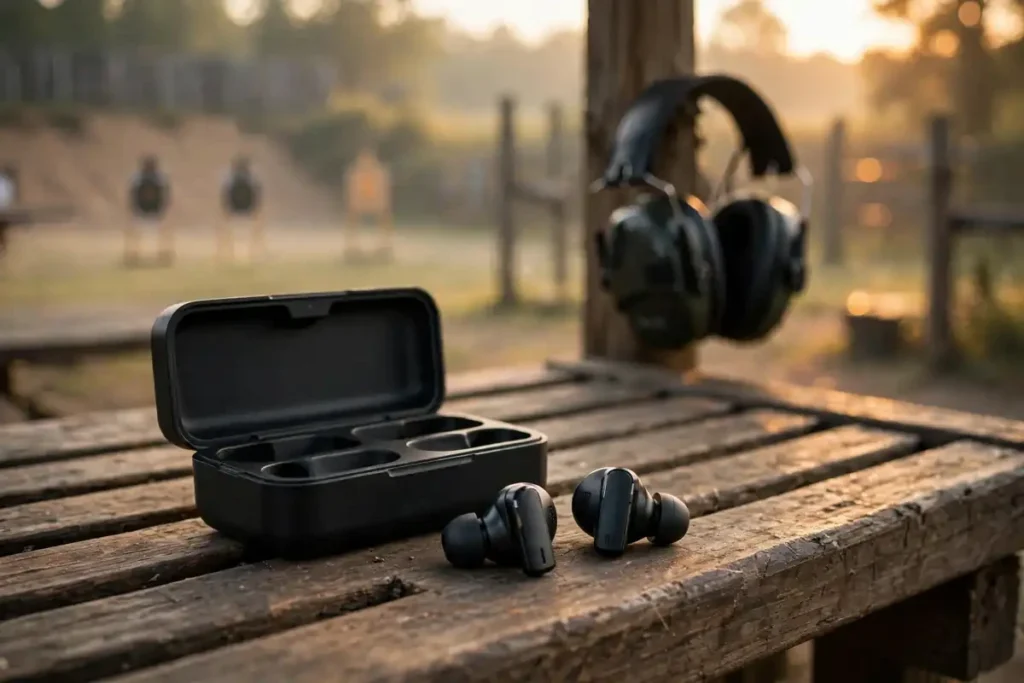
Let’s get the obvious out of the way first: “shooting earbuds” has nothing to do with music. Searchers typing best shooting earbuds want electronic hearing-protection earbuds — the kind that amplify range commands and conversation, then slam the door shut on gunshot noise in milliseconds. We’re SoundMavericks, an audio site, and we’re covering this from the hearing-protection angle: NRR ratings, sound-activated compression, seal, and fit — the things that actually keep your ears intact at the range.
Gunfire runs roughly 140–175 dB depending on the firearm, and permanent hearing damage starts around 140 dB from a single unprotected shot. Every pick below is an in-ear electronic (or passive) device built specifically for that job — Bluetooth for music is a bonus feature, not the point. We’ve ranked seven, from the everyday range staple to a custom-molded passive pair with the highest NRR on this list.
Our Top Picks at a Glance
| Earbud | NRR Rating | Standout Feature | Best For |
|---|---|---|---|
| Walker’s Silencer 2.0 | 24 dB | Sound-activated compression + app control | Best overall for the range |
| AXIL GS Extreme 3.0 | 29 dB SNR* | Hearing enhancement + switchable modes | Best for hunting |
| ISOtunes Sport Advance 2.0 | 26 dB | 8x ambient amplification, MIL-STD build | Toughest for hard use |
| Walker’s Suppressor Bluetooth | 25 dB | 36-hour total battery, low-profile fit | All-day battery life |
| AXIL XCOR PRO 2 | 29 dB SNR* | True-wireless fit, ANR hear-through | Best true wireless |
| GLORYFIRE Bluetooth | 26 dB | 3 sound modes, IP67 waterproof | Best value |
| Decibullz Percussive | 31 dB | Custom-molded thermoplastic, no batteries | Best passive pick |
*AXIL quotes SNR (the European standard) rather than NRR. The two scales aren’t directly interchangeable, so treat these ratings as manufacturer claims rather than a head-to-head with the NRR figures.
1. Walker’s Silencer 2.0 — Best Overall Shooting Earbuds

The Walker’s Silencer 2.0 is the default recommendation for a reason: it’s the electronic earbud that shooting ranges, instructors, and hunters keep coming back to. The core tech is sound-activated compression (SAC) — the onboard mics amplify safe sounds like range commands and conversation, then compress anything above the danger threshold down in a fraction of a second. Its listed 24 dB NRR covers outdoor shooting comfortably, and the rechargeable form factor with the free Walker’s Link app gives you four sound modes (Universal, High Frequency, Power Boost, Clear Voice) to tune for different environments.
Our read is that this is the most complete package for a typical range-goer: Bluetooth for streaming between strings, dynamic wind-noise reduction that actually matters on outdoor ranges, and a low-profile in-ear design that doesn’t fight your rifle stock or shooting glasses. The app-controlled mode switching is the differentiator — Clear Voice mode during instruction, Universal during general range time. Twenty-four dB is the one compromise: for indoor ranges with heavy calibers, consider doubling up with muffs, as OSHA guidance recommends derating NRR in real-world use.
Key specs: 24 dB NRR; sound-activated compression; 4 sound modes via Walker’s Link app; Bluetooth connectivity; dynamic wind-noise reduction; rechargeable with case; touch controls.
Our take: If you only buy one pair of electronic shooting earbuds, this is the one — the best balance of proven protection, situational awareness, and everyday usability.
Pros: proven track record with shooters; app-customizable sound modes; wind-noise reduction for outdoor ranges; low-profile fit with rifle stocks. Cons: 24 dB NRR is modest for indoor magnum calibers; rechargeable batteries need case management.
2. AXIL GS Extreme 3.0 — Best for Hunting

AXIL is the brand that keeps showing up in hunting forums, and the GS Extreme 3.0 is its flagship. What makes it a hunter’s earbud rather than a range earbud is the hearing enhancement side of the equation: beyond compressing gunshots, it amplifies quiet sounds — twigs snapping, game movement — with switchable modes for hearing enhancement, Bluetooth audio, and combined use. AXIL’s hearing-aid heritage shows here; the amplification is more natural and nuanced than the typical “loud everything” approach of budget electronic plugs.
AXIL advertises up to a 29 dB SNR (the European single-number rating) and up to 40 hours in hearing-enhancement mode — 20 hours of Bluetooth playback — with Bluetooth 5.3 and IP65/IP64 water and dust resistance. For a day in the stand or still-hunting, that’s a compelling mix: all-day runtime, weather resistance, and the kind of directional hearing that electronic muffs simply can’t deliver in-ear. It also works fine at the range, but at its premium positioning, its hunting-first design is where the value lives.
Key specs: 29 dB SNR (manufacturer claim); SonicShieldX sound compression; 3 modes (enhancement, Bluetooth, combined); Bluetooth 5.3; up to 40 hours enhancement / 20 hours Bluetooth; IP65/IP64; stabilizing tips.
Our take: The pick for hunters who want protection that doubles as an enhancement tool — the most sophisticated sound processing on this list, purpose-built for the field.
Pros: best-in-class hearing enhancement for hunting; long battery life; weather-resistant; multiple secure-fit tip options. Cons: AXIL quotes SNR rather than NRR, complicating direct comparison; premium positioning.
3. ISOtunes Sport Advance 2.0 — Toughest Shooting Earbuds
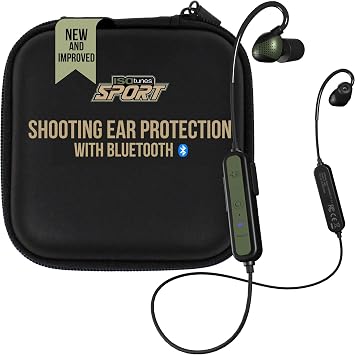
If your shooting life involves dust, rain, drops, and long days — tactical training, outdoor matches, farm pest control — durability stops being a luxury and the ISOtunes Sport Advance 2.0 takes the lead. It’s tested to MIL-STD 810H drop/shock specs and carries an IP67 dust/waterproof rating, which is the strongest protection-against-the-elements claim on this list. The listed 26 dB NRR is also the highest NRR of any electronic pick here, backed by Tactical Sound Control technology and up to 8x ambient sound amplification — enough to hear whispered commands while shots get flattened.
The practical spec that sold us is battery life: 15+ hours of continuous audio streaming, up to 24 hours in Tactical Sound Control mode, plus a charging case and replaceable memory-foam tips. That’s multiple full range days without touching a charger. The 8x amplification does noticeably more for situational awareness than the typical 4–5x on budget models, and the foam tips — four sizes included — are key to actually achieving the rated 26 dB.
Key specs: 26 dB NRR (ANSI-rated); 8x ambient amplification; MIL-STD 810H; IP67; 15+ hours streaming / 24 hours protection mode; Bluetooth; memory-foam tips.
Our take: The workhorse pick — if your earbuds will live in a range bag and get abused, this is the one built to survive it while delivering top-tier NRR.
Pros: highest NRR among electronic picks; genuinely rugged build; excellent battery life; strong amplification for awareness. Cons: bulkier than true-wireless options; premium positioning.
4. Walker’s Suppressor Bluetooth — Best Battery Life

The Walker’s Suppressor takes the brand’s electronic protection formula and stretches the battery to 36 hours total — a full weekend of shooting on one case charge, and the best endurance on this list. Its listed 25 dB NRR sits a notch above the Silencer 2.0’s 24 dB, and the low-profile design with locking fins is explicitly built to stay put under active movement and to sit flush enough that rifle stocks aren’t an issue.
Like its sibling, it runs through the Walker’s Link app for sound-mode control, with sound enhancement for conversation and compression for impulse noise. The waterproof build makes it a solid crossover for outdoor use. The trade-off versus the Silencer 2.0 is features: you get fewer sound modes and no dedicated Clear Voice equivalent, so it’s the simpler, longer-running sibling rather than the smarter one. For all-day classes, multi-day training courses, or shooters who just hate charging things, that simplicity-plus-endurance is exactly the right trade.
Key specs: 25 dB NRR; 36-hour total battery (buds + case); Bluetooth; Walker’s Link app; sound-activated compression; locking-fin fit; waterproof design.
Our take: Choose this over the Silencer 2.0 if endurance is your priority — set it and forget it for an entire shooting weekend.
Pros: class-leading 36-hour total battery; 25 dB NRR; secure locking-fin fit; low-profile for rifle stocks. Cons: fewer sound modes than the Silencer 2.0; larger case footprint.
5. AXIL XCOR PRO 2 — Best True Wireless

The AXIL XCOR PRO 2 is the current-generation answer for shooters who want a completely cable-free form factor. The standout addition over earlier AXIL earbuds is ANR (active noise reduction) in hear-through mode — it actively filters background noise while passing speech through, layered on top of the impact compression that handles gunshots. Combined with AXIL’s SonicShieldX sound management and a 6.5mm dynamic driver for better Bluetooth audio, it’s the most “consumer earbud”-like experience on this list without giving up the protection job.
The redesigned lower-profile shell sits deeper and more discreetly, which matters for glasses and hat compatibility, and the charging case delivers four full recharges with an LED readout so you’re never guessing. AXIL advertises up to a 29 dB SNR for the XCOR line. The honest caveat — same as with the GS Extreme 3.0 — is that SNR isn’t NRR, so direct comparison with the Walker’s and ISOtunes ratings requires a grain of salt. What it offers instead is the most modern feature set: ANR, a refined fit, and audio quality that doesn’t feel like an afterthought.
Key specs: 29 dB SNR (manufacturer claim); ANR hear-through mode; SonicShieldX compression; 6.5mm dynamic driver; Bluetooth 5.x; charging case with 4 recharges and LED readout; low-profile fit.
Our take: The tech-forward pick — if you want your hearing protection to feel like a modern pair of wireless earbuds, this is the one.
Pros: newest tech with ANR hear-through; discreet low-profile fit; good music audio for a protection device; charging case with battery readout. Cons: SNR vs NRR complicates comparisons; premium price tier.
6. GLORYFIRE Bluetooth — Best Value Shooting Earbuds
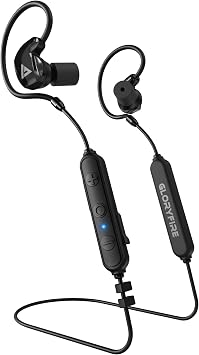
Not everyone needs app control and hearing-aid-grade processing — some shooters just need solid protection that doesn’t cost a fortune. GLORYFIRE’s Bluetooth earbuds list a 26 dB NRR, matching the ISOtunes rating, with three practical sound modes (Clear Voice, Ambient, Quiet), smart compression, and an IP67 waterproof build. Twelve hours per charge with USB-C fast charging covers any single range day.
What we like at this tier: the three modes are genuinely useful rather than marketing padding — Quiet mode maximizes protection for indoor lanes, Ambient keeps you aware outdoors, and Clear Voice is the one you’ll live in at a social range day. The foam-tip fit kit matters here because budget earbuds stand or fall on seal; the multiple sizes help you actually hit the rated NRR. You give up Bluetooth audio refinement and app-based fine-tuning, but for the protection-per-dollar ratio, this is the hardest pick on the list to argue against.
Key specs: 26 dB NRR; 3 sound modes (Clear Voice, Ambient, Quiet); smart compression; 12-hour battery with USB-C; IP67; Bluetooth; foam-tip fit kit.
Our take: The smart buy for budget-conscious shooters — NRR that matches flagship models without the flagship price.
Pros: excellent protection-per-dollar; useful 3-mode system; IP67 and USB-C; long per-charge runtime. Cons: less refined audio and no app tuning; comfort depends heavily on tip choice.
7. Decibullz Percussive — Best Passive Shooting Earplugs

Sometimes electronics are the wrong answer: dead batteries, dead electronics, and a price tag you don’t want to risk in mud and rain. The Decibullz Percussive earplugs are the passive counterpoint on this list — thermoplastic plugs you heat in water and mold to your exact ear shape, fitted with percussive impulse filters that mechanically block gunshot-level sound while letting low-level sound (conversation) pass. No batteries, nothing to charge, nothing to break — and a listed 31 dB NRR, the highest rating on this list.
Our view: these are the perfect backup pair, the budget pair, or the “double-up” pair to wear under electronic muffs at indoor ranges. The custom mold is the real story — getting a perfect seal is what turns an NRR rating from a lab number into real protection, and a mold you made from your own ear canal is as close to a perfect seal as consumer earplugs get. You lose amplification and Bluetooth entirely, so they’re a one-job device. But it’s a job they do better, on paper, than everything else here.
Key specs: 31 dB NRR (highest on this list); thermoplastic custom-moldable; percussive impulse filters; no batteries required; reusable; made in the USA.
Our take: The no-compromise passive option — maximum rated protection, zero electronics, and the best fit guarantee of any plug on this list.
Pros: highest NRR rating here; custom-molded fit; nothing to charge or break; doubles well under muffs indoors. Cons: no sound amplification or Bluetooth; molding process takes a few minutes of effort.
Buying Guide: How to Choose Shooting Earbuds
NRR vs SNR — read the right number
NRR (Noise Reduction Rating) is the US standard you’ll see on American-made protection; SNR (Single Number Rating) is the European equivalent. They measure similar things on different scales and aren’t directly interchangeable, so compare NRR to NRR when you can. As a rule of thumb: look for 24 dB+ for outdoor shooting and 28 dB+ (or doubling up) for indoor ranges, where walls reflect blast energy back at you. And remember that lab NRR assumes a perfect seal — OSHA guidance effectively derates it in the real world, so a higher rating plus a good seal beats a high rating alone. For context on how decibel levels translate to real hearing risk, see our breakdown of how many decibels hearing protection actually blocks.
Electronic vs passive
Electronic earbuds use microphones and fast compression circuits to amplify safe sounds (conversation, range commands) and crush impulse noise above roughly 85 dB. They’re the right choice for instructors, hunters, and social range days. Passive plugs (like the Decibullz) simply block — quieter to converse through, but simpler, cheaper, and immune to dead batteries. Many serious shooters own both: electronics for the range, passive plugs as backup or for doubling up under muffs indoors.
Fit and seal matter more than features
An electronic earbud with a poor seal protects worse than a well-sealed cheap plug — sound leaks around the tip and the NRR number becomes fiction. Prioritize multiple tip sizes, foam tips for maximum seal (they compress and expand in your canal), and molded options if your ear canals are hard to fit. This is doubly true for smaller ears: if standard tips never seal for you, our guide to earbuds for small ears covers fit strategies that apply to shooting plugs too.
Battery reality check
Range days run long. Rechargeable models typically deliver 8–15 hours of active use plus case reserves — fine for a day, risky for a multi-day course if you forget the case. If you’re doing all-day classes or weekend training, the 36-hour Walker’s Suppressor or the 40-hour enhancement mode on the AXIL GS Extreme 3.0 buys real margin. For true set-and-forget reliability, passive plugs never die mid-session.
Bluetooth is a bonus, not a requirement
Streaming music between strings is nice, but evaluate these devices as protection first. A higher NRR with no Bluetooth beats a lower NRR with great Bluetooth every time your ears are on the line. That said, if you’ll also wear them for yard work or the workshop — ISOtunes built its whole brand on that crossover — Bluetooth earns its keep.
Frequently Asked Questions
Are shooting earbuds actually safe for your hearing?
Yes — when properly fitted and matched to the environment. Electronic shooting earbuds use fast sound-activated compression to reduce gunshot impulse noise (which can hit 140–175 dB) down to safer levels, while amplifying conversation and range commands. Safety depends on two things: an NRR rating adequate for your setting and a proper seal in the ear canal. A poorly fitted 26 dB earbud can protect less than a well-fitted 24 dB one.
What NRR do I need for shooting?
Aim for 24 dB NRR or higher for outdoor shooting, and 28 dB or higher — or earbuds doubled with earmuffs — for indoor ranges, where reflected blast energy raises exposure. Keep in mind that lab-rated NRR assumes a perfect seal; real-world protection is typically lower, so more NRR headroom is always better.
Are electronic earbuds better than earmuffs for shooting?
Each has advantages. Earbuds don’t interfere with rifle stocks, cheek welds, or shooting glasses, stay cooler in summer, and pack smaller. Earmuffs can offer slightly higher protection and are easier to put on and take off. Many experienced shooters use both: electronic earbuds for outdoor rifle work and hunting, and muffs (or both together) for loud indoor ranges.
Can I use regular noise-cancelling earbuds at the shooting range?
No. Consumer ANC earbuds (like AirPods Pro or Sony WF models) are designed for steady background noise — engines, office hum — and are not rated to stop gunshot impulse noise. They have no NRR rating, and their microphones and drivers aren’t built for 150+ dB impulses. Only use hearing protection with a real NRR (or SNR) rating at the range.
How do electronic shooting earbuds work?
Tiny microphones pick up ambient sound and amplify safe-level audio (voices, range commands) through the speaker. When the circuit detects impulse noise above roughly 85 dB, it compresses or shuts off the output within milliseconds — fast enough to blunt a gunshot — then instantly restores amplification afterward. It’s electronic reflexes, not just a physical barrier.

I am the founder of Sound Mavericks, where I provide the polite truth about audio equipment. I started this site because consumer electronics reviews are often too technical. Instead of using a silent lab, I test headphones, earbuds, and Bluetooth speakers in the real world – like on a noisy subway or in a busy coffee shop.
To stay independent, I buy my own review units (mostly from the United States) rather than accepting free gifts from brands. Once I finish testing a product, I sell it locally to our community. My goal is to help you understand sound quality, active noise cancellation (ANC), and battery life without the marketing hype.