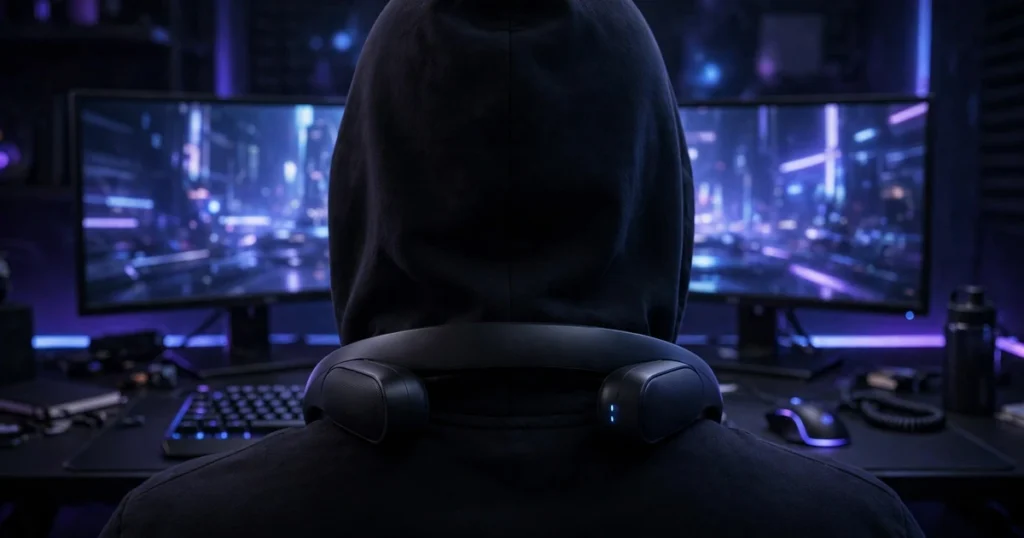
A neckband speaker is the gaming audio setup most players have never considered — and for a specific kind of gamer, the most comfortable one available. Instead of clamping drivers over your ears, a wearable speaker rests on your shoulders and fires sound upward, creating a personal sound zone that follows you from desk to kitchen. No ear fatigue after four-hour sessions, no headset hair, and you can still hear the doorbell or your kids.
The tradeoffs are real: neck speakers leak sound at higher volumes, they cannot match a sealed headset for directional precision, and Bluetooth models add latency you must manage. Our ranking is research-based — manufacturer specs, live Amazon listing data, and third-party review coverage, scored on gaming audio, latency, mic quality, comfort, and value. This is a specification-and-coverage ranking, not hands-on testing.
Updated October 2026 — our #1 pick is the Panasonic SoundSlayer SC-GN01.
Comparison Table
| Product | Gaming highlight | Latency angle | Battery | Mic | Rating |
|---|---|---|---|---|---|
| Panasonic SoundSlayer SC-GN01 | Gaming-tuned modes (RPG/FPS/Voice) | Wired (zero delay) | Wired (USB powered) | Echo-canceling mic | 9.1/10 |
| Sony BRAVIA Theatre U (HT-AN7) | Dolby Atmos spatial audio | Wired low-latency option | 12 hours | Built-in mic | 8.9/10 |
| Sony SRS-NB10 | Best mic for squad chat | Standard Bluetooth | 20 hours | Voice Pickup mic + mute | 8.6/10 |
| Avantree Torus NB05 | aptX Low Latency codec | aptX Low Latency codec | ~8 hours | Built-in mic | 8.3/10 |
| Monster Boomerang Petite | Low latency; 15h battery | Low Latency (listing) | 15 hours | Built-in mic | 8.2/10 |
| HomeSpot JY508 | Budget; 60ms latency claim | 60ms (listed) | 12 hours | Built-in mic | 7.9/10 |
Quick Overview
The Panasonic SoundSlayer SC-GN01 is the only pick built for gaming — genre-tuned modes and a wired connection with zero wireless latency. The Sony BRAVIA Theatre U is the premium alternative with Dolby Atmos spatial audio for cinematic single-player games. Chat-heavy players should look at the Sony SRS-NB10 for its best-in-class mic, while the Avantree Torus leads on wireless latency via aptX Low Latency. The Monster Boomerang Petite and HomeSpot JY508 cover the budget end.
1. Panasonic SoundSlayer SC-GN01 — Best Overall for Gaming

Key specs: TRUE MAGESS 4-channel 3D sound · Gaming modes (RPG, FPS, Voice) · Cinema/Music/Stereo modes · Wired 3.5mm (USB powered) · Echo-canceling mic · Ergonomic shoulder band
The SoundSlayer is the only neck speaker on this list designed for gaming first. Its headline feature is TRUE MAGESS — 4-channel surround processing that places game audio around you, including overhead cues — and its three gaming modes are genuinely purpose-built: RPG widens the soundstage, FPS sharpens positional detail like footsteps, and Voice lifts dialogue clarity. They were tuned with the Final Fantasy XIV Online sound team, an unusual level of intent for this category.
The wired connection is this pick’s secret weapon: Bluetooth adds delay between screen and ears, while a 3.5mm cable has none. It plugs into PC, PS5 and Xbox controllers, and the Switch in handheld mode — making it one of the few neck speakers that works cleanly with consoles. Honest caveats: the cable tethers you to your setup, and review coverage describes the mic as serviceable rather than great — fine for casual squad chat, not the reason to buy.
- Pros: Gaming-tuned modes; wired = zero latency; console-friendly via 3.5mm; 4-channel surround
- Cons: Wired only; mic merely adequate; USB powered, no battery
Our verdict: The definitive gaming neck speaker — genre-tuned modes and zero-latency wired connection.
| Gaming Audio | 9.6 |
| Latency | 9.6 |
| Mic Quality | 7.8 |
| Comfort | 8.8 |
| Features | 8.8 |
| Value | 8.2 |
2. Sony BRAVIA Theatre U (HT-AN7) — Best Premium Spatial Audio Pick

Key specs: Dolby Atmos + 360 Reality Audio · 360 Spatial Sound Personalizer · Up-firing X-Balanced speakers · 12h battery · Bluetooth 5.2 multipoint · Wired low-latency option · Mic · IPX4
If the SoundSlayer is the esports pick, the BRAVIA Theatre U is the cinematic one. Sony’s up-firing X-Balanced speakers plus 360 Spatial Sound processing produce the most convincing surround effect in any neckband we’ve researched — Dolby Atmos mixes genuinely feel like they have height, a remarkable trick for a device on your shoulders. For story-driven single-player games and atmospheric horror, this is the most immersive option here, and independent review coverage has rated it the best-sounding neckband of its type.
For gaming it takes a two-track approach: Bluetooth for everyday wireless use, and a wired connection when you want low latency for focused single-player sessions. It pairs with Sony BRAVIA TVs for Dolby Atmos home theater and suits PS5 setups well. The tradeoff is philosophical — this is a premium home-theater device that games well, not a gaming peripheral, so competitive players chasing milliseconds should still prefer the wired SoundSlayer.
- Pros: Best neckband spatial audio; Dolby Atmos; wired low-latency option; 12h battery
- Cons: Premium tier; Bluetooth latency wirelessly; cinema-tuned, not competitive
Our verdict: The premium immersive pick — unmatched neckband spatial sound, with a wired option for low latency.
| Sound Quality | 9.5 |
| Spatial Gaming | 9.2 |
| Comfort | 9.0 |
| Mic Quality | 8.0 |
| Battery Life | 8.6 |
| Value | 7.6 |
3. Sony SRS-NB10 — Best for Voice Chat and All-Day Comfort

Key specs: 113g · 20h battery · Bluetooth 5.1 multipoint · Precise Voice Pickup mic + mute button · Up-firing speaker · IPX4 · USB-C (10 min = 1h)
The SRS-NB10 was built for work calls, which turns out to be exactly what squad-based gaming needs: its Precise Voice Pickup mic is the most thoughtfully engineered voice setup here, and the dedicated mute button is the detail you appreciate mid-raid. At 113 grams with a flexible rear band, it is also the lightest pick on this list — you will forget you are wearing it, which is the whole point of the category.
The honest framing: Sony tuned this for calls and everyday listening, not game audio. Explosions sound pleasant but not dramatic, and standard Bluetooth latency rules out rhythm games and twitch shooters. But if your gaming is mostly social — Discord lobbies, co-op campaigns, MMO guild nights — clear voice and a 20-hour battery matter more than cinematic bass, and multipoint keeps you paired to phone and PC at once.
- Pros: Best mic here; 113g featherlight; 20h battery; multipoint
- Cons: Call-tuned, not cinematic; standard Bluetooth latency; no game modes
Our verdict: The social gamer’s pick — best voice clarity and comfort for chat-heavy sessions.
| Chat & Mic | 9.2 |
| Comfort | 9.4 |
| Battery Life | 9.4 |
| Gaming Audio | 8.0 |
| Latency | 7.8 |
| Value | 8.2 |
4. Avantree Torus NB05 — Best Low-Latency Bluetooth Option

Key specs: aptX Low Latency + aptX HD · Retractable earbuds · ~8h speaker mode · Bluetooth 5.0 · Dual drivers, 3D surround · Mic
If you want wireless without Bluetooth’s usual delay, the Torus is the answer: aptX Low Latency cuts audio delay to a fraction of standard Bluetooth — enough to keep cutscene lip sync tight and reaction audio believable. Pair it with an aptX Low Latency transmitter and wireless gets close to wired; aptX HD is a bonus for music between sessions.
The standout feature is one nobody else offers: retractable earbuds built into the band. When the house goes quiet, pull them out for sealed, private listening without swapping devices. The tradeoff is around 8 hours in speaker mode — the shortest here — and the listing appeared out of stock at the time of writing, so check availability before getting attached.
- Pros: aptX Low Latency; unique retractable earbuds; aptX HD for music
- Cons: Shortest battery (~8h); showed out of stock at build time
Our verdict: The wireless compromise — low-latency Bluetooth plus earbuds for privacy.
| Sound Quality | 8.4 |
| Latency | 8.8 |
| Comfort | 8.4 |
| Privacy Features | 8.6 |
| Battery Life | 8.0 |
| Value | 8.4 |
5. Monster Boomerang Petite — Best Value Pick

Key specs: Low Latency mode · aptX 3D stereo · 15h playtime · 3W + dual bass diaphragms · Up-firing drivers · IPX5 · Mic · USB-C
The Boomerang Petite earns its spot as the value pick by bundling the three things budget gaming audio needs: a low-latency claim in the listing, aptX support for cleaner wireless sound, and a 15-hour battery that outlasts every other budget option here. Monster’s dual bass diaphragms give it a punchier low end than most neck speakers at this level — explosions actually register, which is what budget game audio usually fails at.
The up-firing drivers keep sound aimed at your ears rather than the room, helping the personal-zone effect at lower volumes, and IPX5 water resistance shrugs off sweat and spills. Be realistic: this is a fun, bass-forward all-rounder with gaming-friendly latency, not a precision instrument — directional cues are present but not pinpoint.
- Pros: Low latency + aptX; 15h battery; punchy bass; IPX5
- Cons: Average directional precision; basic mic; bass-forward tuning
Our verdict: The budget sweet spot — low latency, long battery, real bass.
| Sound Quality | 8.0 |
| Latency | 8.4 |
| Comfort | 8.2 |
| Battery Life | 9.0 |
| Mic Quality | 7.4 |
| Value | 9.0 |
6. HomeSpot JY508 — Best Ultra-Budget Option

Key specs: Low Latency for Gaming/TV (per listing) · 60ms (listed) · Up to 12-hour playtime · 3D stereo surround sound · USB-C quick charging · Touch controls · Built-in mic · TV-friendly pairing
The JY508 is the entry ticket to the category: it puts “Low Latency for Gaming/TV” in its product title and backs it with a listed 60ms audio latency figure — the only pick here that states a latency number outright. Sixty milliseconds is genuinely low for Bluetooth and fine for everything except frame-perfect rhythm and fighting games. It also pairs naturally with TVs, where many budget buyers will use it.
Expectations should match the positioning: pleasant, spacious sound rather than detail, no water resistance rating, and a call-grade mic. What you get is the core neck-speaker experience — ears free, sound following you, all-day battery — at the lowest entry point here. One note: the listing title has shifted slightly between cached and live versions, so confirm the model number (HS-JY508) on the page before buying.
- Pros: Lowest entry point; stated 60ms latency; TV-friendly; 12h battery
- Cons: Basic sound detail; no water resistance; basic mic; verify model HS-JY508
Our verdict: The cheapest way in — honest specs and a real latency number.
| Sound Quality | 7.8 |
| Latency | 8.2 |
| Comfort | 8.0 |
| Battery Life | 8.6 |
| Mic Quality | 7.2 |
| Value | 9.2 |
What to Look for in a Gaming Neckband Speaker
Latency first. This is the spec that decides whether a neck speaker works for gaming. Ranked best to worst: a wired connection (zero delay — the SoundSlayer’s approach), aptX Low Latency Bluetooth (the Torus), then standard Bluetooth, which can lag by a quarter-second or more. For rhythm games, fighters, or competitive shooters, treat anything below aptX Low Latency as a compromise.
Spatial processing second. Neck speakers live or die by surround simulation — the drivers sit inches from your ears with no seal, so raw stereo sounds thin. TRUE MAGESS, Dolby Atmos virtualization, and 3D stereo processing are what create direction and distance. For single-player immersion this matters more than driver size.
Microphone quality third. Open speakers and open mics are a hard combination: the mic hears the game audio too, so echo cancellation does real work. If squad chat is central to how you play, weight the mic heavily — the SRS-NB10’s Precise Voice Pickup is the standout — and keep expectations modest elsewhere.
Comfort and battery close the loop. The category’s whole pitch is all-day wear, so light weight and a flexible band matter more than they look on a spec sheet. And note that consoles rarely support Bluetooth audio accessories — a wired 3.5mm option is what makes a neck speaker actually usable with a PS5 or Switch. For more on pairing audio gear with your TV setup, see our guide to the best wireless headphones for TV watching.
Neck Speaker vs. Gaming Headset: The Honest Tradeoff
A neck speaker will not replace a good gaming headset for everyone. A sealed headset wins on three things: directional precision (footsteps in competitive FPS), isolation from room noise, and privacy. If you play ranked shooters seriously, a headset or a pair of low-latency gaming IEMs remains the right tool.
The neck speaker wins everywhere else: zero ear or head fatigue, no heat buildup, full awareness of your surroundings, and freedom to get up mid-session without removing anything. It is the better pick for parents who need to hear the house, for long RPG and strategy sessions, and for anyone whose ears cannot tolerate hours of clamping or in-ear pressure. Many players end up owning both — headset for ranked nights, neck speaker for everything else. One more honest limit: neck speakers offer no noise cancelling. If your gaming space is genuinely loud, a sealed ANC option isolates far better — see our gaming noise cancelling headphones guide for the crossover, or our high-isolation picks for noisy environments.
How We Ranked Them
This is a research-based ranking, not hands-on testing. We scored each neckband speaker on gaming audio, latency, mic quality, comfort, battery, and value — using manufacturer specs, live Amazon listing data (every ASIN verified against its product title and image at build time), and third-party review coverage where it existed. Scores reflect gaming suitability: a great music neck speaker with standard Bluetooth latency ranks below a modest one with a wired connection, because latency decides the gaming experience.
Frequently Asked Questions
Do neckband speakers have audio delay for gaming?
It depends on the connection. Wired models like the Panasonic SoundSlayer have effectively zero delay, and aptX Low Latency Bluetooth (as on the Avantree Torus) keeps lag low enough for most games. Standard Bluetooth can lag noticeably — fine for RPGs and strategy, distracting for rhythm games and competitive shooters.
Are neck speakers good for competitive FPS games?
For casual play, yes; for serious ranked competition, a headset still wins. Neck speakers place sounds around you convincingly, but without a sealed ear cup, directional precision and low-end impact are softer — footsteps are audible but harder to pinpoint. The SoundSlayer’s FPS mode is the strongest attempt here, and still a compromise versus sealed audio.
Can other people hear what I’m playing?
Somewhat — the category’s main social tradeoff. At higher volumes, people nearby will hear your game. Fine at low-to-moderate volume in a shared living room; the Avantree Torus is the exception, with retractable earbuds for sealed listening.
Do neckband speakers work with PS5, Xbox, and Switch?
Usually only via a wired connection, since consoles generally do not support Bluetooth audio accessories. The SoundSlayer’s 3.5mm cable — plugging into controllers or the Switch in handheld mode — is the most console-friendly option here. Wireless console audio typically needs a dedicated USB transmitter.
Can I use a neck speaker as my mic for Discord and game chat?
Yes, every pick here has a built-in mic, but quality varies. Open speakers make echo cancellation harder, so expect clear but not broadcast-grade chat audio. The Sony SRS-NB10 is the best of the bunch for voice, with dedicated voice-pickup processing and a hardware mute button.
Are neck speakers comfortable for long gaming sessions?
That is their defining strength: nothing on or in your ears means no clamping pressure, no ear heat, and no canal fatigue. The flexible bands here rest on the shoulders rather than gripping the neck.

I am the founder of Sound Mavericks, where I provide the polite truth about audio equipment. I started this site because consumer electronics reviews are often too technical. Instead of using a silent lab, I test headphones, earbuds, and Bluetooth speakers in the real world – like on a noisy subway or in a busy coffee shop.
To stay independent, I buy my own review units (mostly from the United States) rather than accepting free gifts from brands. Once I finish testing a product, I sell it locally to our community. My goal is to help you understand sound quality, active noise cancellation (ANC), and battery life without the marketing hype.