How we score: our ratings are editorial judgments based on published specifications, professional reviews, and our own comparative analysis. We haven’t tested the IE 900 hands-on in our own lab — the score below reflects how it stacks up on paper and in its reputation among reviewers and owners, not a hands-on test.
The Short Version: Our Verdict
The Sennheiser IE 900 is Sennheiser’s flagship wired in-ear monitor, and it makes its case with engineering rather than gimmicks: a single 7mm TrueResponse dynamic driver — crafted in Germany — paired with Sennheiser’s X3R technology, a triple-chamber absorber and acoustic vortex system designed to kill masking resonances and extend the treble. No Bluetooth, no app, no active noise cancelling, no microphone. Just sound.
Our research-based verdict: the IE 900 is the purist’s flagship IEM. Across professional reviews and owner reports, the consensus is unusually consistent — reference-grade detail retrieval, treble extension that few single dynamic drivers match, and deep, tightly controlled bass with no mid-bass bloat. It demands good source material and rewards it; feed it compressed streams through a laptop jack and you’ll hear exactly why reviewers insist on a quality DAC and lossless files.
SoundMavericks’ bottom line: if your priority is maximum sound quality from a wired in-ear monitor and nothing else, the IE 900 is our top pick in the flagship tier. Buy it for the listening; accept that every modern convenience was deliberately left out.
| Sound Quality | 9.6 |
| Comfort | 9.0 |
| Build & Design | 9.3 |
| Value | 8.0 |

Sennheiser IE 900: Key Specs
Specs below are taken from Sennheiser’s official product data and the Amazon listing — no estimates, no filler.
| Driver | Single 7mm dynamic (TrueResponse, Extra Wide Band) with X3R technology |
| Frequency response | 5 Hz – 48,000 Hz (-10 dB) |
| Impedance | 16 ohms |
| Sensitivity | 123 dB (1 kHz, 1 Vrms) |
| THD | < 0.05% (1 kHz, 94 dB) |
| Housing | Precision-milled anodized aluminum |
| Connector | Gold-plated Fidelity+ MMCX, recessed socket |
| Cables | 3 × 1.25 m para-aramid reinforced: 3.5mm unbalanced, 2.5mm & 4.4mm balanced |
| Ear tips | 3 pairs silicone (S/M/L) + 3 pairs memory foam (S/M/L); adjustable ear hooks |
| Weight | 4 g per earpiece (24 g with cable) |
| Microphone / remote | None — audio-only cables |
| Noise control | Passive isolation (no ANC) |
| Warranty | 2 years |
Sound: One Driver, Zero Excuses
The IE 900’s entire philosophy fits in one sentence: a single, superbly engineered dynamic driver beats a stack of lesser drivers on coherence. Multi-driver IEMs need crossovers, and crossovers introduce phase quirks; the IE 900 sidesteps all of it with one 7mm TrueResponse transducer handling the full range, while the X3R system — triple-chamber absorber, acoustic vortex, and a newly developed membrane foil — cleans up the resonances that normally smear treble in single-driver designs.
In practice, reviewers describe a neutral-leaning signature with a bright tilt: treble that extends remarkably far with genuine refinement rather than harshness, a midrange that stays transparent and articulate, and bass that digs deep without the mid-bass hump that makes lesser IEMs sound thick. It’s a revealing tuning — poor recordings and low-bitrate streams get exposed, which is exactly why experienced reviewers pair the IE 900 with a quality outboard DAC and CD-quality-or-better files. WhatHiFi’s testing reached the same conclusion we did from the data: these deserve a serious source, not a laptop headphone jack.
Two practical notes on driving them. First, at 16 ohms and 123 dB sensitivity, the IE 900 is easy to drive to loud volumes — you don’t need a powerful amp. Second, the included balanced cables (2.5mm and 4.4mm) exist for a reason: plugged into a proper balanced source, owners consistently report a broader, more authoritative presentation than the single-ended 3.5mm cable delivers.
Genre-wise, the IE 900’s balance makes it unusually versatile for a reference-leaning IEM. Complex orchestral and acoustic recordings benefit most — the treble air and layering let dense arrangements breathe — but the deep, disciplined low end keeps modern productions engaging rather than clinical. What it won’t do is flatter: bright or harshly mastered tracks stay bright, and thin recordings stay thin. Think of the IE 900 less as an equalizer and more as a window — the view depends entirely on what’s on the other side.
Design, Build & Comfort
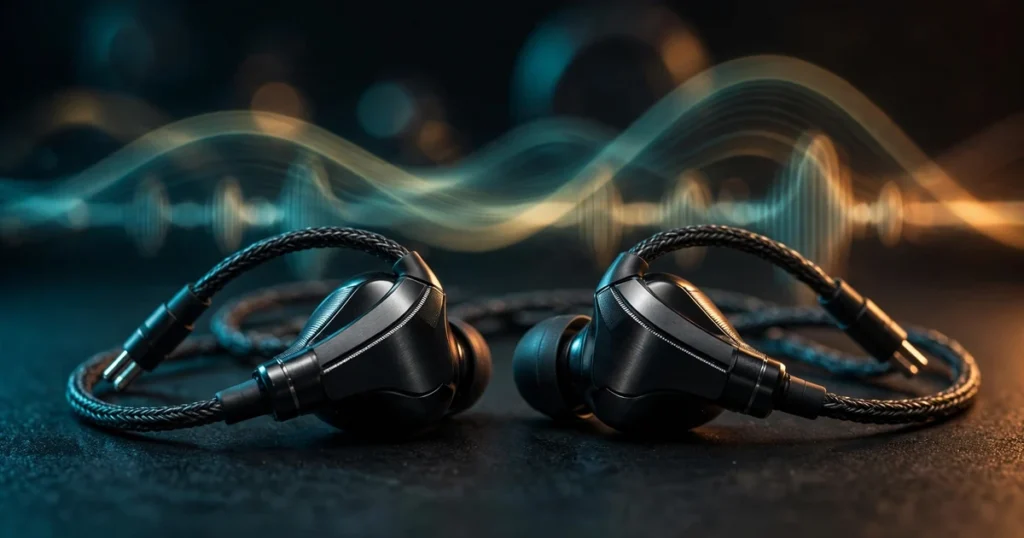
The housings are precision-milled from aluminum, and each earpiece weighs just 4 grams — light enough that long sessions don’t become an ear-fatigue contest. The shells are compact, the ear hooks are flexible and adjustable, and with the right tip (you get silicone and memory foam in three sizes each), the passive isolation is excellent. TechHive’s review made isolation a headline virtue, and the sealed design genuinely removes the need for battery-powered noise cancelling on flights and commutes.
Durability is engineered in, not assumed. The gold-plated Fidelity+ MMCX connectors sit in a recessed socket for strain relief and are rated for 500+ attachment cycles; the cables are para-aramid reinforced to survive thousands of bend cycles. The unboxing is flagship-grade too: a presentation box, a signed customer certificate, and a serialized carry case.
The honest caveats, from owner reports and reviews: anodized aluminum looks superb but can pick up micro-scratches with daily carry — a soft pouch (or the included case) is worth using. Some reviewers note the cable transmits movement noise when worn on the move. And the purist brief cuts both ways: there is no microphone and no inline remote on any of the three cables, so these are a music-only proposition.
What’s in the Box
- IE 900 in-ear monitors
- 3 para-aramid reinforced cables with Fidelity+ MMCX: 3.5mm unbalanced, 2.5mm balanced, 4.4mm balanced
- 3 pairs of silicone ear adapters (S/M/L) and 3 pairs of memory foam ear adapters (S/M/L)
- Premium serialized carry case
- Cable clip and cleaning tool
- Presentation box with signed customer certificate and user manuals
IE 900 vs IE 600: Which One Should You Buy?
This is the question most buyers actually face. The IE 600 sits one step down in Sennheiser’s IE lineup, built around the same single-dynamic-driver philosophy — enthusiast discussion often notes its zirconium-alloy shell as arguably the more premium-feeling housing of the two. The IE 900 answers with the X3R triple-chamber system, the more extended treble, and the full flagship presentation.
SoundMavericks’ take: the IE 600 is the rational buy for most listeners — you get the core of the Sennheiser single-driver sound in the same family. The IE 900 is for the listener chasing the last few percent: finer treble refinement, the more resolving top end, and the engineering statement. If diminishing returns bother you, stop at the IE 600. If they don’t, the IE 900 is audibly the more complete earphone.
IE 900 vs Other Flagship IEMs
Most competing flagships take the opposite engineering path: multi-driver balanced-armature or hybrid arrays, with driver count as the headline spec. The IE 900’s counter-argument is coherence — one driver means no crossover and no phase artifacts, which is why its imaging and timbre read as so natural in reviews.
Against similarly tiered single-driver rivals, the IE 900 holds its ground on refinement: in WhatHiFi’s comparative listening, the IE 900’s more expressive midrange was its edge over a similarly priced competitor known for low-end punch. Our analysis: if you value a coherent, natural presentation over driver-count bragging rights — and you listen mostly to well-recorded material — the IE 900 remains the flagship benchmark for the single-driver approach.
There’s also a practical argument for the single-driver design: longevity. No balanced-armature drivers to drift, no complex crossover network to age — just one robust dynamic transducer in a metal shell with user-replaceable cables. For a flagship-tier purchase meant to last a decade, that simplicity is a feature, not a compromise.
Who Should Buy the IE 900 — and Who Shouldn’t
Buy it if: you want reference-grade wired sound above all else; you own (or plan to buy) a decent DAC or balanced source; you listen to lossless or high-quality files; you value build quality and a complete flagship package.
Skip it if: you need a microphone or call handling; you want wireless convenience or ANC; your library is mostly low-bitrate streaming (these will show you every flaw); or the step-down IE 600 already stretches the budget — it gets you most of the way there.
Sennheiser IE 900: FAQ
Is the Sennheiser IE 900 worth it?
For the purist listener, yes — our 9.0/10 verdict reflects a rare consensus among reviewers that the IE 900 delivers genuinely flagship-grade detail, treble extension, and bass control from a single driver. It’s worth it if sound quality is the entire brief; it isn’t if you need microphones, wireless, or ANC, because none of those exist here at any price.
Does the IE 900 need a headphone amp or DAC?
Not for volume — at 16 ohms and 123 dB sensitivity, even a phone drives it loudly. But the IE 900 is highly revealing, so a quality outboard DAC and lossless files make a clearly audible difference versus a basic laptop or phone output. The included 2.5mm and 4.4mm balanced cables are there for exactly this kind of source.
Does the Sennheiser IE 900 have a microphone or inline remote?
No. All three included cables are audio-only, with no mic and no inline controls. This is a deliberate purist design choice, not an omission — but it does rule the IE 900 out for calls and on-the-go track control.
What’s the difference between the IE 900 and the IE 600?
The IE 900 is the flagship: X3R triple-chamber absorber technology, the most extended and refined treble in the line, aluminum housings, and the full presentation package. The IE 600 is the step-down model in the same single-driver family — including a zirconium-alloy shell that some enthusiasts consider the nicer housing — and represents the better value for most buyers.
Is the IE 900 good for commuting and travel?
Mostly yes: the sealed design and tip selection deliver excellent passive isolation with no battery to charge. Two caveats from reviews — the cable can transmit movement noise when you’re walking, and the aluminum shells benefit from the included case to avoid micro-scratches in a bag or pocket.

I am the founder of Sound Mavericks, where I provide the polite truth about audio equipment. I started this site because consumer electronics reviews are often too technical. Instead of using a silent lab, I test headphones, earbuds, and Bluetooth speakers in the real world – like on a noisy subway or in a busy coffee shop.
To stay independent, I buy my own review units (mostly from the United States) rather than accepting free gifts from brands. Once I finish testing a product, I sell it locally to our community. My goal is to help you understand sound quality, active noise cancellation (ANC), and battery life without the marketing hype.