
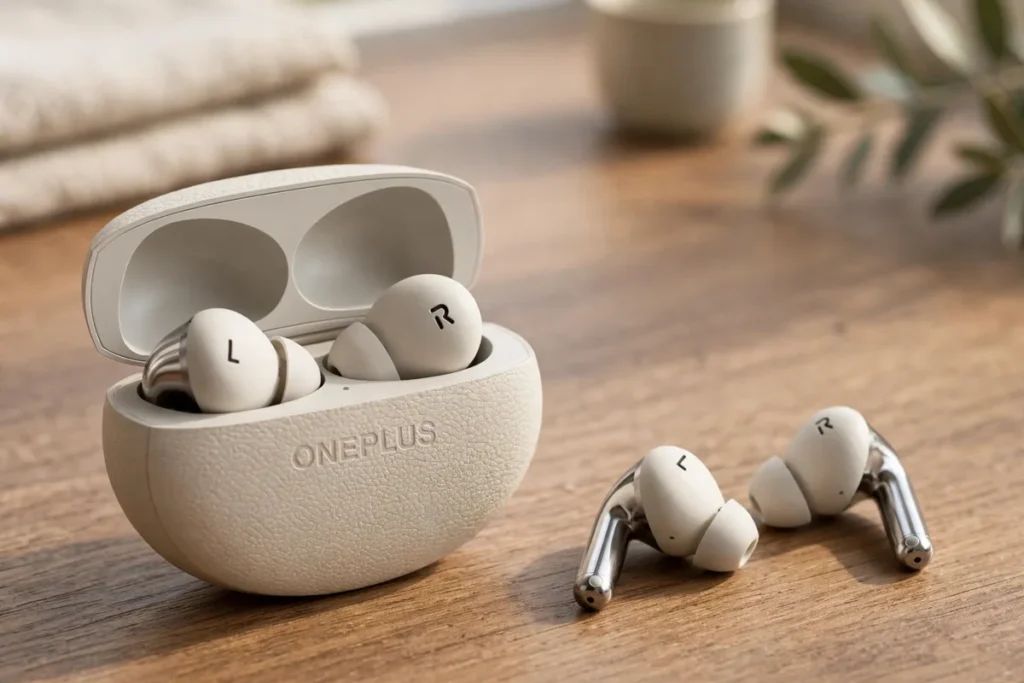
This oneplus buds pro 3 review is about a flagship that puts sound first. Dual drivers do the work: an 11mm woofer handles the low end and a 6mm tweeter handles the top, a split Tom’s Guide also highlighted in its breakdown of the design. Our verdict is 8.5 overall. Sound leads at 8.8, ANC follows at 8.6, and Battery matches it at 8.6. Calls and Comfort sit at 8.4 each. Value is the lowest bar at 8.0, because a cheaper model in the same range now beats it on one headline number.

OnePlus Buds Pro 3 8.5/10
Why you: you want sound to lead. Dual drivers and LHDC 5.0 give these buds real detail and width, and the case charges wirelessly for desk use.
Trade-off: ANC tops out at 50 dB, a step behind the cheaper Buds 4, and total battery is a little lower at 43 hours. The best codec also needs a phone that supports LHDC.
LHDC 5.0 and AAC · Multipoint · IP55 · Wireless charging · 43 hours total
Sound quality
Sound scores 8.8, and it earns that mark. Bass has depth without swamping the middle. Kick drums land with weight, bass guitars keep their shape, and vocals stay forward enough for podcasts and acoustic tracks. The top end is clean rather than sharp. Cymbals shimmer without turning harsh at higher volume, which makes long listening easier than on the older bass-heavy tuning.
Android Central called these the best-sounding OnePlus earbuds by a big margin and noted the move away from a mainly bass-focused tuning. That shift is the story here. Rock, jazz and film scores all hold together better than before. The soundstage feels wider than the small housings suggest, and instrument separation stays clear on busy mixes where cheaper buds blur into one block.
LHDC, EQ and spatial sound
LHDC 5.0 is the codec that matters, but only on phones that support it. On a matching OnePlus phone, detail and width step up in a way you can hear on well-recorded tracks. On AAC the buds still sound good, just less distinctive. The app EQ rewards small moves. Leave the bass alone at first, add a touch of presence if vocals feel distant, and test spatial sound with films before you use it for plain stereo music.
Noise cancelling and transparency
ANC scores 8.6. It cuts train rumble, office hum and cabin drone well, and it adapts as your surroundings change. Consumer Reports rated the noise reduction as excellent in its test summary. In daily use the low end drops first and furthest, which is what most commuters need. Voices nearby soften but do not vanish, and that is normal for this class.
The honest limit sits in the feed record itself. ANC tops out at 50 dB, a step behind the cheaper Buds 4. That gap looks odd on paper. In practice the Pro 3 still cancels strongly, and the sound advantage is the reason to pay more. Transparency is clear and quick to toggle for platform announcements. For more options in this family, see our guide to the best earbuds for OnePlus phones.
Calls and microphones
Calls score 8.4. Your voice comes through close and clear in a quiet room, and the system holds up on a busy street better than most rivals at this level. A voice pickup sensor helps the buds separate your speech from background noise. SlashGear noted that strong ANC can interfere with microphone output on calls, and that matches the one weak spot: in very loud places, turn cancelling down a level if the other person says you sound thin.
Comfort, fit and the case
Comfort scores 8.4. The buds are light, the shape sits securely, and pressure stays low over a full work session. The pinch and slide controls on the stems take a day to learn. Pinch is reliable. The slide gesture for volume can feel fiddly at first, a point Android Central also made, so practise it at a desk before you rely on it on a train.
The case is a specific strength of this model. The oval case has a faux leather finish, charges wirelessly, and feels a clear step up from the plain plastic cases in this range. It is larger than the old flat case, so tight pockets notice it. That trade is worth it for most buyers. Wireless charging on a desk pad removes the daily cable hunt, and the finish grips better in the hand. If pairing is new to you, our guide on how to pair OnePlus Buds walks through the steps.
Battery and everyday features
Battery scores 8.6, with 43 hours in total from the case in the feed record. A fast top-up covers a commute after a short charge. Multipoint keeps a laptop and a phone connected at once, and switching works without re-pairing. IP55 covers workouts and light rain. For a wider shortlist, compare this model against our picks for the best noise cancelling earbuds and the best wireless earbuds.
Value scores 8.0. You pay flagship money for sound, the case and wireless charging. If those three things matter, the price makes sense. If you only want strong cancelling for less, the Buds 4 undercuts it inside the same range. That is a real choice, not a flaw, and it is why Value sits below the other bars instead of beside them.
Controls, app and daily living
The HeyMelody app handles EQ, ANC levels, control mapping and firmware on Android and iPhone alike, while OnePlus phones fold those settings into the system Bluetooth menu. That split matters. On a OnePlus phone the experience feels native and quick. On other phones the app does the same job with one extra download. Either way, updates land without fuss and the settings stick.
Daily living is easy. The buds reconnect fast when the case opens, multipoint hands over cleanly when a call arrives on the second device, and wear detection pauses music when you pull one bud out to talk. The IP55 rating covers a sweaty training session and a wet walk home. Taken together, these small behaviours are why a flagship feels finished rather than merely well specified on paper.
OnePlus Buds Pro 3 specs
| Spec | OnePlus Buds Pro 3 |
|---|---|
| Form | In-ear true wireless |
| Codecs | LHDC 5.0, AAC |
| Noise cancelling | Standard ANC, up to 50 dB |
| Multipoint | Yes, two devices |
| Water resistance | IP55 |
| Battery, total with case | 43 hours |
| Wireless charging | Yes, case |
Verdict
Buy the Buds Pro 3 if sound quality comes first, you use a OnePlus or LHDC phone, and you want wireless charging in a case that feels properly finished. The 8.8 Sound bar is the reason, and the 8.6 ANC bar backs it up for daily travel.
Skip it if you want the strongest stated cancelling in the OnePlus range for less money, or if your phone cannot use LHDC and you resent paying for a codec you cannot hear. The 8.5 overall reflects a sound-led flagship with one clear, named compromise. Check the shortlist in our best multipoint Bluetooth earbuds guide if two-device use matters most.
Frequently asked questions
Do the OnePlus Buds Pro 3 support LHDC?
Yes. LHDC 5.0 is on board alongside AAC. You need a phone that supports LHDC to hear the benefit, and OnePlus phones are the surest match. On other phones the buds fall back to AAC and still sound strong.
How long does the OnePlus Buds Pro 3 battery last?
The feed record lists 43 hours in total with the case. Battery scores 8.6 in our rating. Using LHDC and spatial features shortens the per-charge run, so the case does regular top-up work on long days.
Is the OnePlus Buds Pro 3 good for calls?
Yes. Calls score 8.4. Voices stay clear in a quiet room and hold up outdoors, though strong ANC can work against the microphones in very loud places, a point SlashGear also raised in its testing.
Are the OnePlus Buds Pro 3 water resistant?
Yes. The buds carry an IP55 rating in the feed record, which covers dust and splashes. That suits workouts and light rain. The case itself has no stated ingress rating, so keep the case dry.
Should OnePlus phone owners buy the Buds Pro 3 or the Buds 4?
Buy the Pro 3 for sound quality, wireless charging and the smarter case. The Buds 4 counters with slightly stronger stated ANC and a lower step in the range. Our scores put the Pro 3 ahead on sound at 8.8.

I am the founder of Sound Mavericks, where I provide the polite truth about audio equipment. I started this site because consumer electronics reviews are often too technical. Instead of using a silent lab, I test headphones, earbuds, and Bluetooth speakers in the real world – like on a noisy subway or in a busy coffee shop.
To stay independent, I buy my own review units (mostly from the United States) rather than accepting free gifts from brands. Once I finish testing a product, I sell it locally to our community. My goal is to help you understand sound quality, active noise cancellation (ANC), and battery life without the marketing hype.
