The best iems for musicians are not simply good earphones used on a stage. A stage monitor has a harder job than a commuter earbud: it must stay sealed while you move, sing and sweat, block enough of the room that you can run your mix at a safe level, present your own instrument and voice honestly enough to play in tune and in time, and survive being coiled, dropped and plugged in again night after night. Every pick below is a wired in-ear from our Finder database, scored on our published bars, and judged here on the four things that decide live use: fit, isolation, tuning honesty and durability. The Shure SE215 leads, because it was designed for exactly this job and still does it well.
Shure SE215: Best stage pick: comfort 9.0, a secure over-ear fit, detachable cable and a warm tuning that forgives long sets. Check Price on Amazon
Sennheiser IE 200: Best sound per size: sound 9.4 in a tiny shell, for players who double their monitors as daily listeners. Check Price on Amazon
Etymotic ER4XR: Best isolation: the deep seal shuts out the room, with accuracy singers and engineers can trust. Check Price on Amazon
Etymotic EVO: Best isolation with body: three armatures and the same deep seal, with more low-end presence than the ER4XR. Check Price on Amazon
Moondrop Aria 2: Best all-rounder: sound 8.9 and comfort 8.7, smooth enough for rehearsal, practice and listening alike. Check Price on Amazon
Truthear Hexa: Best honest tuning on a budget: sound 9.0 and value 9.2, a neutral reference for checking your tone. Check Price on Amazon
DUNU Titan S: Best build on a budget: a metal shell and detachable cable that shrug off gig-bag life. Check Price on Amazon
The shortlist: seven stage-ready in-ears
Start with the SE215 if you play live regularly and want the proven tool. Choose the ER4XR or EVO if your stage is loud and isolation is the whole problem. Take the IE 200 or Aria 2 if the same pair must also be your everyday listen. Take the Hexa if you need a neutral second pair for practice and tone checks, and the Titan S if the budget pair still has to survive a gig bag. Singers should read the isolation notes closely; drummers and bassists should read the fit and cable notes, because a seal that breaks mid-song costs more than any tuning difference on this page.
Compared: the seven picks side by side
| Pick | Sound | Isolation (ANC bar) | Comfort | Value | Overall | Check price |
|---|---|---|---|---|---|---|
| Shure SE215 | 8.2 | 4.5 | 9.0 | 8.4 | 6.4 | Check Price on Amazon |
| Sennheiser IE 200 | 9.4 | 4.0 | 8.8 | 8.9 | 6.5 | Check Price on Amazon |
| Etymotic ER4XR | 8.8 | 7.2 | 5.8 | 6.6 | 6.1 | Check Price on Amazon |
| Etymotic EVO | 8.2 | 7.0 | 6.4 | 6.8 | 6.1 | Check Price on Amazon |
| Moondrop Aria 2 | 8.9 | 4.0 | 8.7 | 8.5 | 6.4 | Check Price on Amazon |
| Truthear Hexa | 9.0 | 2.5 | 8.4 | 9.2 | 6.2 | Check Price on Amazon |
| DUNU Titan S | 7.8 | 3.5 | 8.0 | 8.8 | 7.2 | Check Price on Amazon |
One column needs explaining. These are passive in-ears, so the isolation column is our ANC bar used as a seal score: it measures how much of the room the fit keeps out, with no electronics involved. The Etymotic pair leads it by a wide margin because their deep-insertion fit seals like earplugs. The Hexa sits at the bottom of that column despite its excellent sound score, because its shallower fit lets more stage wash in. On a quiet stage that hardly matters. On a loud one it decides whether you turn up, and turning up is what in-ears are supposed to prevent.
The picks, one by one
Shure SE215

Shure SE215 6.4/10
Why you: you play live and need the monitor to disappear as a problem. The SE215 was built as a stage monitor: the cable routes up and over the ear so it stays put when you move, the shells sit low and secure, and comfort scores 9.0 because the fit works for whole sets, not just soundchecks. Our database lists stage monitoring as its home ground, and that is exactly where it earns this lead slot.
Trade-off: the stock cable carries no microphone or remote, and the tuning favours warmth over fine detail, so string players chasing bow texture should look at the IE 200 or Hexa below. Shure also charges a premium over newer rivals with longer spec sheets.
In-ear · Wired · Single dynamic driver · Detachable MMCX cable · Over-ear cable route
The SE215’s live reputation rests on boring virtues. The detachable cable is the big one: cables are what die on stage IEMs, usually at the plug or the earpiece joint, and an MMCX cable swaps in minutes instead of ending the earphone. The over-ear route also kills most cable tug and microphonics, the rustling noise a swinging cable feeds straight into a shallow fit. Sound at 8.2 with a warm tilt is a deliberate stage choice. A slightly softened top end is easier to live with at performance volume for two hours, and the low end has enough weight for kick and bass to register without the mix being pushed. Vocalists get a present, unfatiguing midrange to pitch against. It is not the most revealing IEM here, and on stage that restraint is a feature.
Durability reasoning, stated plainly: the shells are light plastic that flexes rather than cracks, the cable is thick and replaceable, and the model has a long production history, which means spare cables and tips are easy to find. A working musician’s backup pair is often a second SE215, bought because the first one refused to die.
Sennheiser IE 200

Sennheiser IE 200 6.5/10
Why you: you want stage-capable fit with the best pure sound on this page. Sound scores 9.4, the highest here, from a small shell that sits comfortably for rehearsals, travel and long practice sessions as well as gigs. Comfort at 8.8 backs that up: this is the pick for players whose monitors double as their main listening pair.
Trade-off: the sound shifts with tip fit more than most IEMs, so tip rolling is part of ownership, and the stock cable is thin and passes handling noise. There is no microphone. Isolation is ordinary, so very loud stages belong to the Etymotic pair.
In-ear · Wired · Single dynamic driver · Detachable cable · Compact shell
The IE 200 makes its case on detail per gram. It resolves the top end of acoustic instruments, cymbal work and vocal harmony stacks with a clarity the SE215 does not attempt, which suits players in quieter ensembles: folk, jazz, worship bands and acoustic acts where the stage volume is civilised and the monitor mix can stay detailed. The small shell also suits smaller ears that find stage IEMs bulky. The trade is robustness of seal. Because the tuning depends on a good tip seal, a broken seal mid-song costs both bass and balance, so singers who move a lot should test it at rehearsal volume before trusting it on a gig.
Etymotic ER4XR

Etymotic ER4XR 6.1/10
Why you: your stage is loud and your hearing is the priority. The ER4XR’s deep seal shuts out 35 to 42 dB of the world by our record’s account, with no batteries and no hiss, so your monitor mix can run far quieter than the room. A single matched armature delivers a detailed, forward midrange with no added warmth: accuracy you can pitch and phrase against.
Trade-off: the fit goes deep into the ear canal, which some people never tolerate, and comfort scores 5.8 for exactly that reason. Bass stays lean by modern standards, so bassists who monitor by feel should hear the EVO first.
In-ear · Wired · Single balanced armature · Deep-insertion fit · Detachable cable
Isolation is hearing protection with a mix inside it. Every decibel the seal blocks is a decibel you do not have to add at the mixer, and the ER4XR blocks more than anything else on this page. Drummers and guitarists standing in front of loud cabinets get the most from it. The XR tuning adds a touch of low-end lift over a pure studio response, which keeps kick and bass guitar audible without turning the seal’s leanness into thinness. The honest warning is fit: the deep insertion that creates the isolation is also the reason some players return them within a week. Try them seated, at rehearsal, before a paying audience depends on them.
Etymotic EVO

Etymotic EVO 6.1/10
Why you: you want the Etymotic seal with a fuller low end. The EVO runs three balanced armatures with dual bass drivers, so the bottom of the mix has real presence while the deep fit still shuts out the world without batteries, apps or hiss. Isolation scores 7.0, close behind its sibling, with a warmer balance for players who found the ER4XR too lean.
Trade-off: the deep fit divides opinion just as firmly here, comfort at 6.4, and there is no microphone and no warmth added beyond the tuning itself. Players who hate deep insertion should not start with either Etymotic.
In-ear · Wired · Triple balanced armature · Deep-insertion fit · Metal shell
Think of the EVO as the ER4XR’s answer to bass players and drummers who monitor the low end as information, not decoration. The dual bass drivers keep kick drum weight inside a sealed, quiet picture, so the kit feels physical at safe listening levels. The metal shell also shrugs off gig-bag abuse better than resin rivals. It shares the family trade completely: the fit is the product. Players who accept deep insertion get the two best isolation scores in our database. Players who cannot, get a very expensive lesson, so the rehearsal test matters more for this pair than for any other pick here.
Moondrop Aria 2

Moondrop Aria 2 6.4/10
Why you: your IEMs split their life between rehearsal, practice, travel and listening for pleasure. Sound scores 8.9 with a smooth, musical balance, and comfort at 8.7 makes the Aria 2 the easiest pair here to wear for a full day of sessions. It is the pick for students, teachers and multi-instrumentalists whose monitors rarely see a big stage but work constantly.
Trade-off: mid-bass emphasis can sound thick on dense mixes, and the stock tips are average, so budget for tips that seal well. Isolation is modest, which rules it out as the primary monitor for loud stages.
In-ear · Wired · Single dynamic driver · Detachable cable · Metal shell
The Aria 2 earns its place by being the pair musicians actually keep in their ears. Practice is where technique is built, and a comfortable, pleasant monitor gets worn for the unglamorous hours. Its tuning flatters acoustic instruments and voices, which keeps intonation practice honest without turning harsh. On smaller stages and in rehearsal rooms it monitors perfectly well. The boundary is stage volume: when the room gets loud, its ordinary seal means the mixer fader creeps up, and the Etymotic pair or the SE215’s secure fit is the safer tool.
Truthear Hexa

Truthear Hexa 6.2/10
Why you: you need a neutral reference more than a stage weapon. Sound scores 9.0 and value 9.2: the Hexa’s measurement-friendly tuning makes it the pair to check your tone, your backing tracks and your practice recordings against, because it adds almost nothing of its own. As a second pair in the gig bag, it is the cheapest honesty available.
Trade-off: the tuning is honest rather than exciting, bass quantity is modest, and the nozzle is on the larger side for small ears. Isolation scores just 2.5, the weakest seal here, so it should not be your only monitor on a loud stage. The stock cable has no microphone.
In-ear · Wired · Hybrid drivers · Detachable cable · Neutral tuning
Every band benefits from one neutral pair in the room. The Hexa is how a guitarist hears whether the brightness is in their patch or in their headphones, and how a singer checks a harmony recording without a warm tuning voting in favour. Treat it as the reference and rehearsal tool it is. Its stage role is the quiet end of the circuit: acoustic sets, theatre pits with controlled volume, and studio tracking sessions where its balance is worth more than isolation.
DUNU Titan S
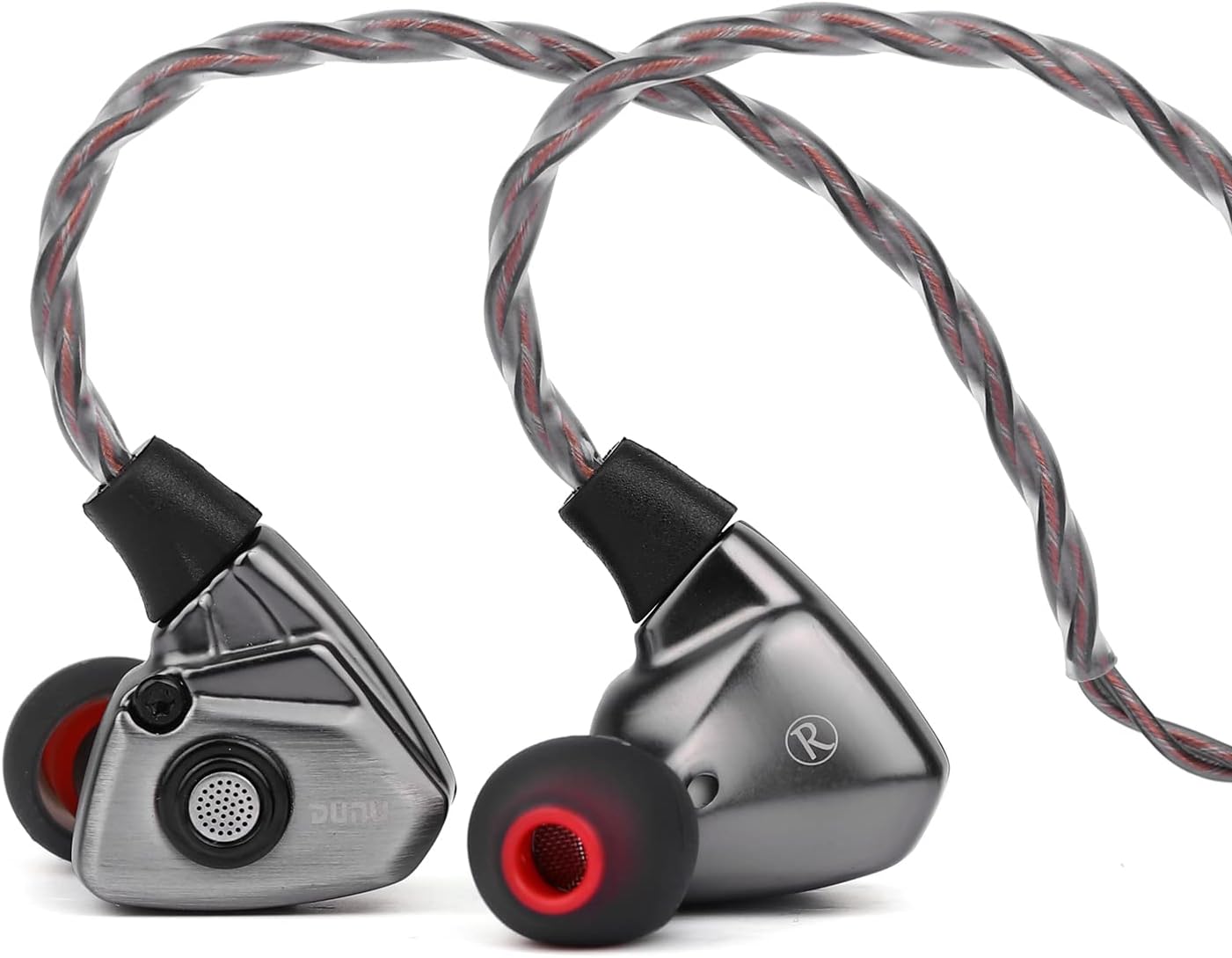
DUNU Titan S 7.2/10
Why you: the budget pair still has to survive real use. The Titan S is built from zinc alloy with an 11mm driver and a proper detachable cable, hardware that feels a class above its tier, and its 7.2 overall is the highest on this page under our wired scoring conventions. It is the sensible first monitor for a young band equipping itself.
Trade-off: the tuning leans bright, so treble-sensitive listeners should be careful at stage volume, and there is no microphone on the stock cable. Isolation is middling, so loud-stage players should step up to the SE215 or an Etymotic.
In-ear · Wired · 11mm dynamic driver · Zinc alloy shell · Detachable cable
Budget stage gear fails in predictable places: cracked shells, dead cables, tips that vanish. The Titan S answers with metal where rivals use thin plastic and a cable you can replace. Its brighter tuning also has a stage use: in a muddy monitor mix, a little extra top-end presence helps a vocal sit forward without more volume. For a school band, a church team or a first touring act buying several pairs at once, that combination of build and clarity is the rational spend.
What actually matters on stage
Fit is security. An IEM that shifts when you turn your head breaks its seal, and a broken seal takes the bass and the isolation with it. Over-ear cable routes, like the SE215’s, exist because stages involve movement. Test any new pair with the movement your set involves: singing, headbanging, looking down at a pedalboard.
Isolation is volume control. The quieter the room sounds through the seal, the quieter your mix can run, and the longer your hearing lasts. That is why the isolation column matters more for live use than small differences in sound score, and why foam tips, which seal more completely than silicone for most ears, are standard issue on loud stages.
Durability is a cable question. Drivers rarely die on tour. Cables die constantly, at plugs and joints stressed nightly. Every pick on this page has a detachable cable for that reason, and carrying a spare cable is cheaper than carrying a spare pair. If you are comparing against full-size options for the studio end of the job, our best in-ear monitors guide covers the wider field, and singers have a dedicated cut in our best in-ear monitors for singers roundup.
Also consider
Sennheiser IE 600: the IE 200’s bigger sibling, with sound at 9.4 and a more refined build, for players who want the same small-shell idea at a higher tier. 7Hz Timeless: a planar IEM with sound at 8.8 that images well enough for music and games, better suited to studio and practice than to loud stages. Final Audio E3000: a warm, featherweight bullet IEM that disappears in the ear, best for quiet sets and as a spare, since its fixed cable breaks the detachable rule the main picks follow. All three sit in our Finder database with published scores, and each lost its main-list place on a stage-specific point rather than on sound.
Frequently asked questions
What makes an IEM good for musicians rather than for listening?
Stage work adds three demands ordinary listening does not: a fit that keeps its seal while you move, enough passive isolation to run your mix at a safe level in a loud room, and a detachable cable, because cables are what fail on tour. The Shure SE215 leads this list because it was designed around those three demands.
How much isolation do I need for live performance?
Enough that you can hear your mix clearly without pushing its level. On loud stages that usually means a deep or foam-tip seal like the Etymotic ER4XR and EVO offer, rated in our database at 7.2 and 7.0 on the isolation bar. On quiet acoustic stages, an ordinary seal like the Aria 2’s is sufficient.
Are expensive IEMs always better for the stage?
No. Stage value concentrates in fit, isolation and replaceable cables, not in driver count. The DUNU Titan S and Truthear Hexa both score above 9 or close to it on value in our database and cover rehearsal and quiet-stage work well. Spend more when you need isolation or a specific tuning, not as a default.
Should singers choose different IEMs from instrumentalists?
Often, yes. Singers pitch against their own voice in the mix, so midrange accuracy and a seal that survives jaw movement matter most, which favours the ER4XR’s accuracy or the SE215’s secure fit. Our dedicated guide to in-ear monitors for singers goes deeper on the vocalist’s side of the choice.
Can I use these IEMs with a wireless stage system?
Yes. These are wired earpieces, and a wireless monitoring system ends in a belt pack with a standard headphone output. The IEM plugs into the pack, not into a transmitter directly. Cable length and the over-ear route then matter even more, because the cable runs down your back to the pack.
Why do all the picks have detachable cables?
Because the cable is the part that fails. It is flexed, coiled, stepped on and plugged in nightly, while drivers sit protected inside shells. A detachable cable turns the most common stage failure into a two-minute swap, and it is the single clearest line between a stage IEM and a consumer earphone.

I am the founder of Sound Mavericks, where I provide the polite truth about audio equipment. I started this site because consumer electronics reviews are often too technical. Instead of using a silent lab, I test headphones, earbuds, and Bluetooth speakers in the real world – like on a noisy subway or in a busy coffee shop.
To stay independent, I buy my own review units (mostly from the United States) rather than accepting free gifts from brands. Once I finish testing a product, I sell it locally to our community. My goal is to help you understand sound quality, active noise cancellation (ANC), and battery life without the marketing hype.