
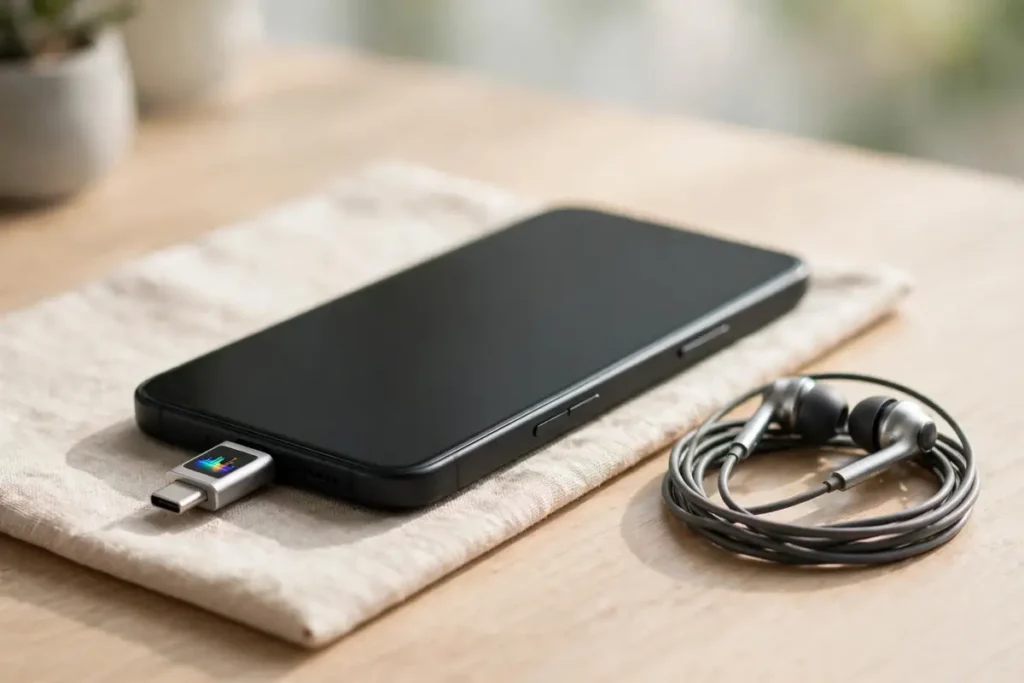
Most dongle DACs improve a phone output and stop there. The best dongle DACs with EQ do a second, more valuable job: they correct the headphone itself. A parametric equalizer stored in the dongle can pull down a treble peak, lift a recessed band or trim a bass hump, and the correction follows you across apps and devices. This page lists only dongles whose EQ we could verify from the maker or the listing: five models, led by the Qudelix 5K, still the reference for portable parametric EQ, and four FiiO and Shanling models with real, configurable EQ rather than fixed presets.
The cut is strict on purpose. Famous dongles without configurable EQ are not here, however good they sound, because a preset labelled Rock is not an equalizer you control. Cards below are scoreless: these products sit outside our scored headphone database, and rather than invent a score set, each card states the EQ facts that earned the pick its place. For the wider field, see our best portable DACs and dongles roundup; this page is the EQ-specific cut.
The shortlist
Qudelix 5K: The EQ reference: parametric and graphic EQ stored in the device, applied to Bluetooth and USB alike. Check Price on Amazon
FiiO KA17: Most power with PEQ: dual ES9069Q chips and a desktop mode, with PEQ through FiiO Control. Check Price on Amazon
FiiO KA15: Best screen and PEQ balance: a 10-band parametric EQ, three stored profiles, and a colour display. Check Price on Amazon
FiiO JadeAudio JA11: Cheapest real PEQ: a tiny USB-C to 3.5 mm dongle with custom PEQ through the app. Check Price on Amazon
Shanling UA4: The app-EQ alternative: Eddict Player control and a 10-band graphic EQ inside its player app. Check Price on Amazon
What counts as real EQ in a dongle
Three tests separate the picks here from preset dongles. First, control: you set frequencies and gains yourself, ideally with band width as well, which is the parametric standard. Second, storage: the settings save to the device or a profile slot, so the correction survives unplugging and follows the dongle to a laptop or a console. Third, reach: the EQ applies to the music you actually play, across apps, not only inside one player. The Qudelix 5K passes all three at the highest level. The FiiO trio passes them through the FiiO Control app and web interface. The Shanling UA4 passes the first in a limited, player-side form, and its card says so plainly.
Why it matters: headphones differ from each other mostly in frequency response, and response is exactly what EQ edits. A measured preset library, such as the AutoEq profiles the Qudelix app supports, turns a good IEM into a corrected one for the cost of a dongle. That is a different purchase from a plain DAC, and it is why this list exists separately from the general dongle roundups.
The picks, one by one
Qudelix 5K

Qudelix 5K
Why you: the EQ is the product: a parametric and graphic equalizer processed in the device, with per-headphone preset support, applied to every input. Dual ES9219 outputs, 3.5 mm and 2.5 mm balanced, plus Bluetooth with LDAC and aptX Adaptive on the listing.
Trade-off: There is no display, the balanced jack is 2.5 mm rather than the now-common 4.4 mm, and the deep app rewards listeners who enjoy setup work.
Bluetooth and USB DAC/amp · Dual ES9219 · 3.5 mm and 2.5 mm outputs · App and browser control
The 5K remains the answer when the question is EQ. Its equalizer runs on the device DSP, not in one app, so a correction you build applies to streaming, local files, video and calls alike, over Bluetooth or USB. The app exposes parametric bands with frequency, gain and width, graphic mode, pre-gain, and a library of per-headphone presets drawn from the AutoEq project, which means most popular IEMs and headphones can be corrected from a published measurement in minutes.
As a DAC and amp it is complete rather than exotic: dual ESS chips, both jack sizes, a clip-on body with its own battery for Bluetooth duty, and a browser extension for desk setup. If you buy one dongle on this page, this is the one the other four are measured against. Our wider context for Bluetooth DAC duty sits in the FiiO BTR17 review, a rival receiver with its own PEQ, for readers comparing the two ecosystems.
FiiO KA17

FiiO KA17
Why you: FiiO lists the KA17 among its wired PEQ models, set through the FiiO Control app or web interface, and pairs that EQ with the strongest drive in this list: dual ES9069Q chips, a desktop mode and a second USB-C port for external power.
Trade-off: EQ setup needs the Android app or a computer web session; there is no iPhone app path for configuration, though listening on iPhone works once profiles are set.
USB-C dongle · Dual ES9069Q · 3.5 mm and 4.4 mm outputs · Desktop mode
The KA17 is the power pick that keeps the EQ. FiiO own PEQ documentation names it among the models with wired PEQ support through FiiO Control and the web interface, and the hardware around that EQ is the most serious here: dual flagship-class DAC chips, balanced output, and a desktop mode fed by a second USB-C power input for demanding full-size headphones.
Choose it when your headphones need drive as well as correction: planar over-ears and insensitive IEMs both sit in its brief. The workflow caveat is real and stated on the card: build your profiles on Android or a computer, then treat the dongle as set-and-forget on any source, including an iPhone.
FiiO KA15

FiiO KA15
Why you: a 10-band parametric EQ with three custom profile slots stored on the device, dual CS43198 chips, and a small colour display with a cassette-style playback animation that makes settings visible without a phone.
Trade-off: As with the KA17, EQ configuration runs through the Android app or web control; iPhone owners configure from a computer first.
USB-C dongle · Dual CS43198 · 3.5 mm and 4.4 mm outputs · Colour display
The KA15 is the friendliest serious EQ dongle here. FiiO documents its PEQ in detail: ten bands, adjustable frequency across the audible range, gain and Q, filter types from peak to shelves and passes, seven fixed presets above three custom slots you can rename, save, share and recall from the device menu. That is a genuine parametric tool, one step below the Qudelix in depth and ahead of everything else at its level in clarity.
The display earns its keep during setup, showing mode and status without opening the app, and the dual CS43198 design with a desktop mode covers most headphones a portable listener owns. For most buyers on this page, the KA15 is the balance point: real PEQ, real power, least friction.
FiiO JadeAudio JA11

FiiO JadeAudio JA11
Why you: the budget door into parametric EQ: a USB-C to 3.5 mm dongle with a built-in DSP, custom PEQ through FiiO Control, and shared preset curves from other listeners, in a body that weighs almost nothing.
Trade-off: Output power is modest, there is no balanced jack, and it is a single-ended tool for IEMs and easy headphones, not a desktop replacement.
USB-C to 3.5 mm · Built-in DSP · Custom PEQ via app · Mic and inline control support
The JA11 matters because it removes the price excuse. FiiO sells it under the JadeAudio label as an entry dongle, yet it carries the feature this page exists for: customizable PEQ through the FiiO Control app, with preset styles for listeners who want a starting point and shared curves from the community. For a first IEM that runs bright or bass-heavy, this is the cheapest correction available.
Keep expectations in their lane. Power is modest, output is 3.5 mm only, and demanding headphones belong on the KA15 or KA17. Paired with the wired IEMs in our metal and general IEM coverage, though, the JA11 plus a measured preset is the highest-value upgrade path in portable audio right now.
Shanling UA4

Shanling UA4
Why you: a strong dongle in its own right, ES9069Q chip, 3.5 mm and 4.4 mm outputs, a small display with hardware buttons, and Eddict Player app control. Its player carries a 10-band graphic equalizer.
Trade-off: Be precise about the EQ: it lives in the Eddict Player app and applies to playback inside that app, not in the dongle DSP across every source. Android app control only. If system-wide PEQ is your goal, buy the Qudelix or a FiiO above.
USB-C dongle · ES9069Q · 3.5 mm and 4.4 mm outputs · Display and buttons
The UA4 closes the list with its limitation printed on the card rather than buried: its equalizer is the Eddict Player 10-band graphic EQ, which shapes music played through Shanling app, alongside app control of filters, gain and balance. That is real, usable EQ for listeners who live inside one player app, and the hardware around it, display, buttons, balanced output and healthy drive, is the most polished here.
It is included because the brief asked us to check Shanling Eddict Player models, and this is the honest result of that check: a good dongle with player-side EQ, ranked last on an EQ list for exactly that reason. If your listening is local files in one app, it serves. If your listening is streaming across apps, the four picks above it exist for you.
Setting up your first correction
Start from a target, not from taste. The fastest reliable route is a published measurement of your headphone: the Qudelix app carries preset libraries built from measurements, and FiiO Control lets you import and share curves, so for most popular IEMs and headphones a measured starting point already exists. Load it, then adjust by ear in small steps. A preset built from a measurement of your exact model will beat an evening of blind slider work almost every time.
Then follow three working rules. First, cut before you boost: pulling a peak down keeps your amplifier headroom intact, while boosting a dip spends headroom and can push a small dongle into distortion on loud passages, which is why both the Qudelix and FiiO tools expose a pre-gain control. Second, change one band at a time and listen to a full track, not a five-second loop, because metal, electronic and acoustic material expose different bands. Third, save the flat profile beside your correction and compare at matched volume; louder always sounds better in a quick switch, and matching the level is the only way to know the correction itself helped.
Expect the first correction to be modest. A few decibels of cut at one treble peak and a gentle low shelf is a typical good result, not the dramatic curve beginners draw. If your saved profile looks extreme, the likelier explanation is a fit problem, a broken tip seal on an IEM, or the wrong earpad on an over-ear, and no dongle on this page can EQ its way past a physical problem like that. Fix the fit first, then let the EQ do the smaller, precise job it is good at.
Compared: the five picks side by side
| Pick | EQ type | Where it lives | Best for | |
|---|---|---|---|---|
| Qudelix 5K | Parametric and graphic, device DSP | Stored in device, all inputs | The EQ reference | Check Price on Amazon |
| FiiO KA17 | Parametric, FiiO Control and web | Profiles saved to device | Most power with PEQ | Check Price on Amazon |
| FiiO KA15 | 10-band parametric, app and web | Three custom slots on device | Best balance, display | Check Price on Amazon |
| FiiO JadeAudio JA11 | Custom PEQ, FiiO Control | App-managed profiles | Cheapest real PEQ | Check Price on Amazon |
| Shanling UA4 | 10-band graphic, in player app | Inside Eddict Player only | App-EQ alternative | Check Price on Amazon |
Also consider
Readers who want EQ with a desktop footprint should look at the DAC and amp coverage in our what is a DAC explainer before spending. The AK HC5 USB DAC review covers a premium dongle from the other direction, sound first, for listeners weighing whether EQ matters to them at all. And iPhone-first readers should compare this list against our portable DAC for iPhone coverage, where the configuration caveats on the FiiO cards matter most.
Buying notes
Decide by EQ depth first. If you want measurement-based correction that follows you everywhere, the Qudelix 5K is the purchase. If you want parametric EQ with more drive for full-size headphones, take the KA17; with a screen and an easier daily experience, take the KA15. If you want to learn what PEQ does for the least money, take the JA11 and a published preset for your IEM. Take the UA4 only with its app boundary understood.
Whichever you buy, set the EQ up properly once: apply a modest pre-gain cut before boosting anything, change one band at a time, and compare against the flat profile at matched volume. EQ done that way is a correction tool. EQ done by pushing every slider up is a louder, worse version of the headphone you already own.
A word on who should skip this list entirely. If your headphones already measure close to the response you like, a plain dongle from the general roundup will serve you as well and cost less. If your listening is one player app with its own good equalizer, the dongle adds little beyond drive. The EQ dongle earns its money in the common middle case: a headphone or IEM you like that is one or two response problems away from right, used across several apps and devices, where only a correction stored in the hardware itself follows you everywhere. Judge your own listening against that case before you spend.
Headroom is the quiet constraint behind every EQ decision on this page. Each boost asks the amplifier for more output at that frequency, and a dongle that sounds clean flat can clip on a boosted bass shelf during a loud passage. The KA17 desktop mode and the KA15 desktop mode exist partly for this reason: external power buys back the headroom your correction spends. On battery-free dongles without a desktop mode, keep boosts small and lean on cuts.
Frequently asked questions
What is the difference between parametric EQ and a normal equalizer?
A normal equalizer gives you fixed bands you push up or down. Parametric EQ lets you set each band centre frequency, gain and width, so you can target one exact peak or dip in a headphone response and leave everything else alone. The Qudelix 5K and the FiiO KA15 and KA17 offer true parametric EQ; a preset-only EQ cannot do that correction work, which is why this page only lists dongles with the real thing or a clearly described alternative.
Does the EQ stay applied when I change apps or devices?
On the picks here, yes, with one exception stated on its card. The Qudelix 5K stores EQ in the device and applies it to every input, Bluetooth and USB. The FiiO models save profiles to the dongle through the FiiO Control app or web interface, so the correction travels with the dongle. The Shanling UA4 EQ described here lives in its player app, so it applies inside that app rather than system-wide.
Can EQ fix a bad headphone?
It can fix frequency-response problems: a treble peak, a bass hump, a recessed midrange band. It cannot fix distortion, poor fit or a driver that runs out of headroom, and heavy boosts eat amplifier headroom, which is why the Qudelix and FiiO tools include pre-gain control. Used with a published measurement target or a preset library, EQ is the cheapest real upgrade in portable audio; used blind, it is a toy.
Do I need Bluetooth in a dongle DAC?
Only if you want the dongle to double as a wireless receiver for wired headphones. The Qudelix 5K is the pick here with Bluetooth onboard, including LDAC and aptX Adaptive on its listing. The FiiO and Shanling picks are USB-only, which keeps them simpler and lighter. If your phone still has a headphone socket, none of this applies; these dongles exist for phones and laptops without one, and for listeners who want the EQ.
Which of these works with an iPhone?
All five connect over USB-C. The configuration side differs: FiiO EQ setup for the KA15 and KA17 runs through the Android app or the web interface, so iPhone owners set their profiles from a computer and then just listen. The Qudelix app covers iOS directly. Check each card for the setup path before buying, since the EQ is the reason to buy.

I am the founder of Sound Mavericks, where I provide the polite truth about audio equipment. I started this site because consumer electronics reviews are often too technical. Instead of using a silent lab, I test headphones, earbuds, and Bluetooth speakers in the real world – like on a noisy subway or in a busy coffee shop.
To stay independent, I buy my own review units (mostly from the United States) rather than accepting free gifts from brands. Once I finish testing a product, I sell it locally to our community. My goal is to help you understand sound quality, active noise cancellation (ANC), and battery life without the marketing hype.

