
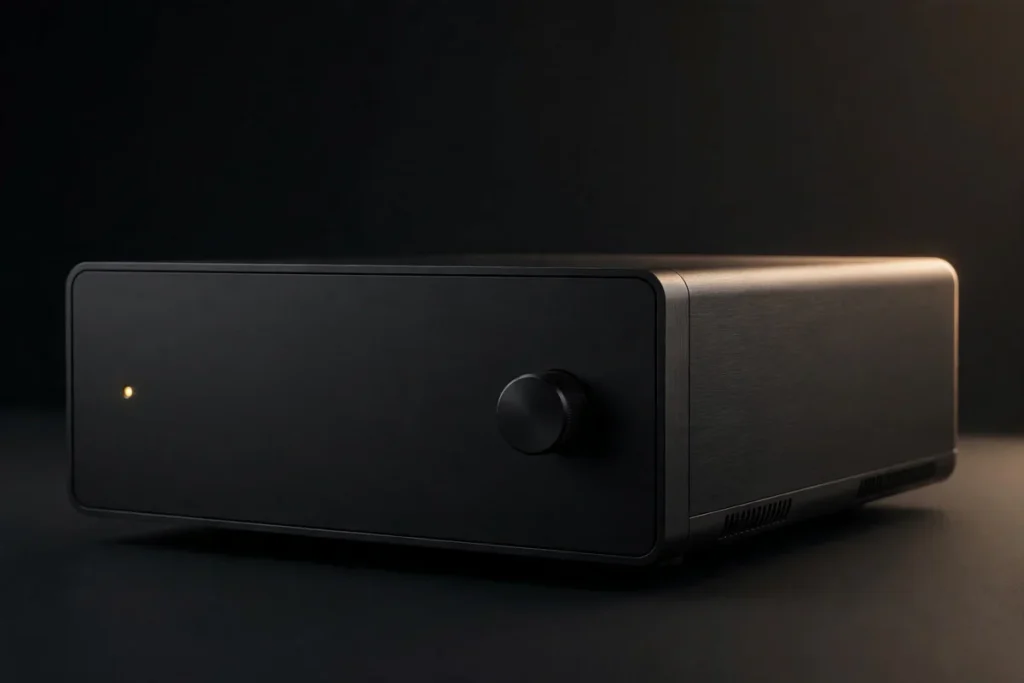
This rega dac review covers the original Rega DAC, the standalone desktop converter Rega built around a pair of Wolfson WM8742 chips in parallel, five selectable digital filters and five digital inputs. It is not the later DAC-R, which added a remote control, asynchronous USB and three filters in place of five. The original DAC is the unit the keyword and the review record point to, so it is the unit covered here, judged honestly as the legacy product it now is.
A note on how this review was put together. It is a research review, built from Rega’s published manual and specifications and independent review coverage. We have not had a unit on the desk, so there is no hands-on claim anywhere on this page, and there is no score. We do not score source gear from a spec sheet. One buying note up front: no current Amazon US listing for the original Rega DAC could be verified at the time of writing, so the buy links on this page point to a tagged Amazon search rather than a single listing, and there is no product image for the same reason.
Why you: Twin Wolfson WM8742 converters run in parallel, a discrete output stage borrowed from Rega’s CD player engineering, and five filters that let you tune the top end to your system. The published record credits it with a deep, layered soundstage and an analogue ease that many DACs of its period did not manage.
Trade-off: The USB input is the weak door: isolated but limited to 16-bit at up to 48kHz, so hi-res computer audio belongs on the S/PDIF inputs. There is no remote control, no headphone output and no DSD support.
Rega DAC specifications
| Product | Rega DAC desktop digital to analogue converter (original model) |
| DAC chipset | Pair of Wolfson WM8742 converters in parallel, with Wolfson digital receiver |
| Bit depth and rates | 16, 20 and 24-bit at 32, 44.1, 48, 88.2, 96, 176.4 and 192kHz; no sample rate conversion |
| Inputs | USB Type B isolated (16-bit, up to 48kHz), 2 optical Toslink, 2 coaxial (isolated 75 ohm), all S/PDIF inputs 24-bit to 192kHz |
| Outputs | Single pair RCA line output, 2.175V maximum into 100k ohm load; coaxial digital output |
| Filters | 5 user selectable digital filters |
| Distortion | 0.006% at 1kHz with 24-bit/96kHz input, per Rega |
| Case | Custom aluminium and steel case, Nichicon FG capacitors in the analogue signal path |
| Where to buy | Rega DAC search on Amazon US (no single verified listing at the time of writing) |
Rega’s first standalone DAC
Rega spent decades arguing that a CD transport and its converter belonged in one box, tuned together. The DAC was the company breaking its own rule, because music had moved to computers and streamers and its customers wanted Rega conversion behind sources Rega did not make. The engineering carried over from the CD players: the buffer stage feeding the converters follows the arrangement in the Isis reference player, the output amplifier is a discrete differential design, and the capacitors in the analogue path are Nichicon FG parts. This was not a badge on a generic board. It was Rega’s digital team building a standalone product in the company’s own image.
The case tells the same story. It is a custom aluminium and steel enclosure with a glass front panel, sample rate and lock indicators, and two buttons that cycle inputs and filters. There is no remote, which dates it every time you cross the room to switch from the streamer to the TV. There is also a coaxial digital output, an unusual inclusion that lets the DAC work as a reclocking pass-through for a second converter downstream. Few buyers will use it. It says a lot about how Rega thought about the product: a digital hub built by engineers, finished by engineers.
The USB limit, stated plainly
Every honest account of this DAC starts with the USB input. It is galvanically isolated, which is good practice, but it accepts only 16-bit data at 32, 44.1 and 48kHz. CD-quality files and standard streaming pass through at full quality, and for a large share of real libraries that is the whole library. Hi-res downloads do not. They need the coaxial or optical inputs, which accept 24-bit data at up to 192kHz, or a USB to S/PDIF converter in front of the DAC, which is how many owners ran it. Reviewers at the time treated the USB socket as a convenience input and the S/PDIF inputs as the product. That is still the right way to read it, and any used listing that leads with hi-res USB playback is describing the DAC-R, not this unit. Our guide to what a DAC does covers why input limits like this matter more than headline sample rates.
Five filters, and what they are for
The five filters are the WM8742’s own filter set: linear phase half-band, minimum phase soft-knee, minimum phase half-band, linear phase apodising and minimum phase apodising. They trade the shape of the response at the very top of the band against ringing behaviour, and the differences are small but real, most audible as a slight softening or sharpening of treble edges. Rega’s manual is candid that the cut-off points sit at the upper end of the frequency range. Owners tended to settle on one filter per system and leave it there, with the minimum phase options often preferred for a more relaxed top end. Treat the filters as seasoning rather than five different DACs, and they make sense.
Sound character, as the record describes it
TechRadar’s review praised the Rega as detailed, sweet and well featured, while noting that imaging could seem a touch distant. Long-term owner reports and forum comparisons return to the same qualities: a deep and layered soundstage, vocals placed slightly back rather than pushed forward, tight and well defined bass, and a treble that stays sweet where analytical DACs turn hard. Darko’s coverage called the flavour earthy and organic next to the ESS-based rivals of the day. Put together, the record describes a DAC voiced for long listening rather than quick comparisons. It flatters live recordings and acoustic music. It will not spotlight detail the way a modern measurement-led design does, and buyers choosing between this and a current model in our best DACs coverage are really choosing between those two presentations.
Rega DAC or DAC-R?
The DAC-R is the later refinement: asynchronous USB that accepts 24-bit/192kHz on every input, a remote control, three filters and a headphone-era feature set the original lacks. If both appear on the used market at similar money, the DAC-R is the easier unit to live with, full stop. The original DAC answers when it costs clearly less, when your sources are S/PDIF anyway, or when you want its particular five-filter Wolfson voicing. What neither unit offers is DSD playback, balanced outputs or a headphone socket, so listeners who need those should look at current designs such as the units in our best balanced DACs coverage instead of stretching a legacy purchase past its design.
Verdict
The original Rega DAC holds up as a characterful desktop converter: twin Wolfson chips, a serious output stage and a soundstage that reviewers kept writing home about. Its USB ceiling and missing remote mark it as a product of its period, and the lack of a verifiable new listing makes it a used-market decision only. Buy it for S/PDIF sources and long, relaxed listening, at a price that respects its age. Skip it if hi-res USB is your main source, because that job belongs to the DAC-R or a modern DAC.
Frequently asked questions
What is the difference between the Rega DAC and the Rega DAC-R?
The DAC-R is the later model. It adds asynchronous USB accepting 24-bit/192kHz on all inputs, a remote control and three digital filters. The original DAC covered here has five filters, no remote, and a USB input limited to 16-bit at up to 48kHz, with hi-res handled by its optical and coaxial inputs.
Does the Rega DAC support hi-res audio?
Yes, over S/PDIF. The two optical and two coaxial inputs accept 24-bit data at up to 192kHz, and the DAC applies no sample rate conversion. The USB input is limited to 16-bit at up to 48kHz, so hi-res computer playback needs an S/PDIF connection or a USB to S/PDIF converter.
Does the Rega DAC have a headphone output or a remote?
No. It is a line-level DAC with one pair of RCA outputs, plus a coaxial digital output. Input and filter selection are made with buttons on the front panel. The remote control arrived with the later DAC-R.
What do the five filters on the Rega DAC do?
They select between linear phase and minimum phase filter shapes, including apodising variants. The audible effect is subtle and sits at the top of the frequency range, slightly softening or sharpening treble presentation. Most owners pick one per system and leave it set.
Is the Rega DAC still worth buying?
As a used purchase for S/PDIF sources, yes, if the price reflects its age and the USB limit does not affect your setup. There is no verified new Amazon US listing for the original model, so check any listing carefully and confirm it is the original DAC rather than the DAC-R before paying.

I am the founder of Sound Mavericks, where I provide the polite truth about audio equipment. I started this site because consumer electronics reviews are often too technical. Instead of using a silent lab, I test headphones, earbuds, and Bluetooth speakers in the real world – like on a noisy subway or in a busy coffee shop.
To stay independent, I buy my own review units (mostly from the United States) rather than accepting free gifts from brands. Once I finish testing a product, I sell it locally to our community. My goal is to help you understand sound quality, active noise cancellation (ANC), and battery life without the marketing hype.

