
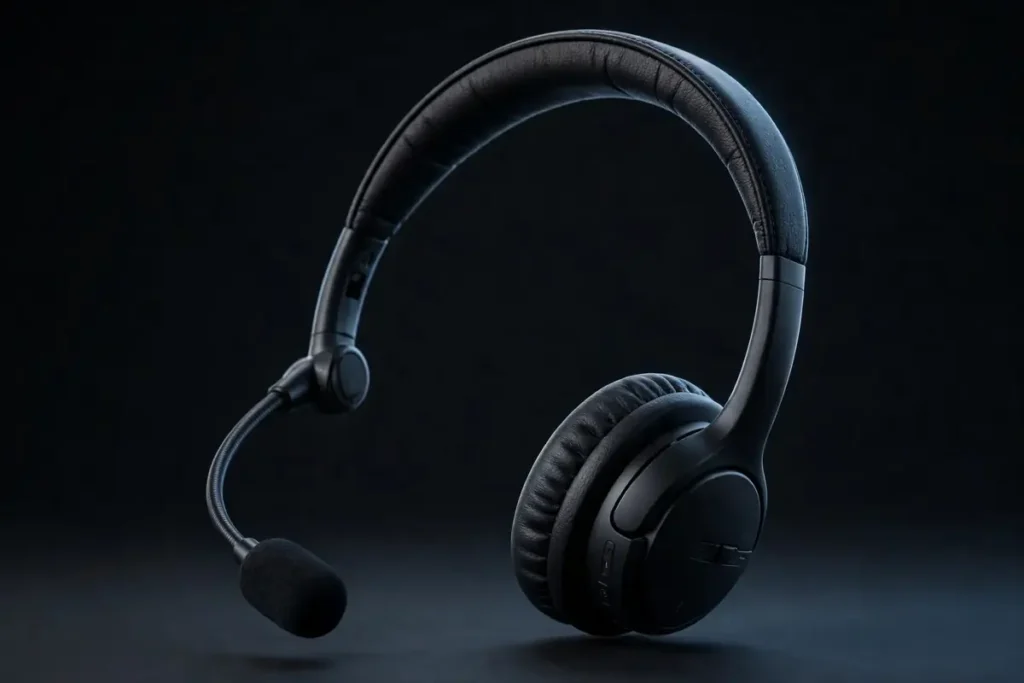
This eksa h16 review covers a wireless headset that is easy to misread from the brand name alone. EKSA built its name on gaming headsets, but the H16 belongs to the EKSAtelecom line: an on-ear Bluetooth headset with a boom microphone, a USB dongle in the box and call quality as the headline job. It scores 6.9 overall here, and the shape of the bars tells the story before the words do. Battery scores 9.0 and Calls 7.8, while Sound sits at 6.8 and ANC at 3.0, because there is no listener-side noise cancelling at all.
A note on method. This review is research-based and the scores are provisional. They are built from the manufacturer specifications, the verified listing details and the published verdicts of reviewers who tested the product hands-on, scored on the same scale our headphone database uses for every model. Where published tests disagree, the scores sit on the cautious side of the disagreement.

EKSA H16 6.9/10
Why you: you spend your day on calls and want one headset that pairs with your phone and plugs straight into a work laptop. The USB dongle removes pairing friction, the boom mic keeps your voice forward, and the 55-hour music rating means charging is a weekly event, not a daily one.
Trade-off: music is the weak seat. Published listening tests describe a boxy, bass-heavy tuning with a thin top end, and the on-ear pads press on the ears over long sessions. There is no active noise cancelling for what you hear, only processing for what you say.
Bluetooth 5.2 · USB-A dongle · 40mm driver · VoicePure ENC mic · 55-hour music battery
What the H16 is built to do
The H16 is a single-sided job description worn on both ears. It is an on-ear headset with an adjustable boom microphone, made for people whose workday is a chain of Teams calls, phone calls and video meetings, with music fitted in around the edges. EKSA sells it through its telecom arm rather than its gaming catalogue, and every design choice follows that brief: light plastic construction, physical controls on the earcup, a microphone that swings into place, and battery life measured in work weeks rather than evenings.
That positioning matters for buyers arriving from the gaming side. There is no virtual surround, no game-chat mix dial and no 3.5mm cable for a controller. What you get instead is dual connection that working people actually use, Bluetooth 5.2 for phones and a USB-A dongle that makes a locked-down work laptop connect without a pairing menu or an IT ticket. Our best call center headset guide ranks headsets on exactly this ground, and the H16’s dongle-plus-Bluetooth pairing is the feature that earns it a place in that conversation.
Call quality and the VoicePure ENC microphone
Calls score 7.8, and the microphone is the best reason to buy this headset. EKSA’s VoicePure ENC processing listens to the room around you and subtracts it from the microphone feed, so the person at the other end hears your voice with less of your kitchen, office or street attached. Reviewers who tested the H16 hands-on found speech clear and natural in ordinary rooms, with voices easy to follow even when the room was not quiet.
The limits show up where every budget ENC system struggles. In genuinely loud surroundings the processing works harder and your voice can come out thinner, and one long-term review noted a faint feedback tone in the earcup on the microphone side. For home offices, quiet call centres and ordinary commutes, none of that outweighs the core result: people hear you clearly, which is the whole point of a telecom headset. Buyers comparing wired desk options should also read our Logitech H390 review, the wired benchmark this kind of wireless headset has to beat on convenience.
Sound quality
Sound scores 6.8, the honest middle. The 40mm drivers produce a bass-forward, slightly boxy tuning that flatters voices and podcasts, where the midrange weight keeps speech intelligible at low volume. For music the same tuning is a compromise: kick drums thump without much definition, the top end is understated, and detailed recordings sound smaller than they should. No reviewer we surveyed treated the H16 as a music headphone, and neither do we.
Context softens the verdict. A call headset is judged on whether voices stay clear for eight hours without fatigue, and a gentle top end helps there even as it dulls cymbals. If your listening is podcasts, calls and background playlists while you work, the tuning fits the job. If music is the main event and calls are occasional, our best work from home headset picks include better-balanced options at similar money.
Comfort and build
Comfort scores 6.5, the most divided bar in this review. The on-ear design keeps the headset small and light, the headband padding is well judged, and the earcups fold into a shape that travels in a laptop bag without drama. The build is plastic throughout but feels sturdier than the price suggests, with firm headband adjustment that holds its setting.
The disagreement is about the pads. On-ear cushions rest on the ear rather than around it, and several testers found the H16’s pads pressed hard enough to need regular adjustment on long calls, with some heat build-up in warm rooms. An over-ear version exists in the same family for buyers who know on-ear pressure bothers them. For short call bursts the fit is a non-issue; for all-day wear, weigh the comfort scores in our best office headsets roundup.
Battery and connections
Battery scores 9.0. The 400mAh cell is rated for up to 55 hours of music and 35 hours of talk time at 70 percent volume, and a full charge takes about 2.5 hours over USB-C. In working terms that is a week of heavy call days per charge, and it removes the nightly charging ritual that smaller headsets demand. Published tests broadly confirmed the rating is realistic at moderate volume.
Connection range is rated at 15 metres, enough to leave the laptop and make coffee without the call breaking up. The gap in the spec sheet is a wired mode: there is none, so the headset is silent while it charges unless you plan the charge around your calls. Bluetooth multipoint pairing to two devices at once is not a headline feature here; the dongle is the second-connection answer instead.
EKSA H16 specs
| Spec | EKSA H16 |
|---|---|
| Design | On-ear wireless headset with adjustable boom microphone |
| Bluetooth | 5.2 |
| Connections | Bluetooth and USB-A dongle |
| Driver | 40mm |
| Microphone | Boom mic with VoicePure ENC voice noise reduction |
| Battery | Up to 55 hours music, 35 hours talk (70% volume), 400mAh |
| Charging | About 2.5 hours, USB-C |
| Range | Up to 15 metres |
| Noise cancelling | Microphone ENC only. No listener ANC |
Verdict
Buy the H16 if your headset budget is really a call-quality budget. The dongle connection, the clear ENC microphone and the 9.0 Battery score make it a strong tool for remote work and call-heavy days, and the 6.9 overall reflects a specialist doing its specialism well.
Skip it if music quality leads your decision, if you need active noise cancelling for a loud office, or if on-ear pressure has bothered you before. Gamers arriving on the brand name should also pause: this is a telecom headset from a gaming company, and our best budget PC gaming headset guide is the better starting point for play.
Frequently asked questions
Is the EKSA H16 a gaming headset or an office headset?
It sits between the two, closer to the office. EKSA is a gaming brand, but the H16 comes from its EKSAtelecom line and is built for calls, meetings and call-centre work first, with a boom microphone and noise reduction aimed at your voice rather than at game audio. It works for casual gaming over Bluetooth or the dongle, but it has no surround processing, no low-latency gaming mode and no wired option, so committed gamers should look at a dedicated gaming headset instead.
How does the EKSA H16 connect?
Two ways. Bluetooth 5.2 pairs it with phones, tablets and computers, and the USB-A dongle in the box gives plug-and-play connection to a PC or laptop without pairing menus. The rated range is 15 metres. There is no 3.5mm wired fallback, so a flat battery ends the session until it charges.
How good is the EKSA H16 microphone?
Calls score 7.8. The VoicePure ENC system works on the microphone signal to strip background noise from your voice, and published tests found speech clear and easy to follow in quiet and moderately busy rooms. In loud cafes or open-plan noise the processing can thin your voice out, which is the common limit of single-boom ENC at this price.
How long does the EKSA H16 battery last?
EKSA rates the 400mAh battery at up to 55 hours of music playback and 35 hours of talk time at 70 percent volume, with a full charge taking about 2.5 hours. Battery scores 9.0, the strongest bar in this review, and it is the main reason the headset suits long shifts and full work weeks between charges.
Does the EKSA H16 have noise cancelling?
Not for the listener. There is no active noise cancelling on the audio you hear, and the on-ear fit gives only light passive isolation, which is why ANC scores 3.0. The noise cancelling it does have works in the other direction, cleaning up your voice for the people on your calls.

I am the founder of Sound Mavericks, where I provide the polite truth about audio equipment. I started this site because consumer electronics reviews are often too technical. Instead of using a silent lab, I test headphones, earbuds, and Bluetooth speakers in the real world – like on a noisy subway or in a busy coffee shop.
To stay independent, I buy my own review units (mostly from the United States) rather than accepting free gifts from brands. Once I finish testing a product, I sell it locally to our community. My goal is to help you understand sound quality, active noise cancellation (ANC), and battery life without the marketing hype.
