This juzear nebula review covers the Juzear x KOTO Nebula, a five-driver tribrid IEM co-tuned with Japanese reviewer KOTO. Each shell packs a custom dynamic driver for bass, three balanced armatures for the midrange and a micro-planar driver for treble, joined by a four-way crossover. Independent reviews landed within weeks of the debut and were unusually warm for this class: clear vocals, deep but controlled bass, and technical performance several reviewers placed well above the asking price.
This is a launch review, built from Juzear’s published specifications, the HiFiGo listing and the first independent hands-on reviews. We have not listened to the Nebula, and nothing here pretends otherwise. What follows is paper analysis: the hardware, the tuning as its makers and first reviewers describe it, and who should buy now or wait. This page will be updated as measurements and further reviews appear.

Juzear x KOTO Nebula On sale now
What it is: a tribrid IEM with a MACCD dynamic driver on bass, three custom balanced armatures on the midrange and a micro-planar driver on treble, plus a modular cable with 3.5mm and 4.4mm plugs in the box.
Watch out: it scales with power, so a weak phone dongle undersells it, and the included pouch offers little shell protection. Reviewers suggest a source with real output, ideally balanced.
1DD + 3BA + 1 micro-planar · 32Ω · 110 dB · 0.78mm 2-pin · Modular 3.5mm / 4.4mm
Juzear Nebula quick facts
| Drivers | 1 dynamic driver + 3 balanced armatures + 1 micro-planar driver per side, four-way crossover |
| Launch price | $129.99 |
| Status | On sale now; debuted at CanJam Singapore on June 8, 2026 |
| Where to buy | Amazon US and HiFiGo |
| Amazon US | Listed, ASIN B0H44MKZ7H (Azure), verified November 15, 2026; the listing spells the name as Ne Bula |
| Finishes | Nebula Azure and Ember |
What the Nebula is
The driver layout is the story. Per Juzear’s listing, the bass driver is a custom unit with a multi-layer amorphous carbon composite diaphragm, which Juzear calls MACCD. Three custom balanced armatures cover the midrange, and a custom micro-planar driver takes the treble, the same division of labour the step-up sets in our best IEMs coverage use. A four-way electronic crossover feeds four independent acoustic tubes, so each driver group reaches the nozzle through its own path.
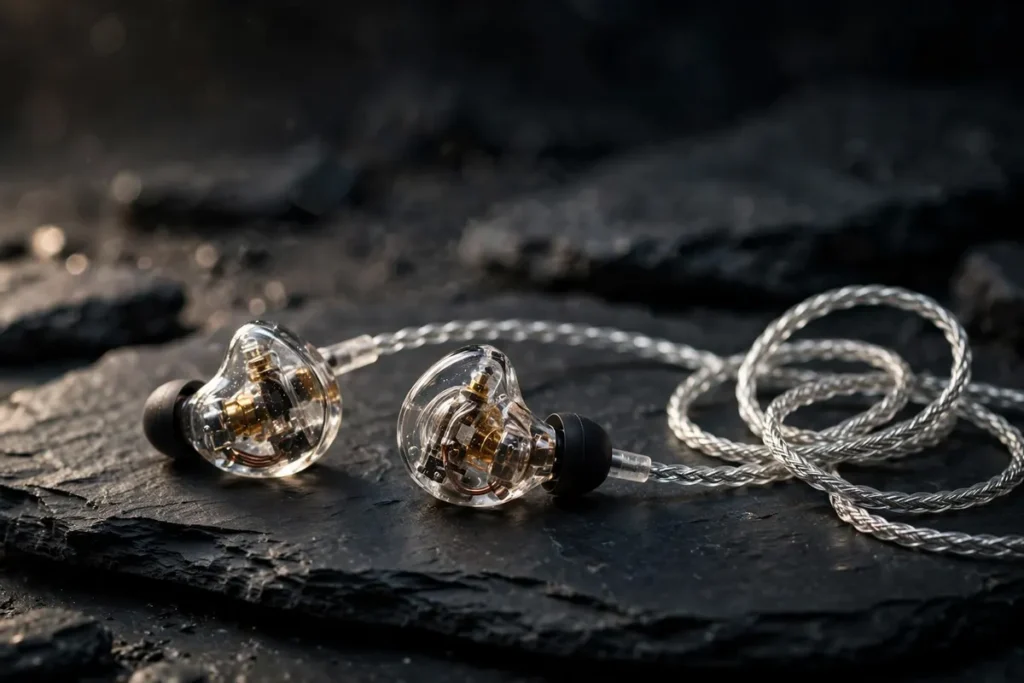
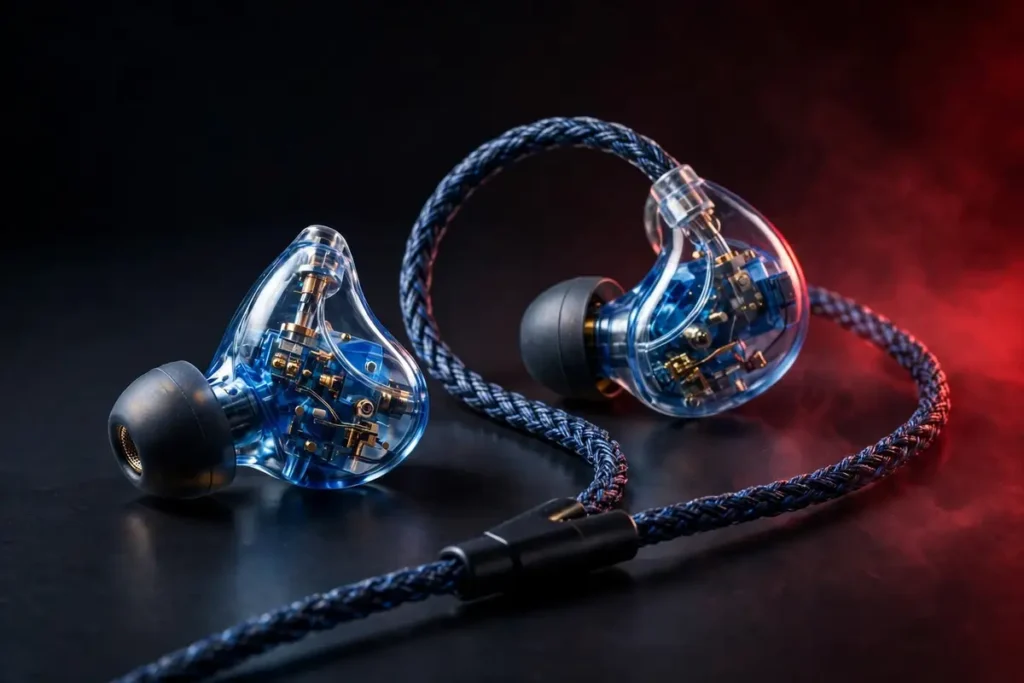
The shells are medical-grade anti-allergic resin in a semi-custom shape with a small stability wing, at 6.1 grams per side. Two finishes exist: the blue Nebula Azure and a red Ember. The cable is a 6N OCC silver-plated design with 400 cores across four strands, on standard 0.78mm 2-pin connectors, and its plugs are modular: 3.5mm single-ended and 4.4mm balanced both come in the box. Reviewers singled the cable out as one of the best stock cables at this level. Silicone tips in three sizes complete the package.
Nebula vs Defiant: what the extra driver changes
The Nebula follows Juzear’s Defiant in the line, and The Headphone List is clear that it is a sibling rather than a straight successor: the published graphs look similar, but the Nebula adds the micro-planar tweeter the Defiant does not have, and the emphasis differs in the ear. Where the Defiant is a four-driver hybrid, the Nebula is a five-driver tribrid with a more elaborate crossover.
| Product | Drivers | Crossover | Treble driver |
|---|---|---|---|
| Juzear x KOTO Nebula | 1DD + 3BA + 1 micro-planar | Four-way, four acoustic tubes | Micro-planar |
| Juzear Defiant | 1DD + 3BA | Hybrid crossover | Balanced armature |
On paper the planar tweeter is the upgrade that matters: it is the driver type this class uses to buy treble extension and air without the hardness balanced armatures can produce. Whether it earns its place is a listening question, and the early reviews suggest it does.
Juzear Nebula specifications
| Product | Juzear x KOTO Nebula Check Price |
| Driver configuration | Custom MACCD dynamic driver + 3 custom balanced armatures + 1 custom micro-planar driver per side |
| Crossover | Four-way electronic crossover, four independent acoustic tubes |
| Impedance | 32Ω |
| Sensitivity | 110 dB ± 1 dB |
| Frequency response | 20 Hz to 20 kHz |
| THD | Under 0.8% |
| Passive isolation | 26 dB (manufacturer rating) |
| Shell | Medical-grade anti-allergic resin, semi-custom shape, 6.1 g per side |
| Connector | 0.78mm 2-pin |
| Cable | 6N OCC silver-plated, 400-core, modular plugs |
| Plugs | 3.5mm single-ended and 4.4mm balanced included |
| Launch price | $129.99 |
Tuning: vocal-forward, W-shaped on paper
Juzear and KOTO describe the target as vocal- and technicalities-focused: forward, expressive vocals over an expansive stage, with bass that reaches deep and then gets out of the way. That is the makers’ framing. The independent descriptions line up with it. The Headphone List heard a fairly pronounced W-shaped signature with a warm overtone, good bass thump and relaxed, extended highs. Mobile Audiophile praised calm, clear vocals and layering it did not expect at this level, while noting the set scales hard with power: medium gain, the balanced plug and a clean amplifier each brought audible gains.
One practical note runs through the coverage. Gizaudio’s take, carried in HiFiGo’s review roundup, is that the Nebula needs a bit of juice, with around 200 mW suggested as the source target. At 32 ohms and 110 dB it will play loudly from almost anything; playing well is the separate question, and buyers planning to run it from a basic phone dongle should expect the good version of this IEM rather than the best one. Our best budget IEMs guide covers the dongles that pair sensibly at this level.
Early coverage
Unlike most launch pages, this one has real reviews to point to. Mobile Audiophile and The Headphone List both published full hands-on reviews, HiFi Oasis covered the Azure finish, and HiFiGo’s roundup collects further verdicts, including a 9.5 out of 10 from Jaytiss. The shared thread is value: reviewer after reviewer describes performance they associate with pricier sets, with caveats aimed at accessories and power appetite rather than the tuning. We credit those verdicts to their authors; our own position stays provisional until measurements settle.
Should you buy now, or wait?
The buy-now case is unusually strong for a launch page, because the evidence already exists. The hardware list is long, the cable and plug system need no immediate upgrade, and the first reviews are positive in the same places. Owners of a balanced source get the version of the Nebula its reviewers describe.
The wait case is narrower. If your only source is a low-power dongle, budget for a better one or pick a less demanding set from the rivals below. If you want pinpoint imaging on large orchestral recordings, Mobile Audiophile flags that as the Nebula’s remaining weakness. And the storage pouch is a soft one, so a hard case is a sensible extra. Our read: listeners with a decent source can buy now with their eyes open.
Also consider
Three sets we have already covered and scored: the proven hybrid, a single-driver saving and a step up.

A 1DD+4BA hybrid that anchors our best IEMs for gaming roundup: proven imaging, a small light shell and a strong stock cable. Its stock cable has no in-line mic, and the upper mids can sound metallic at high volume.

Moondrop’s single-driver all-rounder from our best IEMs roundup: warm-neutral tuning, metal shells and swappable plugs for notably less money. The mid-bass emphasis can sound thick on some tracks, and the stock tips are average.

The tribrid idea taken further: a microplanar tweeter, a three-way crossover and hand-finished resin shells on the proven New Meta tuning. It sits a price tier above the Nebula and is nearly as new.
Frequently asked questions
When was the Juzear Nebula released?
The Nebula debuted at CanJam Singapore on June 8, 2026 and is on sale now through HiFiGo and Amazon US.
How much is the Juzear Nebula?
The launch price is in the quick facts box at the top of this page. It launched at the same US list price at HiFiGo and Amazon, though individual retailers run their own discounts.
Where can I buy the Juzear Nebula?
It is on sale at Amazon US and HiFiGo. The Amazon listing runs under ASIN B0H44MKZ7H for the Azure finish, and the buttons at the top of this page go to both listings.
Is the Juzear Nebula on Amazon?
Yes, under ASIN B0H44MKZ7H (Azure), verified on November 15, 2026. Note that the Amazon listing spells the model name as Ne Bula; the driver configuration and the Azure finish confirm it is this IEM.
What drivers does the Juzear Nebula use?
Five drivers per side: a custom MACCD dynamic driver for bass, three custom balanced armatures for the midrange, and a custom micro-planar driver for treble, joined by a four-way electronic crossover with four independent acoustic tubes.
Does the Juzear Nebula need an amplifier?
Not strictly, at 32 ohms and 110 dB sensitivity it reaches volume from a phone dongle. Reviewers do note it rewards power, though, and suggest a source with around 200 mW or more, ideally on the 4.4mm balanced plug, to hear it at its best.

I am the founder of Sound Mavericks, where I provide the polite truth about audio equipment. I started this site because consumer electronics reviews are often too technical. Instead of using a silent lab, I test headphones, earbuds, and Bluetooth speakers in the real world – like on a noisy subway or in a busy coffee shop.
To stay independent, I buy my own review units (mostly from the United States) rather than accepting free gifts from brands. Once I finish testing a product, I sell it locally to our community. My goal is to help you understand sound quality, active noise cancellation (ANC), and battery life without the marketing hype.