
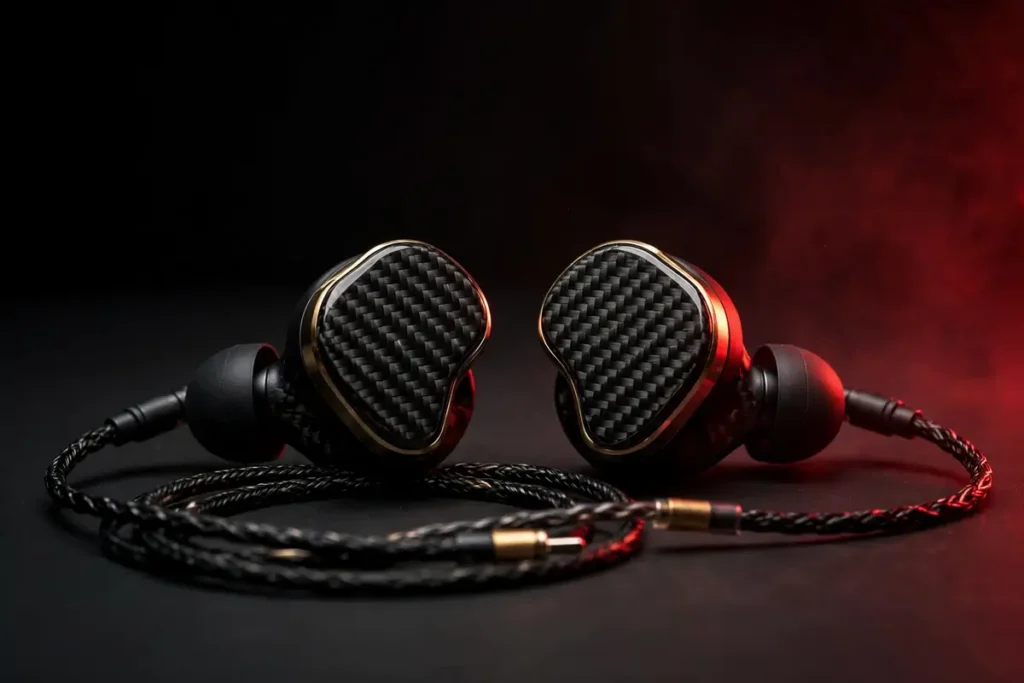
This audeze euclid review covers the Euclid, Audeze’s closed-back planar magnetic in-ear and the smallest application of the driver technology the company is known for in full-size headphones. A single 18 mm planar driver sits in a milled aluminium shell with a carbon fibre faceplate, using the same Fluxor magnet array, Fazor waveguides and Uniforce voice coil ideas as the over-ear range. Our provisional scoring puts it at 5.9 overall on the wired scale, with a 9.2 Sound score that explains why it exists and a Value score that explains why it is a considered purchase.
A note on method. This review is research-based and the scores are provisional. They are built from published measurements, manufacturer specifications and the consensus of specialist reviewers who tested this exact model, scored on the same six-bar scale our headphone database uses. Wired models follow our standard conventions: Battery sits at a neutral 5.0 because there is no battery, and Calls scores 3.0 where the stock cable carries no microphone.

Audeze Euclid 5.9/10
Why you: you want the planar sound, fast, even and detailed across the range, in an in-ear that isolates like a closed design should. There is no crossover, so the whole range comes from one driver and stays coherent in a way multi-driver sets work hard to copy.
Trade-off: it costs flagship money, the shells are large for an in-ear, and there is no microphone or wireless option. Efficiency is good, but it still rewards a clean, reasonably strong source.
Single 18 mm planar magnetic driver · Closed-back · 12 ohms · Fazor waveguides · MMCX braided cable · 15 g per pair
Sound quality
Sound scores 9.2, the highest bar in this review by a wide margin. Reviewers who tested the Euclid reach for the same words: neutrality with clarity through the mids and highs, detail retrieval at a level that invites comparison with full-size planar headphones, and a stage that feels wide for a closed in-ear. Headphone Guru concluded it performs at the level of good open-back planars despite the small closed shell. There is no crossover because there is one driver, and the coherence shows most on complex recordings, where instruments keep their own space instead of smearing at the joins.
The tuning is a reference-leaning one. Bass is present, fast and textured rather than heavy, so bass-led listeners may find the presentation polite where a dynamic driver would thump. That is the planar trade in miniature: speed and evenness over slam. Listeners who know Audeze’s over-ears will recognise the house priorities, and our Audeze LCD-X review covers the same driver philosophy at full size, while the Audeze LCD-XC review shows the closed-back version of the idea for studios.
Isolation and fit
ANC scores 4.0, a passive figure and a good one for an in-ear. The closed-back design brief was partly about isolation: unlike Audeze’s earlier open in-ears, the Euclid seals the ear and blocks a useful share of outside noise without electronics, which makes it viable for travel and shared spaces in a way the open models never were. It still cannot touch active cancelling for low rumble, and buyers who fly weekly should weigh that against the sound quality on offer.
Comfort scores 7.4. At 15 g for the pair without cable the Euclid is light, and the contoured shell with a 5 mm sound port suits many ears well. But the housings are large, as an 18 mm driver demands, and smaller ears may feel the presence over long sessions. Audeze ships SpinFit tips among the options, and tip choice changes both comfort and bass seal more than usual here, so the unboxing experiments are worth the time.
Build, cable and driving it
The build is milled aluminium with carbon fibre faceplates, finished to the standard the price demands, and the package arrives in a hard travel case with a braided MMCX cable. Calls score 3.0 under our wired convention: the stock cable is audio only. Battery scores the neutral 5.0 because there is no battery. Optional cables, including a balanced 4.4 mm version and a Bluetooth receiver cable from Audeze, exist for owners who want them, but they are separate purchases and are not part of this review’s scoring.
Impedance is low at 12 ohms and sensitivity is 105 dB per milliwatt, so the Euclid plays loudly from modest sources. It still scales with a better one: reviewers note tighter control and more dynamic headroom from a capable dongle DAC or portable player than from a basic phone output. Maximum handling is generous and distortion is rated under 0.1 percent at high levels, so the driver is never the bottleneck in a portable chain.
Value and who it suits
Value scores 6.8, and the argument is not about features. The Euclid’s case is that it miniaturises a flagship driver technology into a sealed in-ear with no crossover compromises, for listeners who want one portable set at reference level. Against that, multi-driver rivals at similar money offer more tuning drama and sometimes more accessories, and our best audiophile earbuds guide shows the field it competes in.
It suits listeners who already know they like the planar presentation: even, fast and honest, with detail presented rather than pushed. If your library is bass-led electronic music, sample it first if you can. If your library is acoustic, vocal and orchestral work, the Euclid’s strengths land exactly where your music lives.
How it compares
The comparison that matters is with Audeze’s own open in-ears. The LCDi series offers a wider, more open presentation and asks for EQ or the company’s Cipher cable to sound its best, and it leaks sound both ways. The Euclid takes the opposite brief: sealed, self-contained and consistent from any decent source, with isolation that makes it usable where the open models are not. Listeners who own and love the open models describe the Euclid as the travel answer to the same question.
Against multi-driver flagship rivals, the Euclid’s argument is coherence. A single driver has no crossover points, no driver-matching tolerances between bands and no phase joins to manage. What it gives back is the last measure of low-end physicality that a good dynamic driver produces. Which side of that trade you prefer is a taste question, and it is the right question to ask before spending flagship money on any in-ear.
Audeze Euclid specs
| Spec | Audeze Euclid |
|---|---|
| Design | Wired in-ear monitor, closed-back |
| Driver | Single 18 mm planar magnetic, Uniforce voice coil |
| Magnet structure | Fluxor array, neodymium N50, with Fazor waveguides |
| Impedance | 12 ohms |
| Sensitivity | 105 dB per mW |
| Frequency response | 10 Hz to 50 kHz |
| Distortion | Under 0.1% at 100 dB SPL |
| Cable | Braided MMCX, 3.5 mm |
| Weight | 15 g per pair without cable |
| Microphone | None on the stock cable |
Verdict
Buy the Euclid if you want planar sound in a sealed in-ear and your budget reaches flagship level. A 9.2 Sound score with genuine passive isolation is a rare pairing, and the single-driver coherence is something hybrid sets at this money still chase.
Skip it if you want heavy bass, a microphone or wireless freedom, or if value per feature drives your buying. The 5.9 overall follows our wired conventions, so the Sound bar is the honest headline here.
Frequently asked questions
Is the Audeze Euclid really closed-back?
Yes. It is Audeze’s first closed-back in-ear, unlike the open and semi-open LCDi models. The sealed design gives useful passive isolation, scored at 4.0 here, and makes it practical for travel and shared rooms.
Does the Euclid need a powerful amplifier?
No, but it rewards a good source. At 12 ohms and 105 dB per milliwatt it plays loudly from a phone dongle, and reviewers found better control and dynamics from a capable portable DAC or player.
How does the Euclid differ from full-size Audeze headphones?
It uses the same planar ideas, Fluxor magnets, Fazor waveguides and a Uniforce voice coil, scaled to a single 18 mm driver in an in-ear shell. The presentation is recognisably Audeze: even, fast and detailed, in a portable sealed form.
Does the Euclid have a microphone or Bluetooth?
Not in the box. The stock braided MMCX cable is audio only, so Calls scores 3.0 under our wired convention. Audeze sells optional cables, including a Bluetooth receiver cable, as separate accessories.
Is the Euclid good for bass-heavy music?
It depends on taste. The bass is fast, clean and textured, but the tuning is reference-leaning rather than bass-heavy. Listeners who want physical low-end weight usually prefer a dynamic driver set.

I am the founder of Sound Mavericks, where I provide the polite truth about audio equipment. I started this site because consumer electronics reviews are often too technical. Instead of using a silent lab, I test headphones, earbuds, and Bluetooth speakers in the real world – like on a noisy subway or in a busy coffee shop.
To stay independent, I buy my own review units (mostly from the United States) rather than accepting free gifts from brands. Once I finish testing a product, I sell it locally to our community. My goal is to help you understand sound quality, active noise cancellation (ANC), and battery life without the marketing hype.
