
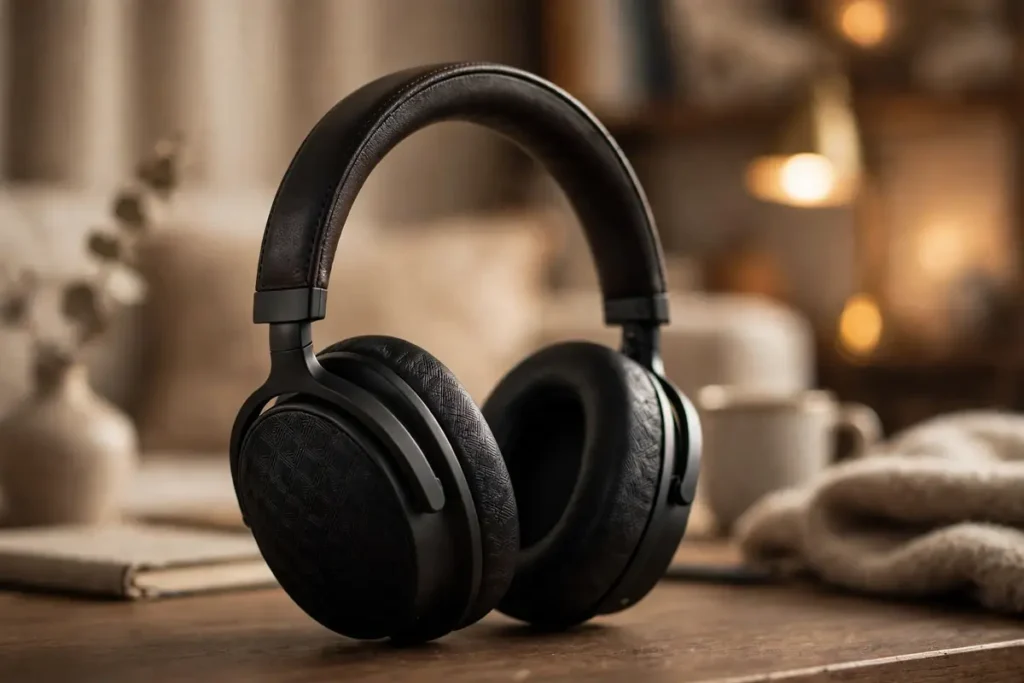
This focal elegia review covers the Elegia, Focal’s closed-back entry in its M-shaped driver family, built for listeners who need the sound to stay in the room they are sitting in. Where the open-back models leak in both directions, the Elegia seals: a 40 mm aluminium-magnesium dome working inside a closed cup, a 35-ohm load tuned for portable sources, and passive isolation that makes it the Focal you can use around family, colleagues and fellow passengers. Its provisional score set lands at 6.0 overall, with sound at 8.4.
A note on method. This review is research-based. The scores are a provisional set built from published measurements and the specialist review consensus for this exact model, cross-checked against the verified Amazon US listing. Focal’s closed-back line has since moved to newer models, covered in our Focal Celestee review and our Focal Stellia review; the Elegia is the design that started that line, and it is judged here on its own record.

Focal Elegia 6/10
Why you: you want Focal’s driver work in a closed-back you can use around other people, with a 35-ohm load that phones and portable players drive without an amp. Sound scores 8.4 and the isolation is real, not a spec-sheet promise.
Trade-off: the closed-back stage is narrower than the open Focal models, and the stock tuning carries a midrange dip some listeners EQ out. It is discontinued, has no microphone, and the short stock cable suits portable use better than a desk across the room.
40 mm aluminium-magnesium M dome · Closed-back · 35 Ω · 105 dB · 430 g · Detachable cable
Sound quality
Sound scores 8.4. The Elegia keeps the family traits that matter: driver speed, clean transients and detail that survives busy recordings. Bass inside the sealed cup is disciplined, with weight that stops when the recording stops, and the treble carries the Focal clarity without the hard edge cheaper closed-backs often add. It sounds like a Focal first and a closed-back second, which was the design brief.
The closed-back costs are real and worth naming. The stage sits narrower than the open models, with images placed closer and less air around them, and the stock tuning carries a dip in the mids that sets some vocal detail back. Both are common to the format; our explainer on open-back vs closed-back headphones covers the physics behind them. The dip responds well to a small EQ lift, and many owners run exactly that. Judged inside its own format, the Elegia holds up well against the closed-back field in our best headphones for audiophiles coverage.
Isolation and everyday use
The cancelling bar scores 3.8, and the number needs its context: there is no active noise cancelling, so the score reflects passive isolation only. The seal and the pads hold back office chatter, household noise and a good share of travel rumble, and just as important, your music stays in the cups. For shared rooms and open offices, that two-way quiet is the feature the open-back models cannot offer at any price.
The 35-ohm impedance and 105 dB sensitivity make the Elegia the easiest Focal in this family to drive. Phones, laptops and portable players reach full volume without an amp, and the short 1.2 m stock cable with its 3.5 mm plug suits that portable use. Desk listeners sitting far from their amp may want a longer second cable; the connectors are standard and replacements are easy to find. There is no microphone on the stock cable, so calls score 3.0 under the wired convention.
Design, fit and comfort
Comfort scores 8.2. The memory foam pads seal without a hard clamp, the leather and microfibre headband spreads the 430 grams evenly, and the fit stays settled over long sessions. Closed cups trap more warmth than open ones, so very long sessions in warm rooms may want a short break; that is the format, not a flaw in this execution.
The build matches the family: aluminium yokes, a solid and damped adjustment action, and a rigid case in the box. The black and silver finish of the standard model is the one to check listings against, since photos of other Focal models circulate in marketplace listings for this headphone. The cups do not fold flat, so the case is the travel solution, and it takes real bag space.
The score, explained
The 6.0 overall is the mean of the six bars. Battery is 5.0 because there is no battery; the figure is a neutral placeholder wired models carry. Calls are 3.0 because there is no microphone. The cancelling bar at 3.8 grades passive isolation against a scale built for active systems, which understates how quiet the headphone feels in a shared room. Judge the Elegia on Sound 8.4, Comfort 8.2 and Value 7.4.
Value carries the discontinued footnote. The Elegia now trades as remaining and third-party stock at terms that vary widely, and at the softer end of that spread it is strong value: flagship-family drivers and build at a mid-tier outlay. At the firm end, newer closed-back models with full warranties compete hard. The 7.4 sits between those two readings, and the advice is to price the specific listing in front of you rather than the model’s reputation.
Who it suits, and who it does not
The Elegia suits the listener in a shared home: the partner reading in the same room, the family in the next one, the colleague two desks over. It also suits the traveller who wants wired quality without broadcasting it, and the portable-first buyer whose source is a phone or a small player and who has no plans to buy an amp. Its easy drive is not a compromise here; it is the point.
It does not suit the soundstage-first listener, who should stay with the open-back models and accept the leak that comes with the width. It does not suit buyers who need active cancelling for flights, where the passive seal alone leaves engine drone partly in place. And it does not suit anyone who wants a current model with a long support runway. Within its brief, though, the Elegia is complete: nothing about the listening feels like a cut-down version of the open-back flagships, just a different answer to a different room.
| Spec | Focal Elegia |
|---|---|
| Design | Over-ear, closed-back, wired |
| Driver | 40 mm aluminium-magnesium M-shaped dome |
| Frequency response | 5 Hz to 23 kHz |
| Impedance | 35 Ω |
| Sensitivity | 105 dB SPL / 1 mW @ 1 kHz |
| Weight | 430 g |
| Cable | Detachable 1.2 m cable, 3.5 mm plug with 6.35 mm adapter |
| Microphone | None |
Verdict
Buy the Elegia if you want Focal sound in a headphone that respects the room: closed-back isolation, an easy drive from portable sources, and build quality from the flagship family. The 8.4 Sound score is a strong result for a sealed design, and the 6.0 provisional overall reflects wired conventions more than any weakness in the listening.
Skip it if soundstage width is your first priority, where the open-back models win, or if you need a microphone or active cancelling. For quiet, private listening in shared spaces, the Elegia remains the sensible Focal, and it earns that place on the bars that describe it.
Frequently asked questions
Is the Elegia open-back or closed-back?
Closed-back. It was Focal’s first closed-back in this driver family, built for listening around other people and in rooms where an open-back would disturb the house. The seal gives real passive isolation, and the sound stays in.
Does the Elegia need an amplifier?
No. At 35 ohms and 105 dB sensitivity it was designed for portable players and phones, and it reaches full volume from them easily. A better source still improves control, but an amp is an upgrade here, not a requirement.
How does the Elegia sound next to the open-back Elear?
Tighter and more contained. The Elegia keeps the family’s speed and detail, with a stage that sits closer and bass that stays disciplined inside the sealed cup. The Elear sounds wider and freer in a quiet room. The Elegia is the one you can use in a shared room.
Is the Focal Elegia discontinued?
Yes. Focal’s closed-back line has moved on to later models, and the Elegia now trades as remaining and third-party stock. Prices and warranty terms vary by seller, so check both before buying.
Does the Elegia have a microphone?
No. The included cable carries no microphone or remote. Calls and voice chat need a separate microphone or a third-party cable with one built in.

I am the founder of Sound Mavericks, where I provide the polite truth about audio equipment. I started this site because consumer electronics reviews are often too technical. Instead of using a silent lab, I test headphones, earbuds, and Bluetooth speakers in the real world – like on a noisy subway or in a busy coffee shop.
To stay independent, I buy my own review units (mostly from the United States) rather than accepting free gifts from brands. Once I finish testing a product, I sell it locally to our community. My goal is to help you understand sound quality, active noise cancellation (ANC), and battery life without the marketing hype.
