
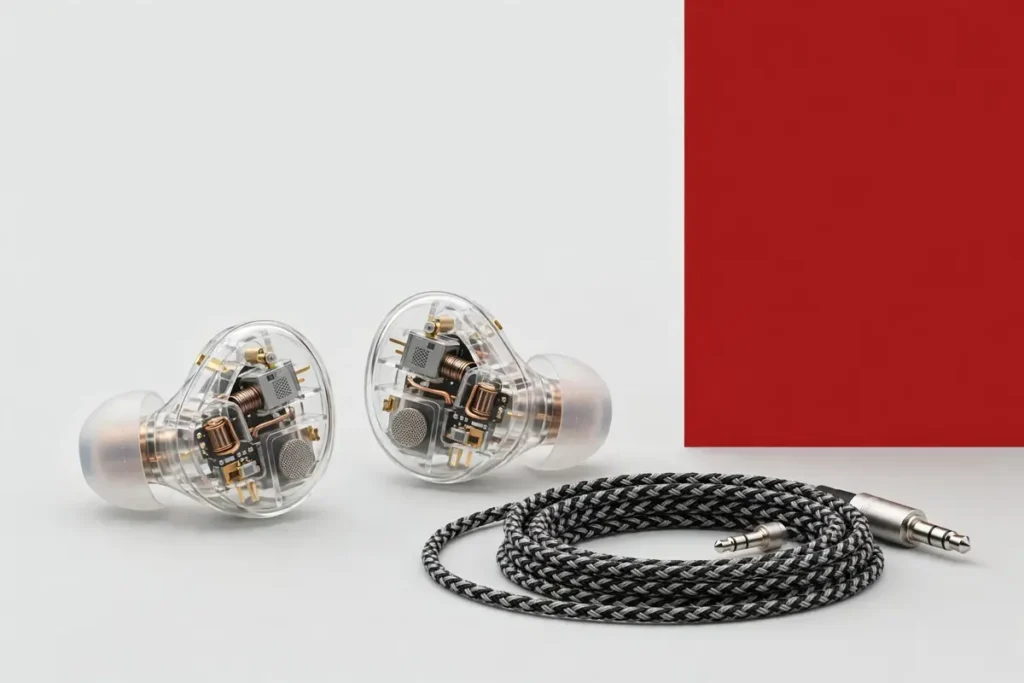
This 1MORE Penta Driver P50 review covers the wired in-ear headphone that took the company’s multi-driver count to five: an 11mm diamond-like carbon dynamic driver working with four balanced armatures in each earpiece, fed by a detachable MMCX cable. Some retail roundups file the P50 among wireless earbuds. It is not one. There is no battery, no Bluetooth and no pairing here, just a hybrid in-ear monitor design aimed at listeners who still plug in.
A note on method. This is a research-based review, built from 1MORE’s published specifications for the P50 (model EH904), the verified Amazon US listing for this exact model, and the wider review record. The scores are our provisional assessment on the SoundMavericks scale, using the standard wired conventions: a neutral 5.0 battery placeholder because there is no battery to rate, a passive noise-control score because isolation comes from the ear tip seal, and a calls score that credits the MEMS in-line microphone against the basic-mic norm. Nothing here is presented as hands-on lab testing.

1MORE Penta Driver P50 6.4/10
Why you: you want hybrid in-ear detail without the flagship bill. The dynamic driver gives the low end body while four balanced armatures divide the mids and treble, and sound scores 8.2, the highest bar on this card by a clear margin.
Trade-off: it is wired only, isolation is passive, and the overall of 6.4 is pulled down by wired conventions, including a battery placeholder for a battery that does not exist. Judge this earphone on its sound and value bars.
Wired MMCX · 1 dynamic + 4 BA · MEMS mic · Hi-Res certified
Sound quality
The driver split is the design in one line. The 11mm dynamic driver, with a diamond-like carbon diaphragm, covers the bass and lower mids, where a moving diaphragm gives weight and texture that balanced armatures struggle to match. Four balanced armatures then divide the upper mids and treble between them, which is where hybrid designs earn their keep: each armature works in a narrow band, and the result is cleaner layering through the frequencies where vocals, strings and cymbals live. Sound scores 8.2.
Against the company’s own ladder, the P50 sits above the Triple Driver in-ear in driver count and ambition. Listeners comparing the two should read our 1MORE Triple Driver in-ear review for the simpler three-driver formula; the P50 is the step up for people who want more resolution in the top half of the spectrum and a cable they can replace. The tuning keeps 1MORE’s house character: present bass with shape to it, a midrange that stays in the picture, and treble with enough extension to show off the armature count without turning harsh on ordinary recordings.
Hi-Res Audio certification is printed on the box, and for once the hardware backs the badge: a five-driver hybrid with a proper crossover is exactly the kind of design that can use a good source file and a decent dongle DAC. Fed from a phone’s basic adapter it still sounds like itself, just slightly less open at the top. The earphones reward better sources without punishing ordinary ones, which is the right balance for a wired set at this tier.
Isolation, not noise cancelling
There is no active noise cancelling. Isolation is passive, from the seal the ear tips make in the canal, and in-ear designs seal better than most: the noise-control score of 4.2 is the highest passive band we give wired earphones, earned because a well-fitted IEM blocks a genuinely useful slice of everyday noise. Office chatter, street sound and train wash all drop to background level with the right tip size.
The honest limit is the same as every passive design. Low engine drone on a flight passes through in a way ANC earbuds would erase, and no tip choice closes that gap. What passive isolation returns for the trade is consistency: it never runs flat, never adds hiss, and never changes how the music sounds. For desk work, commuting and general listening it covers most of what most people need.
Calls and the MEMS microphone
Calls score 6.0, above the wired norm, and the reason is the microphone. The cable’s remote carries a MEMS mic rather than the cheapest electret capsule, and it shows in clarity: voices are crisp indoors and hold up in moderate street noise, and the three-in-one control handles calls, playback and volume without the phone leaving your pocket.
Keep expectations in class. There is no noise reduction processing behind the mic, so a windy platform or a busy roadside will still push your surroundings into the call. For desk calls, quick check-ins and voice notes it is genuinely good. For long calls in bad environments, a headset with a boom or a modern multi-mic earbud remains the better tool. Within the wired in-ear class, though, 6.0 is a strong result, and it is one of the P50’s quiet advantages over rivals that treat the mic as an afterthought.
Comfort, build and the MMCX cable
Comfort scores 7.8. The housings are compact for a five-driver design, the cable routes in the usual in-ear monitor style, and long sessions pass without the ache that larger shells can cause. As with every IEM, the fit is decided by the ear tips: the right size seals well and stays put, the wrong size does neither, and the minutes spent trying sizes are the cheapest sound upgrade available.
The build decision that matters most is the connector. The cable attaches by MMCX, the rotating standard across the in-ear monitor world, so it detaches cleanly. A worn cable becomes a low-cost replacement instead of a dead earphone, and owners can swap in an upgrade cable or a Bluetooth adapter cable later. Fixed-cable rivals, including some of this company’s own earlier models, cannot offer that. In a category where cables are the first thing to fail, the detachable standard is worth real money over the life of the product, and it is a large part of why the P50 earns its place in our best in-ear monitors coverage.
Everyday use
The P50’s daily pattern is the wired one: plug in, listen, no charging routine and no pairing menu. Latency is zero, which makes it a natural fit for video and gaming as well as music. The friction is the modern phone, which usually means a dongle between the cable and the USB-C port. A decent dongle DAC is a small cost, improves on most phones’ old built-in output, and turns the P50 into a pocket listening setup that wireless earbuds at this tier cannot match for fidelity.
It also travels well in the other direction. The same earphones that work from a phone work from a laptop, a controller, a handheld console or a desktop interface without any of them exposing a weakness, and they sit comfortably in the wired wing of our best IEMs coverage: models bought for sound first, with convenience scored honestly rather than assumed. Nothing about the P50 expires. The cable is replaceable, there is no battery to fade, and the driver technology does not date the way Bluetooth versions do.
1MORE Penta Driver P50 specs
| Spec | 1MORE Penta Driver P50 |
|---|---|
| Driver | 11mm DLC dynamic + 4 balanced armature (penta-driver hybrid) |
| Model | EH904 |
| Noise control | Passive in-ear isolation (no active noise cancelling) |
| Battery | None, fully wired (5.0 on our card is the neutral wired placeholder) |
| Cable | Detachable MMCX, MEMS in-line microphone with 3-in-1 control |
| Extras | Hi-Res Audio certified |
Verdict
Buy the Penta Driver P50 if you want hybrid in-ear sound with a replaceable cable and a mic that respects your callers. Sound at 8.2 is the headline, value at 7.2 is fair for a five-driver design, and the MMCX connector quietly fixes the failure mode that kills most wired earphones. The 6.4 overall is a wired-convention average, not a listening verdict.
Skip it if you need wireless freedom, real noise cancelling for flights, or the simplest possible one-piece earphone. Listeners who want the same house sound with fewer drivers and a lower tier should start with the Triple Driver in-ear instead.
Frequently asked questions
Is the 1MORE Penta Driver P50 wireless?
No. The P50 is a fully wired in-ear headphone, despite some retail roundups filing it with wireless earbuds. It connects by cable, has no battery and needs no pairing. Phones without a headphone jack need a USB-C or Lightning dongle.
What does penta driver mean on the P50?
Five drivers per earpiece: an 11mm diamond-like carbon dynamic driver for bass and body, plus four balanced armature drivers covering the mids and treble. The split lets each driver work in the range it handles best instead of asking one driver to cover everything.
What is the MMCX connector for?
MMCX is the rotating connector where the cable meets each earpiece. Because the cable detaches, a worn cable is a cheap replacement, and owners can swap in upgrade cables or a Bluetooth adapter cable without replacing the earphones.
Does the Penta Driver P50 have noise cancelling?
No active noise cancelling. Isolation is passive, from the seal of the ear tips in the ear canal, and in-ear designs seal well, which is why it scores 4.2 for noise control. It will not erase plane engine drone the way ANC earbuds do.
How is the P50 microphone for calls?
Better than most wired in-line mics. The MEMS microphone in the cable remote scores 6.0 for calls in this review: clear in quiet and moderate noise, with a three-button control for calls and playback. Wind and heavy traffic will still get through, as with any cable mic.

I am the founder of Sound Mavericks, where I provide the polite truth about audio equipment. I started this site because consumer electronics reviews are often too technical. Instead of using a silent lab, I test headphones, earbuds, and Bluetooth speakers in the real world – like on a noisy subway or in a busy coffee shop.
To stay independent, I buy my own review units (mostly from the United States) rather than accepting free gifts from brands. Once I finish testing a product, I sell it locally to our community. My goal is to help you understand sound quality, active noise cancellation (ANC), and battery life without the marketing hype.
