
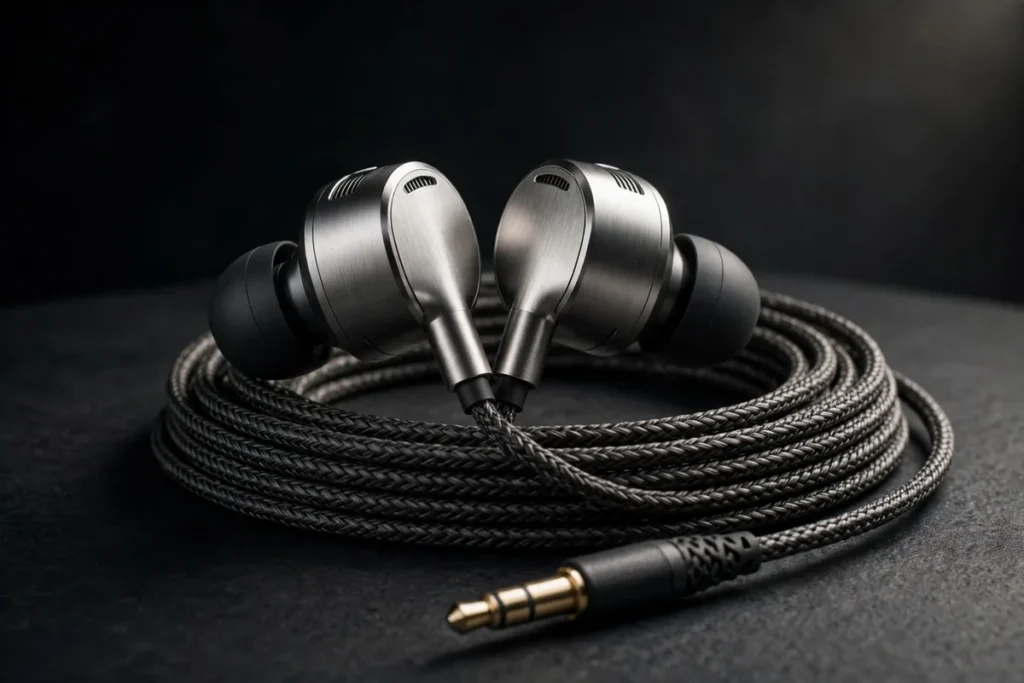
This 1MORE Triple Driver in ear headphones review covers the wired earphone that taught a mainstream audience what a hybrid driver setup could do. Each side packs two balanced armature drivers and one dynamic driver into a metal housing, a configuration that used to belong to far pricier in-ear monitors, and sends the result down a cable: no battery, no pairing, no latency. The scores below are our research-based assessment on the SoundMavericks scale, and the low overall needs context: it reflects the wired conventions on our card, not the sound, which scores 8.4 on its own.
A note on method. This is a research-based review, built from 1MORE’s published specifications, the verified Amazon US listing for this exact model and the wider review record. The model predates our headphone database’s coverage, so its scores are a provisional assessment made for this review, using our standard wired conventions: a neutral 5.0 battery placeholder, because there is no battery to rate, and a passive noise-control score, because the isolation comes from the ear tips. Nothing here is presented as hands-on lab testing.

1MORE Triple Driver In-Ear Headphones 6.7/10
Why you: you want wired sound quality that wireless earbuds at this level cannot touch. Two balanced armatures over a dynamic driver give detail that scores 8.4, and value scores 8.6 because there is nothing to charge or pair.
Trade-off: isolation is passive only, the cable is fixed rather than detachable, and the in-line mic is serviceable rather than good. The 6.7 overall reflects wired conventions, not the listening.
Wired 3.5mm · 2 BA + 1 dynamic · 32 Ω · In-line mic · 18 g
Sound quality
The hybrid layout is the whole story. The dynamic driver handles bass and lower mids, where its size gives real weight, while the two balanced armatures divide the upper mids and treble between them. That split is why these earphones resolve detail that single-driver rivals smear: cymbal decay, room reverb on live recordings, the edge on a vocal. The tuning, developed with Grammy-winning mixer Luca Bignardi, aims for a mild V shape, lifted bass and treble with a midrange that stays present rather than scooped out. Sound scores 8.4, a figure wireless earbuds several times the price work to reach.
Bass deserves a precise word. It is full and textured, and kick drums have genuine body, but it stops short of the heavyweight slam that bass-first models chase. Listeners who want their low end to dominate should look elsewhere; listeners who want to hear what the bassist played will be happy. The earphones are also easy to drive at 32 ohms and 99 dB sensitivity, so a phone, a laptop or a basic dongle DAC gets them loud without strain, and a better dongle tightens the low end further. Owners stepping up from here usually look at the same family’s flagship, covered in our 1MORE Quad Driver review, which adds a fourth driver and a step of refinement.
Isolation, not noise cancelling
There is no active noise cancelling, and the ANC bar of 3.8 on the card records that honestly. What the Triple Driver offers is passive isolation: a sealed fit from the ear tips that blocks a useful slice of everyday noise. With the right tip size the seal is good enough to take the edge off office chatter, street noise and train rumble, and the wide selection of tips in the box makes finding that seal easier than usual.
Set expectations against the right rivals. On a plane, a decent ANC earbud will silence far more, and no tip fit closes that gap. What passive isolation never does is run out of battery, add hiss, or change how the music sounds, and for desk work, walks and general listening it covers most of what people actually need. The trade is stated plainly so the score makes sense: this bar measures a feature the earphone deliberately does not have.
Calls and the in-line microphone
A MEMS microphone sits in the in-line remote on the cable, and calls score 6.4. Indoors and in quiet streets it is perfectly serviceable: voices are clear, the mic sits close enough to your mouth to pick up well, and the three-button remote handles calls and playback without reaching for the phone. The volume buttons are most reliable on Apple devices; on some Android phones they may not adjust volume even though calls and the play button work normally.
Outdoors in wind or traffic, the limits show. There is no noise reduction processing behind the mic, so your surroundings arrive with your voice. Treat the microphone as a convenience for quick calls rather than a tool for important ones, which is a fair description of nearly every in-line mic ever made.
Comfort and build
Comfort scores 8.2, and the design explains it. The metal housings are small, the nozzles angle obliquely to follow the ear canal rather than fight it, and at 18 grams the whole set weighs less than a single wireless earbud case. Hours of wear pass without the hot spots that larger in-ear monitors can cause, provided the tip size is right. The cable is braided over a Kevlar core, which resists tangling better than plain rubber and has a good survival record, but it is fixed: if it fails, the earphones fail with it, the standing risk of this design.
The box contents are generous for the class, with a wide range of silicone and foam tips and a hard carry case with a magnetic clasp. That case matters in practice, because wired earphones live in pockets and bags where cases earn their keep. Build quality overall is a cut above the disposable end of wired earphones: metal shells, tidy strain relief and a plug that feels made to be used daily.
The tip selection is worth experimenting with rather than treating as spares. Silicone tips keep the sound at its brightest and are the better choice for detail work. The foam tips seal more completely, which brings the bass up, improves the passive isolation by a clear step and softens the top end slightly. Many owners settle on foam for travel and silicone at a desk, which amounts to two tunings from one earphone. Either way, the seal is the single biggest variable in how these sound, and it costs nothing but a few minutes to get right.
Gaming and everyday use
Wired earphones have one advantage no wireless model can answer: zero latency. Sound and picture stay locked together in games and video, and the detailed treble that flatters music also places footsteps and positional cues cleanly in shooters. That is why wired sets like this one keep appearing in our best IEMs for gaming coverage despite having no gaming branding at all. The in-line mic covers casual team chat; competitive players will still want a dedicated microphone.
The everyday friction is the modern phone. With headphone jacks gone from most flagships, the Triple Driver usually reaches a phone through a USB-C or Lightning dongle. That is a small cost and a small adapter to carry, and a decent dongle DAC improves on most phones’ old built-in jacks anyway. On laptops, consoles, controllers and anything with a 3.5mm socket, it is simply plug and play, forever, with nothing to charge before a trip.
Source pairing is forgiving, which is part of the appeal. At 32 ohms with 99 dB sensitivity, these earphones reach full volume from almost anything, and they do not hiss from sensitive outputs the way some balanced-armature sets can. A basic dongle gets you the full performance for music on the move. A desktop DAC and amp add grip in the bass and a wider sense of space on good recordings, but the step is refinement rather than rescue, and nobody needs to buy hardware to enjoy what the Triple Driver does. That easygoing nature is why the same set keeps working across a phone, a handheld console, a controller and a studio interface without any of them exposing a weakness. One earphone, every socket, no settings menu: that is the wired bargain in a sentence, and the Triple Driver is one of its clearest examples.
1MORE Triple Driver specs
| Spec | 1MORE Triple Driver In-Ear Headphones |
|---|---|
| Driver | 2x balanced armature + 1 dynamic (hybrid triple driver) |
| Noise control | Passive isolation from ear tips (no active noise cancelling) |
| Battery | None, fully wired (5.0 on our card is the neutral wired placeholder) |
| Impedance | 32 ohms |
| Sensitivity | 99 dB |
| Weight | 18 g |
| Cable | Braided cable (fixed), 3.5mm plug, in-line MEMS mic with three-button remote |
| Extras | Hi-Res Audio certified, wide ear tip selection, hard carry case |
Verdict
Buy the 1MORE Triple Driver if sound per pound of kit is your measure and you are content with a cable. Sound at 8.4 and value at 8.6 are the bars that describe the listening, and they put this earphone ahead of most wireless sets anywhere near its tier. It is a fixture of our best wired earbuds coverage because the formula has no expiry date: no battery to degrade, no codec to fall behind, nothing to update.
Skip it if you need real noise cancelling for flights, if a fixed cable worries you, or if your phone life has no room for a dongle. Read the 6.7 overall correctly, too: it is the average of a card where two bars measure things a wired earphone deliberately skips. Judged on the listening alone, this remains one of the easiest recommendations in wired audio.
Frequently asked questions
Do the 1MORE Triple Driver earphones need charging?
No. They are wired earphones with a 3.5mm plug and no battery at all. Phones without a headphone jack need a USB-C or Lightning dongle DAC, which also tends to improve the sound.
Do the 1MORE Triple Driver earphones have noise cancelling?
No active noise cancelling. Isolation is passive, from the seal of the ear tips, which is why trying the included tip sizes matters. A good seal blocks a useful amount of everyday noise but will not match ANC earbuds on a plane.
Does the 1MORE Triple Driver microphone work with iPhone and Android?
The in-line MEMS microphone and the play/pause button work on both platforms. The volume buttons are most reliable on Apple devices; on some Android phones they may not adjust volume, though calls and playback control still work.
What is the difference between the 1MORE Triple Driver and Quad Driver?
The Quad Driver adds a fourth driver, a diamond-like carbon unit, in a larger housing, and sits a step above in refinement and price. The Triple Driver is the lighter, simpler model and the better value of the two for most listeners.
Are the 1MORE Triple Driver earphones good for gaming?
Yes, for the wired reason: there is no Bluetooth latency at all, and the detailed treble makes footsteps and positional cues easy to place. The in-line mic is fine for casual chat, though streamers will want a dedicated microphone.

I am the founder of Sound Mavericks, where I provide the polite truth about audio equipment. I started this site because consumer electronics reviews are often too technical. Instead of using a silent lab, I test headphones, earbuds, and Bluetooth speakers in the real world – like on a noisy subway or in a busy coffee shop.
To stay independent, I buy my own review units (mostly from the United States) rather than accepting free gifts from brands. Once I finish testing a product, I sell it locally to our community. My goal is to help you understand sound quality, active noise cancellation (ANC), and battery life without the marketing hype.
