
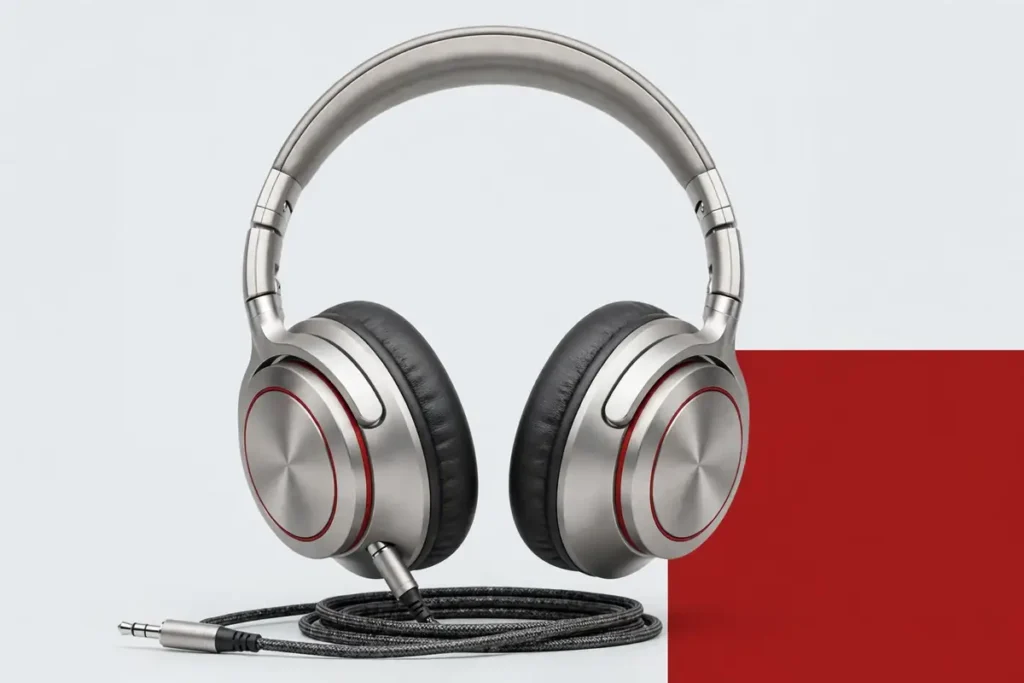
This 1MORE Triple Driver over ear headphones review covers the H1707, the full-size headphone that took the company’s triple-driver idea out of the ear canal and closed it inside an over-ear cup. One distinction matters before anything else: this is not the in-ear Triple Driver. That wired earphone has its own following and its own review on this site. The H1707 is a different product entirely, a closed-back over-ear where a 40mm graphene driver, a ceramic tweeter and a passive bass reflector share each cup, connected by cable from end to end.
A note on method. This is a research-based review, built from 1MORE’s published specifications, the verified Amazon US listing for the graphene-driver revision in its Silver and Titanium finish, and the wider specialist review record. The scores are our provisional assessment on the SoundMavericks scale, using the standard wired conventions: a neutral 5.0 battery placeholder, because there is no battery to rate, and a passive score for noise control, because the isolation comes from the cups and pads. Nothing here is presented as hands-on lab testing. Availability has thinned to third-party offers, and the copy says so where it matters.

1MORE Triple Driver Over-Ear Headphones (H1707) 6.1/10
Why you: you want the multi-driver detail of the in-ear Triple Driver with the bass weight and room that only a full-size cup gives. The graphene driver, ceramic tweeter and bass reflector divide the work three ways, and sound scores 7.9 with value at 7.6.
Trade-off: isolation is passive only, despite some retail copy calling this headphone noise cancelling. There is no battery to rate, so the neutral 5.0 placeholder pulls the overall to 6.1, a wired-convention figure rather than a verdict on the listening.
Wired 3.5mm · Triple driver · 32 Ω · In-line mic · 293 g
Sound quality
Three parts share the work in each cup. The 40mm graphene dynamic driver covers the bass and mids, where a full-size diaphragm moves enough air to give kick drums and bass lines real body. A ceramic tweeter handles the top end, which is where the detail lives: cymbal texture, string bite, the front edge of a vocal. The third element, a passive bass reflector, reinforces the low frequencies without asking the main driver to work harder. It is the same divide-and-specialise thinking as the in-ear model, executed at over-ear scale.
The tuning that results is bass-driven but not bass-blind, and specialist reviewers who covered the H1707 praised exactly that balance at its tier. Low end arrives with weight and shape rather than a single thump, and the tweeter keeps the presentation from going dark. Sound scores 7.9. It sits below the refinement of the company’s own flagship in-ear, covered in our 1MORE Quad Driver review, and above most single-driver over-ears at this level, which tend to choose between bass quantity and treble clarity. The H1707 mostly declines to choose.
Which revision you are looking at matters. The H1707 was sold in two versions: an earlier titanium-driver build and the later graphene-driver revision. The listing this review is built on, and the one specialist reviews link, is the graphene version in the Silver and Titanium finish. The two are close relations rather than different headphones, but the graphene driver is the one with the review record behind it, and it is the one to buy if both turn up.
Isolation, not noise cancelling
Some retail copy for the H1707 uses the words noise cancelling. It should not. There is no active noise cancelling system here, no microphones sampling the room and no processor cancelling anything. What the headphone offers is passive isolation from a closed-back cup and a padded seal around the ear, and the ANC bar of 3.5 records that honestly.
Passive isolation from a closed over-ear is still useful. It takes the edge off office noise, street sound and the general wash of a commute, and because it is mechanical it never runs flat, never hisses and never changes the tuning. What it cannot do is erase engine drone on a flight the way a proper ANC headphone does. If silent travel is the priority, this is the wrong tool and the score says so. If your listening happens at a desk, on a sofa or on a train where moderate quiet is enough, the closed cup covers it.
Calls and the in-line microphone
The cable carries an in-line microphone and remote, and calls score 5.5. That figure sits above the 3.0 we give wired headphones with no microphone at all, and below anything with a proper multi-mic array. Indoors, voices come through clearly enough for everyday calls, and the remote handles answering and playback without reaching for the phone.
Outdoors, the limits are the usual in-line ones. The mic sits on the cable wherever the cable hangs, and there is no noise reduction processing behind it, so wind and traffic arrive in the call alongside your voice. Treat it as a convenience for quick conversations rather than equipment for important ones. That is a fair description of nearly every cable mic, and the H1707 is neither better nor worse than the class norm.
Comfort and build
Comfort scores 7.2. At 293 grams the H1707 is light for a full-size closed-back, the pads are soft, and the folding design means the cups sit flat when the headphone comes off. Ordinary listening sessions pass without complaint. The pressure is spread around the ear rather than on it, which is the over-ear advantage over on-ear rivals, and the headband padding does its job on longer stretches.
The cable deserves its own sentence, because on a wired headphone the cable is the product’s weak point by design. Here it detaches from the earcup, so a worn or damaged cable is a cheap replacement instead of a repair bill, and the cable itself is built to resist tangling. That one decision extends the useful life of the headphone more than any other in the design. The folding frame and the detachable cable together make this a headphone that tolerates being carried, packed and used daily, which is the life most headphones at this tier actually lead.
Everyday use and sources
At 32 ohms the H1707 asks nothing special of its source. A phone through a dongle, a laptop, a games controller: all of them drive it to full volume without strain. A better DAC and amp add a measure of grip in the bass and a wider sense of space on well-recorded material, but that is refinement, not rescue. Owners of the in-ear sibling, the model in our 1MORE Triple Driver in-ear review, will find the same easygoing behaviour scaled up: plug in, press play, no settings to manage.
The H1707 also holds a steady place in our best wired headphones coverage for a simple reason: nothing about it expires. There is no battery to degrade, no Bluetooth version to fall behind, no app to be abandoned. The compromises are the wired ones, stated plainly: a cable, passive isolation, and availability that now runs through third-party sellers rather than a factory buy box. Buyers who accept those terms get a headphone that sounds well above its station.
1MORE Triple Driver Over-Ear (H1707) specs
| Spec | 1MORE Triple Driver Over-Ear Headphones (H1707) |
|---|---|
| Driver | 40mm graphene dynamic + ceramic tweeter + passive bass reflector |
| Noise control | Passive closed-back isolation (no active noise cancelling) |
| Battery | None, fully wired (5.0 on our card is the neutral wired placeholder) |
| Impedance | 32 ohms |
| Weight | 293 g |
| Cable | Detachable, tangle-resistant, in-line microphone and remote |
| Extras | Hi-Res Audio certified, folding earcups |
Verdict
Buy the H1707 if you like the multi-driver idea and want it in a full-size headphone that needs nothing but a socket. Sound at 7.9 and value at 7.6 are the bars that describe the listening, and the detachable cable plus folding frame make it a practical daily headphone rather than a delicate one. Read the 6.1 overall correctly: it is dragged down by bars that measure things a wired headphone deliberately does not have.
Skip it if you need real noise cancelling, if you want wireless freedom, or if the thinning third-party availability puts you off. And if what you actually want is the earphone version, that is a different product with a different review; the two share a name, not a design.
Frequently asked questions
Is the 1MORE Triple Driver Over-Ear the same as the Triple Driver in-ear earphones?
No. They are two different products that share a name and a three-driver idea. The in-ear model puts two balanced armatures and a dynamic driver in each earpiece. The H1707 covered here is a full-size closed-back over-ear headphone with a 40mm graphene driver, a ceramic tweeter and a passive bass reflector in each cup.
Do the 1MORE Triple Driver Over-Ear headphones have noise cancelling?
No active noise cancelling, despite some retail copy using the phrase. The H1707 is a passive closed-back headphone: the earcups and pads block some outside noise, but there is no ANC system and no battery to power one.
Is the cable on the H1707 detachable?
Yes. The cable detaches from the earcup, which makes replacement simple if it wears out, and the cable itself is designed to resist tangling. An in-line microphone and remote ride on the cable for calls and playback control.
Does the 1MORE Triple Driver Over-Ear need an amplifier?
No. At 32 ohms it runs happily from a phone dongle, a laptop or a controller. A desktop DAC and amp can add grip and space on good recordings, but nothing about this headphone requires extra hardware to reach full volume.
Does the H1707 fold for travel?
Yes. The earcups fold so the headphone packs flatter in a bag, and at 293 grams it is light enough to carry daily. It remains a full-size headphone though, so it takes more room than an in-ear set or a compact on-ear.

I am the founder of Sound Mavericks, where I provide the polite truth about audio equipment. I started this site because consumer electronics reviews are often too technical. Instead of using a silent lab, I test headphones, earbuds, and Bluetooth speakers in the real world – like on a noisy subway or in a busy coffee shop.
To stay independent, I buy my own review units (mostly from the United States) rather than accepting free gifts from brands. Once I finish testing a product, I sell it locally to our community. My goal is to help you understand sound quality, active noise cancellation (ANC), and battery life without the marketing hype.
