
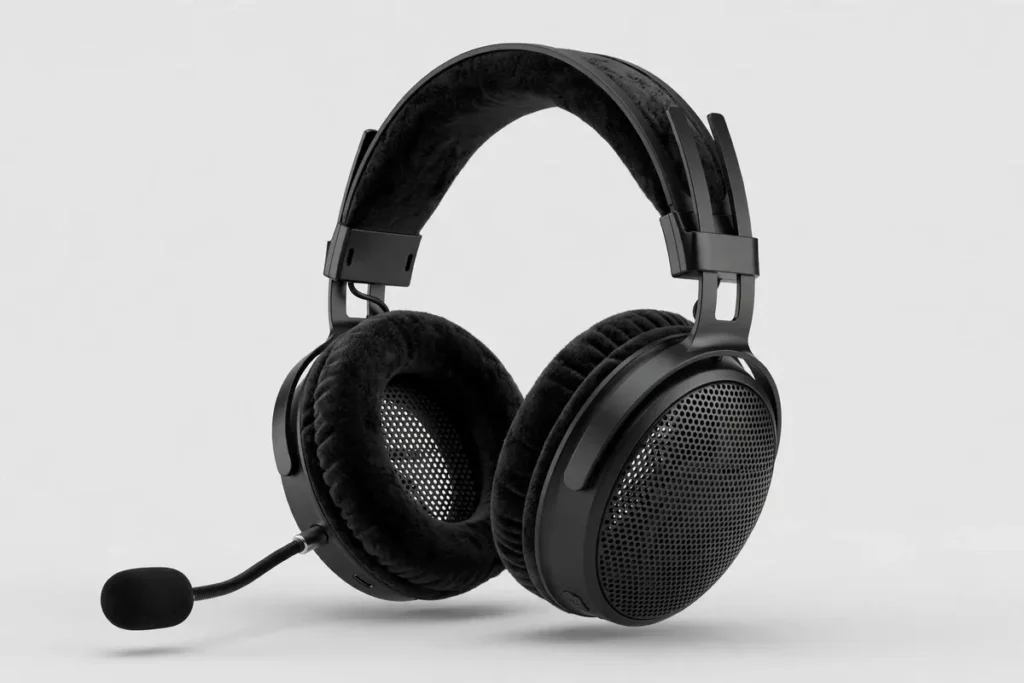
This beyerdynamic MMX 130 wireless review is a research verdict, not a hands-on test. We have not worn the headset yet, so every score below is provisional. The verdict is built from beyerdynamic’s published specifications, the verified Amazon US listing, and the hands-on reports from the launch events, weighed against the other wireless gaming headsets we cover.
The MMX 130 wireless does something genuinely rare: it puts an open-back design into a wireless gaming headset. The earcups are perforated, air moves freely across titanium-coated 40mm drivers, and the sound spreads out into a wide stage instead of staying boxed inside closed cups. It shares its platform with a closed-back sibling, including Bluetooth 6.0, a low-latency dongle, a detachable boom microphone and a battery rated past 80 hours. It arrived in October in Black and Arctic White. Everything interesting about this headset follows from that one open-back decision, so this review gives it the space it deserves.

Why you: A wide, natural soundstage from open-back earcups and titanium-coated drivers, with full wireless gaming connections and a battery rated past 80 hours.
Trade-off: The open cups isolate almost nothing and leak your audio into the room, so this is a quiet-room headset only.
Verdict up top
Open-back gaming headsets exist, but almost all of them are wired. The MMX 130 wireless combines the open-back sound that single-player games deserve with the dongle, Bluetooth and battery of a modern wireless headset, and that combination is the whole story. Our provisional overall score is 7.5, and the shape of the scores tells you why: sound and comfort score high, battery is excellent, and the ANC score of 1.8 is not a flaw in the product so much as a property of the design. An open-back headset cannot block noise. If your room is quiet and yours alone, that barely matters. If it is not, nothing else about this headset will save it for you.
Open-back: what you gain, what you give up
Start with the gain, because it is real. In a closed-back headset, sound reflects inside a sealed cup and the presentation stays close and contained. Open the cup up and those reflections escape. The result is a wider soundstage, where a game world feels spread around you rather than pressed against your ears. Orchestral scores breathe. Ambient detail, wind, water, distant machinery, sits at a believable distance. Beyerdynamic points this model at atmospheric games, RPGs and simulations, and that is exactly where the design pays off. Positional audio also gains: with a stage this open, judging where a sound sits in the world feels less like decoding and more like listening.
Now the costs, and they are not small print. Sound travels both ways through an open cup. Room noise reaches your ears almost unimpeded: a partner watching television, a fan, traffic through an open window, a mechanical keyboard at the next desk. Launch hands-on reports noticed exactly this, with ambient noise breaking into play during show-floor demos. Your audio leaks out the same way, so anyone in the room hears a thin version of your game, and in a shared space at night that is a genuine problem. There is no active noise cancelling to fall back on, and there cannot be in an open design.
The practical rule is simple. A quiet, private room: the MMX 130 wireless is built for you. A shared living room, an open-plan office, a dorm, a commute: buy a closed-back headset instead. Our explainer on open-back vs closed-back headphones walks through the physics if you want the longer version. One comfort dividend does come with the design: air circulates through the cups, heat builds up less, and long sessions feel cooler than in a sealed headset.
Sound: titanium-coated drivers
The driver is a 40mm dynamic unit with a titanium-coated diaphragm, tuned for the open enclosure, with a published response range of 20 Hz to 20 kHz. Beyerdynamic credits the coating with precise, detailed reproduction, and launch listening reports describe a spacious, natural presentation with the clear treble the brand is known for. Bass behaves the way open-back bass usually does: present and textured, but without the sealed-in pressure and slam a closed cup produces. Explosions will sound big; they will not thump your skull.
That profile suits story-driven and open-world games better than competitive shooters. In an FPS you can still place footsteps, and the wide stage helps, but the lack of isolation means a noisy room eats the quiet cues first. Our provisional sound score is 8.6, the highest mark in this review, because judged as a listening device in the conditions it is designed for, this is the most interesting sound in its class. An EQ in the companion app lets you trim the tuning to taste.
Music deserves a mention too, because this headset will spend real hours playing it. Open-back headphones have always been the music listener’s choice at a desk, and the same qualities that widen a game world, the unboxed stage and the natural decay of notes, flatter acoustic recordings, live albums and film scores. With the boom microphone detached, the MMX 130 wireless is closer to a proper open-back music headphone with a gaming option than the other way round.
Design and comfort
At 265 g the MMX 130 wireless is a touch lighter than its closed-back sibling, and the ear pads are dual-layer: a breathable velour surface over memory foam. Combined with the open cups, the fit is the airy kind that disappears during long sessions, which is why comfort scores 8.8. The build follows the family pattern, aluminium sliders and steel hinges, and the repairability carries over too. The battery is user-replaceable, the pads swap out, and the microphone detaches.
One own-voice note belongs here: your own voice sounds natural in an open-back headset, because you hear yourself through the room rather than through a sealed cup. Long voice-chat sessions feel less fatiguing for that reason alone, and players who dislike the plugged-ear feeling of closed headsets will notice it immediately.
Connections: the full wireless set
The platform is shared with the closed-back model. Bluetooth 6.0 handles phones and handhelds. The included USB-C dongle gives a 2.4GHz low-latency connection rated below 30ms for PC, PlayStation and Switch, and it is the mode to game in. USB audio and a 3.5mm analogue cable cover everything else, including Xbox, which does not take the wireless modes. Beyerdynamic’s documentation also notes the microphone is not carried over Bluetooth on Switch, so dongle or cable is the route for voice chat there.
Hands-on reports from the launch add one limitation: the headset does not hold Bluetooth and dongle connections simultaneously yet, with dual connection expected through a firmware update. For a headset aimed at a single desk setup, that matters less than it would on a travel headphone.
Microphone and calls
The detachable META VOICE boom microphone is the same unit the rest of the range uses, with a pop filter included, and it earns the same 8.4 call score. A boom at the mouth captures your voice with a clarity built-in earcup microphones cannot match. One honest caveat follows from the open design: the microphone sits in the same room air your ears are exposed to, so in a noisy space your teammates may hear more of your surroundings than they would with a closed headset and its tighter seal around the mic’s environment. At a quiet desk, it is a non-issue. Remove the boom and the headset becomes an open-back Bluetooth headphone for music, a role it is unusually good at.
Battery: past 80 hours, replaceable
Beyerdynamic rates the battery at more than 80 hours per charge, the headset plays while charging over USB-C, and the battery itself can be replaced when it eventually fades. That is the full package a wireless headset should offer, and it scores 9.4 here as it does on the sibling model. For a product category where a dead battery usually means a dead headset, the replaceable design is a buying argument on its own.
beyerdynamic MMX 130 wireless specifications
| Product | beyerdynamic MMX 130 Wireless Open-Back Gaming Headset (Black) |
|---|---|
| Design | Open-back, over-ear |
| Driver | 40mm dynamic, titanium-coated diaphragm |
| Frequency response | 20 Hz to 20 kHz (manufacturer figure) |
| Connections | Bluetooth 6.0, 2.4GHz USB-C dongle (under 30ms), USB audio, 3.5mm analogue |
| Noise cancelling | None. Open-back design provides almost no isolation by design |
| Microphone | Detachable META VOICE boom mic, pop filter included |
| Battery life | More than 80 hours (manufacturer figure), user-replaceable, play while charging |
| Ear pads | Dual-layer velour with memory foam, replaceable |
| Weight | 265 g (without cable) |
| Colours | Black, Arctic White |
| Platform notes | Xbox via analogue cable; mic not carried over Bluetooth on Switch |
How it compares
The comparison that matters is with its own sibling. The closed-back MMX 100 wireless is built on the same platform with plain 40mm drivers and costs less. Choose it if your room has other people in it, if you play competitive shooters, or if you ever plan to use the headset outside your desk. Choose this MMX 130 wireless if your room is quiet and private and your games are the atmospheric kind, where the soundstage is worth more than isolation. Neither is the better headset in the abstract; they are answers to two different rooms.
Against the wider field, the honest rivals are wired open-back headsets, which give up the dongle and the 80-hour battery, and closed wireless models like the RIG R8 Spectre Pro, which give up the soundstage. Our best PC gaming headset guide lays out the field. Nothing else we cover combines open-back cups with a low-latency wireless link, and that gap in the market is precisely why beyerdynamic built this.
Frequently asked questions
What is the difference between the MMX 130 wireless and the MMX 100 wireless?
The earcups and the drivers. The MMX 130 wireless is open-back with titanium-coated 40mm drivers, giving a wider soundstage and almost no isolation. The MMX 100 wireless is closed-back with standard 40mm drivers, giving passive isolation and no leak. Connections, microphone and battery life are shared.
Does the MMX 130 wireless block noise?
No. The open-back earcups let sound pass in both directions by design. Room noise reaches you and your audio reaches the room. It is a headset for quiet, private spaces only.
Is an open-back headset good for competitive gaming?
The wide soundstage helps you place sounds, but the lack of isolation hurts in a noisy room, where quiet cues get buried. In a quiet room it works well; most competitive players still choose closed-back headsets for the isolation.
How long does the battery last, and can it be replaced?
Beyerdynamic rates the battery at more than 80 hours, and the headset works while charging over USB-C. The battery is user-replaceable, as are the ear pads.
Does the MMX 130 wireless work on Xbox?
Yes, over the 3.5mm analogue cable into the controller. Xbox does not support the headset’s Bluetooth or dongle wireless modes.

I am the founder of Sound Mavericks, where I provide the polite truth about audio equipment. I started this site because consumer electronics reviews are often too technical. Instead of using a silent lab, I test headphones, earbuds, and Bluetooth speakers in the real world – like on a noisy subway or in a busy coffee shop.
To stay independent, I buy my own review units (mostly from the United States) rather than accepting free gifts from brands. Once I finish testing a product, I sell it locally to our community. My goal is to help you understand sound quality, active noise cancellation (ANC), and battery life without the marketing hype.
