
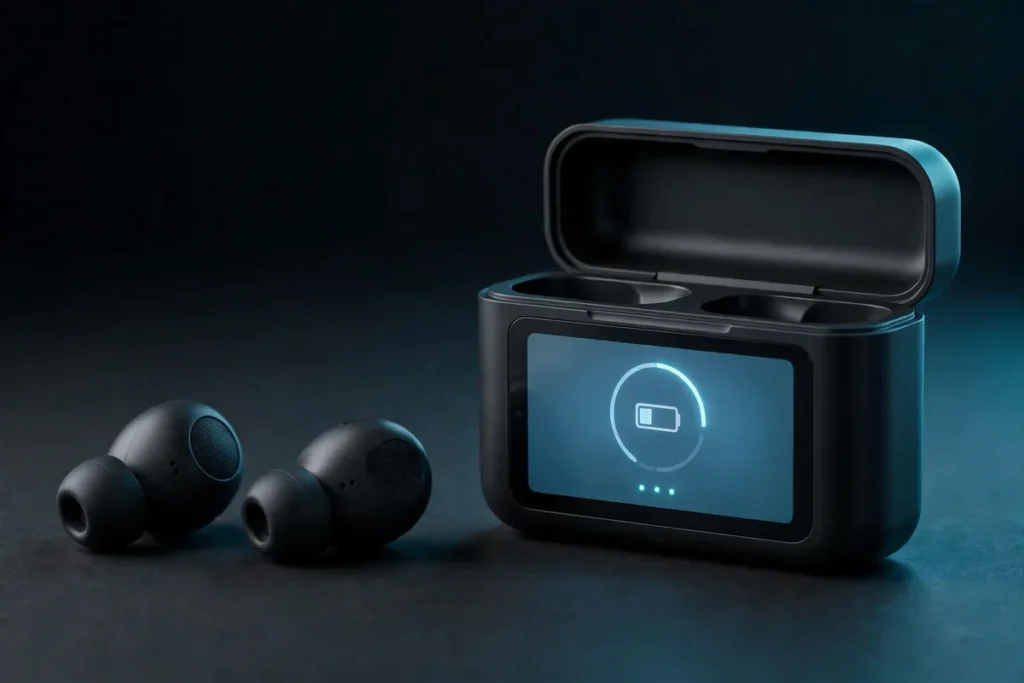
This JBL Tour Pro 3 review covers the generation that fixes the Tour Pro 2’s biggest miss. The smart touchscreen case returns, bigger at 1.57 inches, but the real changes sit in the earbuds and the codec list: a hybrid dual-driver design in each bud, and LDAC support that JBL confirms in its own documentation. Our Tour Pro 2 review called the missing hi-res codec the main flaw in an otherwise complete flagship. The Pro 3 is the answer to that review.
Our scores below are provisional, built from JBL’s published specifications, the verified Amazon US listing and independent measured results rather than hands-on testing. The short version: the Tour Pro 3 scores 8.3 out of 10. Sound steps up to 8.8 on the new drivers and codec, calls and noise cancelling hold at the Pro 2’s level, and per-charge battery drops even as the total with the case climbs.

JBL Tour Pro 3 8.3/10
Why you: you want the case screen and the sound to match it. Dual drivers and LDAC lift the audio a clear step past the Pro 2, call quality stays at the top of JBL’s range, and the case now doubles as a wireless transmitter for wired sources such as in-flight screens.
Trade-off: per-charge battery falls to 8 hours with cancelling on, the case stays bulky at 71.8 grams, and the flagship tier keeps the value score in check at 7.2.
8 h buds (ANC on) · 44 h total · Bluetooth 5.3 · LDAC · 5.6 g per bud · Wireless charging
Sound: the dual-driver upgrade is real
Each bud now carries two drivers: a 10.2mm dynamic unit for the low end and a small balanced armature, 5.1mm by 2.8mm, for the top. The range runs from 20Hz to 40kHz on paper, and the split shows in listening. Bass gets its own driver to work with, so it stays firm without crowding the midrange, and the armature keeps cymbals and vocal edges clean at volumes where a single driver starts to smear. Sound scores 8.8, up from the Pro 2’s 8.4, and it is the one category where the new model pulls clear of the old.
LDAC completes the step. JBL states in its official support documentation that the Tour Pro 3 delivers Hi-Res certified audio wirelessly with LDAC, and that confirmation matters because the Pro 2’s SBC and AAC ceiling was the standing criticism of the line. Android listeners with hi-res catalogs now get the resolution they are paying for. Bluetooth LE Audio is also on board, and JBL Spatial 360 with head tracking carries over for film and video.
The case learns a second job
The Smart Charging Case keeps the touchscreen and grows it to 1.57 inches, about 30 percent larger than the Pro 2’s screen, with the same control pages for playback, ANC modes, EQ and calls. The genuinely new trick is transmission. Plug the case into an AUX or USB-C source with the included cables, an in-flight entertainment screen or a gym console or an older laptop, and the case streams that audio wirelessly to the buds. It turns any wired source into a Bluetooth source without a separate adapter, and it is the feature rival flagships do not have an answer for.
An Auracast broadcast button on the case adds public and shared listening where transmitters exist. The costs are the same as before. At 71.8 grams the case is a pocket presence, and the screen still serves triage better than reading. As with the Pro 2, the controls living in the case means they work with sources that have no JBL app, which remains the strongest argument for the whole design.
Auracast deserves a sentence of its own, because it is easy to file under future features and forget. The broadcast system lets one source feed an unlimited number of listeners nearby: a gym’s televisions, an airport departure board, a friend with the same case. Venues are still rolling it out, so today it is a bonus rather than a reason to buy. But the button costs nothing to carry, and the Pro 3 is one of the few earbuds that will be ready the day your gym switches it on.
Noise cancelling and calls
True Adaptive Noise Cancelling carries over in the same class as the Pro 2, adjusting to your surroundings as they change, with Ambient Aware for letting the street back in. ANC scores 8.6, level with the Pro 2, which places it a step behind the strongest Bose and Sony earbuds in our best noise cancelling earbuds coverage and comfortably ahead of the midfield.
Calls score 8.8, also level with the Pro 2 and the strongest part of the package after sound. Talk time runs to 5.5 hours, and the call system holds a voice together in street noise the way the Pro 2’s did. If your earbuds double as your work headset, this is the JBL to buy; the generation change does not alter that verdict, it just removes the codec asterisk beside it.
App, controls and fit
The JBL Headphones app holds the deep settings: a custom equalizer and presets, Personi-Fi hearing calibration, ANC level adjustment, control remapping and firmware updates. Personi-Fi is worth the few minutes it takes, because it measures your hearing and shapes the tuning to it, and on a dual-driver bud the difference lands mostly in the treble, where the balanced armature does its work. Touch controls on the stems cover playback, calls and ambient modes, and between the stems, the case screen and the app there is no setting on this product that needs more than one of the three to reach.
Fit follows the Pro 2 pattern. The buds sit at 5.6 grams each, the shape is a conventional stem design, and stability is good for commuting, walking and desk work. As with the Pro 2, the tip you choose does more work than usual: the seal drives the bass response and the cancelling at once, so the ten minutes spent trying sizes is part of the setup, not an optional extra. VoiceAware sidetone lets you hear your own voice on calls, which keeps you from shouting into a quiet office, and it can be set in the app.
Connection behaviour is unremarkable in the right way. Pairing is fast, the link holds through a phone in a pocket and a laptop across a room, and the case screen reports each bud’s charge without opening an app. For a product built around features, the basics being boring is a compliment.
Battery: less per charge, more in total
Battery scores 8.2, and the split explains why. Per charge, the Pro 3 falls to 8 hours with noise cancelling on, against the Pro 2’s longer single-session runs, because the dual drivers and the bigger feature set draw more power. With cancelling off the buds reach 11 hours. The case then stretches the total to a quoted maximum of 44 hours, with JBL’s own specification listing the case battery at 33 hours, so how you count the total changes the headline. Frequent flyers who top up between legs will feel the total. Listeners who wear buds for a full work day on one charge will feel the per-charge drop first.
Comfort scores 8.2, unchanged from the Pro 2. The buds weigh 5.6 grams each and keep the same fit family, stable for desks, commutes and walking, with the usual advice applying: work through the tip sizes before judging the bass or the cancelling, since both depend on the seal.
JBL Tour Pro 3 specs
| Spec | JBL Tour Pro 3 |
|---|---|
| Drivers | Hybrid dual drivers per bud: 10.2mm dynamic + 5.1mm x 2.8mm balanced armature; 20Hz-40kHz |
| Noise cancelling | True Adaptive Noise Cancelling, Ambient Aware |
| Codecs | LDAC (Hi-Res certified), Bluetooth LE Audio, SBC, AAC |
| Bluetooth | 5.3 |
| Battery, earbuds | Up to 8 hours (ANC on), 11 hours (ANC off); talk time up to 5.5 hours |
| Battery, with case | Up to 44 hours total quoted by JBL (case battery listed at 33 hours) |
| Case | Smart Charging Case with 1.57-inch touchscreen; doubles as a wireless audio transmitter from AUX or USB-C sources; Auracast broadcast button; wireless charging |
| Weight | 5.6 g per earbud; case 71.8 g |
| Extras | JBL Spatial 360 with head tracking, wireless charging case |
Verdict
Buy the Tour Pro 3 if the Pro 2 tempted you and the codec list stopped you. The dual drivers and LDAC take sound to 8.8, the case transmitter solves the in-flight screen problem no rival flagship touches, and calls stay at 8.8. It holds a firm place in our best wireless earbuds coverage as the control-and-features pick rather than the silence pick.
Skip it if you already own the Pro 2 and mostly want better cancelling or longer sessions per charge, because neither improved, or if the deepest silence is the priority, where Bose still leads. At 8.3 the Tour Pro 3 is the most complete version of JBL’s smart-case idea, and the first one with no asterisk on the audio itself.
Frequently asked questions
Does the JBL Tour Pro 3 support LDAC?
Yes. LDAC is confirmed on the Tour Pro 3, with Hi-Res certification, alongside Bluetooth LE Audio and the standard SBC and AAC profiles. This is the headline upgrade over the Tour Pro 2, which stopped at SBC and AAC.
What can the Tour Pro 3 case do that the Tour Pro 2 case could not?
Two things. The touchscreen grows to 1.57 inches, about 30 percent larger, and the case now works as a wireless audio transmitter: plug it into an AUX or USB-C source such as an in-flight screen or a gym console with the included cables and it streams that audio to the earbuds.
How long does the JBL Tour Pro 3 battery last?
Up to 8 hours per charge with noise cancelling on and 11 hours with it off, with talk time up to 5.5 hours. JBL quotes up to 44 hours in total with the case, whose own battery is listed at 33 hours.
Is the JBL Tour Pro 3 worth upgrading to from the Tour Pro 2?
For sound quality, yes: the dual-driver design and LDAC support are real steps up. Noise cancelling, call quality and comfort sit at the same level as the Pro 2, so owners who mainly want better silence or longer battery will not find it here.
Does the JBL Tour Pro 3 case charge wirelessly?
Yes. The Smart Charging Case refills over USB-C or on a wireless charging pad, and it also carries the touchscreen controls and the transmitter function.

I am the founder of Sound Mavericks, where I provide the polite truth about audio equipment. I started this site because consumer electronics reviews are often too technical. Instead of using a silent lab, I test headphones, earbuds, and Bluetooth speakers in the real world – like on a noisy subway or in a busy coffee shop.
To stay independent, I buy my own review units (mostly from the United States) rather than accepting free gifts from brands. Once I finish testing a product, I sell it locally to our community. My goal is to help you understand sound quality, active noise cancellation (ANC), and battery life without the marketing hype.
