
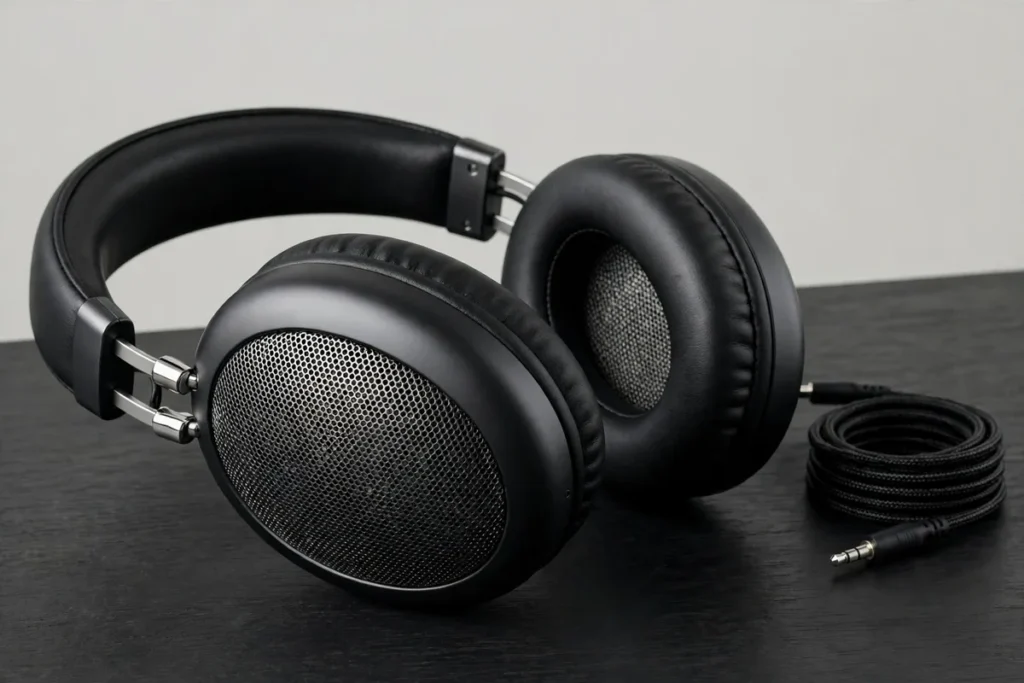
This HiFiMan Edition XS review covers the wired open-back planar magnetic headphone that takes the driver technology from HiFiMan’s pricier egg-shaped models and puts it in a plainer, cheaper frame. It is listed on Amazon US in black, and it has become the default first planar for a lot of desk listeners. What it asks in return is a quiet room and a source with real power behind it, and that trade sits at the centre of this review.
This is a research review. We have not tested the Edition XS on our own heads, so the verdict below is built from HiFiMan’s published specifications, the verified Amazon US listing, and published measurement data. The six score bars are carried over unchanged from our published roundup coverage of this model. They are provisional.

HiFiMan Edition XS 5.9/10 provisional
Why you: you listen at a desk in a quiet room and want the wide, layered staging and deep, flat bass of a planar magnetic driver, with detail that holds up against far pricier headphones.
Trade-off: it leaks sound in both directions by design, there is no microphone, and the large, loose fit and bright top end will not suit everyone.
Planar magnetic driver · Stealth Magnets · Open-back · 18 Ω · 405 g · 8 Hz to 50 kHz · Detachable cable
The score, explained: 5.9 with three wired-model bars
Our overall score is 5.9, the mean of the six bars above, and three of those bars grade things a wired open-back only partly tries to do. Battery scores 5.0 because there is no battery. The Edition XS is wired, and 5.0 is the neutral placeholder we give wired models so they can sit in the same table as wireless ones. Calls & mic scores 3.0, and that one is a real limitation: the stock cable has no microphone, so calls and voice chat mean a separate mic. Noise cancelling scores 1.5, the lowest band we give, because an open-back has no cancelling hardware and no seal. Sound passes through the grills in both directions, which is the design working as intended, not a fault.
The bars the Edition XS actually competes on explain why it keeps its place in our roundups. Sound scores 9.0 on a wide stage, bass that stays flat into the lowest octave, and detail that embarrasses headphones well above it. Comfort scores 7.8: the clamp is light and the pads are roomy, but the fit is loose on smaller heads and the headband draws mixed reports over long sessions. Value scores 9.2, the highest bar on the card, because the driver and the tuning used to live in far more expensive HiFiMan models. Read the 5.9 as a wired desk headphone graded on a wireless scorecard, then judge it on Sound, Comfort and Value.
Sound: a big stage, flat bass and a bright edge
A planar magnetic driver moves a flat diaphragm suspended between magnets, driven across its whole surface instead of at a single point the way a dynamic driver is. Our explainer on dynamic vs planar magnetic drivers covers the mechanics. The Edition XS adds two refinements from HiFiMan’s higher models. The NEO supernano diaphragm is a fraction of the thickness of the film in the earlier Edition X, so it starts and stops faster. The Stealth Magnets behind it are shaped so sound waves pass through the magnet structure with fewer reflections on their way to your ear.
The bass is the clearest step up from older budget planars. Published measurements show it holding a near-flat line deep into the sub-bass instead of rolling away below the mid-bass, so kick drums, synth lows and organ pedals arrive with weight and texture. The level stays honest rather than boosted, and the very bottom eases off gently. It is not a bass-head tuning, but it takes a bass shelf in EQ cleanly if you want one.
The midrange carries the known HiFiMan house trait: a shallow dip in the upper midrange that sets vocals and lead instruments a half-step back. Some listeners hear that as a natural, relaxed presentation. Others hear vocals as slightly thin or distant on familiar tracks. A modest EQ lift in that region is the common fix, and the driver takes it without complaint. Above the dip, the treble rises with a lift in the presence region and a further peak higher up. This is the part of the Edition XS that splits its audience. Half the listeners who measure and review it call the top end crisp and open; the other half call it sharp or sibilant on bright recordings. Both camps are describing the same peak from different chairs.
Imaging and staging are where the big egg-shaped cups earn their size. Instruments sit at clear points in a wide stage, orchestral and live recordings spread out instead of crowding the centre, and dense mixes stay separated. For listeners whose reference point is a closed wireless headphone, the sense of space is usually the first thing they comment on.
Design, comfort and build
The Edition XS weighs 405 g and carries that weight on a padded headband rather than a suspension strap. The cups are large ovals with roomy pads, the clamp is light, and the cups swivel so the pads sit flat against the head. For medium and large heads, the result is an easy fit that disappears over long sessions. The recurring complaints are just as consistent. On smaller heads the fit turns loose, the cups can rest low against the jaw, and some owners report a pressure point at the top of the headband after an hour or two.
Build is metal yokes and matte plastic cups in black, tidy but plainly finished next to HiFiMan’s pricier metalwork. Owners report the odd creak from the frame, and the pads are the wear item to plan around, as they are on most headphones at this level. They come off and can be replaced, and a fresh set restores the seal the bass depends on. Nothing about the build is fragile in normal desk use, but it lives on a desk or a stand, not in a bag.
Power, cables and the missing microphone
The 18 Ω impedance looks like an easy load, and on paper it is. The number that actually decides your source is the 92 dB sensitivity, which is low. A phone or a laptop socket will get the Edition XS playing, and at moderate volume it sounds respectable. Push the volume or play a busy passage and the peaks run short of headroom; the bass softens first. A modest desktop amp, or a dongle DAC with genuine output behind it, is the standard pairing. If impedance and sensitivity numbers are new to you, our explainer on impedance and when you need an amp walks through why a low-impedance headphone can still want power.
The cable detaches at both cups with standard 3.5 mm plugs, runs 1.5 m, and ends in a 3.5 mm plug for the source. Because the connectors are a common standard, replacement cables and balanced cables are easy to find, and a failed cable is a small purchase instead of a repair bill. There is no microphone on the cable and no wireless version of this headphone. The Bluetooth models elsewhere in HiFiMan’s range are different products with different drivers and tuning. This one is wired only.
HiFiMan Edition XS specifications
| Product | HiFiMan Edition XS |
| Design | Open-back, over-ear |
| Driver | Planar magnetic, NEO Supernano diaphragm, Stealth Magnets |
| Frequency response | 8 Hz to 50 kHz |
| Impedance | 18 Ω |
| Sensitivity | 92 dB |
| Weight | 405 g |
| Cable | Detachable, 1.5 m, dual 3.5 mm plugs at the cups |
| Connector | 3.5 mm plug |
| Microphone | None on the included cable |
| Check Price | Check Price on Amazon |
HiFiMan Edition XS vs HiFiMan Sundara
The Sundara is the Edition XS’s closest relative and its standing rival in our coverage; our HiFiMan Sundara review covers it in full. Both are wired open-back planars aimed at desk listening, and both share the same sensitivity figure. They differ in the driver hardware, the voicing and the fit, and those differences decide which one belongs on your desk.
| HiFiMan Edition XS |  HiFiMan Sundara | |
|---|---|---|
| Design | Open-back, over-ear, large oval cups | Open-back, over-ear, round cups |
| Driver | Planar magnetic, NEO Supernano diaphragm with Stealth Magnets | Planar magnetic, NEO supernano diaphragm, standard magnet array |
| Tuning | Wide stage, flat deep bass, brighter top end | Close to neutral, gentler treble, slight upper-mid dip |
| Impedance | 18 Ω, 92 dB sensitivity, wants amp current | 32 Ω, 92 dB sensitivity, wants amp current |
| Headband | Padded headband, cups swivel | Suspension strap under a metal band |
| Weight | 405 g | 342 g |
| Cable | Detachable, dual 3.5 mm at the cups, 1.5 m | Detachable, dual 3.5 mm at the cups, 1.5 m |
| Microphone | None | None |
| Best for | Staging, bass extension and treble detail at a desk | Balanced tone and a lighter fit for long sessions |
| Check Price | Check Price | Check Price |
Pick the Edition XS if you want the wider stage, the deeper bass and the extra top-end energy, and your head is medium or large. Pick the Sundara if you prefer the lighter frame, the suspension strap and a calmer treble, or if vocals sit at the centre of your listening and you want them a fraction closer. Neither isolates, neither has a microphone, and neither leaves the house. They are desk instruments, and the choice between them is mostly a choice of voicing.
Who should buy the HiFiMan Edition XS
Buy it if you listen in a quiet room and want a first serious planar magnetic headphone, because the staging and bass extension here are the reasons most listeners buy one. Buy it if you are happy to use EQ, because a small cut up top and a small lift in the upper midrange answer the two common complaints. Buy it if you already run a small desktop amp or a capable dongle, because it will use what they offer.
Skip it if you share a room or an office, because the open back leaks your music out and the room in, at full strength in both directions. Skip it if you know you are sensitive to treble and do not want to EQ, because the top end is the one part of this headphone that divides its owners. And skip it if your head is small or your listening happens on the move; the fit is loose by design and there is no isolation, no folding frame and no microphone.
Frequently Asked Questions
Does the HiFiMan Edition XS need an amp?
Effectively, yes for most listeners. The impedance is a low 18 Ω, but sensitivity is only 92 dB, so phones and laptops play it quietly and the bass loses grip at higher volumes. A modest desktop amp or a dongle DAC with real output power is the standard pairing.
Does the HiFiMan Edition XS have a microphone?
No. The Edition XS is a wired listening headphone and the included cable has no microphone or remote. For calls and voice chat you need a separate microphone.
Should I buy the Edition XS or the Sundara?
The Edition XS gives you the wider stage, deeper flat bass and a brighter top end in a heavier, larger-fitting frame. The Sundara is lighter, sits on a suspension strap and sounds calmer up top. Choose on voicing and fit; both want an amp and a quiet room.
Does the HiFiMan Edition XS leak sound?
Yes, in both directions. The open-back grills pass sound freely, so people nearby hear what you play and you hear the room. It is a quiet-room headphone.
Is the HiFiMan Edition XS good for gaming?
For single-player games, yes. The stage is wide and imaging is precise, which places effects and footsteps well. For voice chat you need a separate microphone, and the open back leaks sound in shared rooms.
Can you replace the Edition XS cable and ear pads?
Yes. The cable detaches at both cups with standard 3.5 mm plugs, so replacements and balanced cables are easy to find. The pads also come off and can be swapped, and a fresh set restores the seal and the bass that worn pads lose.
Final verdict
The Edition XS earns its place the honest way: the driver hardware from HiFiMan’s expensive models, a stage and bass performance that still lead its class, and a frame that keeps the money in the sound. The 5.9 headline undersells it, because three of the six bars grade a battery, a microphone and a cancelling system it never claimed to have. On the bars that describe the headphone itself (Sound 9.0, Comfort 7.8, Value 9.2) it is one of the strongest wired buys we cover. Add a small amp, give it a quiet room and a head it fits, and settle the treble question with a touch of EQ if your ears ask for it.

I am the founder of Sound Mavericks, where I provide the polite truth about audio equipment. I started this site because consumer electronics reviews are often too technical. Instead of using a silent lab, I test headphones, earbuds, and Bluetooth speakers in the real world – like on a noisy subway or in a busy coffee shop.
To stay independent, I buy my own review units (mostly from the United States) rather than accepting free gifts from brands. Once I finish testing a product, I sell it locally to our community. My goal is to help you understand sound quality, active noise cancellation (ANC), and battery life without the marketing hype.
