
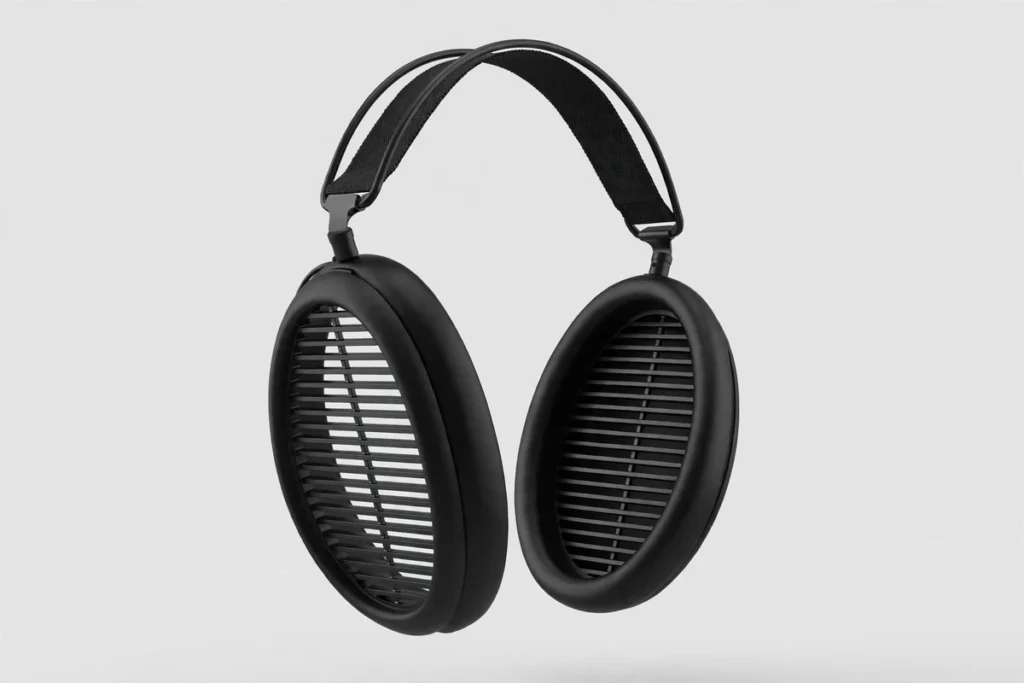
This HiFiMan Ananda review covers the current version of HiFiMan’s big open-back planar: the Ananda built around Stealth Magnets and the NEO supernano diaphragm. It is the headphone in the range that pairs a genuinely wide stage with a sensitivity high enough to run from almost anything, and it is listed on Amazon US under the full name HIFIMAN Ananda with Stealth Magnet. Which Ananda you are actually buying matters, because HiFiMan has sold more than one headphone under this name, so this review pins the version down before it scores anything.
This is a research review. We have not tested the Ananda on our own heads, so the verdict below is built from HiFiMan’s published specifications, the verified Amazon US listing, and published measurement data. The score is provisional.

HiFiMan Ananda (Stealth Magnets) 6.2/10 provisional
Why you: you want the wide, open staging and fine detail of a large planar driver at a desk, without buying a dedicated amp first, because this one runs happily from a phone or a dongle.
Trade-off: it leaks sound in both directions by design, there is no microphone, and the treble carries enough energy that bright recordings can turn sharp at high volume.
Planar magnetic driver · Open-back · Stealth Magnets · 25 Ω · 103 dB · 399 g · Detachable cable
Which Ananda is this? The versions, pinned down
HiFiMan first sold the Ananda with a conventional magnet array. The version in production now, and the one the Amazon US listing sells, replaced those magnets with Stealth Magnets: magnets shaped so sound waves pass through the array with far less diffraction turbulence bouncing back at the diaphragm. The giveaway on the listing is the title itself, which names the Stealth Magnet design, and the weight, which dropped to 399 g on this version. If a listing just says Ananda with no mention of the magnet design, check the specification block before you pay.
Two near-namesakes are separate models, not versions of this one. The Ananda Nano is a smaller, lighter-silver model with a nanometer-thickness diaphragm, a much lower 94 dB sensitivity and a brighter reputation; it needs more power and sounds different. The Ananda Unveiled removes the outer grills entirely and leaves the drivers exposed, which is a different headphone again with a handling warning attached. Neither is covered here, and neither is a substitute if the listing in your cart turns out to be one of them. This review covers the Stealth Magnets Ananda only.
The score, explained: 6.2 with three wired-model bars
Our overall score is 6.2, the mean of the six bars above, and three of those bars grade things a wired open-back only partly tries to do. Battery scores 5.0 because there is no battery. The Ananda is wired, and 5.0 is the neutral placeholder we give wired models so they can sit in the same table as wireless ones. Calls & mic scores 3.0, and that one is a real limitation: the stock cable has no microphone, so calls and voice chat mean a separate mic. Noise cancelling scores 2.0 because an open-back has no cancelling hardware and no seal. Sound passes through the grills in both directions, which is the design working as intended, not a fault.
Judge the Ananda on the three bars that describe the headphone itself. Sound scores 9.3 on the width of its stage and the cleanliness of its detail, a step up in scale from the smaller planars below it in the range. Comfort scores 8.6 on the big ear-shaped cups and the suspension strap, with the caveats covered below. Value scores 9.0 because the driver technology here used to sit in a far more expensive bracket, and the current Ananda sells well under where it started. Read the 6.2 as a wired desk headphone graded on a wireless scorecard.
Sound: the wide stage is the whole point
A planar magnetic driver moves a flat diaphragm suspended between magnets, driven across its whole surface instead of at a single point the way a dynamic driver is. Our explainer on dynamic vs planar magnetic drivers covers the mechanics. The Ananda’s NEO supernano diaphragm is 1 to 2 microns thick, a fraction of the film in older planar designs, and the Stealth Magnet array behind it is shaped to stay out of the sound’s way. Low moving mass plus a clear path out of the cup is the recipe, and what it produces is space.
The stage is the first thing listeners report, and it is wider and taller than the Sundara’s, with instruments placed out past the cups rather than between the ears. Orchestral recordings and live albums use that room properly. Imaging inside the space is precise, so a quartet reads as four musicians at four points, not a blend. If your listening leans on atmosphere and separation, this is the Ananda’s home ground.
The tuning is bright-neutral. Bass reaches down with real extension and stays controlled, sitting level with the midrange instead of pushed up for effect, so electronic lows and kick drums carry texture without bloat. The midrange is clean and present. The treble is where opinions split: there is extra energy in the presence region that reads as sparkle and air on good recordings, and as a slight sizzle on hot ones played loud. It never turns the Ananda harsh for most listeners, but if your library is full of bright, compressed rock, try before you commit.
Design, comfort and build
The Ananda’s cups are the tall, asymmetrical shape HiFiMan uses on its larger models, moulded to follow the outline of a human ear, with the Window Shade grill pattern over the open back. At 399 g it is not a light headphone, but the hybrid headband spreads the load through a suspension strap, and the big pads spread the clamp over a wide area. Long sessions are its normal use case, and comfort reports from owners are consistently good.
Two caveats. The cups do not fold and do not swivel flat, so the Ananda lives on a desk or a stand, not in a bag. And like most large open-backs it asks for a little care: the exposed grill is not a handle, and the pads are a wear item that softens with age and swaps out when it does. Build is metal with a matte black finish, a clear step up in feel from the smaller models in the range.
Power, cables and the missing microphone
Here the Ananda breaks with the planar stereotype. The 25 Ω impedance is low and the 103 dB sensitivity is high, so a phone, a laptop socket or a basic dongle drives it to full volume with headroom to spare. This is the rare large planar that does not ask you to buy an amp in the same order. A clean desktop amp or DAC still pays off in control and quiet backgrounds, but it is an upgrade, not a requirement. If the numbers are new to you, our explainer on impedance and when you need an amp shows why sensitivity, not impedance alone, decides this.
The cable detaches at both cups with standard 3.5 mm plugs, so replacements, longer runs and balanced cables are easy to find, and a damaged cable is a small purchase rather than a repair. There is no microphone on the cable and no wireless version of this headphone. The Ananda BT is a separate Bluetooth model built on the first version’s design, not this one, so do not let a listing blur the two.
HiFiMan Ananda specifications
| Product | HiFiMan Ananda (Stealth Magnets) |
| Design | Open-back, over-ear |
| Driver | Planar magnetic, NEO supernano diaphragm, Stealth Magnets |
| Frequency response | 8 Hz to 55 kHz |
| Impedance | 25 Ω |
| Sensitivity | 103 dB |
| Weight | 399 g |
| Cable | Detachable, dual 3.5 mm plugs at the cups |
| Connector | 3.5 mm plug |
| Microphone | None on the included cable |
| Check Price | Check Price on Amazon |
HiFiMan Ananda vs HiFiMan Sundara
The Sundara is the step down in the same range, and our HiFiMan Sundara review covers it in full. Both are wired open-back planars for a desk. The Ananda is the bigger instrument: larger cups, a wider stage, and a far easier load for your source.
| HiFiMan Ananda |  HiFiMan Sundara | |
|---|---|---|
| Design | Open-back, over-ear, large ear-shaped cups | Open-back, over-ear, round cups |
| Driver | Planar magnetic, Stealth Magnets, NEO supernano diaphragm | Planar magnetic, NEO supernano diaphragm |
| Tuning | Bright-neutral, very wide stage, extra treble energy | Close to neutral, slight upper-mid dip, smaller stage |
| Impedance | 25 Ω | 32 Ω |
| Sensitivity | 103 dB, runs well from a phone or dongle | 92 dB, wants a small amp or a strong dongle |
| Cable | Detachable, dual 3.5 mm at the cups | Detachable, dual 3.5 mm at the cups, 1.5 m |
| Weight | 399 g | 342 g |
| Microphone | None | None |
| Best for | Stage width, detail and easy driving at a desk | Neutral tuning and value for amp owners |
| Check Price | Check Price | Check Price |
Pick the Ananda if the stage is what you are buying, your source is a phone or a modest dongle, and you want the more refined of the two. Pick the Sundara if you already own a small amp, prefer a calmer top end, and would rather keep the difference in money for music. Neither isolates, neither folds, and neither has a microphone. Both are quiet-room desk headphones.
Who should buy the HiFiMan Ananda
Buy it if you listen in a quiet room and want the big-stage planar experience without adding an amp to the bill, because the 103 dB sensitivity makes it the easiest large planar in the range to feed. Buy it if your library runs on orchestral, jazz, live and acoustic recordings that reward space and separation. Buy it if you are stepping up from a Sundara-class headphone and want scale more than you want a different flavour.
Skip it if you share the room, because the open back leaks at full strength in both directions. Skip it if calls or voice chat are part of your day, because there is no microphone. And skip it if your recordings run bright and loud, because the treble energy that gives the Ananda its air will sit on the wrong side of the line for you.
Frequently Asked Questions
Which version of the Ananda does this review cover?
The Stealth Magnets version, which is the Ananda in current production and the one Amazon US lists. The listing title names the Stealth Magnet design, and the specification block shows 25 Ω, 103 dB sensitivity and 399 g. The first version used a conventional magnet array and weighs more. The Ananda Nano and Ananda Unveiled are separate models and are not covered here.
Does the HiFiMan Ananda need an amp?
No. Sensitivity is 103 dB at 25 Ω, so a phone, a laptop or a basic dongle DAC drives it to full volume with headroom. A clean desktop amp or DAC is a worthwhile upgrade for control and quiet backgrounds, but it is not a requirement the way it is with lower-sensitivity planars.
Does the HiFiMan Ananda have a microphone?
No. The Ananda is a wired listening headphone and the included cable has no microphone or remote. For calls and voice chat you need a separate microphone.
What is the difference between the Ananda and the Ananda Nano?
They are different models. The Nano uses a nanometer-thickness diaphragm, runs 14 Ω with a much lower 94 dB sensitivity, so it wants a proper amp, and it has a brighter, more forward sound in a smaller silver housing. The Ananda covered here is the larger, easier-to-drive Stealth Magnets model.
Is the HiFiMan Ananda good for gaming?
For single-player games, yes. The wide stage and precise imaging place effects and movement well. For voice chat you need a separate microphone, and the open back leaks sound in shared rooms.
Does the HiFiMan Ananda leak sound?
Yes, in both directions. The open-back grills pass sound freely, so people nearby hear what you play and you hear the room. It is a quiet-room headphone.
Final verdict
The Ananda earns its step up the range on one quality: scale. The stage is bigger, the detail is cleaner and the whole presentation feels more grown-up than the models below it, and it does all of that while asking almost nothing of the device you plug it into. The 6.2 headline undersells it, because three of the six bars grade a battery, a microphone and a cancelling system it never claimed to have. On the bars that describe the headphone itself (Sound 9.3, Comfort 8.6, Value 9.0) it is the point in the HiFiMan range where the big planar sound arrives without the big planar demands. Give it a quiet room and it will justify its desk space.

I am the founder of Sound Mavericks, where I provide the polite truth about audio equipment. I started this site because consumer electronics reviews are often too technical. Instead of using a silent lab, I test headphones, earbuds, and Bluetooth speakers in the real world – like on a noisy subway or in a busy coffee shop.
To stay independent, I buy my own review units (mostly from the United States) rather than accepting free gifts from brands. Once I finish testing a product, I sell it locally to our community. My goal is to help you understand sound quality, active noise cancellation (ANC), and battery life without the marketing hype.
