
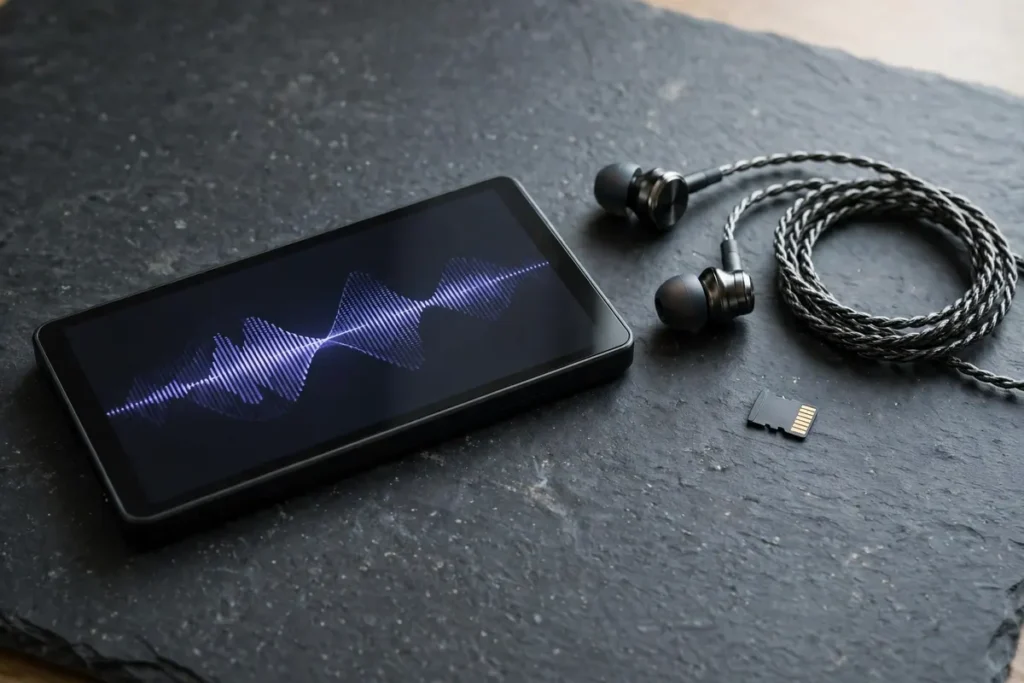
The best DAP under 200 dollars comes from a small, split tier. Four players are worth your money. One runs Android and behaves like a tiny phone that only does music. Two run HiByOS, a lean system built for local files with streaming apps bolted on. The fourth is matchbox-sized and skips Wi-Fi completely. Everything else here is old hardware under a famous name, or a no-name player with a spec sheet nobody verifies.
Our verdict: the FiiO JM21 is the best DAP under 200 for most people: the only full-Android pick here, with balanced power for real headphones in a 13mm body.

FiiO JM21
Why you: you want one player that does everything in this tier: streaming apps, local files, IEMs and full-size headphones, in a body 13mm thin.
Trade-off: battery life is the weak point. The 3GB version linked here is rated at 12.5 hours single-ended, and streaming over Wi-Fi eats into that.
Dual CS43198 DACs · Android 13 · 700mW balanced @ 32Ω · 4.7in touchscreen · microSD up to 2TB
Our picks come from manufacturer specifications and published coverage, not from hands-on testing, and the four are ranked by what most buyers in this tier actually do with a player. If your listening is mostly local files, skip straight to the sound-first pick. If streaming apps are half your listening, the verdict above is the whole story.
The four picks at a glance
| Player | DAC chips | System | Balanced output | Battery (rated) | Screen | |
|---|---|---|---|---|---|---|
| FiiO JM21 | Dual CS43198 | Android 13 | 700mW @ 32Ω | Up to 12.5h (3GB version) | 4.7in touch | Check Price |
| TempoTec Variations V3 Blaze | Dual AK4493SEQ | HiByOS | 825mW + 825mW @ 32Ω | About 10h | 3.2in | Check Price |
| HiBy R3 II (2025) | Dual ES9219C | HiByOS | 380mW @ 32Ω | Up to 19h single-ended | 3.2in touch | Check Price |
| Shanling M0 Pro | Dual ES9219C | MTouch OS | 236mW @ 32Ω via adapter | Up to 14.5h | 1.54in touch | Check Price |
FiiO JM21: the Android all-rounder
The JM21 is built around a Snapdragon 680 and Android 13, so it installs the normal Spotify, Tidal and Apple Music apps and behaves like a phone that only plays music. The 4.7-inch screen is big enough to browse a streaming catalog without squinting, which none of the other picks here can claim. For local files, FiiO Music handles libraries on the internal storage or a microSD card up to 2TB.
The audio hardware is a fully balanced design: two CS43198 DACs and two SGM8262 amp chips, giving 245mW per channel single-ended and 700mW per channel from the 4.4mm socket into 32 ohms. That is enough for most full-size headphones, not just IEMs, and it doubles as a USB DAC for a laptop. Two versions exist. The linked 3GB/32GB model is rated at 12.5 hours single-ended; the 4GB/64GB version carries a bigger battery rated at 16 hours and still sits inside this tier. At 156g and 13mm thick, either one carries like a slim phone.
TempoTec Variations V3 Blaze: the sound-first pick

TempoTec Variations V3 Blaze
Why you: you play local files and care about drive and headroom more than apps. Nothing else in this tier puts out this much clean power.
Trade-off: HiByOS only, so streaming means the built-in Tidal and Qobuz apps and nothing else. It is also the heaviest pick here, and the battery is rated at about 10 hours.
Dual AK4493SEQ DACs · HiByOS · 825mW + 825mW balanced @ 32Ω · DSD512 · 3.2in screen
If your search was for the best sounding DAP under 200, this is the one built for you. The V3 Blaze runs two AKM AK4493SEQ DACs behind an FPGA clocking stage, with a rated signal-to-noise ratio of 124dB and balanced output of 825mW per channel into 32 ohms. That is the highest figure in this tier by a clear margin, and it is what lets the Blaze hold together with planar magnetic headphones and high-impedance models that leave the smaller players sounding thin. Decoding headroom is generous too: DSD512 and PCM up to 768kHz.
The compromises are about everything except sound. HiByOS gives you Tidal and Qobuz apps, HiByLink control from your phone, and two-way Bluetooth 5.1, but there is no app store and no Spotify. The 3,500mAh battery is rated around 10 hours, and at roughly 180g and 17mm thick the Blaze feels like a brick next to the M0 Pro. One buying note: the earlier Variations V3, with a weaker 610mW amp stage, still circulates at similar money. The Blaze is the version to buy.
HiBy R3 II (2025): the compact all-rounder

HiBy R3 II (2025)
Why you: you want balanced output, Bluetooth and streaming basics in a player that weighs 118g and shrugs off days of commuting between charges.
Trade-off: the 3.2-inch screen is cramped for browsing a big library, and streaming stops at Tidal and Qobuz. There is no Spotify app and no app store.
Dual ES9219C DACs · HiByOS with MSEB · 380mW balanced @ 32Ω · Bluetooth 5.1 two-way · 118g
The R3 II packs the full feature list into 118g: dual ES9219C DACs, a 4.4mm balanced socket rated at 380mW into 32 ohms, and HiBy’s MSEB tuning board, which lets you nudge tonal balance in software instead of living with a fixed house sound. The 2025 refresh swapped in a faster X1600E processor and better battery efficiency; HiBy rates the 2,000mAh cell at up to 19 hours single-ended, the best figure in this comparison.
HiByOS covers the streaming basics with Tidal and Qobuz apps, plus AirPlay and DLNA for home use. Bluetooth 5.1 runs both ways, out to wireless headphones with LDAC or in from a phone when you want the R3 II to act as a Bluetooth DAC. There is no internal storage, so a microSD card is mandatory. One listing trap: the R3 Pro II is a different, newer player that sits above this tier, and shopping results mix the two. Check the name on the listing twice.
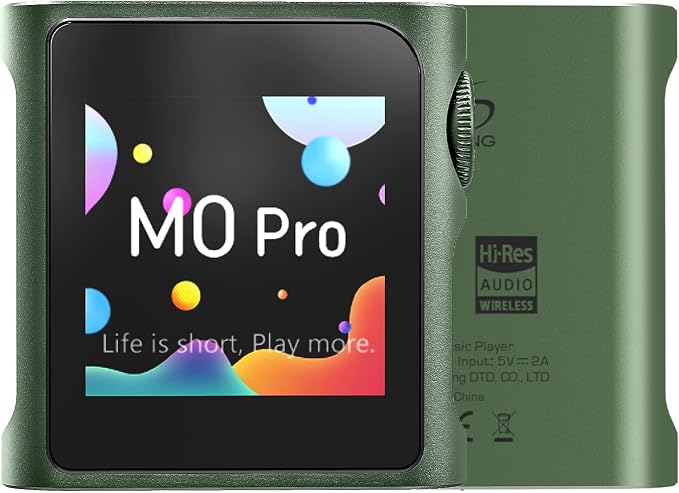
Shanling M0 Pro: the tiny one
Shanling M0 Pro
Why you: you want music in a shirt pocket or clipped to a strap, plus a player that can receive Bluetooth from your phone on the days you do stream.
Trade-off: the 1.54-inch screen makes library browsing slow work, balanced output needs Shanling’s separate adapter, and there is no Wi-Fi at all. A microSD card is required and not included.
Dual ES9219C DACs · MTouch OS · 36.8g · Two-way Bluetooth 5.0 with LDAC · Up to 14.5h battery
The M0 Pro weighs 36.8g and is not much bigger than a smartwatch, yet Shanling fitted dual ES9219C DACs, a touchscreen and a volume wheel. Single-ended output is 90mW into 32 ohms, plenty for IEMs and efficient portables. Balanced output reaches 236mW, but only through Shanling’s 3.5mm-to-4.4mm adapter, which is a separate purchase and an easy thing to lose.
Its best trick is two-way Bluetooth 5.0. It transmits LDAC to wireless earbuds, and it also receives, turning the M0 Pro into a Bluetooth DAC for your phone when you want to stream. Plugged into a computer it works as a USB DAC. Battery is rated at 14.5 hours single-ended. What you give up is browsing: MTouch OS on a 1.54-inch screen shows a few lines at a time, so big libraries are managed by folder and playlist, not by scrolling cover art.
Android or HiByOS: pick your compromise
The real decision in this tier is the operating system. Android, on the JM21, means every streaming app, a proper screen for browsing, and phone-style battery drain. HiByOS, on the R3 II and the V3 Blaze, boots fast, sips power and stays out of the way, but your streaming world shrinks to Tidal and Qobuz. The M0 Pro’s MTouch OS drops streaming entirely and leans on Bluetooth from your phone. Local-file listeners are better served by the HiByOS pair. If streaming is half your listening, the JM21 is the only complete answer under this tier’s ceiling. Our explainer on what a DAC is and what it actually does covers the conversion side of all four players.
What the next tier buys
Step above this ceiling and the gains are battery size, screen quality and output staging rather than a different class of sound: players like the ones in our launch coverage of the HiBy RS2 II, the Shanling M7T and the FiiO M25 R2R add R2R ladders, tube stages and desktop-grade power. Worth knowing about, not worth stretching for if a first player is the goal. The other honest alternative is skipping the player entirely: the picks in our guide to the best portable DACs and dongles hang off the phone you already own.
Frequently asked questions
What is the best DAP under 200 dollars?
For most buyers, the FiiO JM21. It is the only Android player in this tier, so it runs the normal streaming apps alongside local files, and its balanced output drives demanding headphones as well as IEMs. If you only play local files and want the strongest sound hardware, the TempoTec Variations V3 Blaze is the better buy.
What is the best sounding DAP under 200?
On hardware, the TempoTec Variations V3 Blaze. Its dual AK4493SEQ DACs and 825mW per channel of balanced output give it more headroom than anything else here, and headroom is what hard-to-drive headphones actually need. Keep perspective, though: the sound gap between these four players is small next to the gap between headphones, so buy the Blaze for its power, not for a dramatic difference.
Is an H2 a good budget DAP under 150?
It depends which H2 you mean, and that is the problem. The H2 badge sits on several unrelated players, including the HiFi Walker H2 and various no-name models that share nothing but the label. Judge the exact listing, not the badge: look for a named DAC chip, support for the formats you own, and a maker that publishes firmware updates. If you would rather buy a name with a track record, the Shanling M0 Pro sits in the same part of this tier and its hardware is fully documented.
Can a DAP under 200 dollars stream Spotify and Tidal?
The FiiO JM21 can, because it runs Android 13 and installs the normal apps. The HiBy R3 II and the TempoTec V3 Blaze carry built-in Tidal and Qobuz apps only. The Shanling M0 Pro has no Wi-Fi at all; it receives Bluetooth from your phone instead, so the phone stays the streamer.
Do I still need a DAP if I have a good dongle DAC?
Not for sound quality alone. A good dongle DAC on a phone matches these players with most IEMs, and our guide to the best portable DACs and dongles covers the strong ones. A DAP buys you a battery your phone does not drain, a microSD slot for a big library, physical buttons, and a screen with no notifications on it.
How much storage do these players hold?
All four take microSD cards, and the JM21, R3 II and M0 Pro all accept cards up to 2TB. Only the JM21 has real built-in storage: 32GB on the version linked here, 64GB on its step-up version. Budget for a card with the other three, because none is included in the box.

I am the founder of Sound Mavericks, where I provide the polite truth about audio equipment. I started this site because consumer electronics reviews are often too technical. Instead of using a silent lab, I test headphones, earbuds, and Bluetooth speakers in the real world – like on a noisy subway or in a busy coffee shop.
To stay independent, I buy my own review units (mostly from the United States) rather than accepting free gifts from brands. Once I finish testing a product, I sell it locally to our community. My goal is to help you understand sound quality, active noise cancellation (ANC), and battery life without the marketing hype.

