
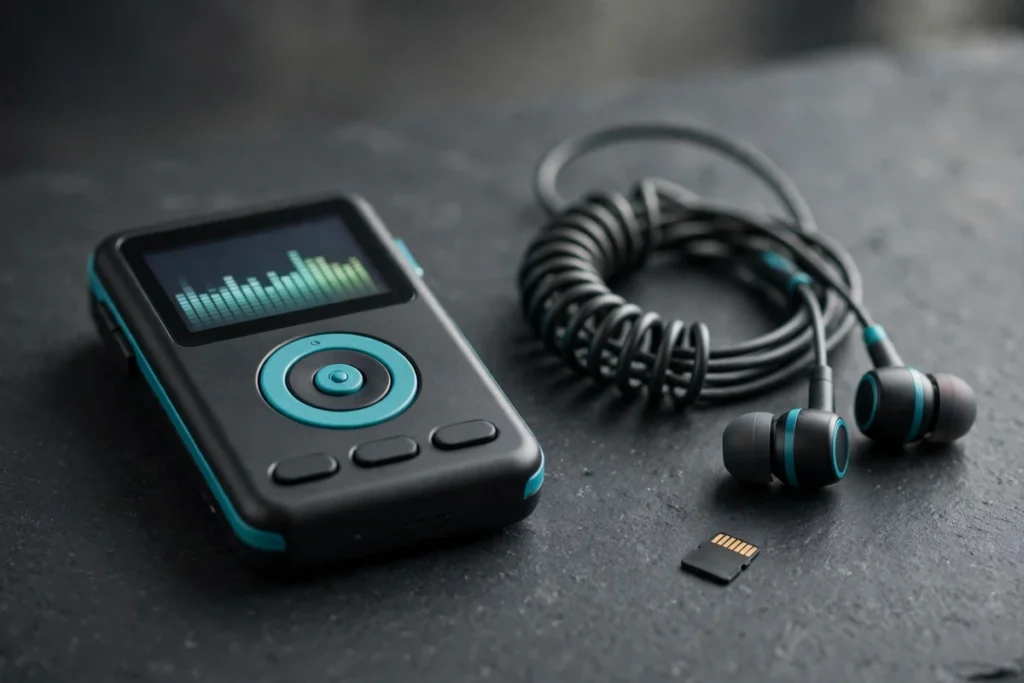
The best portable DAPs under 100 dollars fit on a very short list, and this guide is not going to pad it. We checked the current US lineups of every hi-fi brand selling a portable player, and exactly four machines qualify as real digital audio players at this level. Everything else either crept over the line in the last price rise or is a generic MP3 player wearing a hi-res sticker.
The four picks split cleanly. One streams. One costs half the budget, balanced output included. One has no wireless of any kind and the longest battery here. One is small enough to lose in a jacket pocket. The picks rest on spec sheets, retail listings and published reviews rather than hands-on testing, so the cards carry no scores.
Start here: the HiBy R1 is the one most people should buy: the only touchscreen big enough to browse on, and the only pick that streams.

HiBy R1
Why you: you want a small player that streams over Wi-Fi and plays your files, on a screen you can actually browse.
Trade-off: 3.5mm output only, with modest power. Fine for IEMs and easy headphones; not built for demanding cans.
CS43131 · 3-inch touchscreen · Wi-Fi streaming · Bluetooth 5.1 (LDAC) · microSD to 2TB · 15-hour battery
The four picks at a glance
| Player | DAC chip | Screen | Wireless | Battery | |
|---|---|---|---|---|---|
| HiBy R1 | Cirrus Logic CS43131 | 3-inch touchscreen | Wi-Fi, Bluetooth 5.1 (LDAC) | 15 hours | Check Price |
| Snowsky Echo Mini | Dual Cirrus Logic CS43131 | 1.99-inch, buttons | Bluetooth 5.3 | 15 hours | Check Price |
| MECHEN M30 | Wolfson WM8965 | 2-inch, scroll wheel | None | 25 hours | Check Price |
| HiBy R2 II | ESS ES9219C | 2.45-inch touchscreen | Wi-Fi, Bluetooth 5.1 (LDAC) | 15 hours | Check Price |
Why this list is so short
Phones ate this category from below. A phone already plays every format and app, and a small USB dongle turns it into a good source for wired headphones. Our guide to the best portable DACs and dongles covers that route, and for many listeners it is the right one. What a cheap DAP still offers is separation: files on a card, no notifications, physical controls, and its own battery.
Price creep did the rest of the damage. Players that sat in this tier a few years ago moved up a class. The HIFI WALKER H2, a default budget pick for years, now sells above the line at its maker’s store. Shanling’s smallest player, the M0 Pro, sits a tier up. FiiO sells nothing down here under its own name; its budget effort moved to a retro sub-brand. What is left is four machines, each making a different compromise.
The gap got filled by generic MP3 players, and Amazon results for this budget are thick with them. The tell is simple: every pick below names its DAC chip, a real part from Cirrus Logic, ESS or Wolfson, and decodes DSD and FLAC natively. A listing that hides the chip is an MP3 player, whatever the sticker says. Our explainer on what a DAC is covers why the chip matters.
HiBy R1: the best DAP under 100 for most people
The R1 runs HiBy OS on a 3-inch touchscreen, and that screen is why it leads this list. Browsing a big FLAC library on a 2-inch button-driven player is a chore; on the R1 it feels like a small phone from a few years ago. It is the only player in this tier with Wi-Fi streaming, pulling Tidal and Qobuz through HiBy’s built-in apps. The limits matter: streaming only, no offline downloads from those services, and no Spotify or Apple Music at all. Streamers should read that twice.
The hardware is honest budget hi-fi. A single CS43131 DAC chip, native DSD256 decoding, and HiBy’s MSEB tuning system for shaping the sound without a full equalizer. Bluetooth 5.1 runs both ways (LDAC, aptX), and USB-C doubles as a DAC mode for a laptop. The microSD slot is rated to 2TB, and at 70 grams the player disappears into a pocket in a way no phone-plus-dongle stack does.
Know the ceiling before you buy. Output is 3.5mm only, and the power suits IEMs and easy portable headphones. Planars and high-impedance headphones will sound thin and quiet, and the small screen is fiddly for typing passwords. Neither flaw matters for the job this player is built for: pocket file playback, plus streaming when a network is nearby.
Snowsky Echo Mini: the under-50 pick with a balanced output

Snowsky Echo Mini
Why you: you listen to your own files, prefer buttons to a touchscreen, and want the cheapest route into a balanced IEM setup.
Trade-off: no gapless playback, an 8,192-track library cap, slow scans on a full card. Files only; nothing streams.
Dual CS43131 DACs · 3.5mm and 4.4mm balanced outputs · Up to 250 mW balanced · 8GB built in plus microSD · Bluetooth 5.3 · 15-hour battery
Snowsky is FiiO’s retro line, and the Echo Mini is styled like a shrunken cassette player, buttons and all. Under the costume it is the best-specified player in this guide. Two CS43131 chips feed a 3.5mm socket and a 4.4mm balanced output, something nothing else here offers, with up to 250 mW on the balanced side. That is enough drive for the Chi-Fi IEMs most buyers here own. It plays DSD256 and the usual lossless formats from 8GB of built-in storage or a microSD card.
The compromises sit in the software, not the sound hardware. The library stops indexing at 8,192 tracks even though the card holds far more. Gapless playback is missing, so live albums get a pause between tracks, and a full card scans slowly. Bluetooth 5.3 is there for wireless buds, basic codec only. Treat the Echo Mini as an albums machine for your own files and it is the strongest value in this guide by a wide margin. Treat it like a tiny streamer and you will hate it.
MECHEN M30: metal shell, scroll wheel, no wireless at all

MECHEN M30
Why you: you want a metal player with a one-handed wheel, a battery that lasts the week, and a line-out for a bigger system at home.
Trade-off: zero wireless of any kind, and the library browser caps its database view at 4,000 tracks. Folder browsing still reaches the rest.
Wolfson WM8965 DAC · Scroll wheel and buttons · 3.5mm headphone and line-out · 64GB card included · 25-hour battery · No Bluetooth, no Wi-Fi
MECHEN is an Amazon-native brand rather than a hi-fi name, and the M30 is the pick for buyers who shop that way. The zinc-alloy shell feels a class above the plastic competition, the wheel and button layout copy the classic iPod formula, and a 64GB card in the box means it works the day it arrives. Inside, a named Wolfson WM8965 DAC chip and a Texas Instruments amp stage decode DSD up to DSD128, plus FLAC, WAV and APE. The combined 3.5mm socket also works as a line-out, making the M30 a tidy source for a desktop amp or a car stereo. Battery life is the headline: about 25 hours, the longest here by a clear margin.
Be clear about what MECHEN left out. The listing itself states there is no Bluetooth and no Wi-Fi, so wireless headphones and streaming are off the table. The library browser caps its database view at 4,000 tracks; folder view still shows everything on the card, so big libraries stay usable, just less tidy. Support runs through the Amazon seller, not a dealer network. None of that stops the M30 doing its one job well: playing local files, for days, through a cable.
HiBy R2 II: the smallest touchscreen, with an Amazon catch
HiBy R2 II
Why you: you want the R1’s software, streaming included, in the smallest body that still carries a touchscreen.
Trade-off: Amazon US stock is inconsistent. Most sits with HiBy’s own store and hi-fi dealers, so the button below runs to an Amazon search rather than a fixed listing.
ESS ES9219C DAC · 2.45-inch touchscreen · Wi-Fi streaming (Tidal, Qobuz) · Two-way Bluetooth 5.1 (LDAC) · USB DAC mode · 15-hour battery
The R2 II is the R1’s formula in a smaller shell: HiBy OS, Wi-Fi streaming for Tidal and Qobuz, an ESS ES9219C chip, and two-way Bluetooth 5.1 with LDAC, so it can also work as a wireless DAC fed by your phone. Output through the 3.5mm socket is rated at 90 mW, enough for IEMs and portable headphones. Battery life lands around 15 hours, same as its bigger sibling.
The catch is where you buy it. HiBy sells the R2 II direct and through hi-fi dealers, and Amazon US availability runs through marketplace sellers who come and go. When a listing exists it qualifies on spec and tier; when it does not, the search button above is the honest route. If buying from Amazon matters more than saving pocket space, take the R1 instead. Same software, bigger screen, stable listing.
How the four split, and the under-50 question
Streaming decides the first fork: only the two HiBy players stream, and only from Tidal and Qobuz. For files, the Echo Mini is the player’s pick and the M30 the battery pick. Need Bluetooth for wireless buds? Cross the M30 off. Need a balanced socket for your IEMs? Only the Echo Mini has one.
Searches for this tier keep asking about a best DAP under 50 dollars. The straight answer: one. The Echo Mini launched under that line and still sells around it, a genuine DAP with named DAC chips and a balanced output. Below it, the market is generic MP3 players with unnamed silicon. The wider best budget portable music player question has the same answer: a named DAC chip, native hi-res decoding and a maker that publishes firmware updates. A listing that will not name its chip is telling you something.
What you give up at this level
No Android. That is the big one. None of these players installs apps, so Spotify, Apple Music and YouTube Music are out; streaming starts and ends with the HiBy pair and their two services. Power is the second limit. All four are built for IEMs and easy headphones, and a hard-to-drive full-size headphone exposes that fast. Desk listeners often do better putting the same money into a dongle and keeping the phone as the screen.
The screens are small, the processors slow by phone standards, and the batteries sealed. When the battery fades in a few years, the player is done; there is no replacement program at this level. None of this makes the picks bad; it makes them tools with one job: your files, away from your phone, for a trip or a work week. If you need a full Android player with more power, the step up is real money. Our guide to the best Android music players shows what that money buys.
Frequently Asked Questions
What is the best portable DAP under 100 dollars?
For most buyers, the HiBy R1: the biggest screen here, Tidal and Qobuz streaming over Wi-Fi, microSD up to 2TB. The Echo Mini is better for pure file playback, the MECHEN M30 for battery life, the R2 II for the smallest touchscreen body.
Is there a good DAP under 50 dollars?
One. The Snowsky Echo Mini launched under that line and still sells around it, with dual DAC chips and a balanced output. Everything below it is generic MP3 players with unnamed chips.
Can a DAP under $100 stream Spotify?
No. Nothing at this level runs Android, so nothing installs the Spotify app. The two HiBy players stream Tidal and Qobuz over Wi-Fi through built-in apps, streaming only, no offline downloads.
DAP or phone dongle DAC: which is better on this budget?
A dongle DAC wins on sound per dollar and keeps your streaming apps. A DAP wins on battery independence, physical controls and leaving the phone in another room. Local files and a phone-free pocket: buy the DAP. Stream everything: buy the dongle.
Do these players work with Bluetooth headphones?
Three of the four do. The HiBy pair sends LDAC and aptX; the Echo Mini sends basic Bluetooth 5.3. The MECHEN M30 has no Bluetooth at all: wired headphones only.
How much music can these players hold?
The HiBy pair takes microSD cards up to 2TB. The Echo Mini pairs 8GB of built-in storage with a card slot rated to 256GB. The M30 ships with a 64GB card and accepts cards up to 256GB. Even 256GB holds hundreds of FLAC albums; library caps matter more than raw space.
The verdict
This tier has four honest answers, not ten. Buy the HiBy R1 if you want streaming and a usable screen. Buy the Snowsky Echo Mini if your music lives on a card. Buy the MECHEN M30 if battery life and a line-out matter more than wireless. And if a listing for any other player lands in this tier without naming its DAC chip, leave it where it sits.

I am the founder of Sound Mavericks, where I provide the polite truth about audio equipment. I started this site because consumer electronics reviews are often too technical. Instead of using a silent lab, I test headphones, earbuds, and Bluetooth speakers in the real world – like on a noisy subway or in a busy coffee shop.
To stay independent, I buy my own review units (mostly from the United States) rather than accepting free gifts from brands. Once I finish testing a product, I sell it locally to our community. My goal is to help you understand sound quality, active noise cancellation (ANC), and battery life without the marketing hype.

