The Moondrop Starfield 3 breaks the pattern its own series set. The first two Starfields were single dynamic driver IEMs; the third, announced on October 8, 2026, splits the work between a 10mm wood-dome bass driver and a 7.8mm DLC treble driver, joined by a two-way crossover in what Moondrop calls the D.W.T acoustic architecture. It also ships with three swappable plugs, including a USB-C plug with a built-in sound card and a 32-band parametric EQ.
This is a launch review, built from Moondrop’s published specifications (carried in full on the HiFiGo and Apos listings) and the verified Amazon US listing. We have not listened to the Starfield 3, and nothing here pretends otherwise. What follows is paper analysis: the hardware, what changed from the Starfield 2, and who should buy now or wait. This page will be updated as independent measurements and reviews appear.
Moondrop Starfield 3 On sale now
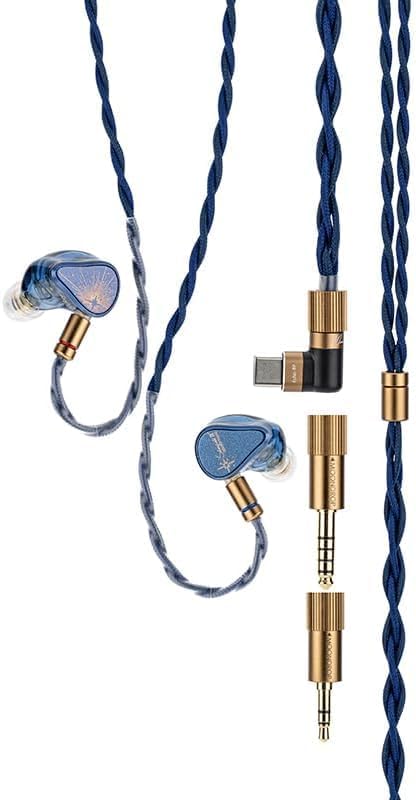
What it is: a dual dynamic driver IEM: a 10mm wood-dome driver handling bass, a 7.8mm DLC dome driver handling treble, a two-way crossover, and one cable that can end in 3.5mm, 4.4mm or USB-C.
Watch out: the impedance is a very low 7.7Ω, so weak or high-output-impedance sources can shift its tone or add hiss, and the 32-band EQ only works through the USB-C plug, not the analogue ones.
10mm wood-dome DD + 7.8mm DLC DD · 7.7Ω · 119 dB/Vrms · 0.78mm 2-pin · 3.5mm / 4.4mm / USB-C plugs
Moondrop Starfield 3 quick facts
| Drivers | 2 dynamic drivers (10mm wood-dome bass + 7.8mm DLC treble), two-way crossover |
| Launch price | $149.99 |
| Status | On sale now; announced October 8, 2026 |
| Where to buy | Amazon US, HiFiGo and Apos |
| Amazon US | Listed, ASIN B0HMCVQ9WV (verified November 3, 2026) |
| Plugs | Swappable 3.5mm, 4.4mm and USB-C (DSP) plugs included |
What the Starfield 3 is
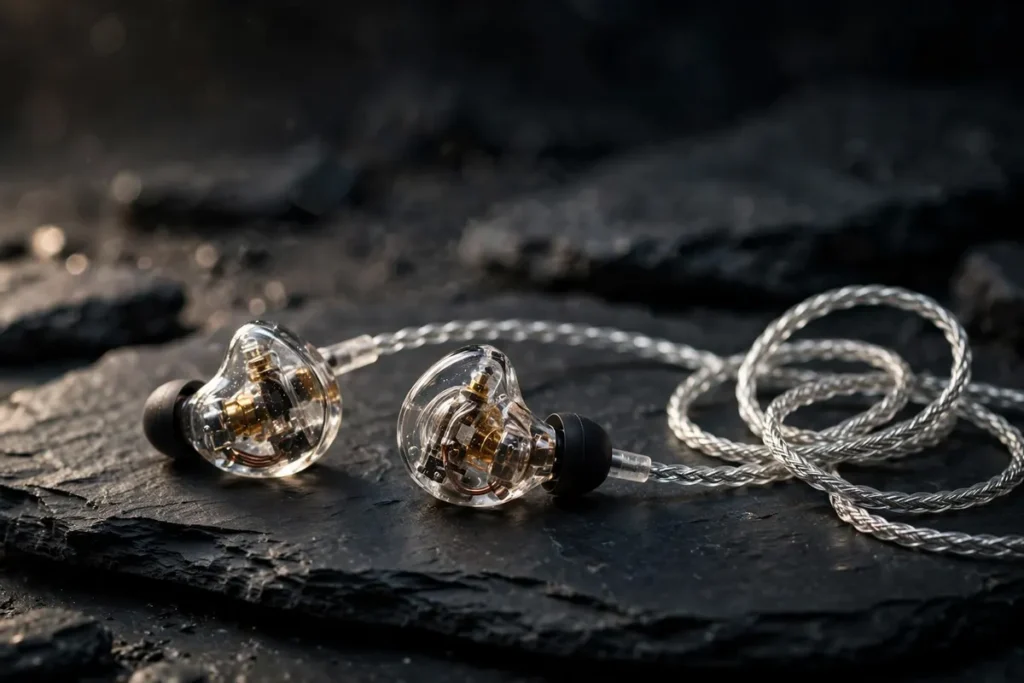
The driver split is the story. Per Moondrop’s listing, the 10mm bass driver uses an ultra-thin natural wood-dome composite diaphragm, chosen for rigidity with internal damping, and an inner-and-outer equal-volume dual-magnet structure to raise efficiency and control. The 7.8mm treble driver uses a rigid DLC (diamond-like carbon) dome with a flexible suspension. A DLP 3D-printed acoustic waveguide and a dedicated electronic crossover coordinate the two, and Moondrop quotes total harmonic distortion of 0.2% or less at 1kHz.
The cable system is the second story. The stock high-purity OCC cable runs on 0.78mm 2-pin connectors and takes three interchangeable plugs: 3.5mm single-ended, 4.4mm balanced, and a USB-C plug with an integrated sound card. On USB-C, the plug carries Moondrop’s second-generation DSP platform: a 32-band parametric EQ with control over frequency, gain, filter type and Q, set through the Moondrop Link app or a web interface. Apos lists the USB-C output at 60mW. EQ is part of the purchase here, not a dongle you buy later.
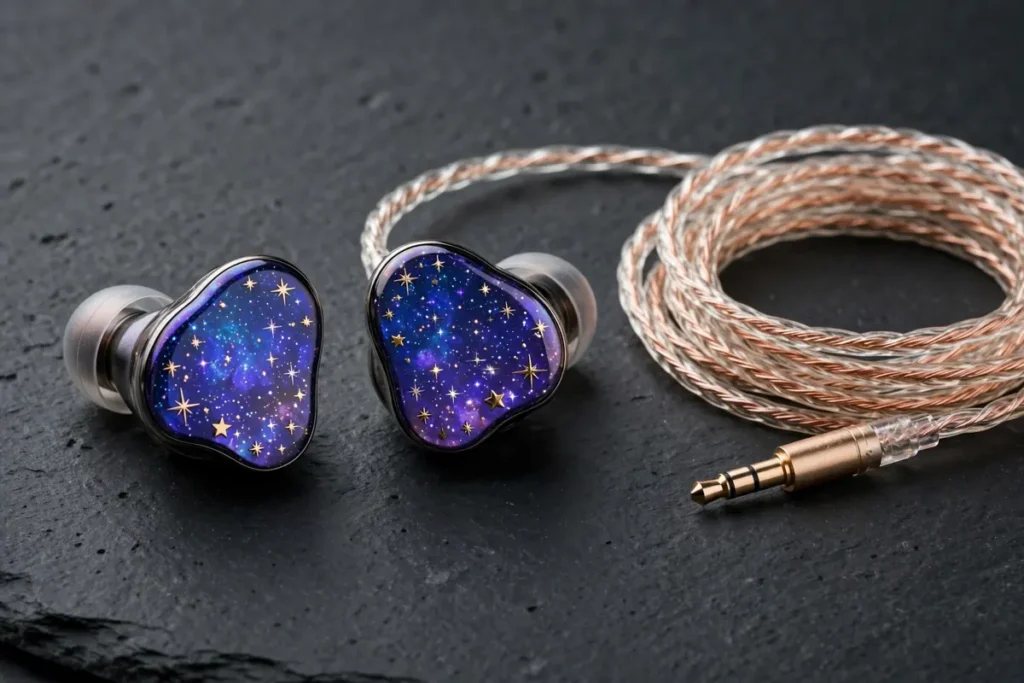
The shells are contoured medical-grade resin, a change from the metal shells of the older Starfields, finished in the series’ signature iridescent paint: blue shifting to violet with a gold-printed starry pattern. At 7.7Ω and 119 dB/Vrms the Starfield 3 is easy to drive to volume from almost anything, though the very low impedance cuts both ways, as the card above notes.
Starfield 3 vs Starfield 2: what changed
The Starfield 2 arrived in 2023 as a single 10mm driver with a lithium-magnesium alloy dome, a zinc alloy shell and a 3.5mm-only stock cable. The Starfield 3 keeps the starry identity and the 0.78mm 2-pin standard, and changes almost everything else: two specialist drivers instead of one generalist, resin instead of metal, and a plug box that covers a phone, a balanced player and a USB-C source with DSP. The paper trade is distortion and flexibility against simplicity: the Starfield 2’s single driver needs no crossover and its higher sensitivity and impedance make it the easier electrical load.
| Product | Drivers | Impedance / Sensitivity | Check Price |
|---|---|---|---|
| Moondrop Starfield 3 | 10mm wood-dome DD + 7.8mm DLC DD, two-way crossover | 7.7Ω · 119 dB/Vrms | Check Price |
 Moondrop Starfield 2 | 10mm single DD, lithium-magnesium alloy dome | 15Ω · 122 dB/Vrms | Check Price |
Moondrop Starfield 3 specifications
| Product | Moondrop Starfield 3 Check Price |
| Driver configuration | 10mm wood-dome composite diaphragm dynamic driver + 7.8mm DLC dome composite diaphragm dynamic driver |
| Crossover | Two-way (acoustic filtering + electronic circuitry), DLP 3D-printed acoustic waveguide |
| Impedance | 7.7Ω ±15% at 1kHz |
| Sensitivity | 119 dB/Vrms at 1kHz |
| Frequency response | 12Hz to 44kHz (effective 20Hz to 20kHz, IEC 60318-4, -3dB) |
| THD | ≤0.2% at 1kHz, 94dB |
| Shell | Medical-grade resin, iridescent paint faceplate with gold-printed star pattern |
| Connector | 0.78mm 2-pin |
| Cable | High-purity OCC cable |
| Plugs | Interchangeable 3.5mm single-ended, 4.4mm balanced and USB-C (integrated sound card, 32-band parametric EQ) |
| Launch price | $149.99 |
Tuning: two drivers, one target, plus EQ
Moondrop developed the Starfield 3’s tuning through finite element analysis, acoustic measurement and repeated listening checks, and its stated aim is a richer, more musical presentation than the older Starfields. That is the manufacturer’s framing, not a measurement of ours. The two-way design hands Moondrop more control over the treble than a single driver allows, at the cost of a crossover region that has to be managed well.
The practical tuning story is the EQ. Thirty-two bands of parametric EQ, adjustable in the app or a browser, is more correction power than most owners will ever use, and it changes the buying logic: a stock tune you only partly like is fixable on the USB-C plug. Analogue listeners on the 3.5mm or 4.4mm plugs get the stock tuning as it ships, with no EQ applied. Which of those you are should decide which plug you reach for.
Early coverage
As of November 3, 2026, independent hands-on reviews and third-party measurements of the Starfield 3 are still scarce. Coverage so far is Moondrop’s announcement thread on Head-Fi, launch write-ups and the retailer listings. Everything here traces back to those sources; this section updates as full reviews and measurements land.
Should you buy now, or wait?
The buy-now case is the package. You get Moondrop’s newest acoustic platform, the most flexible stock cable system in this class, and DSP EQ included rather than sold separately. The Starfield name also carries a large owner community and a steady accessory market, which matters for a set built around replaceable cables and plugs.
The wait case is evidence. Nothing independent has measured the Starfield 3 yet, the very low impedance will expose weak sources, and the Starfield 2 remains on sale for less as the classic single-driver take. Our read: Moondrop loyalists and EQ tinkerers can buy now with their eyes open. Everyone else loses little by waiting for the first measurements to confirm what the spec sheet promises.
Also consider
Three sets we have already covered and scored: a same-brand saving, the hybrid rival and a step up.

Moondrop’s single-driver all-rounder from our best IEMs roundup: warm-neutral tuning, metal shells and swappable plugs for notably less money. The mid-bass emphasis can sound thick on some tracks, and the stock tips are average.

A 1DD+4BA hybrid that anchors our best IEMs for gaming roundup: proven imaging, a small light shell and a strong stock cable. Its stock cable has no in-line mic, and the upper mids can sound metallic at high volume.

The hybrid idea taken further: a microplanar tweeter, a three-way crossover and hand-finished resin shells on the proven New Meta tuning. It sits a price tier above the Starfield 3 and is nearly as new.
FAQ
When is the Moondrop Starfield 3 released?
Moondrop announced the Starfield 3 on October 8, 2026, and it went on sale the same month. It is in stock now at Amazon US, HiFiGo and Apos.
How much does the Moondrop Starfield 3 cost?
The launch price is in the quick facts box at the top of this page. It launched at the same US list price across Amazon, HiFiGo and Apos, though individual retailers run their own discounts.
Where can I buy the Moondrop Starfield 3?
It is on sale at Amazon US, HiFiGo and Apos. The Amazon US listing runs under ASIN B0HMCVQ9WV, and the buttons at the top of this page go to the Amazon and HiFiGo listings.
Is the Moondrop Starfield 3 on Amazon?
Yes, under ASIN B0HMCVQ9WV, verified on November 3, 2026.
What drivers does the Moondrop Starfield 3 use?
Two dynamic drivers per side: a 10mm wood-dome driver for the bass and a 7.8mm DLC dome driver for the treble, joined by a two-way crossover in Moondrop’s D.W.T acoustic architecture.
Moondrop Starfield 3 vs Starfield 2: which should you buy?
The Starfield 2 is a single-driver, metal-shell set with an analogue-only cable, and it costs less. The Starfield 3 adds a second driver, resin shells, balanced and USB-C plugs and DSP EQ. Buy the Starfield 3 for the new platform and the flexibility; buy the Starfield 2 for the classic single-driver recipe.

I am the founder of Sound Mavericks, where I provide the polite truth about audio equipment. I started this site because consumer electronics reviews are often too technical. Instead of using a silent lab, I test headphones, earbuds, and Bluetooth speakers in the real world – like on a noisy subway or in a busy coffee shop.
To stay independent, I buy my own review units (mostly from the United States) rather than accepting free gifts from brands. Once I finish testing a product, I sell it locally to our community. My goal is to help you understand sound quality, active noise cancellation (ANC), and battery life without the marketing hype.