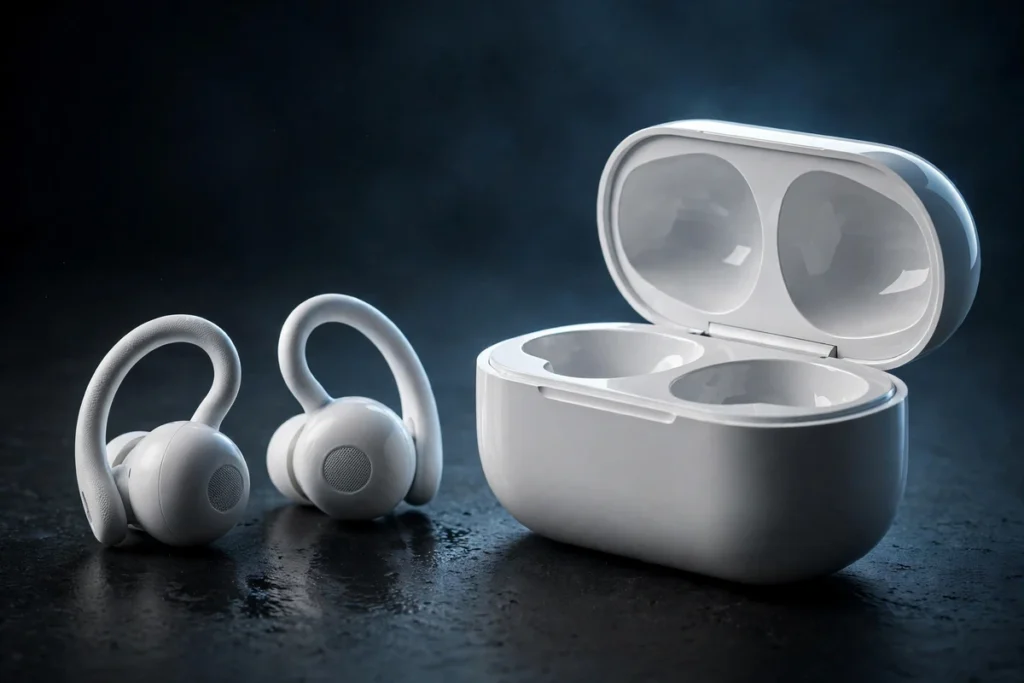
Open-ear earbuds have always asked you to accept one trade: you hear your surroundings, and your surroundings hear everything. The Baseus MC2 NC is Baseus’s attempt to refuse that trade. It is a clip-on open-ear earbud — nothing goes in the canal — that nonetheless claims active noise cancelling of up to -50 dB, sealed-flagship territory. It adds LDAC hi-res audio, Bluetooth 6.0, a six-microphone call array and up to 60 hours of total battery. If even half of that claim survives contact with reality, this is the most interesting open-ear launch of the year. This review separates the engineering from the marketing.
Our Early Verdict
The MC2 NC’s trick is that it isn’t purely open. Its washable silicone ear cushions (four sizes) partly seal the ear, and that partial seal gives its adaptive ANC something to work with — a genuinely new approach in a category where rivals offer no cancellation at all. The rest of the package is strong: a 12mm carbon-fibre driver, LDAC, multipoint Bluetooth 6.0, physical buttons and a 60-hour case. Our caution is aimed squarely at the headline: -50 dB is Baseus’s own figure, not an independent measurement, and open-fit ANC has physical limits. Buy it as a promising open-ear earbud with real noise reduction — not a sealed flagship replacement — and the proposition makes sense.
| Sound Quality (on paper) | 8.4 |
| Noise Cancelling | 7.8 |
| Comfort & Design | 8.8 |
| Battery Life | 8.9 |
| Call Quality | 8.3 |
| Value | 8.5 |

How we are reviewing this one: the MC2 NC has only just reached Amazon US, so this is a research-based launch review built from Baseus’s published specifications, the US Amazon listing, and the launch coverage available to date. We have not worn or measured it ourselves, and the score is provisional for exactly that reason — it reflects the hardware, the documented step up from the Bowie MC2, and a deliberately sceptical reading of the ANC claim, and we will revisit it once independent measurements land.
Baseus MC2 NC Specifications
| Product | Baseus MC2 NC (White) |
| Design | Clip-on open-ear, C-bridge; four sizes of washable silicone ear cushions that partly seal the ear |
| Driver | 12mm carbon-fibre dynamic driver |
| Noise cancelling | Adaptive ANC, up to -50 dB (Baseus’s own claim — not independently measured) |
| Bluetooth codecs | LDAC (Hi-Res Audio Wireless certified), plus standard codecs |
| Bluetooth | 6.0, multipoint (two devices) |
| Battery life | Up to 60 hours total with the case (ANC off); 42 hours with ANC on (Baseus figures; per-bud single-charge figure not published) |
| Charging | Fast charge: ~3 hours of playback from a 10-minute charge |
| Microphones | 6-mic array with ENC and wind-noise reduction for calls |
| Controls | Physical buttons (no touch panels); app control with EQ and Mimi hearing personalisation |
| Water resistance | IPX5 (sweat- and splash-resistant, per the US listing) |
| Weight | 5.9g per earbud |
| Buy | Check Price on Amazon |
The -50 dB Question: How Open-Ear ANC Is Supposed to Work Here
Start with the scepticism, because it is earned. Active noise cancelling works best in a sealed system: plug the ear canal, and the anti-noise signal has a controlled space to cancel sound in. Clip-on open-ear designs — our Soundcore AeroClip 2 review covers the current benchmark — leave the canal open, which is precisely why none of them have offered real ANC until now. So how is Baseus claiming up to -50 dB, a number flagship in-ears advertise?
The answer is in the cushions. The MC2 NC ships with four sizes of washable silicone ear cushions that sit against the ear and partly seal it — not a canal plug, but enough of a barrier to give the adaptive ANC a fighting chance, particularly against the low, constant noise (engines, air conditioning, cabin drone) that ANC handles best. That is a legitimate engineering route, and it makes the MC2 NC a hybrid in the truest sense: open-ear awareness with a partial seal doing quiet work in the background. It also defines the honest expectation. A partial seal will not match a deep-fitting in-ear bud on voices, clatter and other mid-and-high-frequency noise, and “up to” figures are always measured at the single most favourable frequency. The -50 dB figure is Baseus’s own claim; no independent lab measurement has been published yet, and our provisional Noise Cancelling sub-score of 7.8 — the lowest on the card — prices in exactly that gap between claim and proof. If third-party measurements land anywhere near the claim, this section gets rewritten and the score goes up.
Sound Quality and Codecs
The driver is a 12mm carbon-fibre dynamic unit — a step up in size and material from the 11mm driver in the Bowie MC2 — and carbon fibre’s stiffness-to-weight ratio is a sensible choice for an open design, where the driver works against open air rather than a sealed chamber and needs to move volume without breaking up. Baseus pairs it with LDAC and Hi-Res Audio Wireless certification, which matters here for a specific reason: open-ear earbuds live or die on detail at moderate volumes, because there is no seal to rescue a muddy low end, and a high-bitrate codec preserves what the driver can actually deliver. The Baseus app adds a custom EQ and Mimi hearing personalisation, which builds a sound profile from your own hearing test — a genuinely useful feature on an open-ear product, where individual ear shape changes the sound more than it does with sealed buds. What we cannot do yet is describe the tuning from listening: no trustworthy independent sound impressions are published at the time of writing, so the 8.4 Sound sub-score reflects the driver hardware, codec support and personalisation stack rather than a verdict on the signature itself.
Baseus MC2 NC vs Bowie MC2: What the NC Model Adds
The MC2 NC is the flagship sibling of the plain Baseus Bowie MC2, Baseus’s existing clip-on that we verified on Amazon US alongside this review. The family resemblance is obvious — same C-bridge clip concept — but nearly every line of the spec sheet moves:
| Baseus MC2 NC | Baseus Bowie MC2 | |
|---|---|---|
| Noise cancelling | Adaptive ANC, up to -50 dB claimed | None |
| Driver | 12mm carbon fibre | 11mm dynamic |
| Ear seal | Part-sealing silicone cushions, 4 sizes | Fully open fit |
| Codecs | LDAC, Hi-Res Audio Wireless | LDAC, Hi-Res Audio |
| Bluetooth | 6.0, multipoint | 6.0 |
| Microphones | 6-mic array, ENC + wind reduction | 4-mic AI call system |
| Battery (total) | 60h ANC off / 42h ANC on | ~60h (55h per its Amazon listing) |
| Weight (per bud) | 5.9g | 5.1g |
| Water resistance | IPX5 (US listing) | Rated tougher against water than the NC model |
| Buy | Check Price on Amazon | Check Price on Amazon |
Read the table as a trade, not a rout. The NC model adds the entire noise-cancelling story, a bigger and better driver, two more microphones and hearing personalisation — and pays for it with 0.8g more per bud and a lower water-resistance rating on the US listing. If your listening is quiet-room and calls-focused, the plain Bowie MC2 remains a lighter, hardier clip-on. If noise is the problem you are trying to solve, the NC is the only one of the two that even attempts it. Baseus’s own open-ear ambitions run further upmarket too — our Baseus Inspire XC1 review covers the brand’s premium play — but the MC2 NC is the one pushing the category somewhere new.
Battery Life and Charging
Baseus rates the MC2 NC at up to 60 hours of total playtime with the case, ANC off, and 42 hours with ANC on. Both figures sit at the strong end of the clip-on category, and the 42-hour ANC-on number is the one to plan around — it still covers a full week of commutes and workdays for most listeners. One gap to note honestly: Baseus does not publish a per-bud single-charge figure for this model, so we won’t invent one; the totals above are the documented numbers. The fast-charge figure is published and useful — around three hours of playback from a 10-minute charge, enough to rescue a flat case before you leave the house.
Fit, Controls, App and Calls
At 5.9g per bud with a flexible C-bridge clip, the MC2 NC lands in the wear-it-and-forget-it weight class that makes clip-ons appealing in the first place, and the four cushion sizes do double duty: they are the comfort adjustment and the ANC’s partial seal in one part, and they are washable, which matters on a part that sits against the ear all day. Controls are physical buttons rather than touch panels — the right call on a clip-on, where touch surfaces are small, fiddly and easy to trigger while adjusting the fit.
Calls get a six-microphone array with ENC noise reduction and dedicated wind reduction, which is the correct priority order for an open-ear product: you will take calls in exactly the noisy, outdoor places where open designs get worn, and wind is the open-ear call killer. We rate the hardware 8.3 provisionally; as with the ANC, independent call recordings will settle it. The app rounds out the package with EQ, ANC control and the Mimi personalisation noted above. One caveat for US buyers: the AI features announced at the China launch — transcription and live translation across 21 languages — were built on Chinese AI services, and Baseus has not confirmed those features are available in the US version of the app. Treat them as a possible bonus, not a reason to buy.
Living With a Partial Seal: The Daily Trade-Offs
The design decision that defines the MC2 NC also defines its daily compromises, and they are worth spelling out before you buy. A part-sealing cushion is not the same experience as a fully open clip-on. You will feel more contact against the ear than with a bare C-bridge design, and the seal’s effectiveness will vary with cushion size and ear shape — Baseus shipping four sizes is an admission that fit is doing real work here, so expect to experiment rather than wear the default pair. In exchange, the partial seal buys two things fully open designs cannot offer: the ANC described above, and a measure of passive isolation that steadies the sound at lower volumes, which is kinder to your hearing than turning everything up on a noisy street.
The awareness question cuts the other way. The entire point of open-ear earbuds is situational awareness — traffic, announcements, a colleague saying your name — and any seal erodes that to some degree. The MC2 NC’s answer is that the seal is partial and the ANC is switchable: cancellation on for the train, off when you need the world back. That is a more flexible position than either extreme, though it makes the MC2 NC neither the most aware open-ear earbud nor the quietest noise canceller available. It is a deliberate middle, and whether that middle is exactly right or neither-fish-nor-fowl depends on how mixed your listening environments are. For genuinely mixed days — street, office, train, calls — our judgement is that the flexibility wins.
Who It’s For
Buy the MC2 NC if you want open-ear awareness without surrendering to your environment. Commuters who need to hear announcements and traffic but not engine drone, office workers who take calls all day, and runners and cyclists who cannot safely seal their ears are the audience this design exists for — and none of the established clip-ons, including the UGREEN ClipBuds Pro 2, offer them any noise cancelling at all. Even if the real-world reduction lands well short of the claim, partial quiet plus full awareness is a combination nothing else in the category currently sells.
Look elsewhere if maximum silence is the point. Frequent flyers and anyone chasing the deepest possible cancellation should still buy a sealed in-ear ANC flagship, whose physics this design cannot repeal — the MC2 NC’s own claim notwithstanding. And if you simply never listen anywhere noisy, the lighter plain Bowie MC2 covers the same clip-on basics without paying for cancellation hardware you won’t switch on.
Baseus MC2 NC FAQ
Can open-ear earbuds really deliver -50 dB noise cancelling?
That is Baseus’s own claim for the MC2 NC, and it has not been independently measured yet. The design makes a real attempt possible — silicone cushions partly seal the ear, giving the adaptive ANC a barrier to work against — but a partial seal has physical limits, especially on voices and higher-frequency noise. Expect meaningful reduction of low, constant noise rather than flagship in-ear silence until lab measurements say otherwise.
How long does the Baseus MC2 NC battery last?
Baseus rates the MC2 NC at up to 60 hours of total playtime with the charging case with ANC off, and 42 hours with ANC on. A 10-minute fast charge adds roughly three hours of playback. Baseus does not publish a per-bud single-charge figure for this model, so treat the totals as the planning numbers.
Are the Baseus MC2 NC waterproof?
The US Amazon listing rates them IPX5, which covers sweat, splashes and rain — workouts and wet commutes are fine. IPX5 is not a swimming or submersion rating, so don’t shower or swim in them. Note that some overseas launch coverage quoted a higher rating; the US listing for the product you can actually buy says IPX5, and that is the figure to trust.
What is the difference between the Baseus MC2 NC and the Bowie MC2?
The MC2 NC adds adaptive ANC (claimed up to -50 dB) with part-sealing ear cushions, a larger 12mm carbon-fibre driver against the Bowie’s 11mm unit, a 6-mic call array against four mics, and Mimi hearing personalisation. The Bowie MC2 counters by being lighter at 5.1g per bud against 5.9g, carrying a tougher water-resistance rating, and offering a fully open fit with no seal at all. Both support LDAC and Bluetooth 6.0.
Do the MC2 NC’s AI translation and transcription features work in the US?
Unconfirmed. Baseus announced AI transcription and live translation in 21 languages at the China launch, where those features run on Chinese AI services. Baseus has not confirmed that they are available in the US version of the app, so don’t count them as part of the purchase until Baseus says otherwise.
The Bottom Line
The Baseus MC2 NC is the first clip-on open-ear earbud to make noise cancelling its headline rather than its apology, and the engineering behind the attempt is smarter than the category’s usual shrug. Around that headline sits a complete, well-judged package: carbon-fibre driver, LDAC, Bluetooth 6.0 multipoint, six-mic calls, physical buttons and a 60-hour case. Our provisional 8.3/10 holds back exactly one thing: the -50 dB figure is a manufacturer’s claim awaiting its first independent measurement, and this review will be updated when one lands. Buy it for the combination of awareness and real noise reduction, and it is already the most interesting open-ear launch of the season.

I am the founder of Sound Mavericks, where I provide the polite truth about audio equipment. I started this site because consumer electronics reviews are often too technical. Instead of using a silent lab, I test headphones, earbuds, and Bluetooth speakers in the real world – like on a noisy subway or in a busy coffee shop.
To stay independent, I buy my own review units (mostly from the United States) rather than accepting free gifts from brands. Once I finish testing a product, I sell it locally to our community. My goal is to help you understand sound quality, active noise cancellation (ANC), and battery life without the marketing hype.