
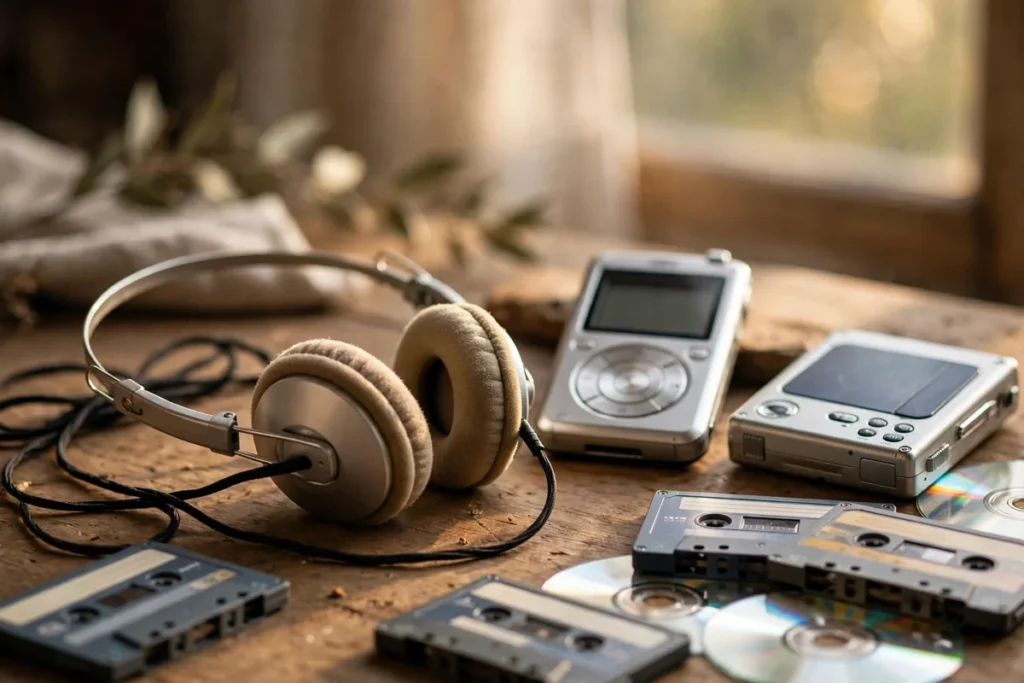
Pull an iPod Classic, a Nano, or an old Sony Walkman MP3 player out of a drawer and it still does the one job it was built for beautifully: it plays your library, offline, with no notifications and no subscription. What usually lets the setup down is the headphone pairing. The earbuds that shipped in the box are long gone or long dead, and the modern headphones most people reach for first — big wireless over-ears used wired, or high-impedance audiophile models — are a poor electrical match for a twenty-year-old portable.
Classic players have weak headphone outputs. An iPod or Walkman was designed to sip battery while driving the cheap, ultra-efficient earbuds it came with, so its amplifier delivers a fraction of the power a phone dongle or desktop amp provides. Plug in a demanding headphone and the result is predictable: thin, quiet sound, flabby bass, and a volume slider parked at maximum. The fix is simple: you need headphones that are easy to drive — efficient designs that get properly loud from very little power. Every pick below was chosen on that basis first.
🏆 Our Verdict — The Best Headphones for iPods, Walkmans & Classic MP3 Players
Best overall: The Koss Porta Pro is the headphone the iPod era never stopped loving — warm, punchy, feather-light, collapsible, and efficient enough to sing straight from a Classic’s jack. Best value on-ear: the Koss KPH30i delivers most of that experience in a cleaner, modern shell. Best in-ear: the Moondrop CHU II is so efficient that even the feeblest Walkman output drives it easily, and its cable unplugs for easy replacement.
Why Classic MP3 Players Need Easy-to-Drive Headphones
Two specifications decide whether a headphone suits an iPod or Walkman: impedance and sensitivity. Impedance, measured in ohms (Ω), is how much the headphone resists the electrical signal. Sensitivity, measured in decibels (dB), is how loud it plays for a given amount of power. A weak portable output wants the friendliest possible combination: low impedance and high sensitivity. As a working rule for classic players, look for roughly 32Ω or under with sensitivity at or above about 98 dB, and no amplifier will ever enter the conversation. We explain the underlying relationship in depth in our guide to headphone impedance and when you actually need an amp.
There is one honest exception to the 32Ω guideline, and it is sitting at the top of this list. The classic Koss portables are rated at 60Ω, which looks demanding on paper — but Koss voiced and tuned them specifically for low-voltage portable devices, pairing that impedance with a healthy 101 dB sensitivity. In practice they reach full, satisfying volume from an iPod at moderate slider settings, which is exactly why they became the default upgrade during the MP3-player era and why Koss’s own product copy has always stressed the volume they deliver from portable sources. Impedance alone never tells the whole story; the pairing of the two numbers, and a design intended for portables, is what matters.
What should you avoid? High-impedance audiophile headphones in the 250–600Ω class, and power-hungry planar magnetic models. Those designs assume a real amplifier. From a Walkman they will play quietly and sound underfed, no matter how good they are on a proper home setup. Save them for a dedicated amp; your classic player deserves partners built for the job it can actually do.
At a Glance: All the Picks Compared
| Headphone | Type | Impedance | Sensitivity | Best For | Check |
|---|---|---|---|---|---|
| Koss Porta Pro | On-ear, semi-open | 60Ω | 101 dB | Best overall | Check Price |
| Koss KPH30i | On-ear, semi-open | 60Ω | 101 dB | Best value on-ear | Check Price |
| Koss KSC75 | Ear-clip, open | 60Ω | 101 dB | Ultralight / exercise | Check Price |
| Moondrop CHU II | In-ear (IEM) | 18Ω | 119 dB/Vrms | Best in-ear / isolation | Check Price |
| Philips SHP9500 | Over-ear, open-back | 32Ω | 101 dB | Home listening | Check Price |
Specifications are manufacturer ratings. The Koss models pair their 60Ω impedance with portable-first tuning and 101 dB sensitivity, which is why they run happily from classic players despite the higher ohm figure.
1. Koss Porta Pro — Best Overall Headphones for iPod & Walkman

The Koss Porta Pro has been in production since 1984 — it predates the iPod by seventeen years — yet no headphone is more closely associated with the MP3-player era. There is a sound reason for that longevity. Its semi-open on-ear design, foam cushions, and adjustable metal headband weigh almost nothing, it collapses flat into a jacket pocket or the same pouch your player lives in, and its warm, bass-forward tuning flatters the compressed MP3 and AAC files that fill most classic libraries. Thin recordings gain body; harsh ones get smoothed over.
On the numbers that matter here, the Porta Pro is rated at 60Ω with 101 dB sensitivity and a 15 Hz–25 kHz frequency response. As discussed above, that combination was engineered for portable sources, and it shows: an iPod Classic or a Walkman NW-series player drives it to full volume well before the slider tops out, with the bass weight intact rather than thinned out. The temporal comfort pads on the headband let you fine-tune clamping pressure, which helps during long album listens.
Ownership is part of the appeal. The foam pads are user-replaceable when they eventually crumble — and on any foam-padded classic, they eventually do — and Koss covers the Porta Pro with its limited lifetime warranty, a rarity at any price. The fixed cable is the one genuine weak point: it is thin, and rough treatment at the plug is the most common failure mode. Treat the plug kindly, coil the cable loosely rather than wrapping it tightly around the player, and a Porta Pro will outlast several players.
2. Koss KPH30i — Best Value On-Ear for Classic Players

If the Porta Pro’s retro styling is a step too far, the Koss KPH30i is the same idea rethought in a cleaner, minimalist shell. It keeps the essentials — a semi-open on-ear design, 60Ω impedance, 101 dB sensitivity, and a 15 Hz–25 kHz response — in a headphone that weighs around 75 grams and adds a modern inline microphone and remote on its cable. That remote is mostly decorative with a classic player, but the cable itself is thicker and feels sturdier than the Porta Pro’s, with a spring strain relief at the plug.
Sonically, the KPH30i trades a little of the Porta Pro’s bass warmth for a cleaner, clearer midrange, which suits vocal, acoustic, and podcast-heavy libraries. It is equally easy to drive: Walkman and iPod outputs push it to comfortable listening levels with room to spare. The trade-offs are durability-related. The plastic headband is the part owners report breaking when the headphones are stretched carelessly over large heads or tossed loose into bags, and the fixed ear-cup design makes driver-swapping modifications harder than on other Koss models. Handled normally and stored in a small case, it is the best-value way to give a classic player a genuinely good headphone.
3. Koss KSC75 — Best Ultralight Clip-On Headphones

The Koss KSC75 removes the headband entirely. Each earpiece clips over the ear, which makes it the lightest option here and the one that disappears during exercise, commuting, or listening in bed. It shares the family recipe — 60Ω, 101 dB sensitivity, 15 Hz–25 kHz response — but uses titanium-coated drivers that give it a brighter, airier presentation than its siblings, with an impressively open soundstage for something that sits outside the ear canal.
That openness cuts both ways. The KSC75 provides essentially no isolation, so on a train your music competes with the world and the world hears a little of your music. Bass is leaner than the Porta Pro’s, the direct result of an open clip fit that cannot seal. Fit is the other caveat: the clips suit most ears well, but they can fight with glasses frames, and some listeners find them fiddly at first. For warm-weather listening, running with a Shuffle clipped to a sleeve, or anyone who hates the feeling of a headband, nothing else at this level of sound quality is this effortless — and it is just as happy on a weak Walkman output as the rest of the Koss portable line.
4. Moondrop CHU II — Best In-Ear Headphones for Classic MP3 Players

Sometimes the right answer is not a headband at all. The Moondrop CHU II is a modern wired in-ear monitor built around a 10mm dynamic driver in a metal shell, and electrically it is the easiest load in this entire guide: 18Ω impedance with 119 dB/Vrms sensitivity. Translated into practice, an aging Walkman with a tired battery and a modest output stage will drive the CHU II to full volume at half slider or less. If your player’s problem is that everything sounds quiet, this is the most complete cure on the list.
Because it seals in the ear canal, the CHU II also gives you the passive isolation the open Koss designs cannot — genuinely useful on planes, buses, and in shared rooms, and it means you can listen at lower, safer volumes. Its tuning is balanced and detailed rather than bass-boosted, which flatters well-ripped libraries and makes a fine excuse to re-rip your favorite discs losslessly; our FLAC vs MP3 comparison covers what you actually gain. Two ownership details matter for a long-term classic-player setup: the cable detaches at standard 0.78mm 2-pin connectors, so the most common failure point is a cheap swap rather than a dead headphone, and the replaceable nozzle filters keep earwax out of the drivers. If you prefer a traditional earbud shape over an in-ear seal, our roundup of the best wired earbuds has more options in that style.
5. Philips SHP9500 — Best Full-Size Headphones for Listening at Home
Not every classic-player session happens on the move. If your iPod lives in a dock or on a desk and feeds evening listening sessions, the Philips SHP9500 is the rare full-size open-back headphone a classic player can genuinely handle. Its 50mm drivers are rated at 32Ω with 101 dB sensitivity — squarely inside the easy-to-drive window — so a Walkman delivers real volume and a wide, airy soundstage without an amp in the chain.
The SHP9500’s strengths are space and comfort: large, breathable ear cups, a light clamp, and an open presentation that suits acoustic, jazz, classical, and live recordings beautifully. Its limits are the mirror image of the CHU II’s — open-back means sound leaks in and out, so it belongs at home, not on a train, and bass quantity is modest next to the Porta Pro. The detachable cable is a quiet durability win, since a worn cable is a replacement part rather than a funeral. For a player that never leaves the house, it is the most spacious sound here.
Can You Use Wireless Headphones With an iPod or Walkman? Bluetooth Transmitters Explained

Yes — with one small gadget. A 3.5mm Bluetooth transmitter plugs into your player’s headphone jack, takes the analog signal, and broadcasts it to modern wireless earbuds or headphones. The best-known example is the Twelve South AirFly Pro, a transmitter/receiver that pairs with up to two sets of wireless headphones at once, runs for extended listening sessions on its internal battery, and supports the aptX Low Latency codec alongside standard aptX and SBC.
Go in with honest expectations, though. Latency: a transmitter adds delay. With aptX Low Latency supported at both ends, the lag is small enough that most listeners will not notice it during music — and for music alone, latency is effectively irrelevant because there is no picture to sync to. It only matters if your classic player also plays video, where standard SBC connections can leave dialogue visibly behind the lips. Codecs: the transmitter and your earbuds negotiate the best codec they share. AirPods, for example, will connect over SBC/AAC-class links rather than aptX, which is perfectly fine for the MP3 and AAC libraries these players hold. Controls and volume: track-skip buttons on your wireless buds generally will not reach through a transmitter — the player still runs the show, which most retro listeners consider a feature. And if you would rather keep everything inside the player, a Bluetooth upgrade for the iPod Classic is the tidy, if more involved, alternative route.
Our honest take: wired picks above still sound better, cost less, and never need charging. A transmitter earns its place when you already own wireless buds you love, or when a cable genuinely gets in the way — the gym, a shared listen with a partner using the dual-pairing, or a player whose jack has grown scratchy but not silent.
Keeping the Classics Alive: Pads, Cables, and Care
Part of the charm of this corner of audio is that the gear is maintainable. Foam ear pads on the Koss models are consumables: they compress and eventually flake, and fresh pads restore both comfort and bass response in minutes — keep a spare set in the drawer. Cables are the other wear item. Headphones with detachable cables, like the CHU II and SHP9500 above, turn the most common failure into a minor purchase; for fixed-cable models, strain-relief springs, loose coiling, and never yanking the plug by its wire will add years. Store players and headphones dry, wipe pads after exercise use, and remember that the player itself usually needs love too — a swollen battery or a scratchy, oxidized jack will undermine any headphone you plug into it. Clean jack contacts gently, and if volume crackles when the plug rotates, the jack, not the headphone, is your first suspect.
How to Choose the Right Pair for Your Player
Choose the Porta Pro if you want the definitive classic-player experience — warmth, portability, and a lifetime warranty. Choose the KPH30i if you prefer a cleaner look and sound for less money and can treat the plastic band kindly. Choose the KSC75 if you run, ride, or simply hate headbands. Choose the CHU II if your player sounds too quiet with everything else, or you need isolation for travel. Choose the SHP9500 if your player lives at home and soundstage is the priority. And add the AirFly Pro only when wireless freedom is worth more to you than the last word in simplicity.
Frequently Asked Questions
What impedance is best for an iPod or Walkman?
As a rule, 32Ω or lower with sensitivity around 98 dB or higher works with any classic player and needs no amp. Efficient designs tuned for portables — such as the 60Ω, 101 dB Koss models in this guide — are also safe, because sensitivity and portable-first design matter as much as the ohm figure alone.
Do I need a headphone amplifier for an iPod Classic?
Not with any headphone in this guide. An amp only becomes necessary with high-impedance (roughly 150Ω and up) or low-sensitivity planar magnetic headphones, which are a poor match for a classic player in the first place. Spend the money on an efficient headphone instead.
Can I use AirPods or other wireless earbuds with a classic iPod?
Yes, by plugging a 3.5mm Bluetooth transmitter such as the Twelve South AirFly Pro into the headphone jack. The transmitter pairs with your wireless earbuds like any Bluetooth source. Expect a small amount of added latency, which does not matter for music, and note that earbud remote buttons will not control the player.
Why do my headphones sound quiet and thin on my Walkman?
Almost always a drive mismatch: the headphone needs more power than the player’s weak output can supply, which shows up first as low volume and weak bass. Switch to a low-impedance, high-sensitivity headphone. If efficient headphones are also quiet, suspect a dirty or worn headphone jack on the player itself.
Are wired headphones better than Bluetooth for classic MP3 players?
For sound quality, simplicity, and cost, yes — a wired connection is direct, lossless within the player’s own limits, and never needs charging. Bluetooth via a transmitter is a convenience upgrade for people who already own wireless earbuds they love, not a sound upgrade.

I am the founder of Sound Mavericks, where I provide the polite truth about audio equipment. I started this site because consumer electronics reviews are often too technical. Instead of using a silent lab, I test headphones, earbuds, and Bluetooth speakers in the real world – like on a noisy subway or in a busy coffee shop.
To stay independent, I buy my own review units (mostly from the United States) rather than accepting free gifts from brands. Once I finish testing a product, I sell it locally to our community. My goal is to help you understand sound quality, active noise cancellation (ANC), and battery life without the marketing hype.

