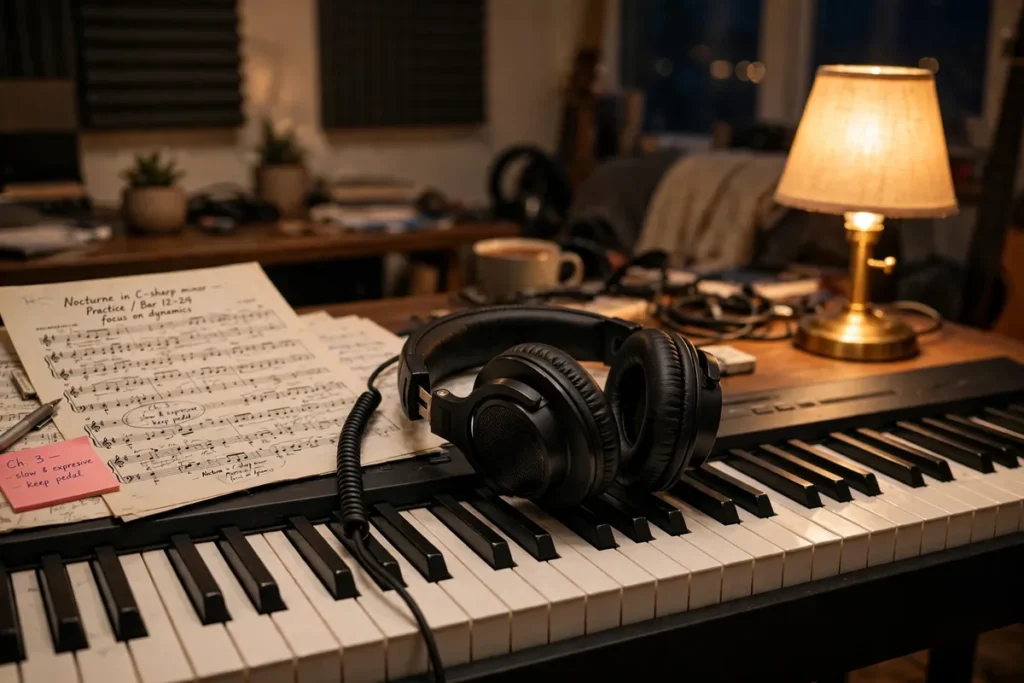
A digital piano makes a promise no acoustic piano can: full practice, at full expression, at midnight, without waking the house. Your headphones decide whether that promise holds. Plug in a pair tuned for pop and bass, and the lowest octave turns to mud while the top notes glare. Plug in the right pair, and you hear the instrument you actually bought — every key, from the lowest A to the highest C, at the dynamic level you played it.
Our analysis at SoundMavericks is simple: piano is the hardest test a headphone faces at home. It spans a wider frequency range than almost any other instrument, it exposes uneven tuning instantly, and practice sessions run long enough for any comfort flaw to become a reason to stop playing. The best headphones for piano practice are therefore not lifestyle headphones at all. They are wired, closed-back studio headphones — plus a couple of instrument-brand designs built specifically for keyboards — chosen for honest full-range reproduction, zero sound bleed, and comfort across two-hour sessions.
Our Verdict — Top Picks for Piano Practice
Best overall: Sony MDR-7506 — the studio standard: detailed, durable, folding, with a long coiled cable made for sitting at a keyboard.
Most honest piano tone: Audio-Technica ATH-M40x — tuned flat, so what you hear is what you played.
Best for long sessions: Beyerdynamic DT 770 Pro (80 Ohm) — soft velour pads and a spacious sound that stays comfortable for hours.
Why Piano Practice Punishes the Wrong Headphones
An 88-key piano runs from A0 at 27.5 Hz to C8 at about 4,186 Hz — and that is only the fundamental notes. Every key also produces harmonics that reach far higher, and a good digital piano sample layers damper resonance, string resonance and pedal noise on top. Headphones that roll off the bass make left-hand parts sound thin and distant. Headphones with a boosted low end — the tuning most consumer models use — smear bass notes into chords and hide the voicing you are trying to learn. A treble spike turns the top two octaves harsh enough to make you play them too softly.
Then there is the room. Silent practice only works if the sound stays inside the earcups. That rules out most open-back designs for shared homes, however natural they sound, and it is the core reason closed-back studio headphones dominate this category. Our explainer on open-back vs closed-back headphones covers the trade-off in depth; for late-night piano, closed-back wins on bleed alone.
Finally, practice is long. A forty-five-minute lesson recording, an evening of scales and repertoire, a weekend session working through a full piece — clamping force, ear-pad depth and weight matter as much as tuning. Every pick below is a headphone our analysis says you can wear for the whole session, not just the first twenty minutes.
What to Look for in Headphones for a Digital Piano or Keyboard
Flat, full-range tuning over exciting tuning
For practice, honesty beats excitement. A relatively flat response lets you judge dynamics, balance between the hands, and pedalling accurately — the same reason these studio models also appear in guides to the best headphones for mixing. Slight warmth is fine for enjoyment listening; a big bass shelf is not.
Closed-back isolation, in both directions
Closed earcups keep your playing in and household noise out. You stay focused, and nobody in the next room hears a faint, tinny version of your Hanon exercises at 11 p.m.
Impedance your piano can actually drive
Digital piano headphone outputs are modest. Models between roughly 32 and 80 ohms reach comfortable volume from virtually any keyboard, stage piano or home digital piano without an amp. Higher-impedance studio variants exist for several picks below — check which version you are buying. Our guide to headphone impedance and whether you need an amp explains the matching in plain terms.
Cable length and the 1/4-inch plug
Most digital pianos use a full-size 1/4-inch (6.35 mm) headphone jack; smaller keyboards often use 3.5 mm. Every pick here either includes a screw-on or snap-on adapter or, in the OneOdio’s case, carries both plug sizes on one cable. Coiled cables earn their place at a piano: they stretch when you lean in to turn a page and contract before they can pool around the sustain pedal.
The Best Headphones for Piano Practice, Ranked
1. Sony MDR-7506 — Best Overall for Piano Practice

The Sony MDR-7506 has been the default monitoring headphone in studios for decades, and piano practice is exactly the work it was built for. Its 40 mm drivers and 10 Hz–20 kHz response cover the piano’s full range with a detailed, forward presentation that makes mistakes easy to spot — uneven scales, rushed ornaments and muddy pedalling all show up clearly, which is what practice headphones are for.
The practical details suit a keyboard setup unusually well. The coiled cable stretches to about 9.8 feet, so it reaches from a piano’s front or underside jack to the bench without a trailing loop on the floor. The headphones fold flat for storage inside a piano bench or gig bag, the 63-ohm impedance is an easy load for any digital piano output, and the included Unimatch plug handles both 3.5 mm and 1/4-inch sockets. The sound leans bright rather than warm, so very long sessions at high volume can fatigue some listeners — keep the level sensible and it remains the most dependable all-rounder here.
2. Audio-Technica ATH-M40x — Most Honest Piano Tone

If your priority is hearing your playing exactly as it is, the Audio-Technica ATH-M40x is our pick. Audio-Technica tunes the M40x flat — flatter than its better-known sibling, the M50x — across a 15 Hz–24 kHz response, so bass notes stay defined instead of blooming, and the balance between your left and right hands is the balance you actually played. For students working on voicing, dynamics and tonal control, that honesty is worth more than any amount of added warmth.
The M40x ships with two detachable cables — a coiled cable that stretches from about 1.2 to 3 metres and a 3-metre straight cable — plus a screw-on 1/4-inch adapter, so it connects to any piano out of the box. At 35 ohms it runs happily from portable keyboards and home digitals alike, the earcups swivel 90 degrees for one-ear checks against the room or a teacher’s voice, and at 240 grams it stays comfortable through long sessions. The clamp is firmer than the Beyerdynamic below; glasses wearers may prefer the DT 770 Pro for marathon practice.
3. Beyerdynamic DT 770 Pro (80 Ohm) — Best for Long Practice Sessions

The Beyerdynamic DT 770 Pro is the comfort pick, and comfort is a genuine performance feature at the piano. Its soft velour ear pads, moderate clamp and roomy earcups make it the pair advanced players reach for when a session runs past two hours. The closed-back design still isolates well and leaks very little, while the soundstage is unusually spacious for a closed headphone — chords feel spread out rather than squeezed between your ears, which suits piano tone particularly well.
Buy the right version: this listing is the 80-ohm model with a 3-metre straight cable, the variant we recommend for digital pianos because it reaches full, clean volume from a piano’s own output. The 250-ohm version wants more gain than many home pianos provide. Tuning carries a gentle lift at the very bottom and top, so it flatters the piano slightly more than the M40x — enjoyable, and still honest enough for serious practice. We cover the model in full in our Beyerdynamic DT 770 Pro review. Nearly every part is replaceable, including the pads, which makes this a buy-once headphone.
4. Audio-Technica ATH-M50x — Best if You Also Listen for Pleasure
The Audio-Technica ATH-M50x shares the M40x’s excellent hardware — 45 mm drivers, three detachable cables including a coiled option, a screw-on 1/4-inch adapter, folding earcups — but tunes the sound with more low-end weight and sparkle across its 15 Hz–28 kHz range. At the piano that translates to a slightly richer, more exciting presentation: grand-piano samples sound grand. The trade-off is precision; the extra bass can mask left-hand detail a little compared with the M40x.
Choose the M50x if the same headphones will pull double duty for everyday listening, recording and practice, and you prefer some warmth in the sound. Choose the M40x if practice accuracy is the whole job. At 38 ohms and 285 grams, the M50x is easy to drive and comfortable, though its firmer clamp and leatherette pads run warmer than the DT 770 Pro’s velour over very long sessions.
5. Sennheiser HD 280 Pro — Best Isolation for Shared Homes
When the practice room is also the living room, the Sennheiser HD 280 Pro is the quietest neighbour on this list. Sennheiser rates its closed earcups at up to 32 dB of ambient attenuation, and in practice it both blocks household noise and contains your playing better than any other pick here. If you practise while someone watches TV in the same room, this is the pair.
Its 8 Hz–25 kHz response is evenly balanced with a slightly reserved treble that stays easy on the ears over long sessions, and the 64-ohm impedance suits piano outputs well. The coiled cable extends from roughly 1 to 3 metres and the earcups fold for storage. The honest caveat is fit: the HD 280 Pro clamps firmly, especially when new. Most players adapt within a week, but if you already know strong clamp bothers you, the DT 770 Pro is the safer long-session choice.
6. Roland RH-5 — Best Piano-Brand Budget Pick

Roland builds digital pianos, so it is no surprise the Roland RH-5 is voiced for exactly this job: 40 mm drivers with a natural, balanced response (10 Hz–22 kHz) intended to present electronic instruments — pianos, keyboards, synths — without exaggeration. It is closed-back, so late-night practice stays private, and at around 190 grams it is the lightest full-size pick here, a real advantage for younger students and anyone who finds studio headphones heavy.
The 3-metre cable and included conversion plug cover both jack sizes found on home pianos, and the 32-ohm impedance means even small portable keyboards drive it to full volume. It does not fold and the build is simpler than the studio models above, but as a first dedicated practice headphone — especially paired with a Roland, or any, digital piano — it is the easiest recommendation at its level.
7. Yamaha HPH-150 — Most Natural Sound, With One Honest Caveat
Yamaha designed the Yamaha HPH-150 specifically for digital instruments, with a neutral tone palette meant to reproduce a piano’s sound faithfully rather than flatter it. The 40 mm drivers, soft velour ear pads and featherweight 163-gram build with a 2-metre single-sided cable make it exceptionally easy to wear, and its open, airy presentation is the closest any pick here comes to hearing a piano in a room rather than inside your head.
The caveat is in the name: the HPH-150 is an open-air design, and Yamaha itself notes that open-air headphones leak sound easily. In a quiet house at moderate volume it is fine for daytime practice; for genuinely silent late-night sessions in a shared space, every closed-back pick above it will serve you better. Buy it for natural tone and daytime comfort, not for secrecy.
8. OneOdio Studio Pro-10 — Best Ultra-Budget Pick
The OneOdio Studio Pro-10 is the budget wildcard that keeps appearing in keyboard practice setups, and the reason is practical: its coiled cable has a 3.5 mm plug on one end and a full-size 6.35 mm plug on the other, so it connects to any piano or keyboard with no adapter to lose. The 50 mm drivers cover a claimed 20 Hz–40 kHz, the earcups swivel for one-ear monitoring, and the SharePort lets a teacher or parent plug a second pair into the same headphone during a lesson — a genuinely useful practice feature no other pick here offers.
Set expectations accordingly: the tuning is livelier and bass-forward compared with the studio picks, so it flatters more than it reveals, and the build is a step below the Sony and Audio-Technica models. As a first pair for a beginner, a spare for a second piano, or a lesson-room headphone, it earns its place.
All Picks at a Glance
| Headphone | Best for | Response / Impedance | Cable | Check Price |
|---|---|---|---|---|
| Sony MDR-7506 | Best overall | 10 Hz–20 kHz / 63 Ω | Coiled, up to 9.8 ft | Check Price |
| Audio-Technica ATH-M40x | Most honest tone | 15 Hz–24 kHz / 35 Ω | Detachable coiled + straight | Check Price |
| Beyerdynamic DT 770 Pro (80 Ohm) | Long sessions | 5 Hz–35 kHz / 80 Ω | Straight, 3 m | Check Price |
| Audio-Technica ATH-M50x | Practice + listening | 15 Hz–28 kHz / 38 Ω | Detachable, 3 cables | Check Price |
| Sennheiser HD 280 Pro | Best isolation | 8 Hz–25 kHz / 64 Ω | Coiled, 1–3 m | Check Price |
| Roland RH-5 | Piano-brand budget | 10 Hz–22 kHz / 32 Ω | Straight, 3 m | Check Price |
| Yamaha HPH-150 | Natural open sound (leaks) | 20 Hz–20 kHz / 48 Ω | Straight, 2 m | Check Price |
| OneOdio Studio Pro-10 | Ultra-budget | 20 Hz–40 kHz / 32 Ω | Coiled, dual-plug | Check Price |
Can You Use These Headphones With E-Drums and Synths?
Yes — everything that makes a headphone right for a digital piano (flat full-range response, easy impedance, a long cable, a 1/4-inch plug) also suits synths and electronic drum modules, and several picks here, notably the Roland RH-5 and the DT 770 Pro, are long-standing favourites at drum modules too. E-drum kits add their own demands around kick-pedal impact and isolation while you play along to tracks, which deserve dedicated coverage; for piano-first players who occasionally sit at a kit or a synth, any closed-back pick above will do the job well.
Final Verdict
Most players should start with the Sony MDR-7506: it is detailed, tough, fairly priced within its class and built around a coiled cable that behaves itself at a piano. Students focused on technique and honest feedback should take the ATH-M40x, and anyone practising in long daily sessions should take the DT 770 Pro (80 Ohm) and forget about their ears entirely. On a tighter budget, the Roland RH-5 is the purpose-built shortcut. Whichever you choose, buy wired, buy closed-back unless your practice room is truly private, and let the piano — all 88 keys of it — be the judge.
Frequently Asked Questions
What type of headphones are best for digital piano practice?
Wired, closed-back, over-ear studio headphones with a relatively flat response are best for digital piano practice. They reproduce the piano’s full range honestly, keep your playing from leaking into the room, need no charging or pairing, and introduce zero latency. Models between 32 and 80 ohms work with virtually any piano’s headphone output.
Can I use wireless Bluetooth headphones with a digital piano?
You can on pianos with Bluetooth audio output, but we do not recommend it for practice. Bluetooth adds latency between key press and sound, which disrupts timing and feel, and many pianos only support Bluetooth MIDI, not audio. A wired pair is cheaper, always ready, and perfectly in sync with your playing.
Do I need a headphone amplifier for my digital piano?
Almost certainly not. Digital piano headphone outputs are designed for typical consumer and studio headphones. Any pick in this guide at 80 ohms or below will reach comfortable volume. Very high-impedance studio variants (such as a 250-ohm DT 770 Pro) are the exception — simply choose the lower-impedance version instead.
Are open-back headphones better for piano practice?
Open-back headphones can sound more natural and spacious, closer to hearing a piano in a room. The trade-off is bleed: they leak your playing outward and let room noise in, which defeats silent practice in a shared home. They suit a private practice room; closed-back models suit everyone else.
What size headphone jack do digital pianos use?
Most full-size digital pianos and stage pianos use a 1/4-inch (6.35 mm) stereo jack, while many portable keyboards use a 3.5 mm jack, and some offer both. Every headphone in this guide includes an adapter for the larger jack or carries both plug sizes, so check your piano’s manual once and you are covered.

I am the founder of Sound Mavericks, where I provide the polite truth about audio equipment. I started this site because consumer electronics reviews are often too technical. Instead of using a silent lab, I test headphones, earbuds, and Bluetooth speakers in the real world – like on a noisy subway or in a busy coffee shop.
To stay independent, I buy my own review units (mostly from the United States) rather than accepting free gifts from brands. Once I finish testing a product, I sell it locally to our community. My goal is to help you understand sound quality, active noise cancellation (ANC), and battery life without the marketing hype.