
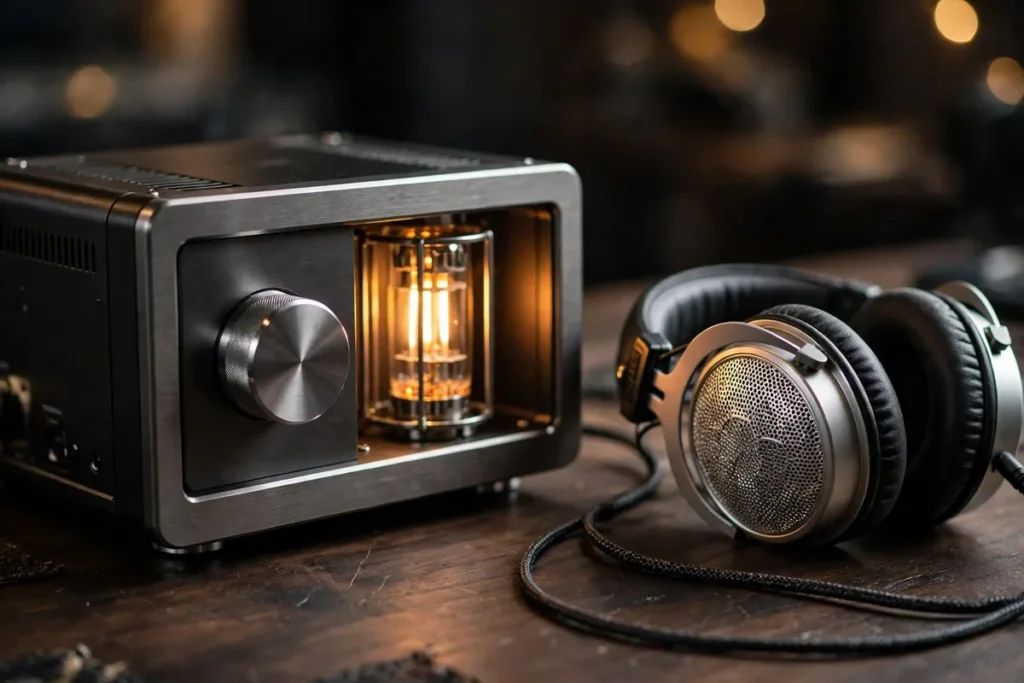
Best headphones for high impedance listening — the 250-ohm Beyerdynamics, the 300-ohm Sennheisers, the 600-ohm flagships — all share the same problem: a phone, a laptop jack, or a budget audio interface cannot swing enough voltage to drive them properly. They play, but quietly, and with the dynamics squeezed flat. The fix is not more watts in the abstract. It is the right kind of power: clean voltage swing, sensible gain, and an output impedance low enough not to rewrite your headphone’s frequency response.
This guide is organised the way the problem actually works — by what your headphones demand — rather than by price band. If you want the underlying physics first, our explainer on what impedance is and whether you need an amp covers it in depth. Here, we turn that theory into six concrete amp picks, each matched to a class of hard-to-drive headphone.
Our verdict
For most 250-ohm and 300-ohm owners, the FiiO K11 is the amp to buy: a DAC and amplifier in one box, with three gain levels and manufacturer-published output that comfortably covers the Beyerdynamic and Sennheiser classes. Stepping up, the FiiO K7 adds a fully balanced output and THX amplification for listeners who also run demanding planars or balanced cables.
Quick picks: the right amp for your impedance class
| Amplifier | Best for | Key strength for high impedance | |
|---|---|---|---|
| FiiO K11 | 250Ω / 300Ω, first dedicated amp | Built-in DAC, 3 gain levels, balanced 4.4mm output | Check Price |
| Schiit Magni Heretic | 300Ω / 600Ω, amp-only purists | Manufacturer-published power at 300Ω and 600Ω loads | Check Price |
| TOPPING L30 II | 600Ω and low-sensitivity flagships | 37Vpp maximum voltage swing, per Topping | Check Price |
| TOPPING DX3 Pro+ | All-in-one desktop convenience | NFCA amp stage, remote, Bluetooth LDAC input | Check Price |
| FiiO K7 | Balanced cables, mixed collections | Fully balanced THX AAA amplification | Check Price |
| xDuoo TA-26S | 300Ω / 600Ω owners who want tube sound | OTL tube design naturally suited to high-impedance loads | Check Price |
Why high-impedance headphones need voltage, not just power
Impedance, measured in ohms, is how strongly a headphone resists the electrical signal. A 32-ohm portable headphone sips current and gets loud from almost anything. A 250-ohm or 300-ohm headphone works the other way: it draws little current but needs the signal delivered at a higher voltage before it reaches listening level. A 600-ohm model pushes that requirement further still. This is why the same laptop jack that drives earbuds to painful volume leaves a set of studio Beyerdynamics sounding thin and distant — the jack runs out of volts long before it runs out of anything else.
Two consequences follow when you shop for an amp. First, headline wattage is the wrong number to chase, because manufacturers usually quote power into a low 32-ohm load. What matters for your headphones is the published output into 300-ohm or 600-ohm loads, and the maximum voltage swing behind it. Second, sensitivity still counts: a 300-ohm headphone with healthy sensitivity may need less heroic amplification than its impedance suggests, while a low-sensitivity 250-ohm model can be quietly demanding. Impedance tells you the shape of the requirement; sensitivity tells you the size of it.
The 1/8 rule: output impedance matters as much as power
An amplifier’s own output impedance interacts with your headphone’s impedance curve. Where that curve rises and falls — and on most dynamic headphones it rises sharply in the bass — a high output impedance lets the response wobble with it, typically bloating the low end and dulling control. The long-standing rule of thumb is to keep the amp’s output impedance below one-eighth of the headphone’s impedance. For a 250-ohm headphone that means an output impedance under roughly 31 ohms, which any modern solid-state amp clears easily; most of the amps below publish output impedances under 1 ohm. The rule bites hardest at the other end of the market — vintage receivers and many tube amps have output impedances in the tens or hundreds of ohms, which is exactly why those sources pair happily with 300-ohm and 600-ohm headphones and poorly with 32-ohm ones.
Gain settings: the most underrated spec on the box
Gain is how much the amp multiplies the incoming signal, and switchable gain is what lets one amp serve a whole collection. High gain is where the voltage for a 600-ohm headphone lives; low gain keeps sensitive earphones hiss-free and gives the volume knob a usable range. Every solid-state pick in this guide offers at least two gain levels, and the FiiO models offer three. If you only remember one shopping rule, make it this: an amp without a gain switch is a compromise aimed at someone else’s headphones.
Match the amp to your headphones
Start from the headphone, not the amp. The three classes below cover nearly every high-impedance model in common use, and each points at a different kind of amplifier.
| Your headphones | What they need | Our match | |
|---|---|---|---|
| Beyerdynamic DT 990 Pro (250 Ohm) and its 250Ω studio siblings | Moderate voltage swing, low output impedance, a DAC upgrade over laptop audio | FiiO K11 | Check Price |
| Sennheiser HD 650 and the 300Ω HD 600 family | Strong output into a 300Ω load, gain headroom for quiet recordings | Schiit Magni Heretic | Check Price |
| 600Ω-class models (Beyerdynamic 600Ω editions) | Maximum voltage swing above all; OTL tubes come into their own here | TOPPING L30 II or xDuoo TA-26S | Check Price |
The picks in detail
FiiO K11 — the default recommendation for 250Ω and 300Ω owners
The K11 is a DAC and headphone amplifier in a single compact chassis, which matters because most high-impedance headphones are being fed by a laptop or PC whose built-in audio is the real bottleneck. FiiO publishes output power of at least 1,400 mW into 32 ohms and at least 73 mW into a 300-ohm load — that second, manufacturer-published figure is the one to care about here, and it is healthy headroom for the Beyerdynamic 250-ohm class and the Sennheiser 300-ohm family at realistic listening levels. Three gain levels, a balanced 4.4mm output alongside the standard 6.35mm jack, and USB, optical, and coaxial inputs round out a box that asks very little of its owner. Our analysis: this is the correct first dedicated amp for the majority of readers, and the one we would buy with our own money for a DT 990 Pro or HD 650 desk setup.
Schiit Magni Heretic — published power where it counts
Schiit earns its place here by doing the thing we wish every manufacturer did: publishing output power at the loads high-impedance owners actually use. Per Schiit’s specifications, the Magni Heretic delivers 410 mW RMS into 300 ohms and 215 mW RMS into 600 ohms — figures that put every headphone class in this guide comfortably within reach, with an output impedance low enough to satisfy the 1/8 rule many times over. It is an amplifier only, so you pair it with your existing DAC, interface, or a matching Modi DAC. Buyers who already own a decent source and want a transparent, US-made amp with a preamp output for powered speakers should start here. For a broader look at amp-only and combo options, see our roundup of the best headphone amps.
TOPPING L30 II — the voltage-swing specialist for 600Ω
If your headphones live at 600 ohms, voltage swing is the whole game, and the L30 II is built around it: Topping publishes a maximum output swing of 37Vpp from its NFCA amplification stage, a figure aimed squarely at loads that starve lesser amps. Three gain settings (including a low-gain mode for sensitive earphones) keep it flexible, and like the Magni it doubles as a preamp for a desktop speaker chain. It needs a separate DAC — the matching Topping E30 II is the obvious partner — but as a pure driving tool for the hardest-to-drive dynamic headphones, this is the strongest solid-state option in its class that we can point to with published numbers behind it.
TOPPING DX3 Pro+ — the all-in-one with a remote
The DX3 Pro+ folds a DAC, an NFCA headphone amplifier, Bluetooth 5.0 with LDAC, and a remote control into one small unit — the pick for a living-room or shared desk where the amp also feeds powered speakers and takes TV or phone input. Its amplifier stage is designed by the same team behind the L30 line, with selectable gain for matching everything from earphones to 300-ohm Sennheisers. We rate it slightly behind the K11 as a pure first-amp value play, but ahead of everything here on convenience. Readers comparing integrated units specifically should also browse our guide to the best headphone amp DAC combos.
FiiO K7 — the balanced step-up
The K7 is the K11’s bigger sibling: dual DAC chips, THX AAA 788+ amplification, and a fully balanced signal path with a 4.4mm balanced output. FiiO publishes balanced output power above 2,000 mW into 32 ohms, and the balanced stage’s higher voltage swing is a genuine, practical benefit for 300-ohm headphones used with balanced cables — not just a spec-sheet trophy. Choose the K7 over the K11 if you own, or plan to own, balanced cables for your Sennheisers, or if your collection mixes high-impedance dynamics with current-hungry planars that appreciate the balanced stage’s extra drive. Our explainer on balanced vs unbalanced audio cables covers when that connection actually helps.
xDuoo TA-26S — the tube option high impedance was made for
Output-transformerless (OTL) tube amplifiers are the exception to the low-output-impedance rule: their naturally high output impedance is a poor match for low-impedance headphones but a classic, much-loved pairing with 300-ohm and 600-ohm dynamics, where the 1/8 relationship still holds. The TA-26S runs a 6N8P tube in the preamp stage and a 6N5P as buffer, offers 6.35mm and 4.4mm balanced outputs, and is built for exactly the Sennheiser and Beyerdynamic flagships this guide is about. Expect a presentation many listeners describe as smoother and more spacious than solid-state, at the cost of warm-up time and eventual tube replacement. If you have ever wondered why HD 650 owners keep recommending tubes, this is the accessible way to find out.
Full comparison: specs that matter for high-impedance headphones
| Amplifier | Type | Manufacturer-published figure to note | Outputs | |
|---|---|---|---|---|
| FiiO K11 | DAC/amp | ≥73 mW into 300Ω (FiiO) | 6.35mm, 4.4mm balanced | Check Price |
| Schiit Magni Heretic | Amp only | 410 mW into 300Ω; 215 mW into 600Ω (Schiit) | 6.35mm | Check Price |
| TOPPING L30 II | Amp only | 37Vpp maximum output swing (Topping) | 6.35mm | Check Price |
| TOPPING DX3 Pro+ | DAC/amp | NFCA amp stage with selectable gain (Topping) | 6.35mm | Check Price |
| FiiO K7 | DAC/amp | >2,000 mW balanced into 32Ω (FiiO) | 6.35mm, 4.4mm balanced | Check Price |
| xDuoo TA-26S | OTL tube amp | Designed for high-impedance loads; 6N8P / 6N5P tube set (xDuoo) | 6.35mm, 4.4mm | Check Price |
One reading note on that table: power figures are only comparable when the load matches. A big number into 32 ohms tells a 600-ohm owner almost nothing, which is why we have quoted each maker’s figure at the load, or in the form, that maker publishes for high-impedance use — and left the cell descriptive where a manufacturer does not publish a directly comparable high-impedance figure.
Do you need a balanced output for high-impedance headphones?
Not strictly — a strong single-ended amp like the Magni Heretic or L30 II drives any headphone in this guide from its 6.35mm jack. Balanced earns its keep in two situations: when an amp’s balanced stage offers meaningfully higher voltage swing than its single-ended stage (true of the FiiO K7), and when a long cable run in an electrically noisy room picks up interference that a balanced connection rejects. If your headphones ship with, or accept, a balanced cable and you are buying a balanced-capable amp anyway, use it. Just do not buy an amp for the balanced badge alone; buy it for published swing and gain, and let balanced be the bonus.
Frequently asked questions
Can a phone or laptop drive 250-ohm headphones?
It will produce sound, but usually not enough of it: most phone and laptop outputs swing too few volts for a 250-ohm headphone, so volume runs short and quiet passages in dynamic recordings disappear first. A dedicated amp with a published 300-ohm output figure, like the FiiO K11, removes the limitation entirely.
What gain setting should I use for 300-ohm headphones?
Start on the middle or high gain setting and set volume to a comfortable level with the knob in the middle of its travel. If you reach comfortable volume with the knob barely turned up on high gain, drop a level — lower gain with more knob travel gives finer control and a lower noise floor.
How much power do 600-ohm headphones actually need?
Less wattage than marketing suggests, but more voltage than most sources can swing. Look for an amp that publishes output into a 600-ohm load, as Schiit does for the Magni Heretic (215 mW RMS, per Schiit), or a maximum voltage swing figure like the Topping L30 II’s 37Vpp, rather than a headline number measured at 32 ohms.
Are tube amps better for high-impedance headphones?
They are a legitimate match rather than a universal upgrade. OTL tube designs such as the xDuoo TA-26S have high output impedance, which pairs correctly with 300-ohm and 600-ohm headphones under the 1/8 rule, and many listeners enjoy their presentation. Solid-state amps remain the cleaner, lower-maintenance default.
Is a higher impedance headphone automatically better?
No. Impedance describes how a headphone needs to be driven, not how well it sounds. The 250-ohm and 300-ohm classics earned their reputations on tuning and build; their impedance is simply the reason they ask for a proper amplifier to show it.

I am the founder of Sound Mavericks, where I provide the polite truth about audio equipment. I started this site because consumer electronics reviews are often too technical. Instead of using a silent lab, I test headphones, earbuds, and Bluetooth speakers in the real world – like on a noisy subway or in a busy coffee shop.
To stay independent, I buy my own review units (mostly from the United States) rather than accepting free gifts from brands. Once I finish testing a product, I sell it locally to our community. My goal is to help you understand sound quality, active noise cancellation (ANC), and battery life without the marketing hype.

