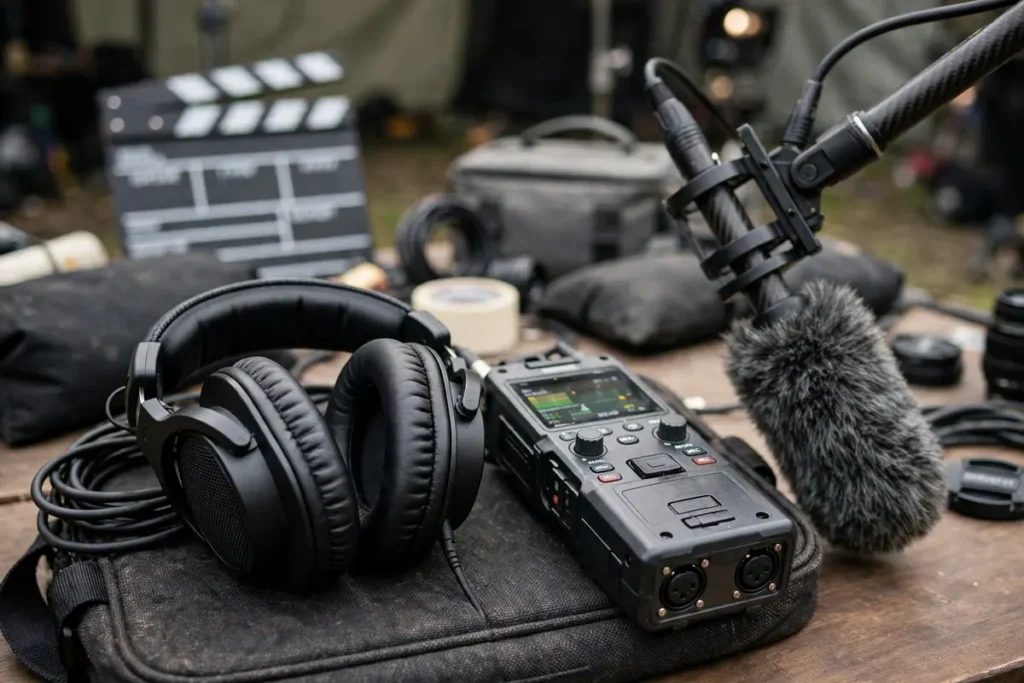
Location sound is the one headphone job where getting it wrong cannot be fixed later. If handling noise, clothing rustle, a hum from a practical light, or a lav mic rubbing against a jacket slips past you on set, it lives in the take forever. That is why the best headphones for location sound are not the most exciting headphones money can buy. They are closed-back, honest in the midrange where dialogue lives, isolating enough to separate the microphone feed from the noise of the set, and tough enough to be dropped, sat on, and repaired in the field.
Our verdict at SoundMavericks is simple. The Sony MDR-7506 remains the default choice for most recordists: it is the headphone the wider industry already knows, so what you hear on location translates predictably to what an editor hears later. If isolation is your top priority, the Sennheiser HD 280 Pro seals out more of the set. If you want a headphone built to be serviced for decades, the Beyerdynamic DT 150 is the tank of this list. Below are six picks for film and location work, based on manufacturer specifications, professional location-sound sources, and our own analysis of how each model fits real set workflows. This is a research-based guide, and every recommendation is tied to a specific job on set.
Our Top Picks at a Glance
Best overall for location sound: Sony MDR-7506 — the industry-standard monitoring sound, light, foldable, and easy to drive from any recorder.
Best isolation: Sennheiser HD 280 Pro — rated attenuation of up to 32 dB, with replaceable pads, cable and headband padding.
Best built to be repaired: Beyerdynamic DT 150 — fully modular construction where every part can be replaced.
What Location Sound Actually Demands From Headphones
Monitoring on location is a different discipline from mixing in a studio or listening at home. In a studio you can reach for open-back headphones with a wide, airy presentation. On set, that openness is a liability: sound leaks out toward microphones and location noise leaks in. If you are weighing up the basics, our guide to open-back vs closed-back headphones explains why every pick in this roundup is closed-back.
Isolation comes before everything
A recordist stands a few feet from the scene, hearing the actors twice: once in the air and once through the microphones. Good passive isolation pushes the direct version down so you can judge the recorded version — the one that matters. This is passive isolation, not electronic cancellation, and the distinction matters on set for the reasons covered in our explainer on active noise cancellation vs passive isolation: there is no battery to die mid-take, no processing delay, and no risk of the headphone itself behaving unpredictably around wireless systems.
Accurate, not hyped, frequency response
Dialogue intelligibility lives in the midrange and lower treble. A headphone that boosts the bass or sparkles the top end may flatter music, but on location it hides problems: low-frequency hype masks rumble and handling noise until post-production finds it, and a dull top end can hide sibilance, hiss and rustle. The headphone’s job is to report, honestly and immediately, what the microphone is capturing.
Durability, spares and single-ear practicality
Location headphones live in cases, on carts, and around necks. Cables get rolled over and yanked; earpads split. That is why replaceable cables, pads and headbands matter more than a fashionable finish. Just as practical is single-ear monitoring: boom operators and mixers routinely slide one cup off to hear the set or take direction, then slide it back. Swiveling or flip-away cups are not a luxury here — they are part of the workflow.
The Best Headphones for Location Sound, Pick by Pick
1. Sony MDR-7506 — The Industry Standard

The Sony MDR-7506 is the headphone you will see on more film sets, news crews and broadcast trucks than any other, and that ubiquity is itself a professional feature. When everyone in the chain — recordist, boom operator, editor — knows the same headphone’s sound, there are no translation surprises between location and post.
Sony’s design is a closed-back model with 40 mm drivers, a rated response of 10 Hz to 20 kHz, and 63-ohm impedance, making it easy to drive to healthy levels straight from a field recorder or mixer. Its presentation is revealing in the upper midrange and treble, precisely where location problems announce themselves: clothing rustle, lav friction, cable taps and early distortion all stand out instead of hiding. That forward character is why generations of recordists trust it as a fault-finding tool rather than a pleasure-listening headphone.
Practically, the 7506 folds flat, weighs little enough to wear around the neck between takes, and uses a long coiled cable that stretches across a sound cart. The honest weaknesses: the cable is fixed rather than detachable, so a serious cable failure is a repair rather than a swap, and the stock earpads are a known wear item — budget for replacements and the headphone will serve for years. Isolation is good rather than class-leading, the one area where the next pick beats it. For most dialogue-driven work, this remains the sound the industry is calibrated to, and our top recommendation.
2. Sennheiser HD 280 Pro — Best Isolation for Noisy Sets

When the location itself is the enemy — traffic, generators, crowds, weather — the Sennheiser HD 280 Pro is the pick built for the fight. Sennheiser rates its closed, circumaural earcups at up to 32 dB of ambient noise attenuation, the strongest published figure among the mainstream picks here, and the firm clamp that produces that seal is a deliberate trade-off.
The sound is widely described in professional comparisons as flatter and less hyped than the Sony, with an accurate, linear presentation across its 8 Hz to 25 kHz rated response. Impedance is 64 ohms, so like the 7506 it runs happily from portable recorders. For a recordist who wants the feed presented with minimal emphasis anywhere, on loud locations where masking is a constant risk, that combination of neutrality and attenuation is exactly the point.
Sennheiser also designed the HD 280 Pro to be kept, not replaced: earpads, headband padding and the single-sided coiled cable are all user-replaceable, and the earcups fold and rotate for transport and quick single-ear checks. The trade-off is comfort: the clamp that delivers the isolation can feel tight over very long days. If your shoots are long but your locations are loud, most recordists accept that willingly.
3. Sennheiser HD 26 Pro — Lightweight Broadcast Specialist
The Sennheiser HD 26 Pro comes from broadcast rather than music production, and it shows in the details location crews care about. It is a closed, supra-aural (on-ear) design weighing about 180 grams, with Sennheiser’s split two-piece headband that distributes pressure automatically — a genuine advantage when the headphones stay on, or around your neck, for an entire shooting day.
Two features set it apart. First, ActiveGard limiting protects your hearing from sudden level peaks above 105 dB — a dropped microphone, a feedback spike, a shout into a live mic — and it can be switched on or off. Second, one earcup flips away by roughly 45 degrees for single-sided listening, so you can keep one ear on the set and one on the feed without holding a cup in place by hand, a manoeuvre every boom operator knows well.
Specifications underline the broadcast brief: 100-ohm impedance, a rated 20 Hz to 18 kHz response focused on the speech range, high maximum sound pressure capability, and a modular build with replaceable cable and cushions. The on-ear fit isolates less than the big circumaural models here, and retail availability can be thinner than the HD 280 Pro, so check current listings before a fleet purchase. For ENG, documentary and broadcast crews who value low weight and hearing protection, it is a purpose-built answer.
4. Beyerdynamic DT 150 — The Repairable Workhorse

The Beyerdynamic DT 150 looks like it was designed in another era, because it was — and broadcast and film facilities have kept buying it for one reason: it is built for loud environments and built to be fixed. Beyerdynamic describes it as a closed dynamic monitoring headphone for use in loud environments and in broadcast, film and recording studios, with a fully modular construction in which every part, from drivers and pads to the single-sided detachable cable, can be replaced.
That modularity changes the ownership maths: a worn pad or damaged cable is a spare part and a few minutes, not a new headphone. The closed circumaural design delivers excellent ambient noise attenuation in Beyerdynamic’s own description, and the neodymium driver system is voiced for balanced, accurate reproduction rather than excitement, across a rated response of 5 Hz to 30 kHz.
One specification demands attention: impedance is 250 ohms. Most modern recorders and mixers will drive it, but maximum level will be lower than with the 63- and 64-ohm picks above, especially from small recorders with modest headphone outputs. If impedance and headphone drive are new territory, our explainer on headphone impedance and whether you need an amp walks through the matching logic. Crews who love the DT 150 concept but need an easier load should also look at its lighter stablemate, the Beyerdynamic DT 250 in its 80-ohm version, a long-running broadcast favourite in a smaller, lighter shell. Choose the DT 150 when the headphone is a long-term tool you intend to maintain for a decade.
5. Audio-Technica ATH-M50x — The Versatile All-Rounder

The Audio-Technica ATH-M50x is the most familiar headphone here to video shooters and one-person crews, and its inclusion comes with a caveat. With 45 mm drivers and a rated response of 15 Hz to 28 kHz, it has more low-end weight and top-end polish than the stricter location tools above. For pure dialogue monitoring, that weight can mask the low-frequency rumble and handling noise a recordist needs to catch early.
So why include it? Because many location jobs are hybrid. The solo shooter who records an interview in the morning and edits it in the afternoon benefits from its practical design: earcups that swivel 90 degrees for genuine one-ear monitoring, a folding frame, and three detachable cables in the box, including coiled and straight options. At 38 ohms it is the easiest headphone here to drive, reaching working level from any recorder, camera or interface.
Use it knowingly. As a first headphone for a small crew that also edits and reviews material, the M50x is a rational, widely supported choice. As a dedicated dialogue-monitoring tool on a professional sound cart, the flatter picks above will tell you the truth sooner.
6. Remote Audio HN-7506 — For Genuinely Extreme Noise
Some locations defeat ordinary headphones entirely: helicopters, race tracks, runways, industrial plants, live concerts recorded from the floor. The Remote Audio HN-7506 exists for those days. Remote Audio takes the 40 mm drivers from the Sony MDR-7506 and houses them in custom, specially baffled ear shells, and the company rates the result at over 40 dB of attenuation in the voice range — a figure in hearing-protector territory, far beyond what a standard closed-back headphone attempts.
The clever part is consistency. Because the drivers are the 7506’s own, the HN-7506 is designed to sound familiar to anyone calibrated to the industry standard, so a mixer can swap between the two without re-learning the recording. Remote Audio positions it for recordists in extreme noise, and for live music recording and mixing, where the same isolation protects both judgement and hearing.
The compromises are obvious and acceptable: the shells are bulkier and heavier than a standard 7506, the fit grips firmly to maintain the seal, and it is a specialist tool sold mainly through pro-audio dealers, so retail availability is limited. Nobody should buy it as an everyday headphone. But as the pair kept for the loudest five percent of jobs, nothing else here does what it does.
Location Sound Headphones Compared
| Headphone | Design | Impedance | Isolation Notes | Cable | Check Price |
|---|---|---|---|---|---|
| Sony MDR-7506 | Closed-back, folds flat | 63 Ω | Good closed-back seal; no published attenuation figure | Fixed coiled cable | Check Price |
| Sennheiser HD 280 Pro | Closed-back circumaural, folding/rotating cups | 64 Ω | Up to 32 dB attenuation (manufacturer rating) | Single-sided coiled, replaceable | Check Price |
| Sennheiser HD 26 Pro | Closed supra-aural, split headband, flip-away cup | 100 Ω | High passive attenuation for an on-ear design; ActiveGard peak limiting | Single-sided, replaceable (modular) | Check Price |
| Beyerdynamic DT 150 | Closed-back circumaural, fully modular | 250 Ω | Excellent ambient attenuation (manufacturer description); built for loud environments | Single-sided, detachable | Check Price |
| Audio-Technica ATH-M50x | Closed-back circumaural, 90° swivelling cups, folding | 38 Ω | Solid passive isolation; less flat than dedicated location tools | Detachable; coiled and straight cables included | Check Price |
| Remote Audio HN-7506 | Closed-back circumaural, custom baffled shells | 63 Ω | Over 40 dB attenuation in the voice range (manufacturer rating) | Single-sided coiled cable options | Check Price |
How Location Work Differs From Studio and Home Listening
It is tempting to shop for location headphones using studio logic, but the jobs diverge quickly. A mixing headphone is judged on imaging and tonal balance in a quiet room; a location headphone is judged on whether you can hear a problem at the moment it can still be fixed — by moving a lav, repositioning a boom, or calling for one more take. That is why recordists forgive the MDR-7506 its forward treble and the HD 280 Pro its clamp: both traits serve fault detection in noise. If your work spans both worlds, our guide to the best headphones for mixing covers the studio side of the kit bag, and many professionals simply own one of each rather than forcing a single headphone to do both jobs badly.
Comfort also reads differently on location. A headphone worn for a twelve-hour day, repeatedly taken off and put back on, needs pads you can wipe down and replace. A secure seal that survives head movement beats a plush fit that shifts and leaks.
Spares, Repairs and Building a Location Kit
Professional location kits treat headphones as maintainable tools. Carry spare earpads for whichever model you choose — pads are the fastest-wearing part, and a flattening pad quietly destroys comfort and isolation. If your headphone has a detachable cable, carry a spare; it is the most common field failure and the cheapest to pre-empt. Owners of the fixed-cable MDR-7506 should know a competent technician can repair or re-terminate its cable, one reason the model survives in rental fleets.
Many recordists keep two tiers in the bag: an everyday pair such as the 7506 or HD 280 Pro, and a specialist pair for extreme noise or long observational days. Finally, label your headphones. On a busy set, identical black headphones walk away with other departments, and tape with your name on the headband is the oldest security system in location sound.
Frequently Asked Questions
What headphones do film sound mixers use most?
The Sony MDR-7506 is the most widely used monitoring headphone in film and broadcast location work. Its revealing upper midrange exposes dialogue problems early, it is light and foldable, and because so many recordists and editors share the same reference, recordings translate predictably from set to post.
Are noise-cancelling headphones good for location sound?
Generally no. Location monitoring relies on passive isolation from closed-back designs, which has no battery to exhaust and adds no processing delay. Active cancellation is designed for listeners, not for judging a recording in real time.
Why is a flat frequency response important for dialogue recording?
A hyped headphone hides faults. Extra bass can mask rumble, handling noise and wind until post-production, while a recessed top end can hide rustle and hiss. A flat, honest response means what you hear is close to what is being recorded.
7506 or HD 280 Pro for a first location headphone?
Choose the MDR-7506 for the industry-standard reference sound, lighter fit and easy drive. Choose the HD 280 Pro if your locations are consistently loud and maximum passive isolation matters more, accepting its firmer clamp.
What impedance works best with field recorders?
Most portable recorders drive headphones in the roughly 32 to 100 ohm range to comfortable levels. Higher-impedance models such as the 250-ohm DT 150 will play quieter from modest outputs, so check your recorder’s specification first.
How often should earpads be replaced on location headphones?
Replace pads when they crack, flake or stop sealing — on a hard-working set pair that can be yearly or sooner. Worn pads reduce isolation and shift the sound, so fresh pads are both a comfort and an accuracy fix.

I am the founder of Sound Mavericks, where I provide the polite truth about audio equipment. I started this site because consumer electronics reviews are often too technical. Instead of using a silent lab, I test headphones, earbuds, and Bluetooth speakers in the real world – like on a noisy subway or in a busy coffee shop.
To stay independent, I buy my own review units (mostly from the United States) rather than accepting free gifts from brands. Once I finish testing a product, I sell it locally to our community. My goal is to help you understand sound quality, active noise cancellation (ANC), and battery life without the marketing hype.