
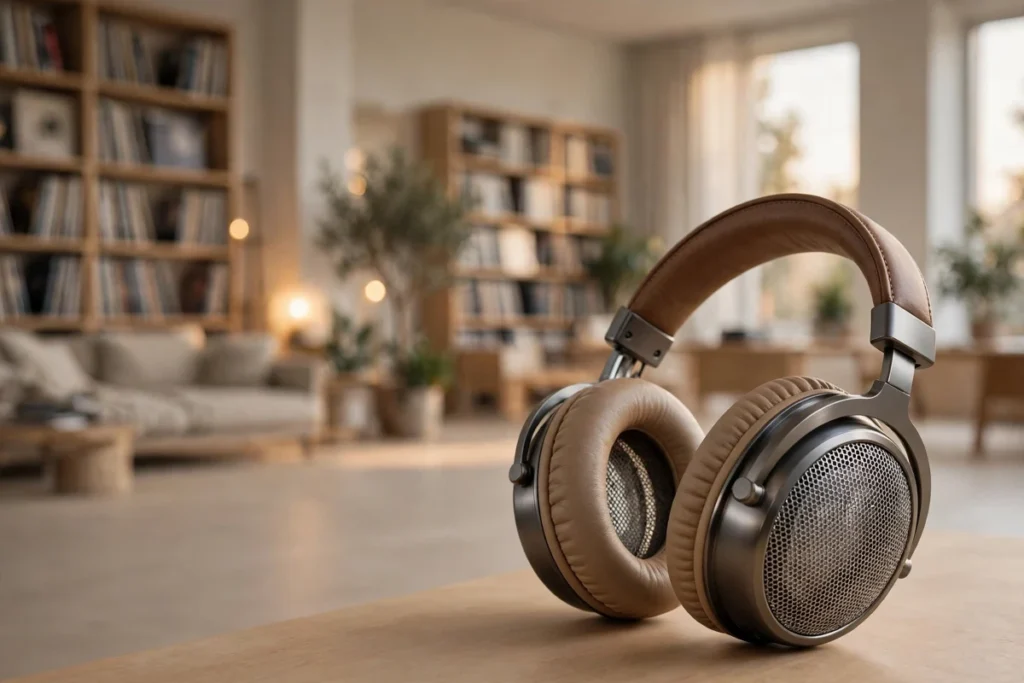
Most headphones put music inside your head. The best headphones for soundstage do something rarer: they move it out in front of you, so an orchestra has rows, a live recording has a room, and a game world has distance you can actually judge. After comparing manufacturer specifications, driver designs and the consistent findings across respected reviews, SoundMavericks’ verdict is clear. The Sennheiser HD 800 S remains the benchmark for sheer width and precise placement. The HIFIMAN Edition XS is the smarter value for depth and layering, thanks to its planar drivers. And the AKG K702 still delivers an unusually wide stage for orchestral listening without reaching flagship territory. None of these are casual, take-anywhere headphones. All seven picks in this guide are wired and open-back, they leak sound, and several need a proper amplifier. This guide explains what soundstage really is, how it differs from imaging, and which model fits your listening — orchestral, live, studio or gaming.
Our Top Picks at a Glance
Best overall: Sennheiser HD 800 S — the widest, most coherent stage in this guide, with angled 56mm ring-radiator drivers.
Best for depth and layering: HIFIMAN Edition XS — planar speed and tall, layered presentation from large oval ear cups.
Best wide stage for orchestral value: AKG K702 — famously spacious, light, and built around flat-wire voice coils and a Varimotion diaphragm.
Also in this guide: Beyerdynamic DT 990 Pro for gaming, Audio-Technica ATH-R70x for natural long sessions, Philips Fidelio X2HR for fun and easy driving, and Sennheiser HD 490 Pro for modern studio work.
What Is Soundstage in Headphones?
Soundstage is the perceived size of the acoustic space a headphone creates — width, depth and, to a lesser extent, height. Think of it as the dimensions of the hall. A wide, deep stage lets violins sit forward and left, brass sit behind them, and reverberation decay into real distance. Our dedicated explainer on what is soundstage in headphones goes deeper into how your brain builds that illusion from timing, level and tonal cues in a recording.
Two honest caveats belong up front. First, no headphone reproduces the true scale of loudspeakers in a room, because speakers let each ear hear both channels and the room itself. Headphones create a convincing simulation, not a replica. Second, the recording sets the ceiling: a closely miked, compressed pop track has little natural space to reveal. Orchestral recordings, live albums, binaural recordings and well-mixed game audio give wide-stage headphones something real to work with.
Soundstage vs Imaging: Why You Need Both
Soundstage and imaging are related, but they are not the same thing, and confusing them leads to disappointing purchases. Soundstage is the size of the space. Imaging is how precisely individual sounds are placed inside that space — whether you can point to where the clarinet sits, or where a footstep came from. A headphone can have a huge stage and vague imaging, so everything feels big but blurry. Another can have a modest stage and pinpoint imaging, so everything feels close but exactly located. The ideal, and what the best picks here aim for, is both: a wide, deep stage with stable, specific placement inside it. Gamers should weight imaging especially heavily, because a wide stage that smears direction is less useful than a slightly smaller stage that locates cues cleanly. Orchestral listeners can weight width and depth more, provided imaging stays coherent enough that sections do not wander.
How We Chose These Soundstage Headphones
SoundMavericks selected these models on research, not marketing claims: manufacturer-published driver designs and specifications, the acoustic logic of each design, and where independent reviews consistently agree. Angled drivers, large ear cups with space around the ear, open ear cups that let sound radiate naturally, and drivers set at a distance from the ear all tend to support a larger perceived stage — and the picks below use one or more of those approaches. We favoured open-back designs throughout, for reasons explained in our guide to open-back vs closed-back headphones, and excluded closed and wireless models, because this guide is about maximum spatial performance at home.
1. Sennheiser HD 800 S — Best Overall Soundstage

The Sennheiser HD 800 S is the headphone other wide-stage models are measured against, and SoundMavericks’ analysis keeps it at the top for a specific reason: it combines exceptional width with imaging precise enough to use that width. Its 56mm ring-radiator transducers are, per Sennheiser, the largest drivers used in a dynamic headphone, mounted at an angle in very large ear cups so sound reaches the ear more like it would from speakers in front of you. An absorber system is designed to tame an unwanted frequency peak, keeping the presentation cleaner than the original HD 800.
For orchestral music, that means genuine front-to-back layering, not just left-right spread. For live recordings, venue ambience reads as space around performers rather than haze behind them. For gaming, width plus placement is excellent for immersion, though the tuning is refined rather than aggressive. The trade-offs are clear: at 300 ohms it wants a capable amplifier, bass is accurate rather than heavy, and there is no isolation at all.
2. HIFIMAN Edition XS — Best for Depth and Layering

Where the HD 800 S wins on width, the HIFIMAN Edition XS makes its case on depth and height. Its large, oval planar magnetic drivers use HIFIMAN’s Stealth Magnet design, shaped so sound waves pass through the magnet structure with less interference, and a very thin Neo Supernano diaphragm for fast response. In practice, across reviews the consistent description is a tall, layered presentation: instruments stack in depth, and vertical cues in recordings and games are unusually easy to follow for a headphone in its class.
That makes the Edition XS compelling for listeners who find purely wide staging a little flat, and a strong immersive gaming pick where height and distance matter. Two practical points matter more than its low 18-ohm impedance suggests: sensitivity is modest at 92dB, so it benefits clearly from a decent amplifier, and at 405g it is one of the heavier picks here, with a headband fit that divides opinion. Judged on spatial performance, SoundMavericks rates it the most persuasive alternative to the flagship above.
3. AKG K702 — Best Wide Stage for Orchestral Value

The AKG K702 has been the value answer to the soundstage question for years, and it still earns its place. AKG’s patented Varimotion two-layer diaphragm and flat-wire voice coil are designed for clean impulse response, and the very large, angled velour ear pads give the drivers room to present a stage that listeners consistently describe as wide, airy and speaker-like. For orchestral repertoire in particular — music recorded with real hall space — that airiness is exactly the point.
Honesty is required about its limits. Imaging is good rather than pinpoint; sounds spread convincingly but locate less precisely than on the HD 800 S. Bass is resolved but lean, so listeners who want weight in film scores may find it light. At 62 ohms it looks easy to drive, but a modest amplifier still helps its dynamics. At just 235g with a self-adjusting headband, long-session comfort is a genuine strength.
4. Beyerdynamic DT 990 Pro — Best for Gaming Immersion

The Beyerdynamic DT 990 Pro takes a different route to space: an open-back stage with emphasised bass and treble — a V-shaped tuning — that makes environmental detail and distance cues stand out. Beyerdynamic itself describes the 250-ohm version as analytical, very spatial and transparent, and that character is why it has long been a gaming favourite. Footsteps, reloads and distant movement sit in a wide field, and the extra treble energy makes positional detail easy to pick out in quiet rooms.
That treble emphasis is the main caution for music: bright recordings can become tiring, and the stage, while wide, is less natural and less precisely layered than the HD 800 S or Edition XS for orchestral work. Think of it as an immersion and cue-detection tool first. Build is a strength — robust headband, replaceable parts and velour pads at 250g — but the 250-ohm impedance means most players should plan on an amplifier rather than a controller jack alone.
5. Audio-Technica ATH-R70x — Best Natural Stage for Long Sessions

The Audio-Technica ATH-R70x is the understated pick in this guide. Its acoustically transparent aluminium honeycomb-mesh housings and 45mm drivers are tuned for a natural, spacious open-back sound rather than a spectacular one. The stage is not the widest here — it is more compact and coherent — but imaging within it is tidy, and the overall presentation suits listeners who find the K702 a little diffuse or the DT 990 Pro too bright. For mixed listening that moves between orchestral, acoustic and studio work, that balance has real appeal.
Its defining advantage is weight: 210g without the cable makes it the lightest pick here, and the wing support is designed for extended wear. The major caveat is power. At 470 ohms, the R70x has the highest impedance in this guide and genuinely needs a capable amplifier; judging it from a phone or basic laptop output is a common, avoidable mistake. Driven properly, it is the best choice here for natural placement and comfort over maximum width.
6. Philips Fidelio X2HR — Best Fun Stage, No Amp Required

The Philips Fidelio X2HR is the most approachable headphone in this guide. Its 50mm Layered Motion Control drivers sit in open, double-layered ear shells, and the tuning adds warmth and bass presence that most reference-style open-backs deliberately avoid. The result is a wide, generous stage with a more cinematic feel — excellent for immersive single-player gaming, film scores and live rock recordings where scale and atmosphere matter more than strict neutrality.
Critically, at 30 ohms and 100dB sensitivity, it is the one pick here that does not require a dedicated amplifier — removing the hidden extra step that catches many first-time open-back buyers. Though at 380g it is not light, and its imaging is enjoyable rather than surgical, SoundMavericks considers the X2HR the lowest-risk first wide-stage headphone for fun listening at home.
7. Sennheiser HD 490 Pro — Best Modern Studio Option
The Sennheiser HD 490 Pro brings soundstage thinking into modern production work. Sennheiser positions its open-back design as delivering an extremely wide, dimensional stage with precise localisation, aimed at mixing and production decisions about stereo placement. Its 38mm dynamic drivers use an angled presentation, a low-frequency cylinder system for defined bass, and — unusually — two included sets of velour ear pads, a producing set and a mixing set, each with its own sound profile, so the staging and balance can be adjusted for creating versus checking a mix.
For pure listening, that studio brief cuts both ways: spacious and precise, but tuned for accuracy over the warmth of the X2HR or the sheer scale of the HD 800 S. At 130 ohms and 260g without cable, it runs well from a good audio interface and stays comfortable for long sessions. Listeners whose soundstage interest comes from making music should start here.
Specifications Compared
| Headphone | Driver | Impedance | Design | Weight | Check Price |
|---|---|---|---|---|---|
| Sennheiser HD 800 S | 56mm dynamic ring radiator | 300 ohms | Open-back | 330g | Check Price |
| HIFIMAN Edition XS | Planar magnetic | 18 ohms | Open-back | 405g | Check Price |
| AKG K702 | 45mm dynamic | 62 ohms | Open-back | 235g | Check Price |
| Beyerdynamic DT 990 Pro | Dynamic | 250 ohms | Open-back | 250g | Check Price |
| Audio-Technica ATH-R70x | 45mm dynamic | 470 ohms | Open-back | 210g | Check Price |
| Philips Fidelio X2HR | 50mm dynamic | 30 ohms | Open-back | 380g | Check Price |
| Sennheiser HD 490 Pro | 38mm dynamic | 130 ohms | Open-back | 260g without cable | Check Price |
Specifications are manufacturer-published figures. Weight is without cable where the manufacturer states it that way.
Do You Need an Amplifier for Soundstage Headphones?
Often, yes — and underpowering a headphone can make its stage sound smaller and flatter, because quiet spatial detail is the first thing a weak output loses. Impedance alone does not tell the whole story; sensitivity matters too, which is why the low-impedance Edition XS still rewards proper power and the 470-ohm R70x demands it. Our explainer on what is impedance and whether you need an amp walks through the matching logic, and our roundup of the best headphone amps covers suitable pairings. As a simple rule from this list: the X2HR is happy from ordinary devices, the K702 and HD 490 Pro improve with a modest amp or interface, and the HD 800 S, DT 990 Pro 250-ohm, Edition XS and R70x should be budgeted as headphone-plus-amplifier purchases.
Open-Back Caveats Every Buyer Should Accept First
They leak sound, and they let sound in
Every pick here is open-back. People nearby will hear a version of what you are playing, and you will hear the room — traffic, conversation, air conditioning — with no meaningful isolation. In a noisy home, a theoretically wider stage can easily sound worse than a closed headphone simply because its quiet details are masked. These are quiet-room, at-home headphones.
Wide does not automatically mean better
Some listeners prefer a more intimate presentation, especially for vocals and close-miked recordings, where an exaggerated stage can feel distant. Genre matters too: listeners who prioritise bass impact will usually find these models lean. Choosing soundstage means choosing spacious, seated, attentive listening.
Comfort decides long sessions as much as sound does
Weight ranges here from the R70x at 210g to the Edition XS at 405g, and headband and clamp differences matter over hours. If you wear glasses or are sensitive to clamp, weight and pad depth deserve as much attention as driver technology.
Frequently Asked Questions
What are the best headphones for soundstage overall?
SoundMavericks rates the Sennheiser HD 800 S as the best overall for soundstage, because it combines exceptional width with precise imaging from its angled 56mm ring-radiator drivers. The HIFIMAN Edition XS is the strongest alternative for depth and layering, and the AKG K702 is the classic wide-stage choice for orchestral listening at a more accessible level.
What is the difference between soundstage and imaging?
Soundstage is the perceived size of the acoustic space — its width, depth and height. Imaging is how precisely individual sounds are placed within that space. A headphone can sound very wide but vague, or narrow but pinpoint accurate. The best soundstage headphones deliver both a large space and stable, specific placement inside it.
Are open-back headphones always better for soundstage?
Generally, open-back designs stage wider and more naturally than closed-back designs because sound can radiate freely instead of reflecting inside sealed cups. But they leak sound and provide no isolation, so they suit quiet home listening only. A good closed-back headphone in a noisy room can be the better real-world choice.
Do I need an amp for wide soundstage headphones?
For most picks in this guide, yes. High-impedance models such as the ATH-R70x at 470 ohms and the HD 800 S at 300 ohms need a capable amplifier, and low-sensitivity planar models such as the Edition XS benefit clearly from one too. The Philips Fidelio X2HR is the exception here, designed to run well from ordinary phones, laptops and controllers.
Which soundstage headphones are best for gaming?
For immersive gaming, the Beyerdynamic DT 990 Pro and Philips Fidelio X2HR stand out — the DT 990 Pro for bright, easy-to-locate positional detail, and the X2HR for a warm, cinematic stage that needs no amplifier. For maximum immersion with precise imaging and a proper amp, the HD 800 S and Edition XS are the higher-end options.
Why do some recordings sound wide and others do not?
Because the recording sets the ceiling. Orchestral, live, binaural and well-mixed game audio contain real spatial cues a wide-stage headphone can reveal. Closely miked, heavily compressed tracks contain little natural space, so even the widest headphone will present them relatively narrowly. The headphone reveals space; it does not invent it.
Final Verdict
Buy the HD 800 S if believable scale is the whole point and your amplifier can support it. Buy the Edition XS if depth, height and layering matter as much as width. Buy the K702 for orchestral width on a sensible path, the DT 990 Pro for gaming detail, the R70x for natural placement over long sessions, the X2HR for an easy, fun first open-back, and the HD 490 Pro if you are creating the mixes other people will stage-check. Whichever you choose, give it the two things soundstage actually needs: a quiet room and a recording with real space in it.

I am the founder of Sound Mavericks, where I provide the polite truth about audio equipment. I started this site because consumer electronics reviews are often too technical. Instead of using a silent lab, I test headphones, earbuds, and Bluetooth speakers in the real world – like on a noisy subway or in a busy coffee shop.
To stay independent, I buy my own review units (mostly from the United States) rather than accepting free gifts from brands. Once I finish testing a product, I sell it locally to our community. My goal is to help you understand sound quality, active noise cancellation (ANC), and battery life without the marketing hype.

