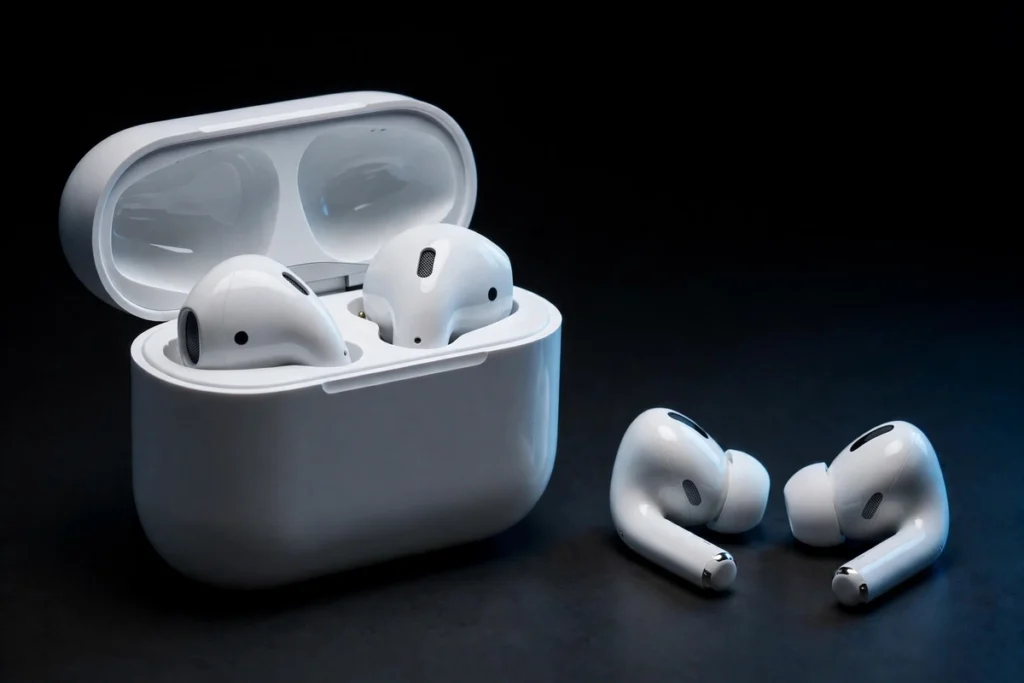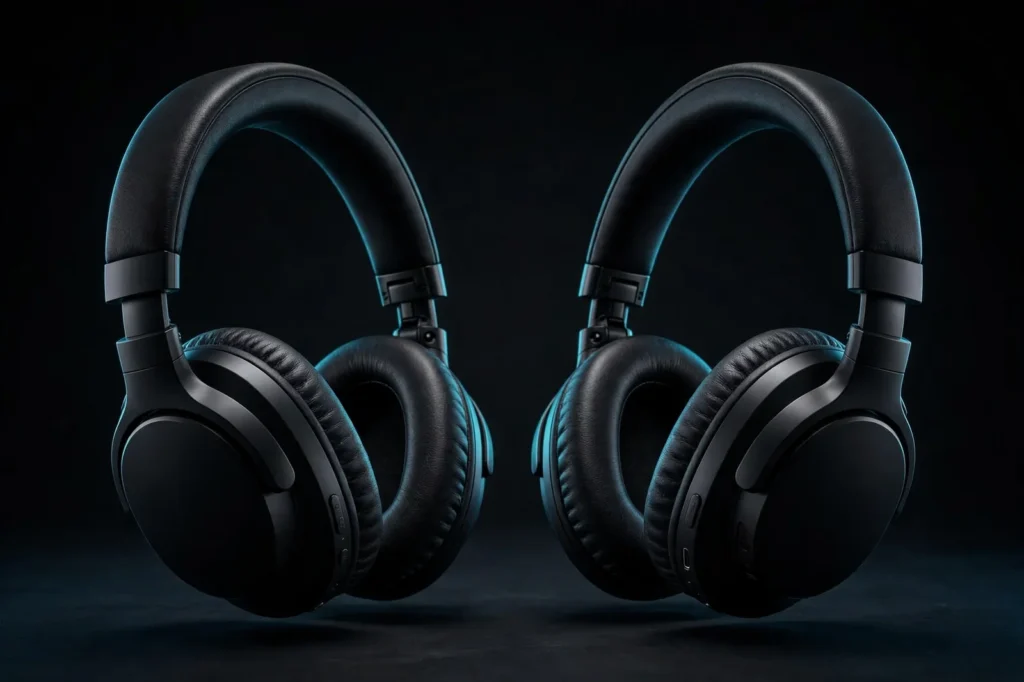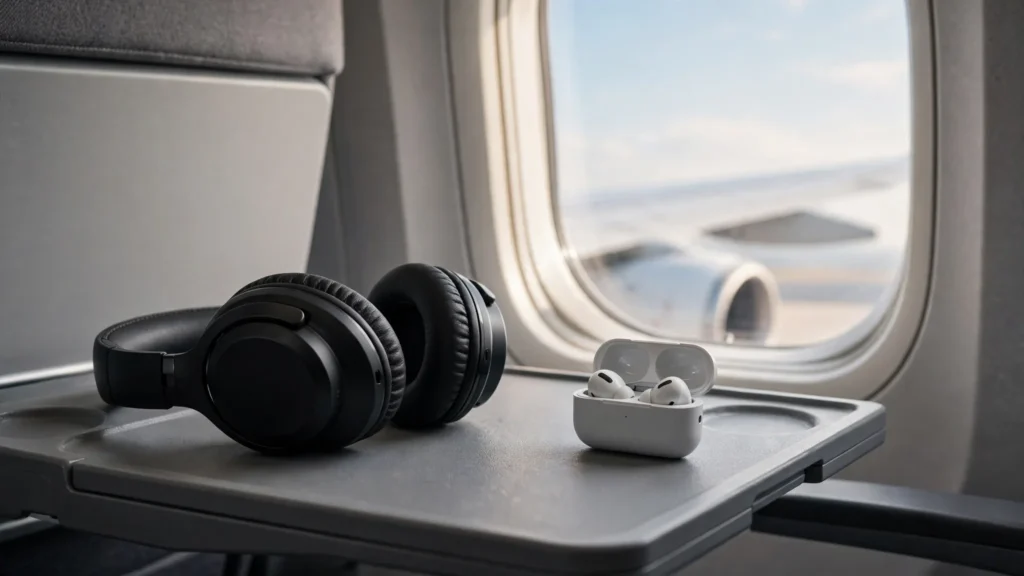
Headphones vs earbuds on airplanes is not really a question about sound quality. It is a question about what an aircraft cabin does to you over three, eight, or fifteen hours: a constant low engine drone, dry pressurized air, a seat that was not designed for sleeping, and a bag that is already full. Both form factors can now cancel noise seriously well. They differ in how they handle comfort over time, how they behave when you try to sleep, how long they last on one charge, and how much of your carry-on they claim before you have even boarded.
This guide works through those differences one by one, using two flagship pairs per side as reference points: the Sony WH-1000XM6 and Bose QuietComfort Ultra Headphones (2nd Gen) over-ear, and the Sony WF-1000XM5 and Bose QuietComfort Ultra Earbuds (2nd Gen) in earbud form. The reasoning applies to any well-sealed active noise cancelling (ANC) model in either format. For model-by-model flying picks, see our guide to the best noise cancelling headphones for airplanes and long flights.
The short verdict
For maximum quiet and all-flight comfort on long sectors, over-ear headphones still lead: a sealed ear cup plus ANC is the strongest combination against engine drone, and one charge covers the whole trip. For sleeping on your side, travelling carry-on-only, and moving through the airport, earbuds win — and flagship earbud ANC is now close enough that many travellers will not miss the difference.
Over-ear reference pick — Sony WH-1000XM6: the balanced flagship for long-haul quiet and battery endurance.
Earbud reference pick — Bose QuietComfort Ultra Earbuds (2nd Gen): the strongest earbud case for travellers who prioritise sleep-friendliness and pocketability.
Are earbuds or headphones better for a plane ride?
It depends on which part of the flight matters most to you. Over-ear headphones put a padded cup around the whole ear. That gives them two layers of defence — physical isolation from the cup and cushion, then electronic cancellation on top — and it spreads contact over a larger area, which is why they tend to stay comfortable for longer. Earbuds seal inside the ear canal instead. That seal does much of the work, the electronics finish it, and the whole product fits in a pocket.
Neither format is simply “better.” Over-ears win most in-seat categories: outright noise reduction, long-wear comfort, and battery life. Earbuds win the around-the-flight categories: packing, sleeping, and hearing announcements without taking anything off. The sections below take each factor in turn, so you can weight them by the flying you actually do.
ANC vs engine drone: which blocks airplane noise better?
Aircraft cabin noise is dominated by a steady, low-frequency roar from the engines and airflow. That steadiness is exactly what ANC handles best: microphones sample the incoming sound and the driver plays an inverted copy that reduces it. Predictable, continuous, low-pitched noise is the easiest kind to cancel, which is why even mid-priced ANC transforms a cabin — and why the differences between good models show up at the edges, in voices, trolley clatter, and the hiss around the drone, rather than in the drone itself.
Why the seal matters as much as the electronics
ANC works on top of a physical seal, not instead of one. Sound that leaks past a cushion or an ear tip arrives at your ear without ever being sampled cleanly, and it is disproportionately the higher-frequency sound that makes a cabin feel harsh. Over-ear cups seal around the ear with a large, forgiving contact area, and they keep that seal when you eat, yawn, or shift in the seat. Earbud seals are smaller and more personal: the right tip size gives an excellent seal, the wrong one quietly undermines both bass and cancellation, and jaw movement can loosen it mid-flight. This is the core of the active noise cancellation vs passive isolation trade-off — headphones start with more passive isolation before the electronics switch on, while earbuds lean harder on fit.
In practice, flagship over-ears such as the Sony WH-1000XM6 and the Bose QuietComfort Ultra Headphones (2nd Gen) still produce the deepest overall quiet in a cabin, particularly across a wider range of sounds at once. Flagship earbuds — the Sony WF-1000XM5 and Bose QuietComfort Ultra Earbuds (2nd Gen) — have narrowed that gap on the engine drone itself to the point where, for music and films at normal volume, many listeners will judge them equivalent. Where over-ears keep an edge is consistency: their performance depends less on your ear shape and on getting a perfect tip fit at 35,000 feet.
Do wireless headphones work on airplanes?
Yes — Bluetooth audio is permitted in flight on most airlines once airborne, and both formats pair to your phone, tablet, or laptop the same way. The friction point is the seatback screen. Many seatback systems still have no Bluetooth and expect a wired 3.5mm connection. Over-ear travel models commonly include a cable in the box, which makes them the zero-effort option for in-flight entertainment. Earbuds cannot plug in directly; the workarounds are a small Bluetooth transmitter that plugs into the seatback jack, an airline-provided wired pair as a fallback, or simply using your own device for entertainment. If seatback films are a big part of how you fly, that practical detail can matter more than a small ANC difference.
Comfort on long flights
Comfort failures rarely appear in the first hour. They appear in hour six, when a headband hotspot, a clamping ache around glasses arms, or an irritated ear canal turns a good product into something you keep taking off — and every break is a break in the quiet.
Over-ear headphones distribute weight around the ear and across a padded headband, and nothing sits inside the ear canal, so there is no canal fatigue. Their weaknesses are heat — sealed cushions get warm on a long sector — and interference with glasses, where a thick temple arm can both ache and break the cushion seal slightly. Earbuds weigh almost nothing and never touch glasses, and they do not make your ears hot. Their weakness is concentrated pressure: a tip sealed in the canal for eight hours, plus the jaw and ear-shape differences that make one person’s perfect fit another person’s slow ache. Swapping tip sizes, and materials, helps more with earbuds than any setting in an app.
Honest summary: for a single long sitting of films and music, most people tolerate over-ears longer. For a flight broken up by meals, walks, naps, and terminal time, earbuds are taken out and put back with so little friction that total comfort across the whole journey can favour them.
Can you sleep in earbuds on a plane?
You can, and for side sleepers this is the clearest win in the whole comparison. An over-ear cup is a hard shell between your head and the pillow, headrest, or your own folded jacket: lean on it and it presses, shifts, and often breaks its seal. Sleeping in over-ears realistically means sleeping upright, or on your back, with the cup acting as a bulky pillow of its own. Some travellers manage that happily on red-eyes; side sleepers generally do not.
Earbuds sit inside the ear’s profile, so a shallow-fitting pair can stay in while your head rests sideways, especially with a travel pillow supporting your neck rather than your ear. Practical cautions apply to both formats: keep the volume low or use one earbud on the pillow side so you can still hear crew announcements, expect a bud to work loose occasionally during sleep, and remember that a loose earbud in a dark cabin seat is easy to lose. If sleep is the main purpose of the purchase, earbuds are the format designed — by shape alone — to allow it. Over-ears used purely as drone-reducers for sleep work best for back sleepers who stay upright.
Battery life: one charge vs the case
This category is not close on a single charge, and it is closer than it looks across a whole trip. Flagship over-ears run for roughly a full day of listening or more on one charge — both the Sony WH-1000XM6 and the Bose QuietComfort Ultra Headphones (2nd Gen) are rated at up to 30 hours — so even the longest scheduled passenger flights finish with charge to spare, and a forgotten charge cable is an inconvenience, not a failure.
Flagship earbuds run for a single-flight span per charge — up to around 8 hours for the Sony WF-1000XM5 and up to 6 hours for the Bose QuietComfort Ultra Earbuds (2nd Gen) — with the charging case carrying several top-ups on top. That is enough for almost any single sector, and the case refills them during a meal or a nap. The failure mode is different rather than worse: earbuds can be mid-case-charge when you want them, the case itself needs charging eventually, and tiny cells age faster than the large battery in an over-ear. For one very long flight with no pauses, over-ears are simpler. For a multi-leg trip with natural breaks, earbuds with a case are rarely caught empty.
Pocketability and life around the flight
Earbuds win this outright. A case fits in a jeans pocket or the smallest personal item, comes out for boarding calls, goes away for security, and offers instant transparency when a gate agent speaks. Over-ears need their case, a meaningful share of a personal item, and a decision — around your neck or packed away — every time you stand up. Carry-on-only travellers feel that on every leg. Our broader guide to the best noise cancelling headphones for travel weighs the same trade-off across more models.
Ear pressure, cabin pressure, and that plugged feeling
Two different sensations get mixed up here. The first is real cabin pressure change during climb and descent, which affects your ears regardless of what you are wearing; swallowing, yawning, and equalising help, and sealed earbuds can make the change feel more noticeable simply because the canal is plugged. The second is the subtle “pressure” some people feel from ANC itself — a by-product of how cancellation is perceived, usually strongest in quiet environments and often more noticeable in high-ANC over-ears. We explain the mechanism in our article on why noise cancelling headphones cause pressure. If you know you are sensitive to it, look for models with adjustable ANC levels in either format, and lower the setting during descent rather than abandoning cancellation for the whole flight.
The four reference models, side by side
These four flagships illustrate the format split cleanly. Treat the table as a summary of the reasoning above, not as a ranking — the right column for you depends on the sections you weighted most heavily.
| Model | Format | Battery (rated) | Where it fits flying | Check Price |
|---|---|---|---|---|
| Sony WH-1000XM6 | Over-ear | Up to 30 hours | Long-haul quiet, films and music, one charge per trip | Check Price |
| Bose QuietComfort Ultra Headphones (2nd Gen) | Over-ear | Up to 30 hours | Maximum cabin quiet and long-wear cushioning | Check Price |
| Sony WF-1000XM5 | Earbuds | Up to 8 hours, plus case top-ups | Light packing with strong ANC and long per-charge life | Check Price |
| Bose QuietComfort Ultra Earbuds (2nd Gen) | Earbuds | Up to 6 hours, plus case top-ups | Sleep-friendliness and earbud-format quiet | Check Price |

Sony WH-1000XM6 — over-ear

Bose QuietComfort Ultra Earbuds (2nd Gen)
Scenario verdicts
Long-haul, awake: over-ear headphones
On a ten-hour sector spent on films, music, and work, the over-ear advantages stack: the deepest and most consistent cancellation, no canal fatigue, a wired option for the seatback screen, and a battery that is simply not a variable. This is the scenario the format was built for, and where a flagship such as the Bose QuietComfort Ultra Headphones (2nd Gen) or the Sony WH-1000XM6 earns its bag space.
Red-eye, sleep first: earbuds
When the point of the flight is to arrive rested, choose the format you can actually sleep in. Earbuds — the Bose QuietComfort Ultra Earbuds (2nd Gen) are the reference here — let a side sleeper keep the drone cancelled with their head on a pillow, at low volume or even with cancellation alone and nothing playing. An over-ear you have to remove to sleep is, for those hours, no headphone at all.
Light packer and multi-leg trips: earbuds
Carry-on-only, several connections, or a trip where the headphones also have to serve trains, walks, and calls at the other end — earbuds again. The Sony WF-1000XM5 pairing of strong ANC with the longest per-charge life of the two earbud references suits this pattern well: pocketable at the airport, capable in the cabin, and topped up by the case between legs.
Frequently asked questions
Are earbuds or over-ear headphones better for flying?
Over-ear headphones are better for outright noise reduction, long-wear comfort, and battery life on a single charge. Earbuds are better for sleeping on your side, packing light, and moving through the airport. Flagship models in both formats cancel engine drone well, so the decision usually comes down to sleep and packing rather than ANC alone.
Can you use earbuds on a plane?
Yes. Wireless earbuds are permitted in flight on most airlines once airborne, and wired earbuds can be used with seatback entertainment where a jack is provided. Follow crew instructions during the safety briefing and take-off and landing, and keep one ear free or use transparency mode when you need to hear announcements.
Do wireless earbuds work on airplane seatback screens?
Often not directly. Many seatback systems have no Bluetooth and expect a wired 3.5mm connection, which earbuds cannot make on their own. A small Bluetooth transmitter plugged into the seatback jack solves it, or you can use your own phone or tablet for entertainment instead.
Do noise cancelling headphones block out crying babies?
Not completely, in either format. ANC is strongest against steady low-frequency noise like engine drone and weakest against sudden, higher-pitched sounds such as voices and cries. The physical seal — an ear cup or a well-fitted ear tip — muffles some of that passively, and removing the roar underneath makes the cabin as a whole far less tiring.
Can you sleep in headphones on a plane?
Yes, with a format caveat. Over-ear headphones suit back sleepers and anyone who sleeps upright, but their cups press against a pillow for side sleepers. Earbuds are the practical choice for side sleeping, ideally a shallow-fitting pair used at low volume so crew announcements remain audible.
Do I need noise cancelling headphones for a plane ride?
No, but the drone is the main source of in-flight fatigue, and ANC — in either format — is the single upgrade that changes how you feel on arrival. If you fly rarely on short sectors, a well-sealed passive pair may be enough. For long-haul or frequent flying, ANC earns its place quickly.
The closing verdict
Headphones vs earbuds on airplanes resolves into two honest answers. If your flights are long, seated, and screen-focused, over-ear headphones block engine noise better, stay comfortable longer, and ask nothing of you mid-flight — take the over-ear reference picks above seriously. If your flights are about arriving rested, travelling light, or stringing several legs together, earbuds give up surprisingly little cancellation and give back sleep and pocket space in return. Decide by how you fly, not by which format wins a spec sheet: the best airplane headphone is the one still on your ears — or in your ears — in hour seven.

I am the founder of Sound Mavericks, where I provide the polite truth about audio equipment. I started this site because consumer electronics reviews are often too technical. Instead of using a silent lab, I test headphones, earbuds, and Bluetooth speakers in the real world – like on a noisy subway or in a busy coffee shop.
To stay independent, I buy my own review units (mostly from the United States) rather than accepting free gifts from brands. Once I finish testing a product, I sell it locally to our community. My goal is to help you understand sound quality, active noise cancellation (ANC), and battery life without the marketing hype.