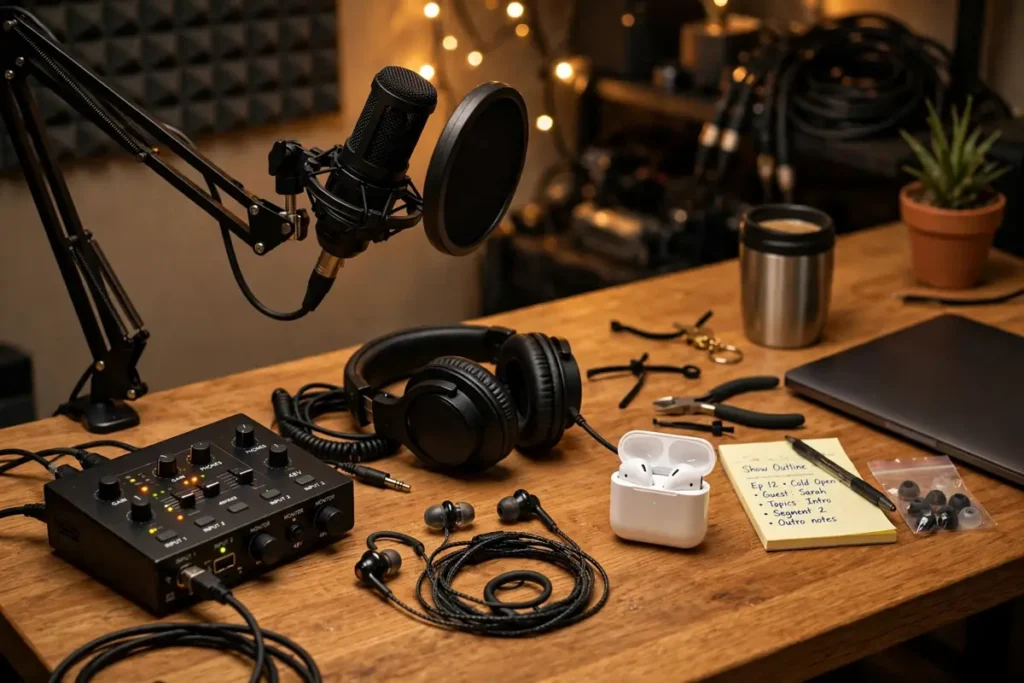
Most lists of the best earbuds for podcasting make one mistake: they treat podcasting as one job. It is two. The first job is monitoring — hearing your own voice accurately, with zero delay, while a microphone is live in front of you. The second job is being heard — joining a remote interview, recording a voice-over on a phone, or guesting on someone else’s show when your main microphone is not available. The best earbuds for podcasting, recording and voice over are the ones matched honestly to the job you actually do most, and this guide splits the picks that way from the start.
Our Top Picks at a Glance
Best for monitoring: Shure SE215 Pro — wired, isolating, zero-latency in-ear monitors built for hearing yourself clearly while you record.
Best for accurate voice monitoring: Etymotic ER2XR — deep-insertion, high-isolation wired earphones with a near-flat response for critical listening.
Best wireless mic for remote interviews: Sony WF-1000XM5 — six microphones, a bone conduction sensor and AI-based noise reduction for clear call pickup.
Best for iPhone podcasters: Apple AirPods Pro 2 — Voice Isolation, strong noise cancelling and seamless switching across Apple devices.
Best for Samsung and Android: Samsung Galaxy Buds3 Pro — three microphones per earbud, a Voice Pickup Unit and super wideband call audio on supported phones.
Best budget wired mic pick: Apple EarPods (USB-C) — an in-line microphone and remote, no battery, no pairing, and a wired connection that simply works.
Best Earbuds for Podcasting: Quick Comparison
Before the detail, here is how the six picks divide by job, connection and microphone. Monitoring picks deliberately have no microphone at all — that absence is a feature, not a gap, because a separate podcast microphone should be doing that work.
| Product | Best For | Connection | Microphone | Check Price |
|---|---|---|---|---|
| Shure SE215 Pro | Monitoring while recording | Wired 3.5mm, detachable MMCX cable | None on standard cable | Check Price |
| Etymotic ER2XR | Accurate, critical monitoring | Wired 3.5mm, detachable cable | None | Check Price |
| Sony WF-1000XM5 | Remote interviews, wireless mic | Bluetooth 5.3, multipoint | 6 mics, bone conduction sensor | Check Price |
| Apple AirPods Pro 2 | iPhone interviews and calls | Bluetooth, USB-C case | Beamforming mics, Voice Isolation | Check Price |
| Samsung Galaxy Buds3 Pro | Android interviews and calls | Bluetooth 5.4 | 3 mics per earbud plus Voice Pickup Unit | Check Price |
| Apple EarPods (USB-C) | Budget wired mic and backup | Wired USB-C | Built-in in-line mic and remote | Check Price |
Why Podcasting Earbuds Have Two Different Jobs
Monitoring wants a wire. Hear yourself back through Bluetooth and the encode, transmit and decode round trip delays your voice — and even a small delay is strangely hard to speak through. A wired earbud plugged into the direct-monitor output of an interface or recorder returns your voice effectively instantly, so you can judge level, microphone distance and plosives in real time.
Microphone work is about convenience. A guest joining from a phone or a voice-over artist sending an audition from a laptop may have no interface at all. Then the earbud microphone is the recording chain, and voice pickup, background-noise rejection and wind handling matter — not monitoring accuracy. That is why this guide keeps the two groups separate.
If you prefer full-size headphones for long studio sessions, our guide to the best headphones for podcasting covers the over-ear side of the same decision. Treat this page as its earbud companion: smaller, more portable, easier to wear on camera, and — in the wired cases — just as honest about what your voice is really doing.
Best Earbuds for Monitoring Yourself While Recording
Shure SE215 Pro — Best Overall Monitoring Pick

The SE215 Pro comes from Shure’s in-ear monitor line — the technology touring musicians use to hear themselves on stage — and that heritage shows in the choices that matter for podcasting. A single dynamic MicroDriver delivers detailed sound with enhanced bass, the cable is detachable via an MMCX connector, and the wireform cable wraps over the ear so the housings stay seated while you talk and turn toward a co-host.
Isolation is the headline. Shure rates its sound-isolating design at up to 37 dB of ambient-noise blocking with the right sleeve fit, achieved passively by sealing the ear canal. Room noise recedes, so you can monitor at a lower volume — and, more important at a microphone, very little leaks back out. Headphone bleed is a quiet recording killer: a guest’s voice leaking from your earbuds gets picked up by your microphone and returns to them as a faint echo. A sealed monitor largely removes that risk.
Shure lists a frequency range of 22 Hz to 17.5 kHz and sensitivity of 107 dB SPL/mW, easily driven by any interface or recorder without an amplifier. Try both sleeve types in the fit kit: foam generally seals more completely, flex is quicker between takes. There is no microphone on the standard cable, and for monitoring that is correct — your podcast microphone should be the only microphone in the chain. If a cable frays, you replace the cable, not the earphones.
Etymotic ER2XR — Best for Accurate, Critical Monitoring

Where the SE215 leans warm, the ER2XR leans truthful. Etymotic pairs its accuracy-first tuning with a modest low-frequency lift — XR stands for extended response — so voices keep some body while the midrange, where speech intelligibility lives, stays honest. For editing and checking a voice-over take, that is the point: mouth clicks, room reflections, sibilance and an off-axis microphone are all easier to hear when the earphone is not flattering them away.
Its isolation figures are the strongest in this guide: 35 dB with silicone tips and up to 42 dB with foam, from a deep-insertion fit. Manufacturer specifications list 20 Hz to 16 kHz frequency response, 15 ohms impedance, 96 dB sensitivity at 1 kHz and a detachable four-foot cable with a 3.5mm plug. User-replaceable filters protect the drivers and extend working life.
The trade-off is the fit itself — deep insertion takes getting used to, particularly with triple-flange tips. Podcasters in untreated rooms tend to decide it is worth it quickly: with this much passive isolation, the room largely stops being part of what you hear. Our roundup of the best wired earbuds puts these monitors in wider context.
Best Earbuds With a Microphone for Remote Interviews and Voice Over
Plain talk first: no earbud microphone replaces a dedicated podcast microphone for your own show’s main recording. What the picks below do well is the second job — sounding clear as a guest, on a remote platform, or in a short voice note or audition, where intelligibility and low background noise matter more than studio depth.
Sony WF-1000XM5 — Best Wireless Microphone for Remote Interviews

Sony describes the WF-1000XM5 as its best-ever call quality, and the hardware is specific. Six microphones feed Precise Voice Pickup Technology, an AI-based noise reduction algorithm and a bone conduction sensor that detects the vibration of your voice directly — helping the earbuds separate speech from surrounding noise rather than simply turning everything down, so the other end hears a voice instead of a room. A wind-noise reduction structure addresses the other classic failure: gusts overwhelming speech.
Multipoint Bluetooth is the practical podcasting feature: stay connected to a laptop and a phone at once, with no re-pairing when a producer call arrives mid-session. Bluetooth 5.3, SBC, AAC and LDAC support, and foam-style isolation tips that help the strong active noise cancelling complete the package. For your own microphone recording, monitor wired and keep these for the guest chair, travel and calls.
Apple AirPods Pro 2 — Best for iPhone Podcasters

For Apple users, the AirPods Pro 2 earn their place on one feature: Voice Isolation. On supported iPhone models and iOS versions, it prioritises your voice and blocks ambient noise during calls, so a guest spot from a kitchen or café arrives far cleaner than the room would suggest. Beamforming microphones, an inward-facing microphone and the H2 chip’s computational audio keep speech forward, and reviewers consistently rank this model near the top for call clarity, including in wind.
Active noise cancelling rated at up to twice the previous generation helps you concentrate while reviewing takes, Adaptive Audio blends cancelling and transparency as surroundings change, and four tip sizes (XS through L) help you get the seal both cancelling and call quality depend on. A USB-C MagSafe case, IP54 dust and sweat resistance, and automatic switching across iPhone, iPad and Mac make these the lowest-friction interview pick in the Apple ecosystem. Our guide to the best noise cancelling earbuds for phone calls goes deeper on call-focused models.
Samsung Galaxy Buds3 Pro — Best for Samsung and Android
Three microphones on each earbud work with a Voice Pickup Unit, and Samsung’s call processing uses AI-based noise reduction alongside super wideband speech — extending call bandwidth up to 16 kHz on supported Samsung phones and networks, double the traditional narrowband call, so voices sound fuller and consonants clearer. Independent reviews highlight the triple-microphone array and stem placement as real call-quality upgrades over earlier Galaxy Buds.
A dual-driver design, Bluetooth 5.4, Samsung Seamless Codec support including its 24-bit mode on compatible Galaxy devices, adaptive noise cancelling and an IP57 rating make these the AirPods counterpart for Android: the right choice is mostly decided by the phone in your pocket. Note that Amazon US listings for this model are commonly international-model variants, so check listing details and warranty terms before ordering.
Apple EarPods (USB-C) — Best Budget Wired Microphone Pick

Every podcast kit needs a backup that cannot run out of battery or fail to pair — and the EarPods with USB-C are that backup, with a genuinely useful microphone attached. The in-line remote carries the microphone close to your mouth, controls volume and playback, and answers calls. The connection is wired and digital over USB-C, so there is no Bluetooth delay and nothing to configure: plug into an iPhone, iPad, Mac or USB-C Android device, and the microphone is simply there.
Set expectations correctly and they over-deliver. The open-fit design rests at the entrance of the ear rather than sealing inside it, so isolation is minimal — do not monitor at high volume near a sensitive microphone, because bleed is possible. What you get is clear, close, consistent voice pickup: hosts often ask guests to use exactly this kind of wired earbud instead of a laptop microphone, because the improvement in intelligibility is immediate. Keep a set in the recording bag. The day a wireless battery dies before an interview, this pick saves the session.
Are Wireless Headphones Suitable for Podcasting?
Yes — for some podcasting work, and no for one specific part of it. Wireless earbuds are suitable for listening back, editing on the move, joining remote interviews as a guest, taking calls and recording short voice material on a phone. Modern call processing, as on the Sony, Apple and Samsung picks above, is very good at those jobs.
Where wireless is not suitable is monitoring your own live microphone. Bluetooth delay means you hear your voice late, and most people find speaking against that lag distracting enough to change how they talk. The professional rule avoids the problem: if a microphone is live and it is your voice, monitor wired. Otherwise, wireless is fine.
What Features Matter Most for Long Recording Sessions?
Comfort decides whether a good earbud is still usable at minute ninety, and for in-ear monitors comfort is mostly seal: try every tip size, because a tip slightly too large will ache and one slightly too small will break seal, leak sound and tempt you to raise the volume. Foam tips often win for long sessions, expanding to distribute pressure; silicone and triple-flange tips win for quick in-and-out use between takes.
Isolation also lowers the volume you need, reducing fatigue. A detachable cable, as on both wired picks, turns the most common failure into a cheap replacement. And a low profile matters on video podcasts: monitors sit discreetly, route their cable behind the ear, and do not dominate the frame the way large over-ear headphones can.
How to Set Up Earbuds for Cleaner Podcast Audio
Setup decides half the result. Plug wired earbuds into the direct-monitor or headphone output of your interface, microphone or recorder — not a software playback path that adds delay — and set your level once, at your loudest natural laugh, then leave it alone.
Before any session that matters, record thirty seconds of test audio and listen back for bleed, room echo and plosives, adjusting microphone distance before anything else. As a guest using earbud microphones, choose a quiet room and keep the earbuds paired to one device only. Record a local backup whenever the platform allows it: a backup track turns a link failure from a lost episode into an inconvenience.
Frequently Asked Questions
Can you use earbuds for podcasting?
Yes. Wired in-ear monitors such as the Shure SE215 Pro and Etymotic ER2XR are well suited to monitoring yourself while recording, because they add no Bluetooth delay, isolate you from room noise and minimise bleed into the microphone. Wireless earbuds work well for remote interviews, calls and listening back, as long as you are not monitoring your own live microphone through them.
Are wireless headphones suitable for podcasting?
Wireless earbuds are suitable for guest appearances, remote interviews, editing and playback. They are not ideal for monitoring your own live voice, because Bluetooth introduces a delay between speaking and hearing yourself. For that specific task, a wired earbud plugged into your interface or recorder is the reliable choice.
Do earbuds have good microphones for recording?
The best current earbud microphones — on models such as the Sony WF-1000XM5, AirPods Pro 2 and Galaxy Buds3 Pro — are good enough for remote interviews, calls and short voice recordings, with multi-microphone arrays and noise reduction keeping speech clear in noisy rooms. They do not replace a dedicated podcast microphone for your own show’s main recording, where a larger microphone captures more vocal detail.
What is the difference between earbuds and in-ear monitors for podcasting?
In-ear monitors are earbuds designed for accurate listening and isolation, usually wired, with a secure over-ear cable and replaceable parts. Consumer earbuds prioritise convenience features such as wireless connection, noise cancelling and built-in microphones. Podcasters often use monitors to hear themselves while recording and consumer earbuds to be heard on remote calls.
How do I stop headphone bleed into my microphone?
Use a sealed in-ear design rather than an open-fit earbud, fit the tips so the seal is complete, and monitor at the lowest volume that lets you hear detail clearly. Sealed monitors such as the SE215 Pro and ER2XR reduce leakage dramatically compared with open designs, and lowering volume reduces whatever remains.
What earbuds should a podcast guest use?
A guest should use the clearest microphone available to them and a wired connection where possible. A wired set such as the Apple EarPods (USB-C) is a dependable minimum that improves intelligibility over a laptop microphone, while a modern wireless set with strong call processing, such as the AirPods Pro 2 or WF-1000XM5, is a good choice in a quiet room.
The Verdict
Split the decision by job and it becomes simple. To hear yourself honestly while a microphone is live, buy wired: the Shure SE215 Pro for a warm, durable, stage-proven monitor, or the Etymotic ER2XR when accuracy and maximum isolation matter most. To be heard clearly when you are the guest, buy the wireless earbud that matches your phone: the Sony WF-1000XM5 for its six-microphone call system, the AirPods Pro 2 for iPhone Voice Isolation, or the Galaxy Buds3 Pro for Samsung’s wideband call audio. And whatever else is in the kit, add the EarPods (USB-C) as the wired backup that never needs charging. That combination covers recording, voice over and remote interviews without asking any single pair of earbuds to do a job it was not built for.

I am the founder of Sound Mavericks, where I provide the polite truth about audio equipment. I started this site because consumer electronics reviews are often too technical. Instead of using a silent lab, I test headphones, earbuds, and Bluetooth speakers in the real world – like on a noisy subway or in a busy coffee shop.
To stay independent, I buy my own review units (mostly from the United States) rather than accepting free gifts from brands. Once I finish testing a product, I sell it locally to our community. My goal is to help you understand sound quality, active noise cancellation (ANC), and battery life without the marketing hype.