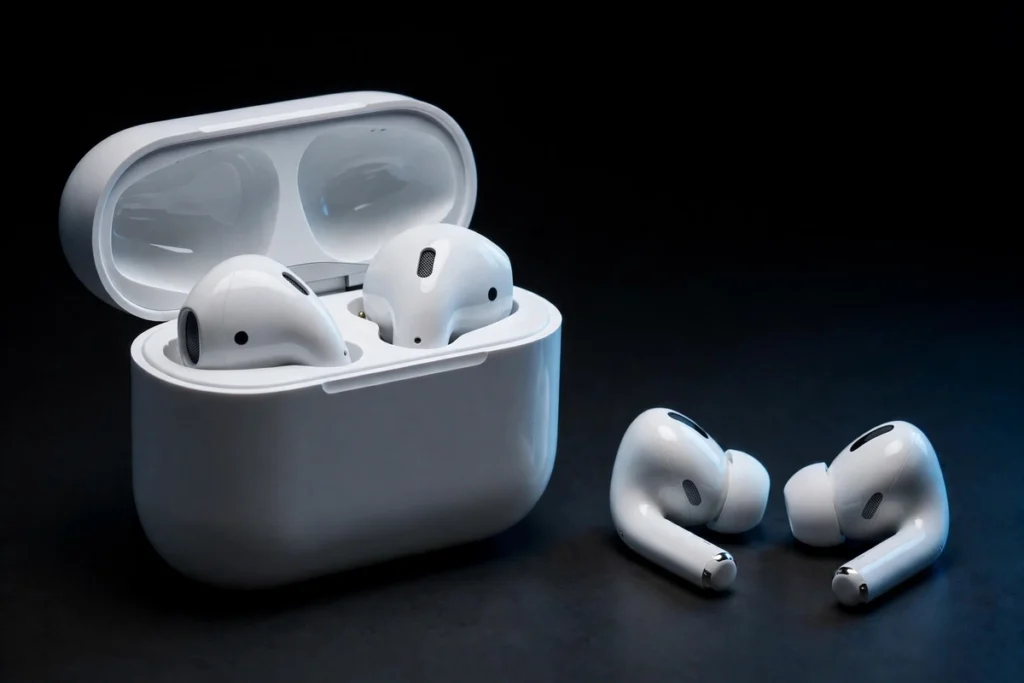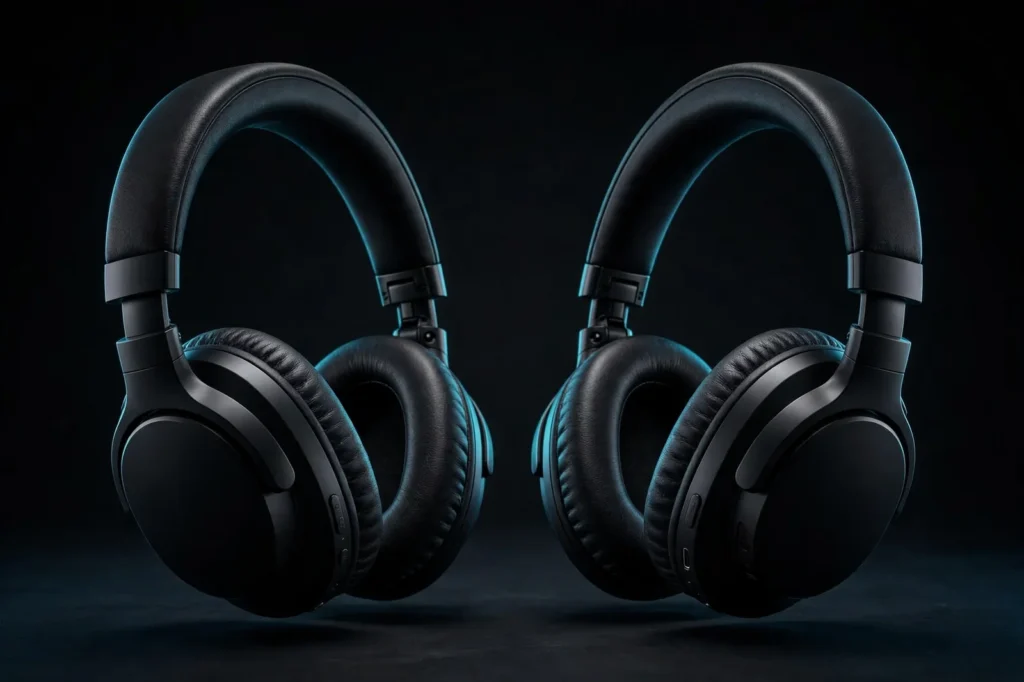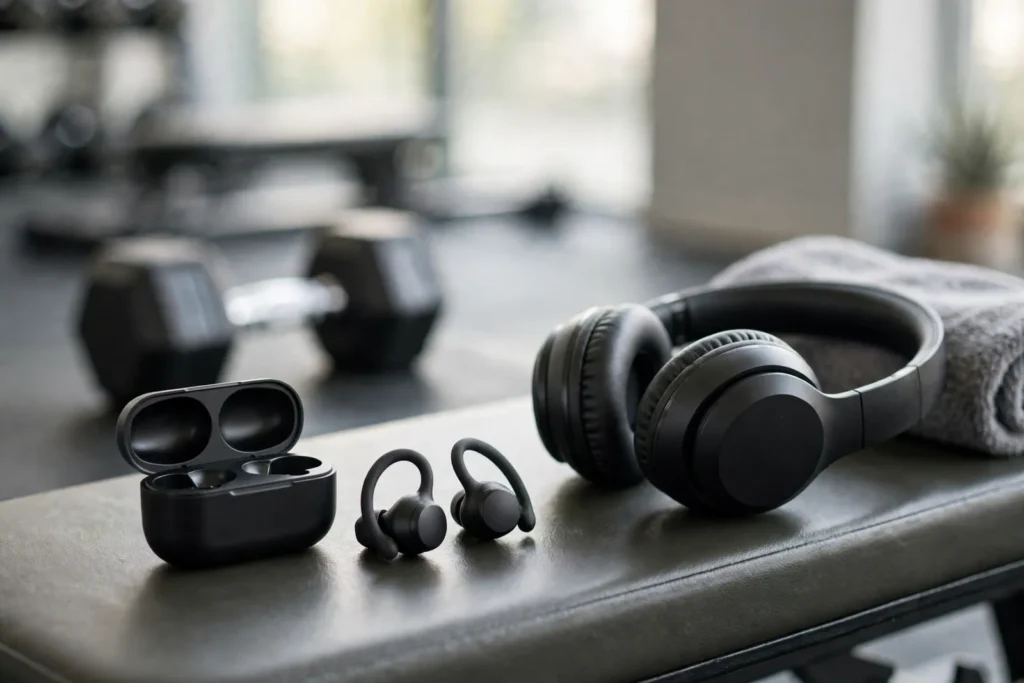
If you train four or five times a week, the earbuds vs. headphones working out debate is not really about sound. It is about what stays put during a burpee, what survives a sweaty session, and what does not cook your ears on a long run. This SoundMavericks comparison breaks the choice down by workout type — running, lifting, HIIT and cross-training, and cycling — across fit security, sweat protection, heat and comfort, awareness, and sound.
Quick verdict: For most training, earbuds win. They are lighter, cooler, sweat-rated, and far less likely to shift, snag on a barbell, or collide with a bench. Headphones win a narrower but real contest: steady lifting and low-movement sessions where bigger drivers, stronger noise cancelling, and long battery life matter more than staying cool. Start with these picks on each side:
Earbuds pick — soundcore Sport X20: adjustable ear hooks, IP68 sealing, and active noise cancelling built specifically for training.
Earbuds pick — Beats Powerbeats Pro 2: secure-fit ear hooks, noise cancelling with a transparency mode, and heart rate monitoring for runners and gym regulars who want one pair to do everything.
Headphones pick — Beats Studio Pro: the over-ear people actually lift in — fully adaptive noise cancelling, a secure clamping fit, and battery life that shrugs off a full training week.
Is it better to work out with earbuds or headphones?
For most people, most of the time, earbuds are better for working out. That is the consistent conclusion across the category, and it comes down to physics. A workout earbud weighs a few grams and locks into or around your ear, so it has almost no momentum of its own when you jump, sprint, or change direction. An over-ear headphone weighs roughly 250 grams or more, sits on top of your head, and is held on mainly by clamping force — exactly the arrangement that starts to slide the moment sweat removes friction and movement adds bounce.
That does not make headphones a bad gym choice — it makes them a selective one. If your training is mostly machines, free weights at a controlled tempo, incline walking, or mobility work, the headband problem mostly disappears, and the headphone advantages — fuller sound, stronger noise cancelling, and much longer battery life — come to the front. A runner and a powerlifter are effectively shopping for different products, so the sections below score each workout type honestly. For model-by-model picks, our guide to the best headphones for working out goes deeper.
Earbuds vs. headphones at a glance
| Factor | Workout earbuds | Over-ear / on-ear headphones |
|---|---|---|
| Fit security | Ear hooks, wings, or fins anchor each bud; very hard to dislodge | Headband and clamp force; stable when still, slides when sweaty and moving fast |
| Sweat protection | Purpose-built IP ratings are standard, from splash-proof to fully dust- and water-sealed designs | Most lifestyle models publish no IP rating at all; cushions absorb sweat |
| Heat and comfort | Minimal contact area, ears stay open to the air; can irritate the ear canal on very long sessions | Cushions trap heat and moisture; comfortable when cool, hard to forget about when hot |
| Awareness and safety | Transparency modes and open designs are common; easy to run with one bud out | Sealed cups isolate more by default; transparency exists on ANC models but the seal still dominates |
| Sound | Punchy and close, with strong bass tuning for motivation; smaller soundstage | Larger drivers, wider and fuller sound, usually the stronger noise cancelling |
| Battery life | A single charge covers a day of training; the pocket case stretches total life across the week | One charge can cover a week or more of sessions with nothing to carry |
Running: earbuds win, and it is not close
Running is where the gap between the two form factors is widest. Every stride is a small impact, repeated thousands of times, and anything resting on top of your head feels it. Over-ear headphones bounce, creep forward, and turn their cushions into sweat sponges within the first few kilometres. They also trap heat exactly where you least want it on a summer run. Earbuds avoid all three problems at once: there is no band to bounce, almost no surface to soak up sweat, and your ears stay ventilated.
Fit design is what separates good running buds from ordinary ones. Plain buds that rely only on an ear-tip seal can work loose as sweat builds. Ear-hook and winged designs add a mechanical anchor that does not depend on friction, which is why both earbud picks in this comparison use hooks. The soundcore Sport X20 lets you rotate and extend its hooks to dial in the fit, while the Beats Powerbeats Pro 2 builds its whole identity around a secure-fit ear hook, with the bonus of heart rate monitoring that feeds straight into your training apps.
Awareness is the other running priority, and it cuts against sealing your ears completely. Outdoors, you need to hear traffic, bikes, and other people. Transparency modes on modern sport buds let ambient sound in without removing a bud, and running with a single bud is a simple fallback headphones cannot match. For more outdoor-focused options, see our roundup of the best running headphones.

Lifting: the one workout where headphones fight back
Walk into most serious gyms and you will see plenty of over-ear headphones on lifters, and there are rational reasons. Lifting is mostly low-movement work: you are stationary under the bar, tempo is controlled, and sessions are built around focus. In that setting, the headphone strengths matter — a big, sealed sound that shuts out gym noise, noise cancelling that removes the clatter between sets, and controls you can hit with chalky hands. Battery life helps too: a headphone you charge once can cover a week of training, with no case to remember.
The honest limits show up at the edges of a lifting session. Bench press presses the headband into the bench, floor work and hip thrusts push headphones around, and a bar resting near the band annoys some squatters. Sweat is the other cost: cushions absorb moisture session after session, and most lifestyle over-ears publish no sweat rating.
Earbuds sidestep every one of those issues, which is why even committed headphone lifters often keep a sport pair for high-sweat days. If you lift in headphones, the Beats Studio Pro is the realistic template: fully adaptive noise cancelling for focus, a firm fit that stays composed during standing work, and up to 40 hours of battery. The lighter Beats Solo 4 is the on-ear alternative many lifters choose — noticeably lighter on the head, up to 50 hours of battery, and less heat than a full over-ear cup, though with no noise cancelling and, like the Studio Pro, no published IP rating. Treat either as a lifting tool, not a running tool, and wipe the cushions down after every session.
HIIT and cross-training: earbuds, by knockout
High-intensity training is the harshest test in this comparison. Burpees, box jumps, kettlebell swings, sled pushes, and Olympic lifts combine rapid direction changes, inverted positions, and heavy sweating — the exact conditions that defeat a headband. An over-ear headphone that survives a treadmill session will usually be on the floor, literally, by the second round of a hard circuit. Trainers and athletes default to earbuds here for a simple reason: there is almost nothing to fall off.
What to look for is a hook or wing, a high sweat rating, and controls that work when you are breathing hard. The JLab Epic Air Sport ANC 3 is built to this brief: an ear-hook fit, IP66 sweat and dust protection on JLab’s spec sheet, hybrid dual drivers for a fuller sound than most sport buds, and noise cancelling with a Be Aware mode for coached sessions where you still need to hear cues. The Sport X20’s IP68 sealing is the strongest protection in this comparison, and its rotatable hooks suit the constant repositioning of circuit training. Either way, the buying rule for HIIT is simple: if it does not anchor mechanically to your ear, do not buy it for this.

Cycling: awareness decides it
Cycling flips the priority list. Fit still matters — a headphone under or over a helmet strap is awkward, and wind buffets big cups noisily — but the deciding factor is awareness. On the road, hearing a car approach from behind is a safety feature, not a preference. Sealed, noise-cancelling headphones are the wrong tool outdoors on a bike, full stop, no matter how good they sound on the trainer at home.
Earbuds win this category on flexibility. A single bud, a transparency mode, or a low-volume sealed bud all keep some connection to your surroundings, and the low profile works with helmet straps and glasses in a way a headband never will. Keep the volume low enough to hear traffic, and treat noise cancelling as an indoor-trainer feature only. Indoors on a static bike the calculation reverses — you are stationary and safe, and headphones deliver the bigger sound for long endurance sessions.
Fit security, sweat, heat, awareness, and sound: the five factors scored
Fit security
Earbuds take this factor clearly. Hooks, wings, and fins create a mechanical lock that survives sweat, while headphones rely on clamp force and friction — both of which degrade mid-session. The faster and more chaotic the movement, the bigger the earbud advantage. Headphones only draw level during slow, upright, controlled work.
Sweat and IP ratings
This is the most one-sided factor of all. Sport earbuds are engineered and rated for sweat: IPX4 is the practical floor for splash and sweat resistance, and the picks here go well beyond it. Most lifestyle headphones, including both Beats models in this comparison, publish no IP rating, which does not mean they fail at the first drop of sweat — it means the manufacturer is not promising anything, and your cushions are absorbing the difference. If IP codes are new to you, our explainer on understanding IP ratings like IPX4 vs. IPX7 decodes what each digit actually guarantees.
Heat and comfort
Headphones feel more comfortable for the first twenty minutes, especially if you dislike anything inside your ear canal. Past that point in a warm gym, the sealed cushion becomes a heat trap, and comfort swings to the earbuds, which leave your ears open to the air. The exception is very long, cool, low-intensity sessions — incline walking, stretching, mobility — where headphones stay pleasant throughout.
Awareness and safety
Both form factors can isolate you; the difference is how easily each lets the world back in. Earbuds offer transparency modes, single-bud listening, and open designs, and they come out in one second flat. Headphones with transparency still sit as a sealed shell around your ear, and removing them mid-set is a two-handed job. Outdoors, earbuds are the safer default; indoors, isolation becomes a feature rather than a risk, which is where headphone noise cancelling shines for focus. Our guide to the best noise cancelling headphones for gym workouts covers the focus-first side of that trade-off.
Sound
Headphones win sound on physics: larger drivers, more air to move, and a wider stage around the ear. For lifting playlists and long indoor sessions, that fullness is real and enjoyable. But workout earbuds have closed most of the practical gap — modern sport buds are tuned with strong, motivating bass, and models like the JLab Epic Air Sport ANC 3 use dual drivers to add detail most gym listeners will never feel short of mid-workout. In a noisy gym at training intensity, fit and seal affect what you hear more than driver size does.
The picks compared
| Product | Type | Fit | IP rating | Noise control | Battery (headline) | Buy |
|---|---|---|---|---|---|---|
| soundcore Sport X20 | Earbuds | Rotatable, extendable ear hooks | IP68 | ANC | Up to 12 hrs per charge; 48 hrs with case | Check Price |
| Beats Powerbeats Pro 2 | Earbuds | Secure-fit ear hooks | IPX4 | ANC + Transparency | Up to 45 hrs total with case | Check Price |
| JLab Epic Air Sport ANC 3 | Earbuds | Ear hooks | IP66 | ANC + Be Aware | Long multi-day total with case | Check Price |
| Beats Studio Pro | Over-ear headphones | Headband, cushioned cups | No rating published | ANC + Transparency | Up to 40 hrs | Check Price |
| Beats Solo 4 | On-ear headphones | Lightweight headband | No rating published | Sound isolation (no ANC) | Up to 50 hrs | Check Price |

Who should choose wireless earbuds vs. wireless headphones?
Choose earbuds if you run, do HIIT or cross-training, cycle outdoors, sweat heavily, train in a hot gym, or want one pair that also disappears into a pocket for the commute. Choose headphones if your training is mostly lifting, machines, and steady indoor cardio, you value focus and fuller sound over staying cool, or you dislike the in-ear feeling. Plenty of serious trainers own both — sport buds for conditioning days, over-ears for lifting days. Match the tool to the session and the debate mostly settles itself.
Frequently asked questions
Is it better to work out with earbuds or headphones?
For most workouts, earbuds are better: they are lighter, stay secure during fast movement, handle sweat with proper IP ratings, and keep your ears cooler. Headphones are better for lifting and low-movement indoor training, where their fuller sound, stronger noise cancelling, and longer battery life matter more than heat and stability.
Are over-ear headphones good for running?
Generally, no. Over-ear headphones bounce with every stride, slide as sweat builds, and trap heat, and most publish no sweat rating. Secure-fit earbuds with hooks or wings are a far better running choice, ideally with a transparency mode for outdoor awareness.
What IP rating do I need for working out?
IPX4 is the practical minimum for gym use, covering sweat and splashes. Heavy sweaters, HIIT athletes, and outdoor runners should look higher: the picks in this comparison range from IPX4 up to IP66 and IP68 designs that add dust protection and much stronger water sealing. Most lifestyle headphones publish no rating at all.
Can you wear headphones while lifting weights?
Yes — lifting is the workout where headphones make the most sense, thanks to controlled movement, strong noise cancelling for focus, and long battery life. Watch the practical limits: headbands can clash with the bench on pressing movements and with the bar on some lifts, and cushions need wiping down after sweaty sessions because most models carry no sweat rating.
Are earbuds or headphones safer for cycling and outdoor workouts?
Earbuds, used carefully. A single bud, a transparency mode, and modest volume keep traffic audible, and the low profile works with helmets and glasses. Sealed noise-cancelling headphones isolate you from approaching vehicles and add wind noise and helmet clashes, so save them for the indoor trainer.

I am the founder of Sound Mavericks, where I provide the polite truth about audio equipment. I started this site because consumer electronics reviews are often too technical. Instead of using a silent lab, I test headphones, earbuds, and Bluetooth speakers in the real world – like on a noisy subway or in a busy coffee shop.
To stay independent, I buy my own review units (mostly from the United States) rather than accepting free gifts from brands. Once I finish testing a product, I sell it locally to our community. My goal is to help you understand sound quality, active noise cancellation (ANC), and battery life without the marketing hype.