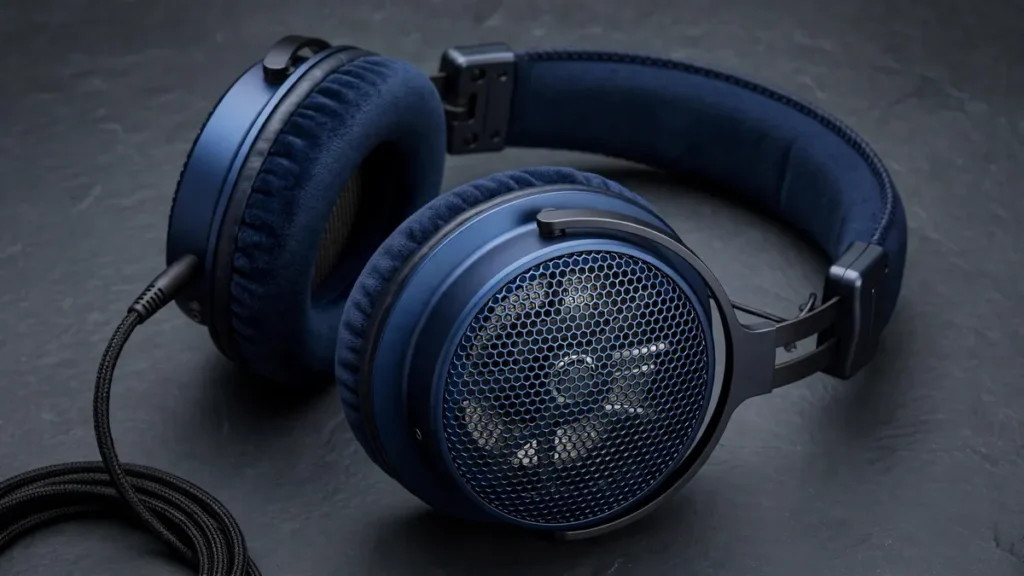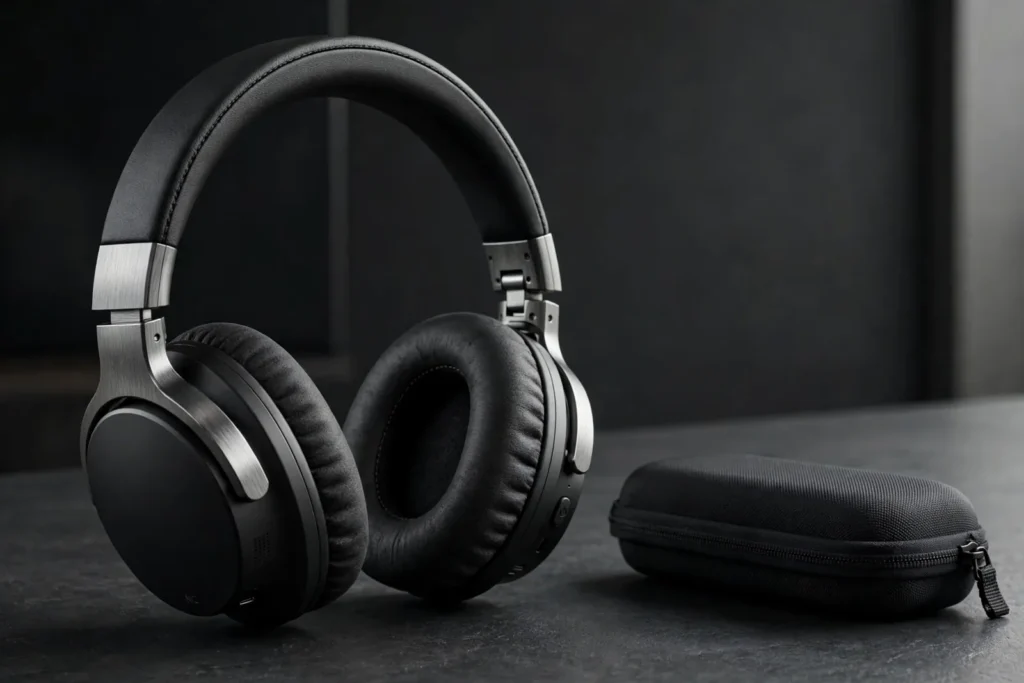
The Technics EAH-A1000 is the flagship over-ear Technics has been building towards since its EAH-AZ100 earbuds became an unlikely sensation. Announced on September 29, 2026 as the successor to the EAH-A800, it scales the AZ100’s magnetic fluid driver up into a 40mm carbon-fibre unit, wraps it in adaptive noise cancelling driven by eight microphones, and adds three-device multipoint and lossless USB audio alongside LDAC — a combination no rival flagship currently offers. It is aimed squarely at the Sony WH-1000XM6 and Bose QuietComfort Ultra crowd.
This is a launch review: our assessment is drawn from Technics’ published specifications, the verified Amazon listing data, and the first wave of independent review coverage, rather than hands-on testing. That coverage converges on a clear story — the sound quality is the headline, the ANC is excellent without quite taking the crown, and call quality is a genuine strength. The caveats are consistent too: the tuning plays things a little safe, the three-device multipoint can be finicky, and the build feels a touch less premium than the flagship billing suggests.
The Technics EAH-A1000 is the sound-first flagship: a 40mm magnetic fluid driver with a carbon-fibre diaphragm that early reviewers rank with the very best wireless sound available, adaptive hybrid ANC, Dolby Atmos with head tracking, three-device multipoint, LDAC and lossless USB playback, and battery life of 45 hours with ANC on — and far beyond it with ANC off. If you buy with your ears first and your feature checklist second, this is the new benchmark. If you want the single strongest noise cancelling at any cost, read the ANC note below first.

| Sound Quality | 9.2 |
| Noise Cancelling | 8.7 |
| Comfort & Design | 8.9 |
| Battery Life | 9.4 |
| Call Quality | 8.8 |
| Value | 8.0 |
Technics EAH-A1000: Specifications
| Product | Technics EAH-A1000 | Check Price |
|---|---|---|
| Drivers | 40mm Magnetic Fluid Driver; carbon-fibre diaphragm; SST (Symmetrical Surround Technology) Edge surround | |
| Acoustic Design | Baffle Flat Structure with Acoustic Control Chamber | |
| Noise Cancelling | Full Adaptive Digital Hybrid ANC — 3 feed-forward + 1 feedback microphone per side (8 total); Ambient Mode | |
| Wireless | Bluetooth 6.0; SBC, AAC, LDAC and LC3 codecs; LE Audio with Auracast | |
| Wired Audio | Lossless USB-C audio; USB-C to 3.5mm cable supplied for analogue sources (no 3.5mm jack on the headphones) | |
| Spatial Audio | Optimised for Dolby Atmos with head tracking | |
| Multipoint | Up to 3 devices connected simultaneously (LDAC listening limits connections to 2 devices) | |
| Microphones & Calls | AI Beamforming with AI noise reduction for calls | |
| Battery Life | Up to 45 hours (AAC, ANC on) and 90 hours (ANC off); up to 40 hours (LDAC, ANC on); talk time approx. 30 hours | |
| Charging | Approx. 3.5 hours full charge; 15-minute quick charge adds approx. 4 hours (AAC, ANC on) | |
| Controls & App | Physical buttons plus slide control on the right earcup; Technics Audio Connect app with 8-band EQ, ANC level, device priority and Sound Share | |
| Design | Approx. 306g; folding design; high-density memory foam ear pads; zippered carrying case included | |
| Colours | Black, Platinum Greige | |
The Magnetic Fluid Driver: Technics’ Party Trick, Explained
Most flagship headphones compete on features; the EAH-A1000 competes on physics. Inside each earcup sits a 40mm driver whose voice coil gap is filled with a magnetic fluid — a ferrofluid formulation Technics first developed for its audiophile TZ700 in-ears and refined for the hit EAH-AZ100 earbuds. The fluid holds the voice coil centred and damps the microscopic wobble and rocking that ordinary drivers suffer as they move, which in theory means the diaphragm pistons cleanly instead of distorting at high excursion. For the A1000, Technics developed a new formulation of the fluid tuned for the much larger driver, and paired it with a rigid, low-mass carbon-fibre diaphragm, an SST Edge surround borrowed from its loudspeaker engineering, a flat baffle structure to cut reflections, and an acoustic control chamber to manage airflow behind the driver.
That is a lot of engineering vocabulary, but it matters: it is the same recipe that made the AZ100 earbuds the surprise audiophile story of their year, applied here at over-ear scale, where a bigger diaphragm and a proper acoustic chamber give the idea far more room to work.
Sound Quality: Refined First, Showy Never
The first-wave verdicts on sound are about as strong as this category produces. Trusted Reviews called the A1000 “arguably the finest-sounding over-ears currently available,” praising a clear, balanced and expansive presentation; eCoustics highlighted the staging and natural signature, and singled out its Dolby Atmos handling as among the best it has heard from headphones. Engadget scored it 89 and led with “superb sound.” The through-line: detail and space without the aggressive bass shelf or treble sparkle that makes rival flagships exciting for ten minutes and tiring for ten hours.
The honest counterpoint, because there is one: more than one outlet found the presentation slightly restrained — refined to the point of playing it safe, with less attack and dynamic drama than the most forward-sounding rivals. What Hi-Fi?’s early take landed in the same place. Whether that reads as “accurate” or “polite” is a genuine taste call, and it is the single most important thing to know before buying: Technics tuned it to reproduce music faithfully, not to impress you in a shop demo. The 8-band EQ in the app is there if you want to add your own drama. Our own read of the evidence: for listeners who rank fidelity first, this is currently the wireless sound to beat.
Adaptive ANC: Excellent, With Two Honest Asterisks
The noise cancelling is Technics’ latest Full Adaptive Digital Hybrid system: three feed-forward microphones and one feedback microphone per earcup — eight in total — continuously adjusting cancellation to your surroundings and to how the headphones sit on your head. Early testing rates it excellent against the noises that dominate real life: engines, traffic, HVAC and the general wash of an aircraft cabin, with voices handled well too. Against the two reigning ANC benchmarks we compare in our Sony WH-1000XM6 vs Bose QuietComfort Ultra 2 comparison, it belongs in the same conversation.
Two asterisks, both from launch coverage. First, Trusted Reviews found the system can struggle with bumps and knocks in transit and with very loud, sudden noises — the adaptive system is at its best on continuous sound, marginally less composed when the world jolts. Second, the overall verdict across outlets is “excellent, just short of the very best” rather than a new ANC champion. If silencing the world is your single buying criterion, the crown is still contested; if it is one of several, the A1000 gives up very little.
Connectivity: Three Devices, LDAC and Lossless USB
Here is the feature that quietly outclasses the field: multipoint that connects to three devices at once — laptop, phone and tablet, say — with automatic switching as each becomes active and per-device priority rules in the app, so a meeting on your laptop is not hijacked by your phone ringing. Almost every rival stops at two. Our Bluetooth multipoint explainer covers how the switching logic works if you are new to it. Bluetooth is version 6.0, with LE Audio and Auracast broadcast support on board.
Codec support runs SBC, AAC, LDAC and LC3 — LDAC being the one that matters for Android listeners who want hi-res wireless, a topic we unpack in our Bluetooth codecs explained guide. Two wrinkles to know: listening over LDAC limits the multipoint connections to two devices, and Engadget found the multipoint switching occasionally finicky in practice — the three-device trick works, but it is the least polished part of the package so far. For the purest signal path there is no compromise at all: plug in the USB-C cable and the A1000 plays lossless audio digitally, and a supplied USB-C to 3.5mm cable covers analogue sources like seatback entertainment (converted to digital internally — there is no 3.5mm socket on the headphones).
Calls, Controls and the App
Call quality is an underrated part of this package. The microphone system uses AI beamforming with AI noise reduction to isolate your voice, and Trusted Reviews rated the call quality among the best available — a meaningful claim at flagship level, where Sony and Bose set a high bar. If your headphones double as your meeting headset, this matters as much as the music.
Technics also kept physical controls when much of the industry went touch-only: two buttons on the right earcup for power/pairing and for cycling ANC, Ambient and off, with a multi-purpose slider between them for volume and track skipping. Early reviewers found the slider tactile and easy to learn. The Technics Audio Connect app completes the picture with an 8-band EQ, adjustable ANC level, Dolby Atmos and head-tracking toggles, device priority, wear detection that can pause when you lift a cup, and Sound Share. One default worth changing on day one: out of the box the headphones stay powered on even when folded into the case, which slowly drains the battery — the auto power-off behaviour is adjustable in the app, and we would adjust it.
Design, Comfort and Battery Life
The A1000 is a substantial-looking headphone — the earcups are larger than most rivals’, and at roughly 306g it is not the lightest flagship either. The comfort reports, though, are glowing: high-density memory foam pads, a reshaped headband and reworked earcup movement distribute pressure evenly, and eCoustics’ reviewer wore them for nearly 14 hours on a flight home from Japan without complaint. Aluminium and faux-leather materials with metallic accents look the part in Black or Platinum Greige, though Trusted Reviews felt the finish reads a little more plasticky than the flagship positioning implies. It folds for travel and ships with a slim, sturdy zippered case.
Battery life is a genuine headline. Technics rates the A1000 at up to 45 hours with ANC on over AAC — already ahead of most flagships — stretching to 90 hours with ANC off, and up to 40 hours with ANC on even over the thirstier LDAC codec. Wired USB listening still returns 30 hours with ANC on. A full charge takes about 3.5 hours, and a 15-minute quick charge restores roughly 4 hours of playback. In plain terms: this is a charge-it-weekly headphone for most people, and a charge-it-rarely one for everyone else.
EAH-A1000 vs EAH-A800: What Four Years Changed
The EAH-A800 has been Technics’ flagship since 2022, and owners weighing the upgrade deserve a straight answer. The driver is all-new: the A800’s 40mm unit used a three-layer PEEK and polyurethane diaphragm, where the A1000 moves to the magnetic fluid design with a pure carbon-fibre diaphragm and the SST Edge surround. Connectivity jumps from Bluetooth 5.2 to 6.0, multipoint grows from two simultaneous devices to three, and Dolby Atmos with head tracking — absent on the A800 — arrives. The ANC moves from the A800’s dual hybrid system to the new adaptive system with its eight-microphone array.
Two changes cut the other way, and pretending otherwise would be a disservice. The A800 was rated for around 50 hours with ANC on over AAC — slightly more than the A1000’s 45 — though the new model claws it back decisively with ANC off (90 hours against 60) and matches the old one over LDAC. And the A800 had a conventional 3.5mm jack and a plain detachable analogue cable; the A1000 drops the socket entirely in favour of USB-C. The A1000 is also a shade heavier, at roughly 306g against 298g. The upgrade case, then, rests on sound quality, spatial audio, three-device multipoint and the smarter ANC — substantial, but A800 owners with modest needs are not being left behind.
Who Should Buy the Technics EAH-A1000
Buy it if sound quality is your first criterion and you have been waiting for a wireless flagship that treats fidelity as the product, not a feature. Buy it if you live on Android with LDAC sources, or you want lossless USB listening at a desk without a separate DAC. Buy it if you genuinely juggle three devices, or if long-haul battery and top-tier call quality share your checklist. It earns its place on any flagship shortlist — including ours for the best noise cancelling headphones. Skip it if the absolute strongest ANC is the whole point of the purchase, if you want the most compact travel fold, or if you like your tuning bold and bass-forward out of the box — the A1000’s refinement is a deliberate choice, and it will not be to every taste.
Frequently Asked Questions
Is the Technics EAH-A1000 worth it?
For sound-first listeners, yes. Early independent reviews rank its audio with the finest wireless headphones available, and it backs that up with excellent ANC, class-leading battery life, three-device multipoint, LDAC and lossless USB playback. It is a flagship product at a flagship position, so the value case rests on how much of that feature set you will actually use — but nothing about the package feels like a compromise purchase.
How long does the Technics EAH-A1000 battery last?
Technics rates it at up to 45 hours with ANC on using AAC, up to 90 hours with ANC off, and up to 40 hours with ANC on using LDAC. Talk time is around 30 hours, a full charge takes about 3.5 hours, and a 15-minute quick charge adds roughly 4 hours of playback.
Does the Technics EAH-A1000 support LDAC and lossless audio?
Yes on both counts. Wirelessly it supports SBC, AAC, LDAC and LC3, so Android users get hi-res LDAC streaming. For true lossless playback, connect the supplied USB-C cable to a phone, tablet or computer and the A1000 plays lossless audio over USB. Note that LDAC listening limits multipoint to two connected devices instead of three.
Can the Technics EAH-A1000 connect to three devices at once?
Yes — it is one of the very few headphones that keeps three Bluetooth devices connected simultaneously, switching automatically as each becomes active, with priority rules you can set in the Technics Audio Connect app. The exception is LDAC listening, which caps connections at two devices, and early reviewers found the switching occasionally finicky.
Does the Technics EAH-A1000 have a 3.5mm headphone jack?
No. There is no 3.5mm socket on the headphones. Technics supplies a USB-C to 3.5mm cable so you can still plug into analogue sources such as in-flight entertainment, and a USB-C to USB-C cable for charging and lossless USB audio. The analogue signal from the 3.5mm cable is converted to digital inside the headphones.
What is the difference between the Technics EAH-A1000 and EAH-A800?
The A1000 replaces the A800’s PEEK-diaphragm driver with a 40mm magnetic fluid driver with a carbon-fibre diaphragm, upgrades Bluetooth 5.2 to 6.0, expands multipoint from two devices to three, adds Dolby Atmos with head tracking, and moves to a fully adaptive eight-microphone ANC system. The A800 counters with a slightly higher ANC-on battery rating over AAC (around 50 hours vs 45) and a conventional 3.5mm jack the new model drops.
Final Verdict
Technics could have shipped a competent flagship and been done with it. Instead it shipped the one with a different driver altogether, the longest battery in the class, the only three-device multipoint at this level, and sound that the first wave of reviewers keeps describing in best-available terms. The ANC is excellent rather than supreme, the tuning will divide listeners who want more drama, and the multipoint needs a firmware polish — all visible before you buy. For everyone whose flagship decision starts with how the music sounds, the EAH-A1000 is the reference point, and it earns our 8.8.

I am the founder of Sound Mavericks, where I provide the polite truth about audio equipment. I started this site because consumer electronics reviews are often too technical. Instead of using a silent lab, I test headphones, earbuds, and Bluetooth speakers in the real world – like on a noisy subway or in a busy coffee shop.
To stay independent, I buy my own review units (mostly from the United States) rather than accepting free gifts from brands. Once I finish testing a product, I sell it locally to our community. My goal is to help you understand sound quality, active noise cancellation (ANC), and battery life without the marketing hype.