Our Verdict: Flagship Features, Budget Caveats — the 30 Max Leads, the H1i Endures
The Baseus Bowie 30 Max packs features budget headphones are not supposed to have — hybrid ANC rated to -45dB, LDAC hi-res audio, head-tracking spatial audio, Bluetooth 5.4 multipoint and up to 65 hours of battery — into a cheap ANC package. Its sound needs EQ help and it is a heavy 320g, but the feature-per-money ratio is real. The Baseus Bowie H1i is the simpler, endurance-first alternative: -38dB ANC, LHDC hi-res audio and a remarkable 100-hour battery rating. SoundMavericks Scores: Bowie 30 Max 7.6/10 · Bowie H1i 7.4/10.
Baseus makes some of the most interesting cheap ANC headphones on sale — and some of the most confusingly named. Search for a Baseus Bowie headphone today and you will meet a crowd of near-identical names: Bowie 30 Max, Bowie H1i, Bowie H1, Bowie MA10 earbuds, and a newer generation of Bowie and Inspire models that has pushed the older ones down the search results. This review cuts through that mess. We verified both headphones in the title against live Amazon US listings, checked every specification against Baseus’s published data and product manuals, and assessed the pair against the published review record — including the criticisms, which are specific and worth knowing before you buy.
First, the honest framing. This is a research-based review, not a marketing rewrite. The Bowie 30 Max and Bowie H1i genuinely do offer specifications that big-brand budget models do not — LDAC and LHDC hi-res codecs, spatial audio, and battery figures that stretch past anything Sony or JBL claims at this level. They also carry the classic budget-brand trade-offs: sound tuning that needs help from the equaliser, heavier and more plasticky builds, and noise cancelling that dulls the world rather than deleting it. Whether they are good buys depends entirely on which of those two lists matters more to you, so we will go through both in detail.

Baseus Bowie 30 Max vs Bowie H1i: Verified Specifications
The two headphones share a brand and a design language, but they are built for different buyers. The 30 Max is the feature flagship of the pair; the H1i is the battery marathon runner. Here is the side-by-side specification comparison, with every figure verified against Baseus’s published data.
| Specification | Baseus Bowie 30 Max | Baseus Bowie H1i |
|---|---|---|
| Driver | 50mm dynamic | 40mm dynamic |
| Noise cancelling | Hybrid ANC, rated up to -45dB | ANC, rated up to -38dB |
| Battery (ANC on) | Up to 50 hours | Up to 70 hours |
| Battery (ANC off) | Up to 65 hours | Up to 100 hours |
| Fast charge | 10 minutes for approx. 14 hours of playback; full charge approx. 1.5 hours | Full charge approx. 2 hours via USB-C |
| Bluetooth | Version 5.4, multipoint connection | Version 5.3, two-device connection |
| Codecs | LDAC, AAC, SBC | LHDC, AAC, SBC |
| Standout features | Head-tracking spatial audio (BISA Pro), app EQ and customisable controls | Low-latency mode at approx. 38ms, app control, spatial audio |
| Weight | Approx. 320g | Over-ear design with metal-reinforced build (ABS, PC and metal) |
| Wired listening | 3.5mm cable included | 3.5mm cable included |
| Check Price | Check Price on Amazon | Check Price on Amazon |
| Sound Quality | 6.9 |
| Noise Cancelling | 7.5 |
| Comfort & Design | 7.2 |
| Battery Life | 9.3 |
| Call Quality | 7.4 |
| Value | 8.4 |
| Sound Quality | 7.3 |
| Noise Cancelling | 7.0 |
| Comfort & Design | 7.6 |
| Battery Life | 9.6 |
| Call Quality | 7.2 |
| Value | 8.2 |
Baseus Bowie 30 Max: The Feature Maximalist
Design and comfort
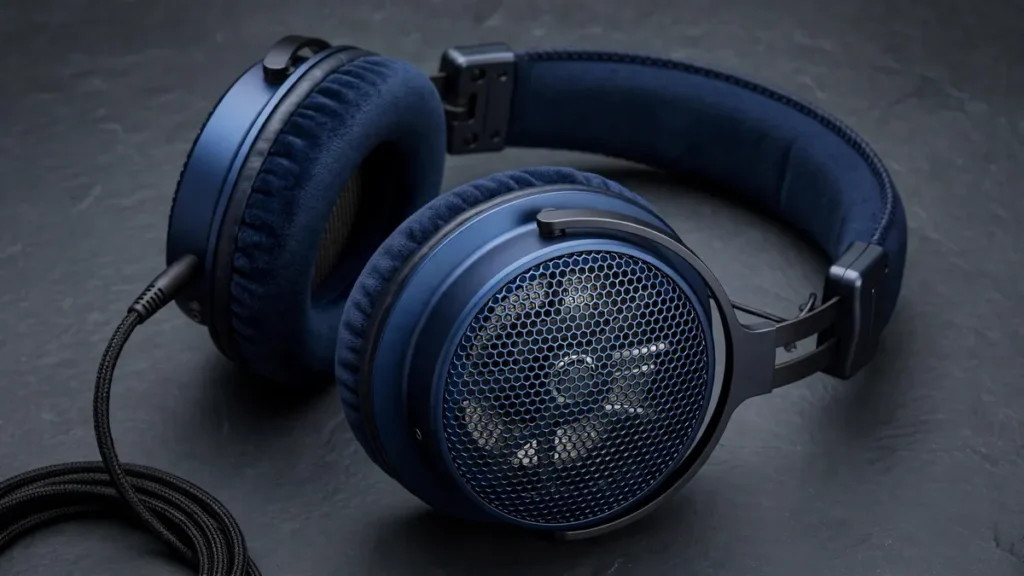
The Bowie 30 Max takes a different visual direction from most budget over-ears, with squarer, more rectangular earcups, a metal-reinforced headband and generously padded cushions. It folds for storage and the earcups rotate, which helps it pack flatter than its size suggests. Size is the operative word, though: at approximately 320 grams, this is a heavy headphone — well over half again the weight of Sony’s budget WH-CH720N — and that weight is the first thing long-session listeners will notice. The padding and moderate clamping force spread the load reasonably well, and published assessments rate comfort positively for typical listening sessions, but if you already know you are weight-sensitive, treat the 320g figure as a genuine consideration rather than a spec-sheet detail. No carry case is included, which is standard at this level but worth knowing for travel.
Noise cancelling
Baseus rates the hybrid ANC system at up to -45dB, using dual microphones and digital noise cancellation, with adjustable levels in the Baseus app. Read that claim the way you should read every budget ANC claim: as a best-case laboratory figure, not a promise of silence. The consistent picture from published reviews is that the 30 Max’s cancellation competently dulls low-frequency noise — traffic, engine hum, air conditioning — and takes the volume out of everyday environments, while falling well short of flagship ANC against voices and sharper sounds. That is acceptable performance for the class, and the app-adjustable levels are a thoughtful touch. Frequent flyers who need the strongest cancellation available should look at the models in our best noise cancelling headphones under $200 guide instead; commuters and office workers will find the 30 Max’s ANC matched to their actual noise.
Sound quality: the honest weakness
This is where our assessment has to be straight with you. The hardware story sounds superb: 50mm drivers, Hi-Res Audio certification, and LDAC streaming at up to 990kbps — a codec most budget rivals, including Sony’s WH-CH720N, simply do not offer. If you are new to why that matters, our guide to Bluetooth codecs — AAC vs LDAC vs aptX explains what LDAC can and cannot do. The catch is tuning. The published review consensus — TechRadar’s review is the clearest example — is that the 30 Max sounds thin in the bass and grating in the treble at higher volumes out of the box, and that the head-tracking spatial audio, while functional, can further thin the sound rather than enrich it. The Baseus app’s EQ and bass boost modes improve matters meaningfully, and many owners are happy with the result after adjusting. But a headphone that needs fixing in an app is a different proposition from one that sounds right immediately, and it is the main reason the 30 Max’s sound score sits below its feature list. Movie watchers may still enjoy the spatial mode’s wider, cinema-style presentation; music-first listeners should budget ten minutes with the equaliser as part of the purchase.
Battery, calls and connectivity
Battery is a clear strength: up to 65 hours with ANC off and 50 hours with it on, dropping to the low thirties with ANC and head-tracking spatial audio running together. A 10-minute rapid charge returns around 14 hours of playback, and a full charge takes about an hour and a half over USB-C. Those are figures most big-brand budget models cannot match. Calls are handled by a dual-microphone system with environmental noise cancellation, and published call assessments rate voice quality as clear and dependable for everyday use. Bluetooth 5.4 multipoint keeps two devices connected, though more than one published review notes the switching between paired devices can occasionally hesitate or bounce — a minor irritation if you live in two devices at once, and a non-issue if you mostly use one.
Baseus Bowie H1i: The Battery Marathon Runner
The Bowie H1i is the older, simpler headphone of the pair, and its headline numbers are endurance numbers: up to 100 hours of playback with ANC off and up to 70 hours with ANC on, from a full charge of about two hours. Even allowing for real-world listening at higher volumes, that is a headphone you charge a handful of times a month rather than every week — a genuinely different ownership experience for students, shift workers and anyone who hates cables on principle.
Around that battery sits a respectable, more conventional specification: 40mm drivers, ANC rated to -38dB, Bluetooth 5.3 with two-device connection, LHDC hi-res wireless audio, a low-latency mode rated at about 38 milliseconds that suits video and casual gaming, app control, and a wired 3.5mm fallback. Published assessments describe a well-finished design for the money, with sound that is enjoyable and bass-capable once you have visited the app EQ. Its noise cancelling is a step below the 30 Max’s on paper — -38dB against -45dB — and in practice it is best understood the same way: effective against steady hum and rumble, modest against voices. Think of the H1i as the Baseus for listeners who value simplicity and stamina over the 30 Max’s spatial-audio party tricks.

Bowie 30 Max vs Bowie H1i: Which One Should You Buy?
Choose the Bowie 30 Max if you want the most features: stronger ANC on paper, LDAC for hi-res streaming from Android, spatial audio for movies, faster charging and newer Bluetooth. Choose the Bowie H1i if battery life is your headline requirement, you prefer a simpler feature set, or you play mobile games and watch a lot of video where its low-latency mode earns its keep. Both need a few minutes in the app EQ to sound their best, and both undercut big-brand rivals on features per money — which is the entire point of the exercise.
One alternative deserves a plain mention: Sony’s WH-CH720N. It offers no LDAC and a smaller battery than either Baseus, but it is dramatically lighter than the 30 Max and its tuning and ANC processing are the more polished, no-fiddling-required package. It is the safer buy for sound-first listeners; the Baseus pair are the better buys for feature-first listeners. Both angles are represented in our best noise cancelling headphones under $100 roundup, and shoppers who simply want the lowest-cost route into over-ear listening can compare these against our best cheap headphones guide.
Pros and Cons
What We Like
- LDAC on the 30 Max and LHDC on the H1i — hi-res codecs big-brand budget models skip
- Exceptional battery ratings: up to 65 hours (30 Max) and 100 hours (H1i) with ANC off
- Hybrid ANC on the 30 Max, app-adjustable, with spatial audio for movies
- Multipoint Bluetooth, fast charging and wired backup on both models
- Feature-per-money ratio that established brands do not match at this level
What Could Be Better
- 30 Max sound is thin and treble-forward out of the box; EQ adjustment is effectively required
- 30 Max is heavy at about 320g, and its spatial mode can thin the sound further
- ANC dulls noise competently but is not close to flagship level on either model
- Multipoint switching on the 30 Max can hesitate between devices
- Baseus’s crowded naming makes buying the exact model harder than it should be — check the listing title carefully
Final Verdict
Are these cheap ANC headphones good? With the caveats on the table, yes — for the right buyer. The Baseus Bowie 30 Max is a feature maximalist’s bargain: LDAC, spatial audio, -45dB-rated ANC and 50-plus hours of battery in a class where rivals offer half that list, held back mainly by tuning that needs EQ help and by its weight. The Bowie H1i is the quiet achiever: fewer tricks, a step less ANC, and battery life that borders on the absurd. If your priority is polished sound with zero fiddling, buy the established brands. If your priority is the longest feature list and the longest battery for the least money — and you are willing to spend ten minutes in an equaliser — Baseus has built exactly your headphones, twice.
Frequently Asked Questions
Are Baseus Bowie 30 Max headphones any good?
They are good value with a specific caveat. The feature set — hybrid ANC rated to -45dB, LDAC hi-res audio, head-tracking spatial audio, Bluetooth 5.4 multipoint and up to 65 hours of battery — is exceptional for a cheap ANC headphone. The caveat is sound tuning: published reviews find the default sound thin and treble-forward, improved but not transformed by the app EQ. Buy them for features and battery, not for out-of-the-box sound polish.
Baseus Bowie 30 Max vs H1i: which is better?
The Bowie 30 Max is better on features: stronger ANC, LDAC, spatial audio with head tracking, Bluetooth 5.4 and faster charging. The Bowie H1i is better on endurance, with up to 100 hours of playback with ANC off and 70 hours with it on, plus a low-latency mode around 38ms. Feature-first buyers should choose the 30 Max; battery-first buyers should choose the H1i.
How long does the Baseus Bowie 30 Max battery last?
Baseus rates the Bowie 30 Max at up to 65 hours of playback with ANC off and up to 50 hours with ANC on, falling to roughly the low thirties with ANC and head-tracking spatial audio combined. A 10-minute rapid charge adds about 14 hours of playback, and a full charge takes about 1.5 hours.
Does the Baseus Bowie H1i have noise cancelling?
Yes. The Bowie H1i has active noise cancellation rated at up to -38dB, alongside up to 100 hours of playback with ANC off and 70 hours with ANC on, Bluetooth 5.3, LHDC hi-res audio and a low-latency mode. Its ANC is effective against steady low-frequency noise such as engine hum and air conditioning.
Do Baseus Bowie headphones support LDAC?
The Bowie 30 Max supports LDAC, along with AAC and SBC, enabling hi-res wireless streaming from compatible Android devices. The Bowie H1i uses LHDC as its hi-res codec instead, also alongside AAC and SBC. Neither codec is supported by iPhones, which will use AAC with both headphones.
Are cheap ANC headphones worth it?
Yes, if you match them to the right job. Cheap ANC headphones like these two are genuinely effective for commuting, offices and study spaces, and they now offer battery life and codecs that budget models lacked a few years ago. They are not worth it if you expect flagship-level silence on flights or perfectly tuned sound with no EQ adjustment — that is what the step-up price tiers buy.

I am the founder of Sound Mavericks, where I provide the polite truth about audio equipment. I started this site because consumer electronics reviews are often too technical. Instead of using a silent lab, I test headphones, earbuds, and Bluetooth speakers in the real world – like on a noisy subway or in a busy coffee shop.
To stay independent, I buy my own review units (mostly from the United States) rather than accepting free gifts from brands. Once I finish testing a product, I sell it locally to our community. My goal is to help you understand sound quality, active noise cancellation (ANC), and battery life without the marketing hype.