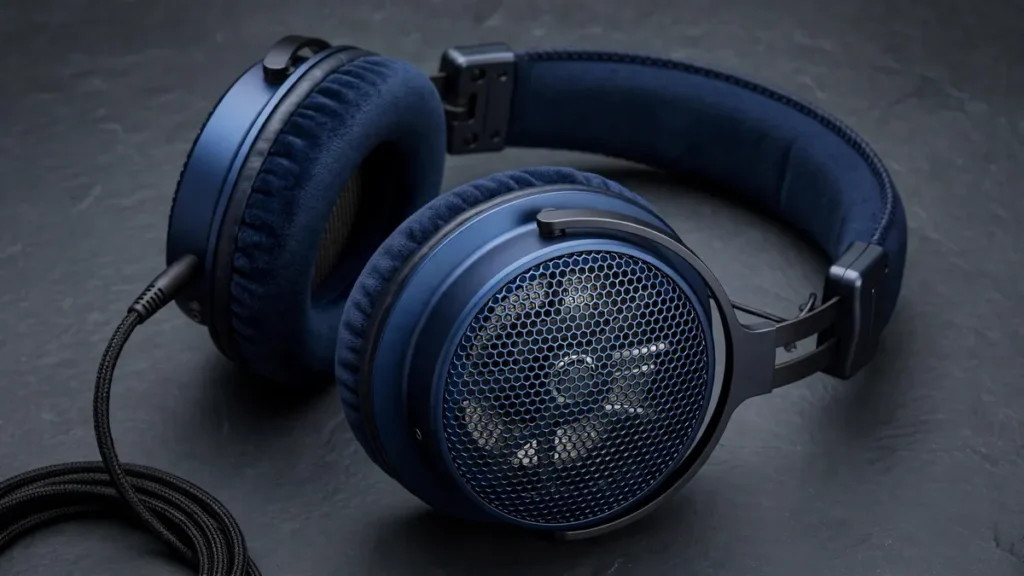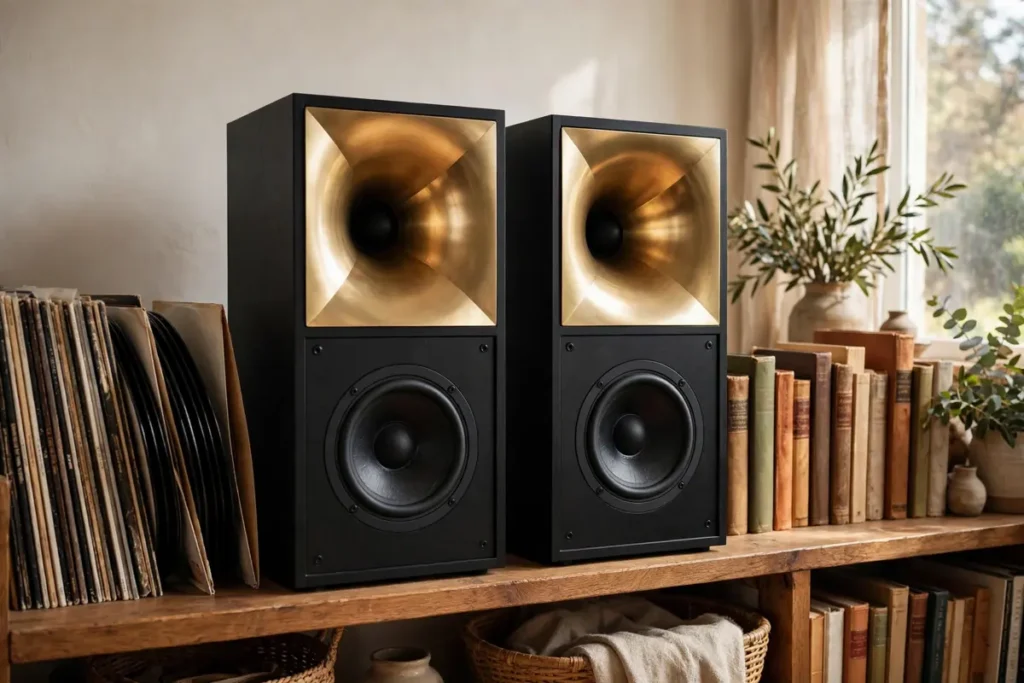
The JBL Studio 530 speakers are the rare affordable bookshelf speakers with a real horn-loaded compression driver — and that single design choice explains almost everything people love about them. Based on our analysis of the published specs and the critical consensus, the Studio 530 delivers focused imaging, a lively midrange and surprising bass from a small woofer, in a cabinet whose looks divide opinion like almost nothing else in hi-fi. It is also a passive, discontinued speaker, so buying well means understanding amplification, placement and stock before you spend anything.
This is a research-based review, built from JBL and Harman’s official specifications, the speaker’s documented design, and the long-running consensus among reviewers and owners.
Our Verdict
SoundMavericks’ verdict leads here: the Studio 530 earns its cult reputation. Most small speakers at its original level used a conventional dome tweeter. JBL instead borrowed from its professional concert systems — a 1-inch compression driver firing through a glass-filled ABS Bi-Radial horn — and paired it with a 5-1/4-inch PolyPlas woofer in a tall, braced MDF cabinet. The result, consistently described across the coverage, is a speaker that sounds bigger, more direct and more fun than its woofer size suggests, without turning harsh the way cheap horn speakers often do.
The compromises are equally clear. Sensitivity is only 86dB, so a tiny amplifier will run out of headroom. The rear port needs breathing room, the deepest bass still needs a subwoofer, and because JBL lists the model as manufactured from 2011 until 2022, new stock now appears intermittently — often refurbished or third-party — rather than as a normal current model.
| Sound Quality | 9.0 |
| Horn & Imaging | 9.2 |
| Build & Design | 8.4 |
| Value | 8.8 |
| Ease of Driving | 7.8 |
JBL Studio 530 Speakers: Full Specifications
Every figure below comes from JBL’s own product page and Harman’s published Studio 530 spec sheet and product information sheet. We have not filled gaps with guesses. Note in particular the unusual combination: a frequency response quoted to 40kHz at –6dB, a low 1.5kHz crossover, and a 6-ohm nominal impedance.
| Specification | JBL Studio 530 |
|---|---|
| Type | Two-way passive bookshelf speaker, ported (rear-facing port), sold as a pair |
| Woofer | 5-1/4" (130mm) PolyPlas cone, Symmetrical Field Geometry (SFG) magnet structure, cast frame, rubber surround, magnetically shielded |
| High-frequency driver | 1" (25mm) compression driver, neodymium magnet, one-piece Teonex diaphragm, on a glass-filled ABS Bi-Radial horn, magnetically shielded |
| Frequency response | 45Hz – 40kHz (–6dB) |
| Sensitivity | 86dB (2.83V @ 1m) |
| Nominal impedance | 6 ohms |
| Recommended amplifier power | 125 watts |
| Crossover frequency | 1.5kHz |
| Enclosure | 3/4" (19mm) MDF, heavily braced, non-parallel surfaces |
| Connectors | Dual gold-plated binding posts, bi-wire capable |
| Finishes (original) | Black; cherry was also listed on the original JBL product page |
| Dimensions (H × W × D) | 18-3/8" × 8-7/16" × 8-3/4" (467 × 214 × 222mm) |
| Weight | 17 lb (7.7kg) per speaker |
| In the box | 2 speakers, 2 horn covers, 2 port tube inserts, adhesive rubber feet, owner’s manual |
That 1.5kHz crossover matters. It hands much of the midrange to the compression driver and horn, rather than asking the small woofer to play high. JBL describes its low-loss network as smoothing that transition and reducing distortion and colouration — consistent with the focused midrange reviewers repeatedly praise.

Design and Build: The Look You Either Love or You Don’t
Let us deal with the design first, because you will have an opinion within five seconds of seeing a photograph. The horn dominates the front of the cabinet. It is not a small waveguide discreetly moulded around a dome; it is a large, sculpted opening that gives the Studio 530 a striking, slightly retro, unmistakably JBL profile. What Hi-Fi? summed up the reaction neatly in its review: look past the appearance and you find a fun-sounding yet refined speaker — while listing “striking looks will divide opinion” as a con. Owner threads say much the same, usually with more jokes.
Our take: in black, on stands, with the horn covers fitted, the Studio 530 looks purposeful rather than pretty. That works in a listening room or home theatre; on a styled living-room shelf, it may not. This is a genuine buying factor — you will look at these speakers every day.
Under the styling, the engineering is serious for the class. The cabinet uses 3/4-inch (19mm) MDF with a rigid, heavily braced design and non-parallel surfaces, which JBL says reduces unwanted resonances. At 17 lb per speaker, a Studio 530 feels substantial for its footprint, though at 18-3/8 inches tall it is taller than many rival bookshelf models — measure your shelf or stand before assuming it will fit where a typical compact speaker fits.
The woofer is equally purposeful: a ribbed PolyPlas cone JBL describes as stiff and lightweight, with a rubber surround, a 1-1/2-inch voice coil, a heavy-duty SFG magnet assembly and a rigid cast frame. The compression driver uses a one-piece Teonex diaphragm with a neodymium magnet. Both drivers are magnetically shielded. Around the back: a rear-facing port and dual gold-plated binding posts, so bi-wiring is possible.
In the box, JBL included horn covers, port tube inserts and adhesive rubber feet. The port inserts are genuinely useful: they tame bass output when placement close to a wall is unavoidable.
Sound Analysis: What the Specs and the Consensus Actually Say
The horn and compression driver
This is the headline. A compression driver does not work like a dome tweeter radiating directly into the room. It fires into a horn that controls directivity, which JBL says delivers cleaner high frequencies at the seated listener’s ear level while minimising unwanted interaction with walls and furniture. In practice, the consensus around the Studio 530 is consistent: detail and focus without the hard, fatiguing edge people associate with budget horn designs.
What Hi-Fi? praised a “focused, precise midrange and treble” and a hugely likeable sound. Crutchfield owner coverage described them as refined, dynamic and involving, with a realistic, holographic image. Those supporting voices line up with what the design predicts: controlled dispersion plus a low crossover should lock a singer in place between the speakers.
Imaging and soundstage
Imaging is the Studio 530’s party trick. Owners repeatedly describe a wide, continuous wall of sound rather than two obvious boxes, and less need to sit frozen in a narrow sweet spot. That fits the horn’s controlled directivity: if the speaker sends a more consistent pattern of sound across the listening area, the image holds together when you move. Slight toe-in toward the listener is the commonly recommended setup, and JBL’s own Studio 5 manual advises placing the pair 6 to 10 feet apart, angled toward the listening position, with the angle between listener and speakers between 40 and 60 degrees for the most accurate stereo soundstage.
Midrange, bass and dynamics
The midrange is where the low crossover pays off. Vocals and acoustic instruments get the clarity and presence that dominate positive reviews of this speaker. If your listening is built around voices, jazz, acoustic recordings and well-recorded rock, that strength matters more than headline bass depth.
Bass is the surprise — up to a point. JBL quotes 45Hz at –6dB, and reviewers consistently call the bass powerful, agile and larger than a 5-1/4-inch woofer should manage, helped by the rear port and the tall cabinet volume. What that does not mean is true deep bass. A –6dB point is already well down in output, and no small bookshelf speaker rewrites physics. For music at sensible levels in a small to medium room, many owners happily run the pair without a subwoofer. For film effects, organ, or bass-heavy electronic music, add a good subwoofer and let the Studio 530 do what it does best above the crossover to the sub.
Dynamics are the third strength. A compression driver has headroom a small dome often lacks, and the coverage describes the Studio 530 as lively and exciting, able to play loudly while keeping control — provided your amplifier can deliver, as the next section explains.
Amp Pairing: The Studio 530 Is Passive, So Budget for Power
The Studio 530 has no built-in amplifier, no Bluetooth, no HDMI and no remote. It is a passive speaker. You need a stereo amplifier, an AV receiver, or separates, plus speaker cable. If you are coming from powered speakers or from JBL’s portable range — readers who know the brand from products we have covered such as the JBL Live 770NC sometimes miss this — factor the amplifier into the total cost from the start.
JBL lists recommended amplifier power as 125 watts. Combined with 86dB sensitivity and a 6-ohm load, our guidance is straightforward. A quality amplifier or receiver rated comfortably for 6-ohm speakers, with genuine headroom, will serve the Studio 530 far better than a bargain mini-amp bought only because its headline wattage looked large. The speaker is not unusually hard to drive — 6 ohms is not a punishing load — but 86dB means it needs roughly twice the power of an 89dB speaker to reach the same level. In a bedroom or nearfield desk system at moderate volume, modest power is fine. In a larger room, or for home theatre peaks, choose the stronger amplifier.
Character matters too. The horn already gives a lively, direct presentation, so a very bright amplifier can push the balance too far and a very dark one can dull it. A neutral, clean amplifier is the safest match. Bi-wiring is possible, but a single good run of cable is the sensible starting point.
Placement Tips That Make a Real Difference
Give the rear port room. JBL’s manual recommends keeping the speakers at least 20 inches from side walls, and the review consensus suggests around 60cm from a rear wall as a good starting point, with slight toe-in. Closer to a wall, bass weight increases — sometimes usefully in a large room, sometimes to the point of boom in a small one. If you cannot pull the speakers forward, try the supplied port tube inserts and re-check the balance.
Use stands if you can, with the horn near seated ear level — the pair will image better than on a crowded shelf. Keep them symmetrical to the seat, start with the manual’s 40-to-60-degree geometry, and adjust toe-in in small steps. The horn rewards careful setup.
Pros and Cons
Pros
- Real horn-loaded compression driver — rare at this level
- Focused, precise midrange and treble with strong imaging
- Lively, dynamic and fun, without the usual budget-horn harshness
- Surprising, agile bass for a 5-1/4-inch woofer
- Serious cabinet and driver engineering, bi-wire capable
- Works as stereo mains or as front or surround channels in a home theatre
Cons
- Polarising looks — the horn dominates the room
- Discontinued; new stock is intermittent and often refurbished or third-party
- Only 86dB sensitive — needs an amplifier with real headroom
- Passive: no Bluetooth, streaming or built-in amplification
- Rear port needs space from walls; tall for a bookshelf speaker
- Still needs a subwoofer for true deep bass
Who Should Buy the JBL Studio 530 — and Who Should Skip It
Buy it if you want a characterful stereo pair for music-first listening in a small to medium room, you value imaging and vocal clarity, and you already own — or are happy to buy — a decent amplifier. It also makes sense as the front pair in a compact home theatre, especially if you can add a subwoofer and, where available, the matching centre from the same Studio 5 family for tonal consistency.
Skip it if you want plug-and-play. A powered speaker or soundbar is a better answer if there is no amplifier in the system and no desire to add one. Skip it if the look genuinely bothers you, if your shelves cannot take an 18-3/8-inch tall speaker, or if you need a guaranteed new, in-warranty pair today — discontinued status makes that a search, not a certainty.
Frequently Asked Questions
Are the JBL Studio 530 speakers passive or powered?
They are passive. The Studio 530 needs a separate stereo amplifier or AV receiver and speaker cable. It has no built-in amplification, Bluetooth or streaming.
What amplifier should I use with the JBL Studio 530?
Use a clean, neutral amplifier or receiver that is comfortable driving a 6-ohm load, with real headroom. JBL lists recommended amplifier power as 125 watts, and the speaker’s 86dB sensitivity means modest mini-amps will run out of steam sooner in larger rooms.
Do the JBL Studio 530 speakers need a subwoofer?
Not for most music in a small to medium room — bass is a noted strength for the woofer size, with a quoted response of 45Hz at –6dB. For film effects and bass-heavy music, a good subwoofer completes the system.
Are the JBL Studio 530 speakers discontinued?
Yes, in practical terms. JBL’s support page lists the Studio 530 as manufactured from 2011 until 2022. Listings still appear, but stock is intermittent and may be refurbished, renewed or sold by third parties, so check the seller and condition carefully.
How far from a wall should I place the Studio 530?
Start with clear space behind and beside the speakers because the port is rear-facing. JBL’s Studio 5 manual recommends at least 20 inches from side walls, and reviewers commonly start around 60cm from a rear wall with slight toe-in.
Can I use the Studio 530 for home theatre?
Yes. JBL designed the Studio 530 to handle left, right or surround channels. As front speakers they work best with a capable receiver and, for films, a subwoofer handling the deepest bass.
Final Verdict
The JBL Studio 530 speakers remain easy to recommend — with eyes open. On sound per the specs and the settled critical consensus, this is one of the most distinctive and enjoyable small speakers JBL has made: horn-driven focus, a midrange that cuts through, imaging that fills the space between the cabinets, and bass that embarrasses larger-looking rivals. Our 8.6 score reflects that strength, with the marks coming off for ease of driving and for a design that will never blend in.
The buying decision is mostly practical: confirm you have the amplifier, the space and the placement room, and that the listing is a genuine pair from a seller you trust. If those boxes are ticked, the Studio 530 is a discontinued classic worth hunting down.

I am the founder of Sound Mavericks, where I provide the polite truth about audio equipment. I started this site because consumer electronics reviews are often too technical. Instead of using a silent lab, I test headphones, earbuds, and Bluetooth speakers in the real world – like on a noisy subway or in a busy coffee shop.
To stay independent, I buy my own review units (mostly from the United States) rather than accepting free gifts from brands. Once I finish testing a product, I sell it locally to our community. My goal is to help you understand sound quality, active noise cancellation (ANC), and battery life without the marketing hype.