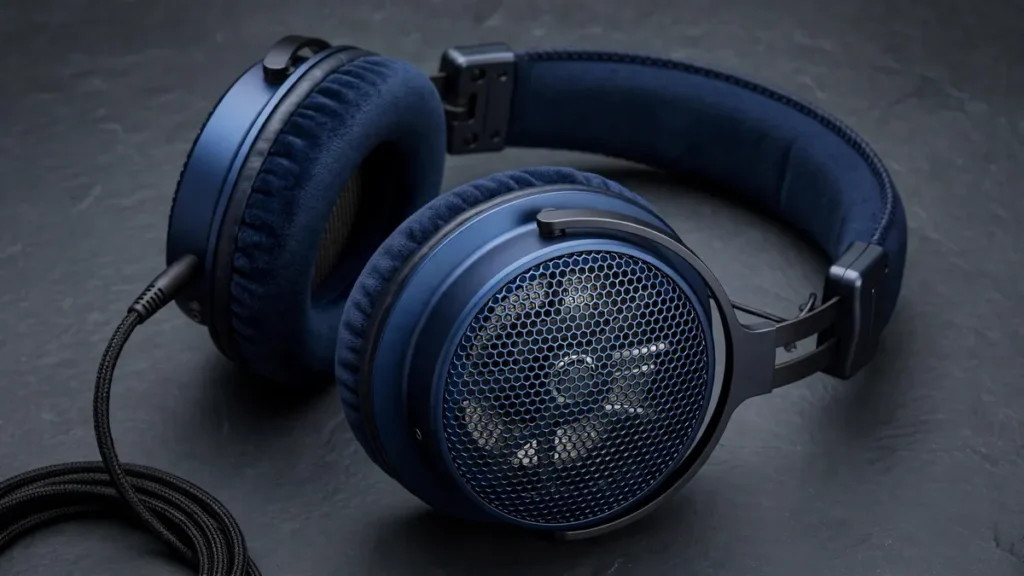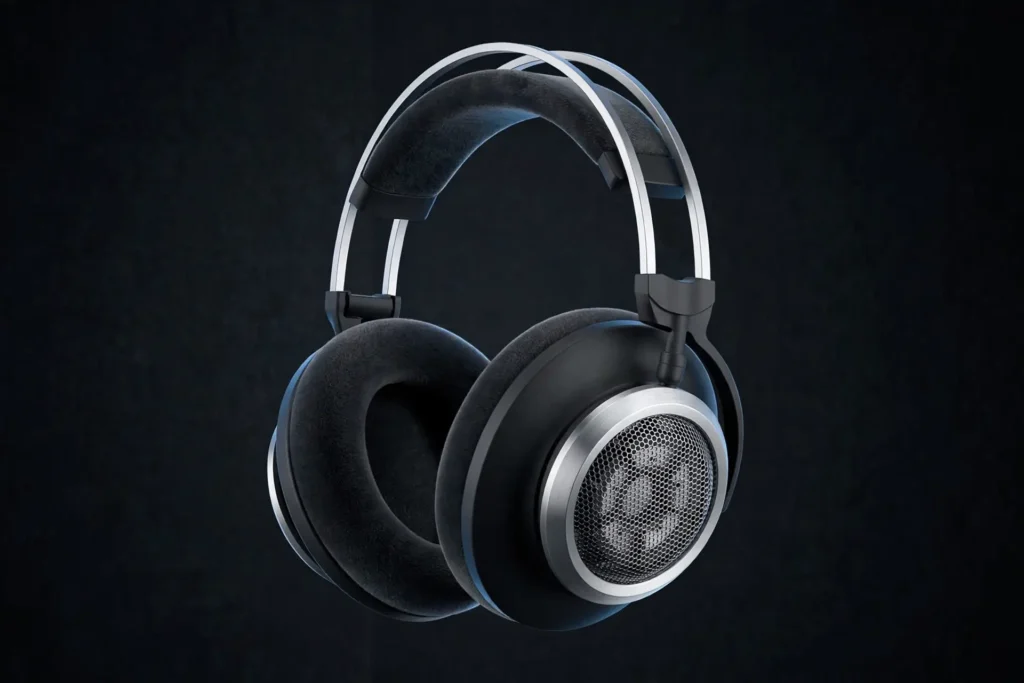
The bottom line: The Sennheiser HD 800 S is still the benchmark open-back flagship — a 56mm ring-radiator headphone with a 4Hz–51kHz response, 300-ohm impedance, and a soundstage no closed-back can touch. It’s ruthlessly revealing: great recordings sound extraordinary, poor ones get exposed. It needs a real amplifier to shine, and it will never leave your desk. SoundMavericks Score: 9.2/10
| Sound Quality | 9.6 |
| Soundstage & Imaging | 9.8 |
| Comfort & Design | 9.0 |
| Build Quality | 9.2 |
| Ease of Driving | 7.0 |
| Value | 8.5 |
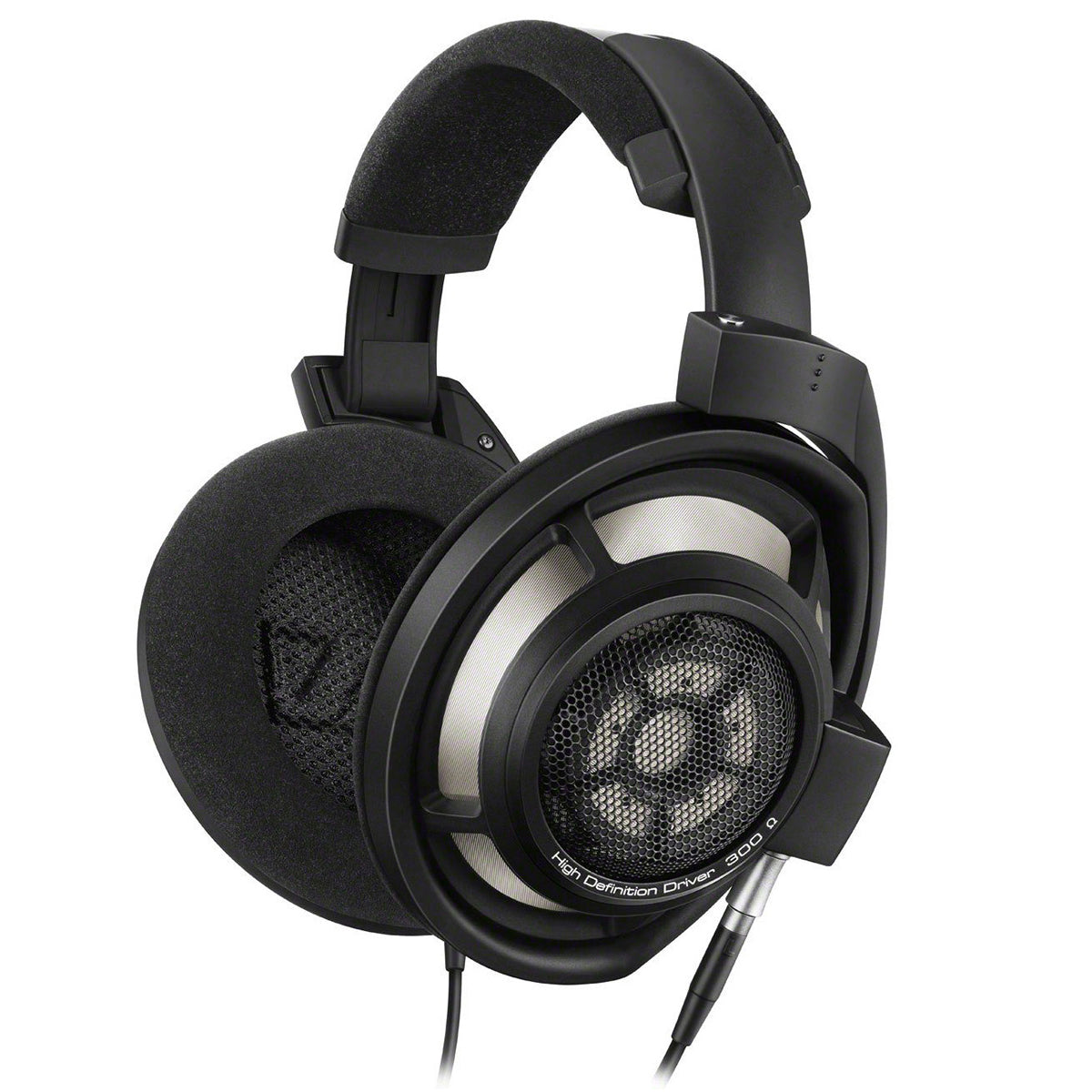
Sennheiser HD 800 S — Key Specifications
| Spec | Detail |
|---|---|
| Transducer | 56mm ring radiator, dynamic, open-back |
| Frequency response | 4 Hz – 51,000 Hz |
| Impedance | 300 Ω |
| Sound pressure level | 102 dB (1 V) |
| Total harmonic distortion | < 0.02% (1 kHz, 1 Vrms) |
| Magnetic field | 10.5 mT |
| Weight | 330 g (without cable) |
| Ear coupling | Circumaural (over-ear) |
| Cables (included) | 3 m detachable cable with 6.35mm unbalanced jack; 3 m cable with 4.4mm balanced Pentaconn jack |
| Optional connection | XLR-4 balanced cable available separately |
| Materials | Stainless steel mesh, matte black metal, microfiber earpads and headband |
| In the box | HD 800 S, 6.35mm cable, 4.4mm balanced cable, manual |
| Article number | 506911 |
What Is the HD 800 S?
The HD 800 S is Sennheiser’s flagship open-back audiophile headphone — the successor to the original HD 800, one of the most famous reference headphones ever made. The “S” revision keeps the landmark 56mm ring radiator driver and open-back architecture while refining the sound: Sennheiser added an absorber system that tames the treble peak critics flagged on the original, and finished the headphone in matte black with a balanced 4.4mm cable in the box.
Handcrafted at Sennheiser’s facilities in Germany and built at their state-of-the-art plant in Tullamore, Ireland, the HD 800 S has been the headphone other flagships get measured against for a decade. It is not a travel headphone, not a gaming headset, and not a casual Bluetooth purchase — it is a reference instrument for people who listen to music as an event.
Sound: Soundstage, Detail, and the Absorber
The HD 800 S’s defining trait is its soundstage. The angled 56mm ring radiator drivers sit slightly off-axis from your ears, projecting a wide, speaker-like presentation that reviewers have called mesmerizing. Instrument placement in a well-recorded orchestra or live album feels mapped in three dimensions — width, depth, and air around each performer. RTINGS’ review calls them excellent sounding headphones for critical listening, and HiFiCritic’s lab measurements confirm the distortion story: a remarkably low-resonance design with total harmonic distortion under 0.02%.
That resolution is a double-edged sword. The HD 800 S is ruthlessly revealing — it exposes poor mastering, low-bitrate streaming, and weak source gear without mercy. Feed it lossless audio through a proper chain and it rewards you with micro-detail few headphones can match; feed it a phone dongle and a compressed stream and it will sound thin and analytical. This is the headphone that tells you the truth about your files, your DAC, and your amp.
The signature improvement over the original HD 800 is the absorber technology: a resonant cavity that soaks up energy in the treble region where the original could sound sharp. The result is a smoother, more forgiving top end while preserving the air and detail that made the 800 famous.
Do the HD 800 S Need an Amp?
Yes — treat a headphone amplifier as part of the purchase. At 300 ohms with 102 dB sensitivity (1 V), the HD 800 S plays quietly and flat off a phone or laptop. It comes alive on a dedicated amp, whether solid-state or tube; our tube amp vs solid state guide covers how each flavor changes the presentation. The included 4.4mm balanced cable is there for a reason — balanced drive gives the high-impedance drivers the voltage swing they want.
Budget for the chain: the HD 800 S belongs at a desk with a DAC and amp, not in a backpack. Buyers who already own a desktop setup will extract far more from it than anyone plugging it into a phone.
Design & Comfort
At 330 grams the HD 800 S is impressively light for a flagship — several reviewers note it disappears during long sessions. The oversized earcups fit large ears comfortably, the microfiber earpads and padded headband keep pressure low, and the dual-axis articulating earcups conform to different head shapes. The open-back mesh cups leak sound freely in both directions, so this is a quiet-room headphone by design; there is no noise cancelling, and there was never meant to be. If you need isolation for travel, see our best noise-cancelling headphones roundup — the HD 800 S is the opposite tool.
What’s in the Box
Sennheiser ships two full 3-meter cables: one terminated in a standard 6.35mm stereo plug, one in a balanced 4.4mm Pentaconn plug — both detachable, so you can add the optional XLR-4 cable later. Also included: the HD 800 S itself and the manual. (Older production runs included a USB stick with the headphone’s frequency response chart; current units ship without it.)
HD 800 S vs HD 800: What’s Different?
- Treble: the absorber system smooths the original’s treble peak — the most audible upgrade.
- Finish: matte black instead of the original’s silver, with a stealthier look.
- Cables: balanced 4.4mm cable included in the box; the original shipped single-ended only.
- Character: the same wide soundstage and detail, with a slightly warmer, more forgiving presentation.
Used-market HD 800s trade cheaper, but the S is the refined, complete package — the one we’d recommend unless the price gap is enormous.
Who Should Buy the HD 800 S (and Who Should Skip It)
Buy it if: you listen critically at a desk, already own or plan to buy a headphone amp, want the widest soundstage in a dynamic headphone, or compare everything else to a reference standard. It also doubles as a superb mixing and mastering tool.
Skip it if: you need portability, noise isolation, Bluetooth, a mic for calls, or bass slam — the open-back design and neutral tuning won’t deliver any of those. Gamers chasing competitive footsteps get the soundstage, but no microphone. For a more affordable entry into the Sennheiser reference sound, our HD 660S2 review covers the easier-to-drive sibling.
Pros & Cons
Pros:
- Reference-grade soundstage and imaging — the benchmark of the category
- 56mm ring radiator with sub-0.02% distortion and 4Hz–51kHz extension
- Absorber system tames the original HD 800’s treble peak
- Balanced 4.4mm and 6.35mm cables included in the box
- Light (330g) and comfortable for long sessions
- German/Irish craftsmanship, premium materials
Cons:
- Needs a dedicated headphone amp to sound its best (300 Ω)
- Open-back: zero isolation, sound leaks both ways
- Ruthlessly revealing of poor recordings and weak sources
- Not portable, no wireless, no mic
- Flagship-tier purchase — amp budget on top
Final Verdict
A decade after launch, the HD 800 S remains the headphone audiophiles measure flagships against — and it holds its ground against pricier planar competition. Its soundstage is still unmatched in a dynamic driver, its distortion figures are still laboratory-grade, and the absorber revision fixed the one real criticism of the original. The trade-offs are structural, not flaws: it demands an amp, a quiet room, and good source material, and in return it delivers a reference listening experience nothing closed-back can imitate. For the dedicated critical listener, it remains one of the safest flagship purchases in audio.
Frequently Asked Questions
What is the frequency response of the Sennheiser HD 800 S?
4 Hz to 51,000 Hz, per Sennheiser’s official specifications — one of the widest published ranges of any dynamic headphone.
Do the HD 800 S need a headphone amp?
Yes. With 300-ohm impedance and 102 dB sensitivity, the HD 800 S underperforms badly on phone or laptop outputs. A dedicated desktop amp — solid-state or tube — is effectively part of the purchase.
What is the difference between the HD 800 and HD 800 S?
The S adds Sennheiser’s absorber system that smooths the original’s treble peak, ships in matte black with a balanced 4.4mm cable included, and presents a slightly warmer, more forgiving sound with the same famous soundstage.
Is the HD 800 S good for gaming?
The soundstage and imaging are outstanding for positional audio, but there’s no microphone and the open-back design leaks sound. Competitive players who need a mic should look elsewhere; pure immersion listeners will love it.
Does the HD 800 S have noise cancelling?
No — it’s an open-back reference headphone with no isolation at all. It’s designed for quiet rooms, not travel or noisy environments.
What cables come with the HD 800 S?
Two detachable 3-meter cables: one with a 6.35mm unbalanced stereo plug and one with a balanced 4.4mm Pentaconn plug. An XLR-4 balanced cable is available separately.

I am the founder of Sound Mavericks, where I provide the polite truth about audio equipment. I started this site because consumer electronics reviews are often too technical. Instead of using a silent lab, I test headphones, earbuds, and Bluetooth speakers in the real world – like on a noisy subway or in a busy coffee shop.
To stay independent, I buy my own review units (mostly from the United States) rather than accepting free gifts from brands. Once I finish testing a product, I sell it locally to our community. My goal is to help you understand sound quality, active noise cancellation (ANC), and battery life without the marketing hype.