
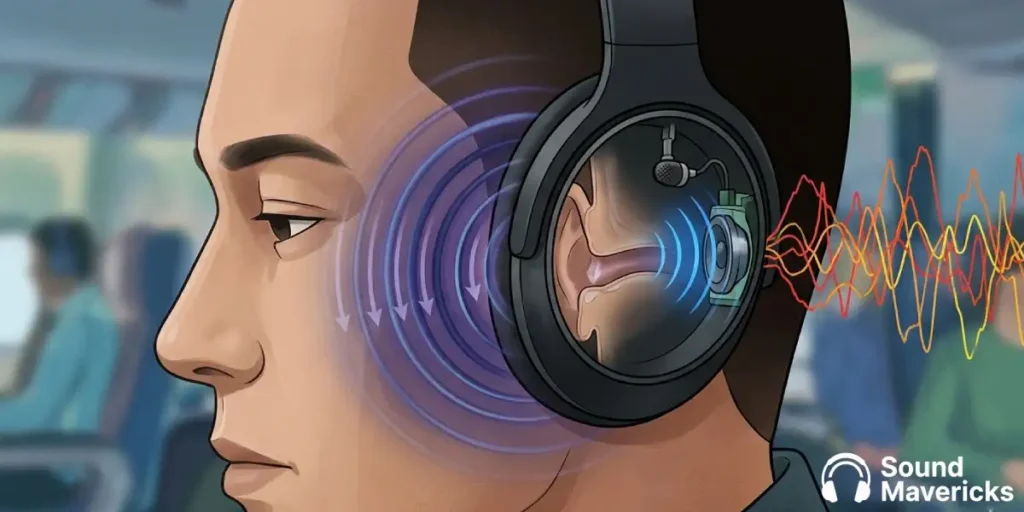
If you’ve ever switched on ANC and immediately felt like your ears were being gently vacuumed from the inside, you’re not imagining things. It’s one of the most commonly reported and frequently misunderstood side effects of active noise cancellation: a sensation of pressure, fullness, or “eardrum suck” that arrives the moment you hit that button. For some people, it’s mildly odd. For others, it’s genuinely unpleasant enough to put the headphones back in the box.
Here’s the reassuring part: this feeling is almost never caused by dangerous pressure changes inside your ear. It’s mostly about how your brain interprets a sudden, dramatic shift in the sound environment around you — and that’s a very different thing from actual physical harm.
In this article, we’ll break down exactly what causes that pressure sensation, why some people feel it more intensely than others, whether it poses any real risk to your hearing, and — most practically — what you can do to reduce or eliminate it.
Check Out: Best ANC Headphones
What People Mean by “Pressure” from ANC
The Strange “Eardrum Suck” Feeling
The sensation goes by several names in audiophile and consumer communities: “eardrum suck,” “ear pressure,” “vacuum feeling,” or simply “that weird ANC thing.” What people actually report experiencing varies slightly from person to person, but common descriptions include:
- A feeling of fullness or stuffiness in the ears
- The sense that your eardrums are being gently pulled inward
- An urge to yawn or swallow to “pop” your ears
- Mild headache or a sense of heaviness in the head
- In more sensitive individuals, light nausea or disorientation
It’s natural to compare this to the ear pressure you feel on an airplane during descent — and there are surface similarities. But the two phenomena aren’t identical. Airplane ear involves a genuine pressure differential between the middle ear and the cabin air as altitude changes. The ANC sensation, as we’ll explore, has a different and far less dramatic cause.
Is There Real Air Pressure Change?
This is the question that trips most people up — because the sensation feels so physical. The short answer is: measurements generally do not find significant air-pressure changes inside the ear canal during normal ANC operation. The headphone is not creating a vacuum. It is not compressing or decompressing air against your eardrum in any meaningful way.
What it is doing is radically changing the acoustic environment your brain has been operating in — often without warning. And that shift in the sound landscape, rather than any actual pressure change, appears to be the primary driver of the sensation. Your brain, it turns out, is surprisingly good at interpreting sudden sound changes as pressure changes. More on why in the next section.
How ANC Changes the Sound Around Your Ears
What ANC Actually Does
Active noise cancellation works by using microphones — mounted on the outside and/or inside of the ear cup — to continuously sample the ambient sound around you. A digital signal processor (DSP) analyses that incoming noise and generates an inverted waveform: a sound wave that is the mirror image of the noise, with the same amplitude but the opposite phase. When the two waves meet at your ear, they interfere destructively and cancel each other out.
ANC is particularly effective at low-frequency, constant sounds — the steady drone of a jet engine, the rumble of a train carriage, the hum of an air conditioning unit. These predictable, slow-moving waves are exactly the kind the algorithm can model and cancel in real time. High-frequency, sudden, or irregular sounds (voices, keyboard clatter, sudden impacts) are much harder to cancel and largely get through.
Why Removing Low-Frequency Noise Can Feel Like Pressure
Here’s where the psychology becomes important. Your auditory system has been operating inside a constant low-frequency soundscape for your entire life — traffic, building systems, distant machinery. This bass-heavy hum is so ubiquitous that your brain has essentially tuned it out and accepted it as the baseline “sound of silence.”
When ANC switches on and strips out that low-frequency content almost instantaneously, your brain notices an abrupt and unusual change in the acoustic environment. The bass is gone. The sound pressure at lower frequencies has dropped sharply. And because your brain associates changes in low-frequency sound pressure with changes in physical pressure — as with altitude or underwater depth — it can interpret this as a sensation of pressure or vacuum, even though your ear canal air pressure has barely moved.
Engineers and acoustics researchers sometimes describe this as a psychoacoustic effect — the perception is real and genuine, but its origin is in how the brain processes sound, not in any physical pressure differential. Anechoic chambers, which absorb nearly all ambient sound, produce a similar unsettling effect in many people: the sudden absence of the usual frequency mix feels deeply strange, and some people find it physically uncomfortable within minutes.
The Role of Fit, Seal, and Headphone Design
Sealed Ear Cups and Ear Tips
The physical design of noise-cancelling headphones adds a second layer to the pressure sensation, distinct from the psychoacoustic effect above. Both over-ear and in-ear ANC headphones are designed to create a tight acoustic seal.
Over-ear headphones use padded ear cups that press firmly around the ear, forming a sealed chamber between the driver and your eardrum. In-ear models use silicone or foam tips that press directly against the walls of the ear canal, blocking sound from entering around the sides. This physical seal is what enables passive noise isolation — the mechanical blocking of sound that operates even when ANC is switched off.
A well-fitting seal improves noise reduction significantly. But it also means your ear is now enclosed in a closed acoustic space rather than open to the air. For many people, this “closed off” sensation is itself a source of mild discomfort — independent of whether ANC is active or not.
Physical Pressure vs ANC Sensation
It’s worth clearly separating two types of pressure that can occur simultaneously:
Mechanical pressure is the physical force of the headphone against your head or ear canal — the clamp of a tight headband, the weight of heavy cups pressing on your ears, or an ear tip inserted too deeply into the canal. This produces real, physical soreness or pain that doesn’t go away when you switch ANC off. It’s a hardware and fit problem, not an electronics problem.
Psychoacoustic “pressure” is the ANC sensation described above — the brain’s interpretation of a changed sound environment as a pressure change. This is specifically linked to ANC being active and tends to reduce or disappear when ANC is switched off while keeping the headphones in place.
In practice, both can be present at the same time, which is why the overall discomfort can feel hard to isolate. Distinguishing between them — by toggling ANC on and off while keeping fit the same — is a useful diagnostic first step.
Why Some People Feel It More Than Others
Individual Sensitivity
The range of responses to ANC pressure is genuinely wide. Some people switch on their first pair of ANC headphones and notice nothing unusual. Others feel mild but tolerable discomfort. And a small proportion of users experience the sensation strongly enough — including nausea, disorientation, or significant ear discomfort — that they find ANC headphones essentially unusable at full strength.
People who are generally more sensitive to motion, spatial changes, or sensory input seem more likely to notice ANC pressure strongly. Those who experience motion sickness, have a history of migraines, or are sensitive to changes in altitude or air pressure often report more pronounced ANC discomfort. Conversely, many users who initially find the sensation uncomfortable report that it fades with regular use as the brain adapts to the new acoustic baseline.
Existing Ear or Sinus Issues
The anatomy and condition of your ears, sinuses, and jaw can also influence how you perceive pressure and sound changes. Congestion, ear infections, issues with the Eustachian tube (which normally equalises pressure between the middle ear and the environment), and temporomandibular joint (TMJ) problems can all affect how sounds and pressure sensations are interpreted and processed.
If you notice that your ANC pressure sensation is significantly more pronounced when you have a cold or sinus congestion, that’s likely the reason. This is not a cause for alarm — but it’s a good indicator to reduce ANC use during those periods.
Important: Persistent or painful ear pressure, a lasting sense of fullness that doesn’t resolve after removing headphones, significant changes to your hearing, or strong dizziness when using ANC are all symptoms worth discussing with a doctor or audiologist. These aren’t typical ANC side effects and may reflect an underlying condition unrelated to the headphones.
Is Noise-Cancelling Pressure Harmful?
What Research and Experts Suggest
The current evidence is reassuring on this point. ANC technology changes your sound environment; it does not meaningfully change the physical pressure inside your ear canal. There is no established mechanism by which the anti-noise signal itself damages hearing or ear structures at normal operating levels.
In fact, ANC can be actively beneficial for hearing health in an indirect way. In noisy environments — on a flight, in a loud office, on public transport — people tend to increase their listening volume to hear their audio over the background noise. ANC removes much of that background noise, which means users can achieve the same comfortable listening experience at a significantly lower volume. Lower sustained volume equals less risk of noise-induced hearing loss over time.
When You Should Worry
Mild, transient pressure that eases or disappears within a few minutes of removing the headphones is generally considered benign. The sensation itself, while uncomfortable, is not known to cause harm in most users.
The following symptoms are red flags that warrant stopping ANC use and seeking professional advice:
- Pain — not just pressure, but actual discomfort or ache inside the ear
- Persistent fullness — a stuffed sensation that doesn’t clear after the headphones are off
- Changes in hearing — sounds seeming muffled or different after a session
- Tinnitus spikes — new or worsened ringing, buzzing, or other phantom sounds
- Strong dizziness or nausea — beyond mild queasiness
None of these are expected effects of normal ANC use. If they occur, the headphones are not necessarily the root cause — but they are a reason to pause and get checked by an ENT specialist or audiologist rather than pushing through.
How to Reduce or Avoid the Pressure Feeling
Tweak ANC and Listening Settings
The most immediate and controllable factor is the ANC setting itself. Maximum cancellation produces the strongest low-frequency reduction — and therefore the most pronounced shift in your sound environment. Many users who struggle at full ANC find that a medium or low setting provides most of the practical noise reduction benefit (particularly on flights and trains) while substantially reducing the pressure sensation.
- Lower ANC strength: If your headphones offer adjustable ANC levels, try stepping down from maximum. Even medium ANC blocks most of the engine and HVAC drone that makes listening uncomfortable.
- Use transparency mode: In situations where maximum ANC feels oppressive — a quieter office, a short walk — transparency mode lets in ambient sound while still providing some passive isolation. Many users find this far more comfortable for extended wear.
- Take regular breaks: Give your ears and your brain a reset. On a long flight or a full workday, removing the headphones for 10–15 minutes every couple of hours can significantly reduce cumulative discomfort.
Improve Fit Without Over-Sealing
A marginally less aggressive seal can reduce the “closed off” sensation without eliminating noise reduction entirely. Small adjustments here often make a meaningful difference.
- Ear tip sizing (in-ear): Try a slightly smaller tip than your usual fit. A tip that’s one size down will still isolate reasonably well but sit less deeply in the canal, reducing the sense of occlusion. Foam tips, while providing strong isolation, sit deeper and can intensify the enclosed sensation — silicone tips may feel less claustrophobic for sensitive users.
- Headband and clamp (over-ear): Many over-ear headphones allow the headband to be extended, which reduces clamp force against the head. Aftermarket pads with softer or thicker material can also redistribute pressure more comfortably. This addresses mechanical pressure rather than the psychoacoustic effect, but the two often compound each other.
Adjust Your Habits
For users who are new to ANC and find the sensation strong, a gradual acclimatization approach often works well.
- Start with short sessions: Begin with 20–30 minute ANC sessions and increase duration gradually over several days or weeks. Many users report that the pressure sensation diminishes substantially as their auditory system adapts to the new acoustic baseline.
- Keep volume moderate: Resist the urge to fill the newly-quiet space with loud audio. The whole point of ANC is that you don’t need to — enjoy the quieter environment at a comfortable, lower volume. Your ears will thank you over the long term.
- Avoid ANC during congestion: If you have a cold, sinus pressure, or ear congestion, the ANC pressure sensation is likely to be noticeably worse. This is a good time to switch to passive-only mode or use a different pair entirely.
Alternatives If You Can’t Get Used to ANC
Rely on Passive Isolation
If ANC pressure remains genuinely unpleasant despite trying the adjustments above, the good news is that meaningful noise reduction is available without active electronics. Well-designed passive noise-isolating headphones — particularly closed-back over-ear models with dense pads, or in-ear models with foam tips — can achieve significant reduction in ambient noise without any of the psychoacoustic effects associated with ANC.
Because passive isolation works through physical blocking rather than electronic phase inversion, it doesn’t produce the same sudden low-frequency shift that triggers the “eardrum suck” sensation. The tradeoff is that it won’t match good ANC for deep low-frequency cancellation (aircraft engines, for example), but for many users it’s a highly practical and comfortable alternative.
Look for Gentler ANC Designs
Not all ANC implementations are equally aggressive. Some headphone designs prioritize a more natural-feeling ANC experience over maximum cancellation depth — using milder algorithms, pressure-relief vents, or gentler acoustic tuning that preserves more of the natural sound environment. If you’re shopping while knowing that pressure sensitivity is a concern, it’s worth specifically looking for reviews that address comfort and pressure sensation, not just cancellation performance numbers.
Where possible, try before you buy — or buy from a retailer with a generous return policy. ANC pressure sensitivity is highly individual, and the only reliable way to know how a specific model affects you is to wear it for 20–30 minutes in a relevant environment. A headphone that’s perfectly comfortable for one person can be immediately oppressive for another with the same sensitivity specifications on paper.
The Science Behind the “Pressure”
The “pressure” feeling from noise-cancelling headphones is real — it’s just not what most people assume it is. It’s not a vacuum being created against your eardrum, and it’s not a sign that the headphones are damaging your hearing. It is, in most cases, the result of three things working together: a dramatic reduction in the low-frequency background noise your brain has been using as its acoustic reference point, the physically sealed environment created by the ear cups or tips, and your individual sensitivity to sudden changes in sensory input.
For the majority of users, the sensation is mild, benign, and manageable — often reduced significantly by adjusting ANC strength, fit, or usage habits. For a smaller group, adaptation over time makes it a non-issue. And for those who find ANC genuinely uncomfortable regardless of adjustment, high-quality passive isolation offers a practical alternative that sidesteps the phenomenon entirely.
The main message is this: if ANC feels strange or uncomfortable, experiment before giving up. Lower the ANC level. Try a different tip size. Take breaks. Give it a few weeks of shorter sessions. In most cases, one or more of these adjustments will bring the experience from uncomfortable to entirely tolerable — and you’ll get to keep all that glorious quiet.

I am the founder of Sound Mavericks, where I provide the polite truth about audio equipment. I started this site because consumer electronics reviews are often too technical. Instead of using a silent lab, I test headphones, earbuds, and Bluetooth speakers in the real world – like on a noisy subway or in a busy coffee shop.
To stay independent, I buy my own review units (mostly from the United States) rather than accepting free gifts from brands. Once I finish testing a product, I sell it locally to our community. My goal is to help you understand sound quality, active noise cancellation (ANC), and battery life without the marketing hype.