Picture this – You are five miles into a run. You are feeling good, the music is pumping, and you are hitting your stride. Then, the sky turns grey. A summer downpour starts. You panic. You grab your expensive earbuds and shove them into your pocket, trying to keep them dry.
We have all been there. Electronics and water do not mix. But today, most audio gear claims to be water-resistant. You see codes like IPX4 or IPX7 on the box. But what do they actually mean? Is the cheaper one safe for the gym? Is the expensive one safe for the shower?
Many people overpay for waterproofing they do not need. Others buy cheap gear and ruin it in a week.
This guide will break down the battle between the two most common audio ratings: IPX4 (the gym standard) and IPX7 (the outdoor standard). By the end, you will know exactly which one you need to buy.
IPX4 vs IPX7: What’s the Difference?
If you want the quick answer without the science lesson, here it is.
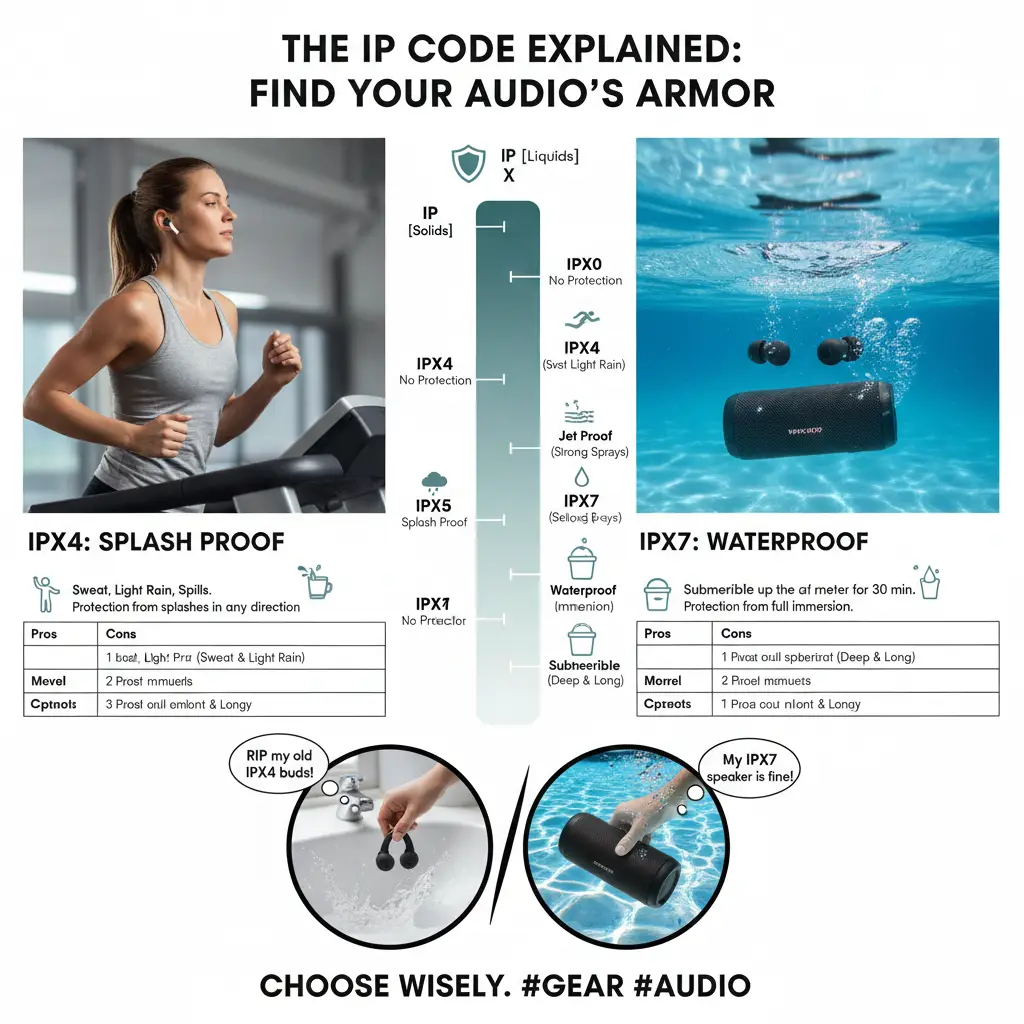
IPX4 is “Splash Proof.”
Think of a drink spilling on a table, or sweat dripping down your face during a hard workout. IPX4 devices can handle water hitting them, but they cannot handle being inside water. If you drop them in a sink full of water, they will likely die.
IPX7 is “Waterproof.”
Think of a submarine. IPX7 devices are sealed tight. You can drop them in a puddle, the toilet, or a shallow pool, and they will survive. They are built to handle pressure.
What about the “X”?
You might notice the “X” in the middle of the code (IPX7). The first number usually stands for dust protection (solids). The second number stands for liquid protection. When you see an “X,” it does not mean the device has zero dust protection. It just means the company did not pay to officially test it for dust. In the audio world, this is very common. If a speaker is sealed against water, it is usually sealed against dust too.
Quick Verdict Table
| Feature | IPX4 (Splash Proof) | IPX7 (Waterproof) |
| Heavy Sweat | Yes | Yes |
| Light Rain | Yes | Yes |
| Heavy Storm | Risky | Yes |
| Dropping in Water | No (Likely Breaks) | Yes (Safe) |
| Swimming | No | Yes (Device survives, but signal cuts) |
| Price | Affordable | Premium |
How the Ratings Are Tested
To really understand why one is better than the other, we have to look at how they are tested in the lab. The difference is not just about getting wet; it is about pressure.
The IPX4 Test (The Spray)
To get an IPX4 rating, a device goes through the Spray Test. Engineers place the headphones or speaker in a chamber. Then, a machine sprays water at the device from all angles – top, bottom, and sides – for at least five minutes.
This test mimics the real world perfectly for runners. When you run, sweat does not just fall from the sky; it runs down your neck, it splashes up from puddles, and it sprays from the wind. IPX4 guarantees that no matter what direction the water comes from, the internal circuits stay dry.
Think of IPX4 like a really good rain jacket. It keeps the rain off your skin, but if you jumped into a lake wearing it, you would still get soaked.
The IPX7 Test (The Dunk)
The IPX7 test is completely different. Engineers do not spray the device; they drown it. They take the speaker or earbuds and submerge them in a tank of water, up to one meter (about 3 feet) deep, for 30 minutes.
Why does this matter? Because of pressure. Water is heavy. When you push something underwater, the water tries to force its way into every tiny crack and seam. A device that can handle a spray might crack under the pressure of being underwater. IPX7 devices have thicker rubber seals and stronger glue to fight this pressure.
Think of IPX7 like a sealed plastic food container. You can throw it in a cooler full of melted ice water, and the sandwich inside stays perfectly dry.
When Does It Matter?
Now let’s take these ratings out of the lab and into your daily life.
The Gym & Running (Winner: IPX4)
If you are strictly buying headphones for the gym, you do not need IPX7.
Many people think, ‘I sweat a lot, so I need the highest rating.’ This is incorrect. Sweat, even heavy sweat, behaves like a splash. It drips. It does not exert pressure like a swimming pool does. An IPX4 rating is perfectly capable of keeping sweat out of your drivers.
However, sweat is salty, and salt can corrode charging ports. The best habit is to wipe down your IPX4 buds after a workout. You don’t need a higher rating; you just need good hygiene for your gear.
Outdoor Adventure & Hiking (Winner: IPX7)
If you are a hiker, a camper, or someone who loves beach days, IPX4 is a gamble.
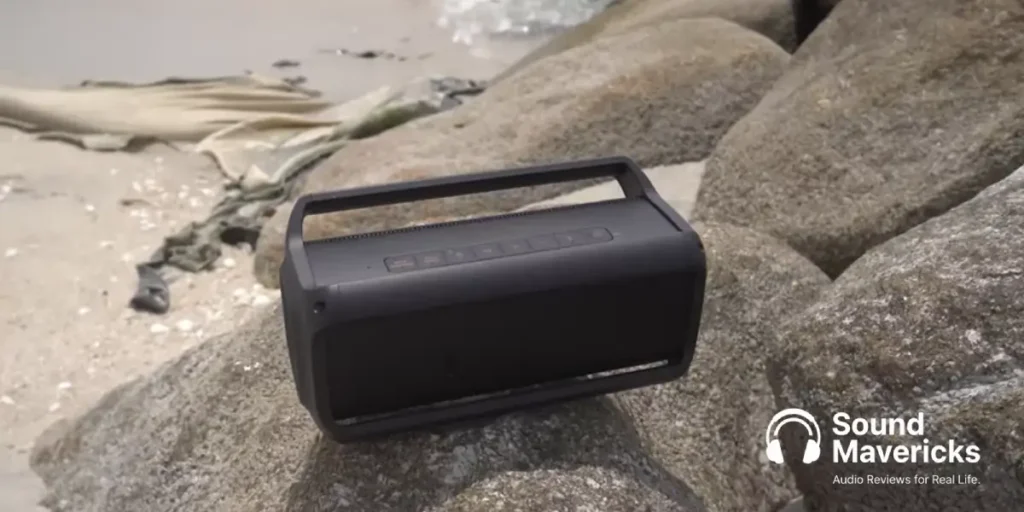
Nature is unpredictable. You might cross a stream and slip. You might be kayaking and drop your speaker in the river. In these moments, an IPX4 device is toast. The moment it hits the water and sinks, the pressure will force water into the battery compartment.
For outdoor use, IPX7 is insurance. It buys you time. If you drop your speaker in the lake, you can fish it out, shake it off, and keep playing music. That peace of mind is worth the extra cost.
The Shower & Swimming (The Grey Area)
This is where things get tricky.
Can I shower with my speaker?
If you have an IPX7 speaker, yes. The steam and the direct spray are fine. While high-pressure jets (like a power washer) technically require an IPX5 or IPX6 rating, a standard home shower is rarely powerful enough to hurt an IPX7 device. An IPX4 speaker in the shower is risky – if it falls into the tub, it’s game over.
Can I swim with my earbuds?
This is the biggest myth in audio. You might buy IPX7 earbuds thinking you can swim laps with them. You cannot.
The earbuds will survive the water, yes. They won’t break. But Bluetooth signals cannot travel through water. The moment you go underwater, the music will cut out. If you want to listen to music while swimming, you need a specific device with built-in MP3 storage, not just Bluetooth.
The Hidden Costs of Waterproofing
Better protection sounds great, but it comes with trade-offs.
Audio Quality vs. Seals
To make a speaker IPX7 waterproof, engineers have to seal everything tightly. This includes the speaker cone itself. Sometimes, this can make the sound feel stiff or less open compared to a non-waterproof speaker. High-end brands solve this with advanced materials, but on budget devices, an IPX7 speaker might sound slightly muffled compared to an IPX4 version.
The Price Jump
Glue, rubber gaskets, and certification cost money. Generally, jumping from IPX4 to IPX7 adds about 20% to 30% to the price tag. You have to ask yourself: Am I paying for a feature I will never use?
Button Stiffness
Have you ever tried to press a button on a waterproof speaker and felt like you needed a hammer? That is because the buttons are covered in thick rubber to keep water out. IPX4 devices often have clickier, easier-to-press buttons because they don’t need such heavy armoring.
Buying Guide: Who Should Buy What?
Let’s make a decision.
Buy IPX4 Gear If:
- You are a runner or a gym-goer.
- You work in an office and commute.
- You are on a budget and want the best sound for your dollar.
- You are careful with your electronics.
Buy IPX7 Gear If:
- You are clumsy. (Be honest – do you drop things often?)
- You spend time near bodies of water (pools, lakes, beaches).
- You want a speaker specifically for the shower.
- You ride a bike or motorcycle where heavy rain is a real threat.
Frequently Asked Questions (FAQ)
You might see IPX8 on very high-end gear. This means the device can go deeper than 1 meter (usually up to 3 meters) for longer periods. Unless you are a professional diver or buying specialized swimming gear, IPX8 is overkill for listening to music.
Usually, no. This is the biggest trap in the audio world. Most brands treat IP ratings as a feature, not a guarantee. If you drown your IPX7 speakers and they stop working, the manufacturer will often say it was improper use and refuse to fix them. Always check the fine print, and treat your gear like it’s not waterproof, even if it is.
Not exactly. Sweat-proof is a marketing word; IPX4 is a technical test. A company can call their headphones sweat-proof because they added a special coating, even if they didn’t pay for the official IP test. However, if you see only the word Sweat-proof without an IP code, be careful. It’s better to trust the official number.
You need to act fast. IP ratings are tested in fresh water, not salt water. Salt is corrosive – it eats through glue and rubber seals quickly. If your gear falls in the ocean (or a chlorinated pool), do not just dry it off. Rinse it gently with fresh tap water first to wash away the salt, then let it dry completely before charging.
Absolutely not. Never charge a wet device, even if it is rated IPX7. Water in the charging port can cause a short circuit that will fry your battery instantly. If you just washed your speaker or came in from a run, wait until the port is 100% dry. Some newer devices have sensors that refuse to charge if they detect moisture, but don’t rely on that.

I am the founder of Sound Mavericks, where I provide the polite truth about audio equipment. I started this site because consumer electronics reviews are often too technical. Instead of using a silent lab, I test headphones, earbuds, and Bluetooth speakers in the real world – like on a noisy subway or in a busy coffee shop.
To stay independent, I buy my own review units (mostly from the United States) rather than accepting free gifts from brands. Once I finish testing a product, I sell it locally to our community. My goal is to help you understand sound quality, active noise cancellation (ANC), and battery life without the marketing hype.