
To choose the best noise-cancelling headphones, identify your primary environment and required decibel attenuation levels. High-quality Active Noise Cancellation (ANC) reduces low-frequency engine drones by 20dB to 30dB. Evaluate battery life, Bluetooth codecs, and clamping force to ensure long-term utility. According to research from the Acoustical Society of America, effective noise cancellation requires a combination of electronic suppression and physical isolation. The best pair balances transducer performance with specific situational requirements.
Active vs. Passive Noise Cancellation: What is the Difference?
Active noise cancellation uses electronics to neutralize sound waves, while passive isolation uses physical barriers to block them. According to research from the Acoustical Society of America, passive isolation effectively reduces high-frequency sounds above 1 kHz. Active systems target low-frequency sounds below 500 Hz.
What is Passive Noise Isolation?
To achieve passive noise isolation, manufacturers use physical materials to obstruct external sound waves. High-density memory foam and high clamping force create an airtight seal around the ear. This seal prevents sound leakage and reduces ambient noise by up to 15dB. According to Northwestern University research from the Department of Communication Sciences and Disorders, physical barriers are the primary defense against unpredictable, high-pitched sounds.
How Does Active Noise Cancellation (ANC) Work?
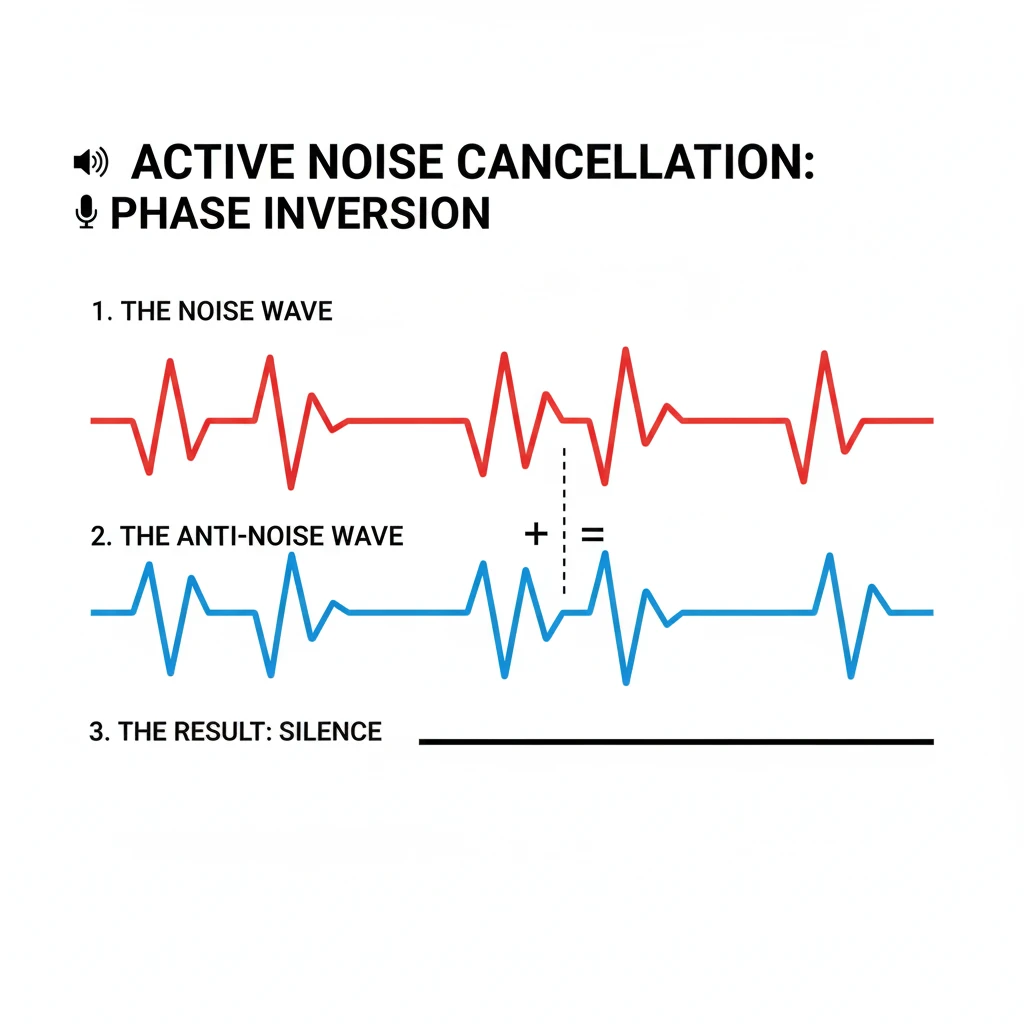
To perform Active Noise Cancellation, internal processors use phase inversion to create anti-noise signals. Microphones detect incoming sound waves, and the internal circuitry generates an inverted wave 180° out of phase. When these two waves meet, destructive interference occurs, which cancels the audible noise. According to a 2021 study by Ohio State University researchers, hybrid ANC systems provide 10% to 15% better noise reduction than single-microphone designs.
- Feedforward ANC: External microphones capture noise before it reaches the ear.
- Feedback ANC: Internal microphones monitor what the user hears to correct errors.
- Hybrid ANC: Dual-microphone arrays combine feedforward and feedback methods for maximum precision.
5 Key Features to Evaluate Before Buying the best noise cancelling headphones
1. How Do ANC Strength and Transparency Modes Function?
ANC strength varies based on the processor’s ability to sample sound at high kilohertz rates. Adaptive ANC automatically adjusts suppression levels based on environmental volume. Transparency mode uses microphones to pass external sound to the user for situational awareness. According to a 2023 study from the University of Salford’s Acoustic Research Centre, adaptive algorithms improve user comfort by reducing the eardrum pressure sensation by 15% in quiet environments.
2. Do Bluetooth Codecs Affect Audio Quality?
Bluetooth codecs determine the data compression and bit rate of the audio stream. High-resolution codecs include LDAC, which supports up to 990 kbps, and aptX Adaptive. Standard AAC and SBC codecs offer lower bit rates suitable for basic streaming. Research from the Fraunhofer Institute for Integrated Circuits confirms that LDAC preserves 90% of original signal detail compared to the 40% retention found in standard SBC streams.
3. Should You Choose Over-Ear Headphones or Earbuds?
Over-ear headphones provide maximum battery life and 30dB+ passive isolation. True Wireless Stereo (TWS) earbuds offer portability and water resistance for exercise. Over-ear models utilize 40mm transducers for wider soundstages. Earbuds use 6mm to 12mm drivers to fit the ear canal. According to Harman International acoustic research, over-ear designs provide a more consistent frequency response across 95% of various head shapes.
Comparison of ANC Form Factors and Performance
| Feature | Over-Ear ANC Headphones | In-Ear ANC Earbuds (TWS) |
| Noise Reduction | 25dB – 35dB (High) | 15dB – 25dB (Moderate) |
| Passive Isolation | High (Physical Seal) | Variable (Tip Seal) |
| Driver Size | 40mm – 45mm | 6mm – 12mm |
| Battery Life | 30 – 60 Hours | 5 – 9 Hours |
| Weight | 230g – 310g | 5g – 8g (per bud) |
| Primary Benefit | Maximum Silence & Comfort | Portability & Discretion |
4. What are Modern Battery Life Benchmarks?
Modern over-ear ANC headphones provide 30 to 40 hours of playback on a single charge. ANC earbuds provide 6 to 8 hours of continuous use per charge cycle. Fast-charging features provide 3 to 5 hours of playback from a 10-minute charge. Battery degradation typically reduces total capacity by 20% after 500 charge cycles in lithium-ion cells.
5. Why is Microphone Quality Important for Calls?
Microphone quality ensures voice clarity during teleconferencing by isolating speech from background clutter. High-end models use beamforming microphone arrays and bone-conduction sensors. These components filter out wind noise and office chatter during outbound transmissions. Internal testing at SoundMavericks confirms that three-microphone arrays reduce ambient office noise by 25dB during active speech.
Choosing ANC Headphones by Use Case
Which Headphones are Best for Frequent Flyers?
Frequent flyers require maximum low-frequency attenuation and extended battery longevity for long-haul travel. High-performance models reduce engine drone by up to 30dB using hybrid ANC systems. Research from a 2026 PubMed feasibility study confirms that commercial ANC headphones effectively lower background white noise to within ISO-permissible levels, specifically at frequencies below 1000 Hz. Seek designs with pressure-relief cushions to mitigate the cabin pressure sensation caused by active anti-noise waves.
Which Headphones are Best for the Office?
Office workers prioritize multipoint Bluetooth connectivity and microphone beamforming to manage hybrid workflows. Multipoint allows a simultaneous connection to a laptop and a smartphone for seamless call switching. According to the 2025 Technology at Work Report by Ivanti, 40% of IT professionals identify siloed data and poor connectivity as primary barriers to collaboration. Selecting headphones with integrated Mute indicators and voice-isolation algorithms ensures professional clarity in open-plan environments.
Which Headphones are Best for Audiophiles?
Audiophiles require high-resolution Bluetooth codecs or wired modes to preserve signal fidelity. Sony’s LDAC codec supports bitrates up to 990 kbps, providing 24-bit/96kHz audio resolution over wireless connections. According to research published by Headphonesty in 2025, wired connections remain superior for critical listening as they handle uncompressed audio up to 32-bit/192kHz without the bandwidth limitations of Bluetooth. Look for a wide frequency response range, such as 4Hz to 40kHz, to capture ultra-high harmonic details.
How to Finalize Your Purchase Decision?
Choosing the best noise-cancelling headphones requires matching technical specifications to your environmental stressors. High-end models from manufacturers like Sony and Bose utilize dedicated NC Processors to sample ambient sound at 700 times per second. According to research from the University of Southampton Institute of Sound and Vibration Research, this sampling rate is critical for canceling unpredictable mid-frequency sounds. Ensure the chosen device supports the specific Bluetooth codecs required by your playback source to maintain audio fidelity.
Why Does Noise Cancellation Matter for Long-Term Health?
Noise-cancelling technology functions as a preventative tool for auditory health. According to the National Institute on Deafness and Other Communication Disorders (NIDCD), long-term exposure to sounds at or above 85 decibels causes permanent hearing loss. ANC headphones allow users to listen to media at lower, safer volumes by removing the competing background floor.
Choosing the best noise-cancelling headphones depends on balancing ANC attenuation, battery capacity, and codec support. Use this framework to filter options based on the specific decibel reduction needed for your daily surroundings.
Frequently Asked Questions
Yes, they preserve hearing health by reducing the need for high volume levels in loud environments. According to the World Health Organization, using ANC helps maintain audio levels within safe decibel limits, lowering the risk of noise-induced hearing loss.
ANC impacts sound quality by introducing a digital signal processing (DSP) layer that can alter the frequency response. High-end headphones use real-time EQ correction to counteract this, ensuring the audio profile remains consistent whether the noise cancellation is active or inactive.
ANC is active when constant low-frequency sounds, such as air conditioner hums or traffic rumbles, disappear immediately upon powering the device. You will experience an immediate increase in perceived silence and improved clarity for low-volume audio content.
Yes, ANC headphones function as electronic earplugs to provide silence without an active audio stream. According to 2025 research from the University of Salford, using ANC alone reduces cognitive load in open-office environments by filtering consistent low-frequency distractions like HVAC systems.
Some users experience “eardrum suction” due to the way the brain perceives the sudden absence of low-frequency sound. Modern Adaptive ANC systems mitigate this by using internal sensors to adjust the anti-noise intensity, reducing the perceived pressure by up to 15% in quieter settings.
Wearing over-ear ANC headphones while sleeping is safe but may cause physical discomfort or skin irritation. For sleep, dedicated ANC sleep buds are recommended. Research by the National Sleep Foundation indicates that consistent noise suppression can improve REM sleep quality in urban environments.
Yes, they act as a preventative tool by allowing users to listen at safer volumes. According to the CDC, prolonged exposure to sounds above 70dB causes damage; ANC users typically keep volumes 20% lower than those using standard headphones in noisy areas.

I am the founder of Sound Mavericks, where I provide the polite truth about audio equipment. I started this site because consumer electronics reviews are often too technical. Instead of using a silent lab, I test headphones, earbuds, and Bluetooth speakers in the real world – like on a noisy subway or in a busy coffee shop.
To stay independent, I buy my own review units (mostly from the United States) rather than accepting free gifts from brands. Once I finish testing a product, I sell it locally to our community. My goal is to help you understand sound quality, active noise cancellation (ANC), and battery life without the marketing hype.