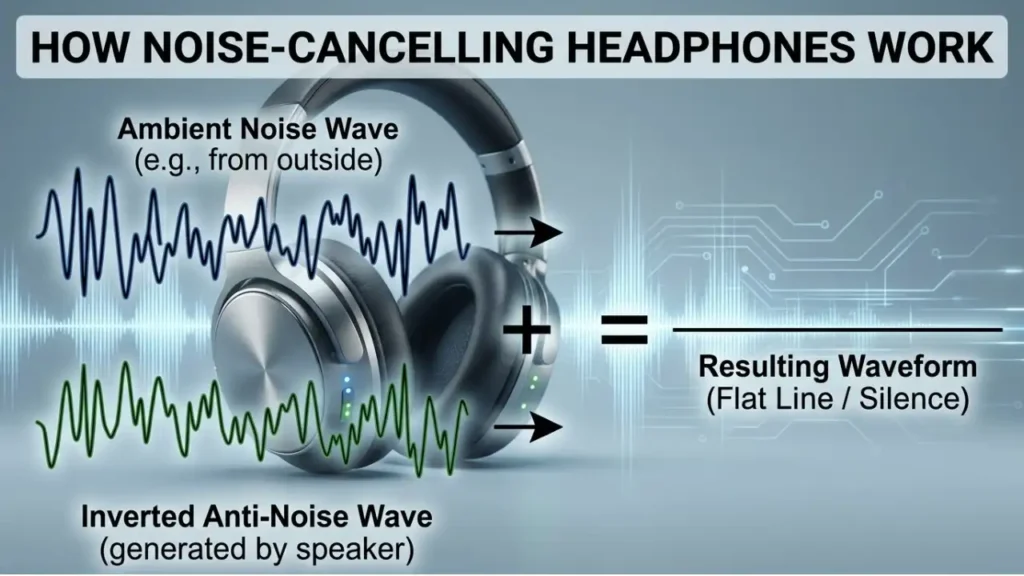
When people start researching noise-cancelling headphones, one of the first questions they ask is: “But how much noise do they actually block?” It’s a completely reasonable thing to want — a number, something concrete to compare against the price tag and the marketing promises.
The honest answer is that there is no single number. How many decibels a pair of ANC headphones blocks depends on the specific model, the frequency of the sound, how well the headphones fit your ears, and the environment you’re in. But there are realistic ranges — and understanding them will help you set accurate expectations before you buy, and get more out of your headphones once you do.
In this article, we’ll explain what decibels actually mean in everyday terms, give you realistic dB reduction ranges for ANC headphones, show how those numbers play out on a plane, in an office, and on the street, and briefly cover what all this means for your hearing health.
A Quick Refresher: What Is a Decibel?
A decibel (dB) is the unit used to measure sound level — how loud a sound is. Normal conversation sits at roughly 60 dB. A busy street might be around 75 dB. A jet aircraft cabin during cruise typically registers in the 80–85 dB range. Prolonged exposure above 85 dB is where hearing health starts to become a concern.
The important thing to understand about decibels is that the scale is logarithmic, not linear. That means the jumps between numbers are not equal the way centimetres on a ruler are. As a practical rule of thumb: a difference of roughly 10 dB is often perceived as about twice as loud — or half as loud, going in the other direction. So going from 80 dB to 70 dB doesn’t feel like a small tweak; it feels like the sound has become noticeably quieter, almost half the perceived loudness.
When we say headphones “block X dB,” we mean they reduce the sound level arriving at your ear by that many decibels. A headphone that reduces noise by 20 dB in a given frequency range is cutting the sound energy arriving at your eardrum by a very substantial amount — not just a little trim at the edges.
How much any specific headphone blocks depends on three things: the frequency of the sound in question (more on this shortly), the quality of the seal between the headphone and your ear, and how the measurement was taken — lab conditions versus the real world. With that context in place, let’s look at what the actual numbers tend to look like.
Typical Decibel Reduction from ANC Headphones
If you want a working range to hold in your head: many quality ANC headphones reduce ambient noise by approximately 20–30 dB in the frequency ranges where they perform best. Some premium models, under ideal conditions and in specific low-frequency bands, can reach claimed reductions in the 40–45 dB neighbourhood. Those figures tend to appear in manufacturer specifications and refer to peak performance at certain frequencies in controlled lab tests — not what you’ll experience across the full range of sound in your daily life.
The gap between the headline “up to X dB” figure and your real-world experience matters here. Controlled lab tests, which measure reduction across a broad range of frequencies simultaneously, often show average overall reductions in the range of roughly 10–20 dB across the full noise spectrum. The peak numbers are real — but they refer to the frequencies where ANC is most effective, not to every sound you’ll encounter.
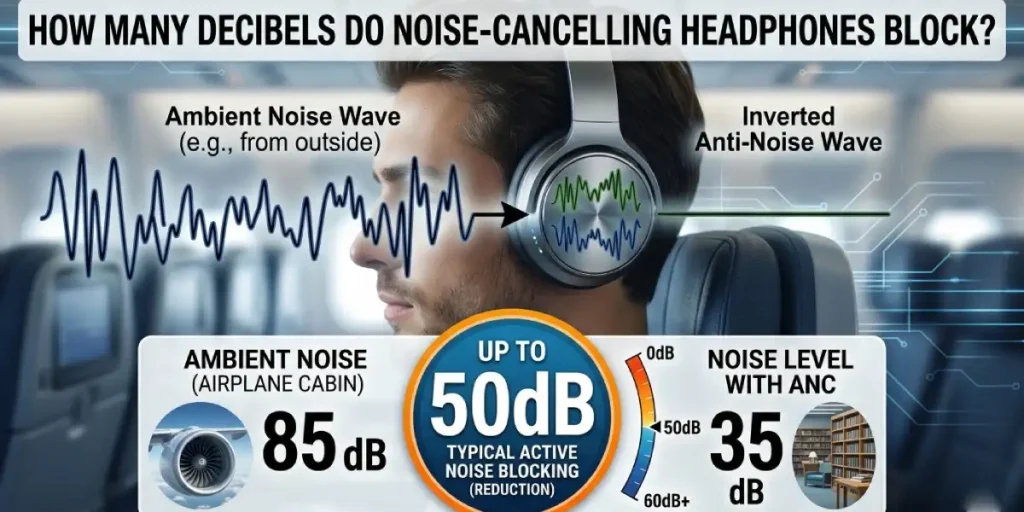
To make these numbers tangible: imagine you’re sitting in an environment with 80 dB of background noise — typical for an aircraft cabin or a busy commuter train. If your headphones reduce that noise by around 20 dB in the key frequency ranges, what reaches your ears is closer to 60 dB. That’s a shift from “busy restaurant” to “normal conversation” level. It doesn’t feel like a modest improvement. It feels like someone turned the volume of the world down significantly.
A 30 dB reduction on the same starting point would bring you to roughly 50 dB — the level of a quiet room or a low conversation. That’s why even numbers that might look modest on paper can translate into a genuinely transformative listening experience. These are approximate ranges, and individual models will vary, but they give you a realistic benchmark to work with.
Why the Answer Depends on Frequency
Here’s the piece of the puzzle that marketing copy rarely explains clearly: ANC performance is not consistent across all sounds. It works dramatically better at some frequencies than others, and the frequency of a sound is one of the biggest factors in whether your headphones will effectively block it.
Think of sound in three broad bands. Low-frequency sounds are the deep rumbles — the drone of a jet engine, the low thrum of a train or bus carriage, the hum of an air conditioning system. Mid-frequency sounds cover much of speech, general ambient chatter, and the overall murmur of a busy environment. High-frequency sounds are the sharp, bright ones — keyboard clicks, clinking cutlery, the consonants in someone’s speech, an alarm.
ANC excels at low frequencies. The algorithm can model the slow, predictable waveforms of deep rumbles and generate an accurate anti-noise signal in real time. In this range, reductions of 20–30 dB are common in good models, and some premium designs push further under ideal conditions. This is exactly why ANC headphones transformed air travel — that constant, exhausting engine roar sits precisely in the frequency band where active cancellation is most potent.
In the midrange, ANC still contributes, but the reduction tends to be smaller and less consistent. At high frequencies, ANC largely steps back — the waveforms change too rapidly for the system to track accurately. Above roughly 1,000–2,000 Hz, it’s the physical seal of the ear cup or ear tip doing most of the work, not the electronics.
So when you see a large dB figure in a product description, it almost always refers to performance in the low-frequency band — and that number is genuinely meaningful for plane travel and traffic rumble. It tells you much less about how well the headphones will handle the person talking two desks away from you.
How Many Decibels in Real-Life Situations?
On an Airplane
An aircraft cabin during cruise flight typically measures somewhere in the 80–85 dB range — loud enough that prolonged exposure without any protection would put you in territory where hearing health guidance suggests caution. The dominant noise source is the continuous low-frequency roar of the engines, channelled through the fuselage and into the cabin.
This is precisely the environment ANC was designed for. A good pair of ANC headphones can reduce that low-frequency engine rumble by roughly 20–30 dB or more in the frequencies where it’s most concentrated. The effect is dramatic and almost immediate: the thunderous roar softens into something closer to a distant, muffled whoosh. The overall perceived loudness of the cabin drops substantially.
Some sounds still get through — voices nearby, a child crying a few rows back, cabin announcements. These sit in the mid-to-high frequency range where ANC is less effective, and the passive seal of the ear cups handles them partially. But the overall acoustic environment is transformed. Many frequent flyers describe the difference as going from “exhausting” to “genuinely restful” on long-haul routes.
In an Office, Café, or on the Street
These environments present a more mixed noise picture. A busy open-plan office or a café might measure somewhere in the 60–75 dB range — louder than it feels, because you’ve become accustomed to it. The noise here is a blend: low-frequency HVAC hum and traffic from outside, mid-frequency chatter and music, high-frequency keyboard clicks and cutlery sounds.
ANC handles the low-frequency components well — the air conditioning drone, the distant traffic rumble blending in through the windows, the general bass-heavy background murmur. For these elements, reductions in the 15–25 dB range are realistic in a quality pair of headphones.
The overall reduction across all the frequencies in this mixed environment might average out to something in the region of 10–20 dB across the full noise spectrum — and that’s enough to make the space feel noticeably calmer even if it doesn’t feel silent. The clatter of a colleague’s keyboard and nearby conversations will still be audible, particularly if they’re close. But the constant low-level grind that produces listening fatigue over a full workday is substantially reduced.
Street noise — traffic, distant construction, urban ambient sound — is similarly well-addressed in its low-frequency components. Wind noise is one area where ANC can actually perform less well, as it can interfere with the external microphones that the system relies on.
Do Noise-Cancelling Headphones Protect Your Hearing?
The relationship between ANC and hearing health is genuinely positive — but it works indirectly, and it comes with an important caveat worth understanding clearly.
The direct benefit is this: by reducing the background noise level reaching your ears, ANC removes one of the main reasons people crank their volume to dangerous levels. In a loud environment, you turn your music up to hear it over the noise. In a quieter environment — even an artificially quieter one created by ANC — you don’t need to. Studies have shown that people using ANC headphones tend to select lower listening volumes than they would in the same environment without ANC. Lower sustained volumes mean less cumulative exposure, which is genuinely better for long-term hearing.
The caveat: ANC does not automatically make any volume safe. The headphones reduce what comes in from outside; they have no effect on the sound your own drivers are producing directly into your ear canal. Listening at high volume for extended periods carries risk regardless of whether ANC is active. The fact that outside noise is suppressed doesn’t change the physics of what’s happening at your eardrum when your music is loud.
The practical takeaway is straightforward: use ANC as an opportunity to turn your volume down, not as permission to turn it up. If you find yourself pushing past the halfway point on your device’s volume while wearing ANC headphones, that’s a signal that either the environment is loud enough that you need a break, or the content you’re listening to warrants a slightly different approach.
ANC headphones are also not a substitute for purpose-built hearing protection in genuinely hazardous environments. For sustained industrial noise above 85 dB — construction, heavy machinery, manufacturing — dedicated ear protection with a certified NRR (Noise Reduction Rating) is the appropriate tool.
How to Read “Up to X dB Noise Reduction” Claims
Almost every ANC headphone marketed today will carry some version of a “reduces noise by up to X dB” claim. Understanding what that number actually represents will save you from disappointment — and help you compare products more honestly.
“Up to X dB” typically means the maximum reduction measured at a specific frequency band under controlled laboratory conditions. It’s the best-case scenario: the right frequency, a perfect fit, a quiet and temperature-controlled test room, and the headphones performing at their theoretical peak. It is a real number — it’s not invented — but it describes a narrow slice of performance, not what you’ll experience across the full range of sounds in your daily life.
In real-world use, several factors pull that number down. Your head moves, briefly breaking the seal. The fit of ear tips or ear cups varies slightly from person to person and from session to session. The noise around you is a complex mix of frequencies — not the steady single-frequency tone used in lab tests — and performance varies significantly across that mix. The result is that your lived experience of noise reduction will typically sit meaningfully below the headline “up to” figure, particularly if that figure is a high one.
Rather than chasing the biggest advertised dB number, it’s worth looking for a few other things when evaluating headphones. Independent reviews that include full noise-reduction measurements across a range of frequencies — not just a peak figure — give a much more honest picture of real-world performance. Consistent fit and comfort matter enormously, because a headphone that seals perfectly and feels good for three hours will outperform a technically superior model that you keep adjusting. And reading user feedback from people who use the headphones in your specific environment (flights, offices, commutes) will tell you more than a single specification number ever can.
Think of “up to X dB” as a best-case ceiling — useful for rough comparison, but not a guarantee of what you’ll experience.
So How Many Decibels Do ANC Headphones Really Block?
Here’s the plain-language version of everything above. In the frequency ranges where ANC works best — the deep, low-frequency rumbles of engines, HVAC systems, and traffic — most quality ANC headphones reduce noise by approximately 20–30 dB. Some premium models reach higher peaks under ideal conditions. That level of reduction is genuinely significant: it can take a tiring, loud environment and make it feel dramatically quieter.
Across the full range of real-world noise — which includes mid and high frequencies where ANC is less effective — a 10–20 dB overall reduction is a realistic expectation for many good pairs of headphones. That’s enough to make a noisy plane feel manageable, a busy office feel calmer, and a commute feel less exhausting. It’s not total silence, and it was never designed to be.
The exact number you’ll get depends on which headphones you’re using, the frequencies of the noise around you, how well the headphones seal against your ears, and the specific environment you’re in. No single dB figure covers all of that — which is why the best approach is to use these ranges as a guide rather than expecting one magic number. Focus on comfort, consistent fit, and a moderate listening volume, and the decibels will largely take care of themselves.

I am the founder of Sound Mavericks, where I provide the polite truth about audio equipment. I started this site because consumer electronics reviews are often too technical. Instead of using a silent lab, I test headphones, earbuds, and Bluetooth speakers in the real world – like on a noisy subway or in a busy coffee shop.
To stay independent, I buy my own review units (mostly from the United States) rather than accepting free gifts from brands. Once I finish testing a product, I sell it locally to our community. My goal is to help you understand sound quality, active noise cancellation (ANC), and battery life without the marketing hype.